Myanmar Inorganic Pigments Market Size, Share & Growth Rate
The Myanmar Inorganic Pigments Market was estimated at USD 759 Million in 2025 and is projected to reach USD 1076 Million by 2032, growing at a CAGR of 5.1% from 2026 to 2032. This upward trajectory is primarily driven by the rapid expansion of the construction and automotive sectors, coupled with a growing demand for high-quality coatings. As these industries continue to flourish, the need for stable and durable inorganic pigments in paints and coatings further cements the market's robust growth outlook.
Myanmar Inorganic Pigments Market Year-wise Growth Rate and Key Drivers
This graph highlights how the Myanmar Inorganic Pigments Market has steadily grown over the years, supported by major growth factors.
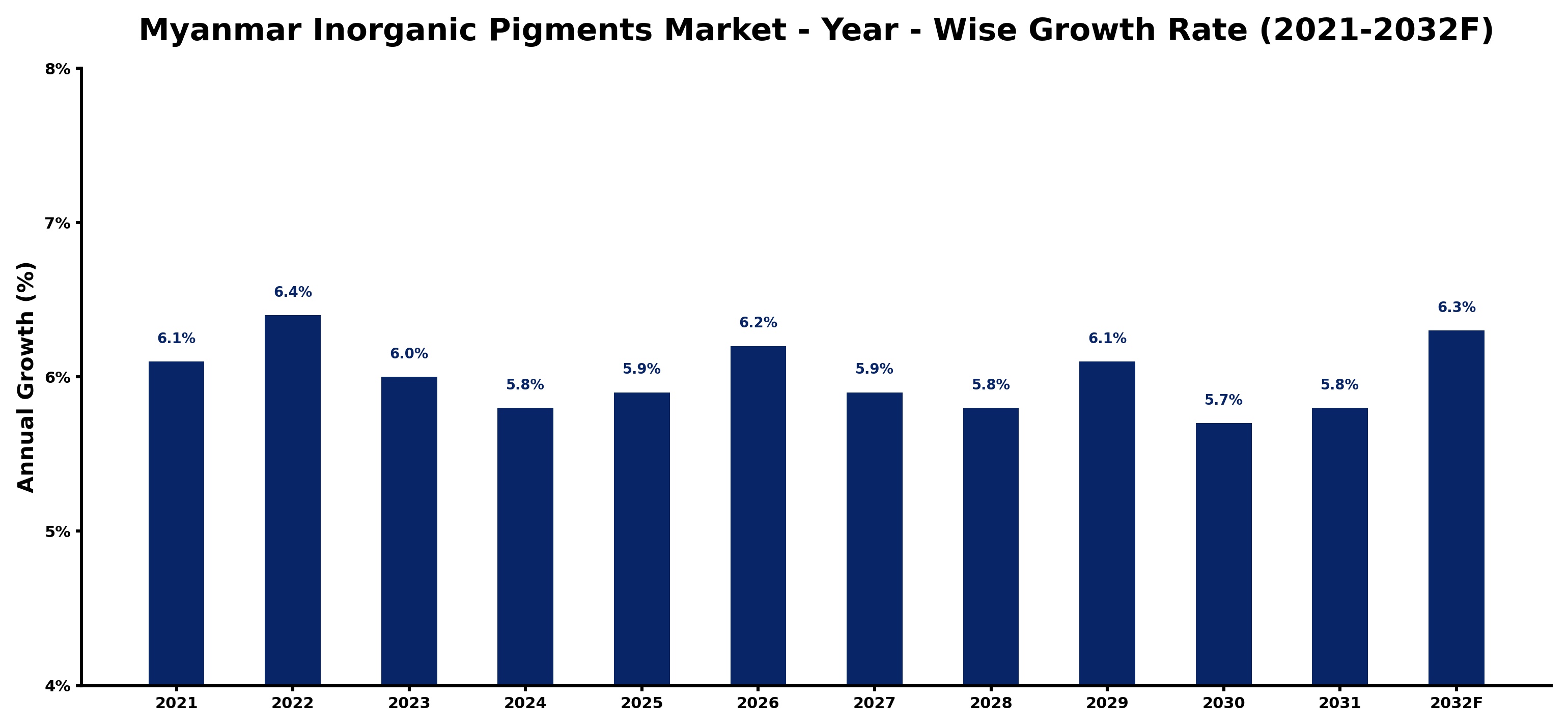
The table below presents the year‑wise growth rates along with the key drivers influencing the market
| Year | Growth Rate | Major Drivers |
| 2021 | 6.1% | Construction sector demand increased |
| 2022 | 6.4% | Automotive industry growth accelerated |
| 2023 | 6.0% | Paint and coatings market expanded |
| 2024 | 5.8% | Plastic manufacturing adoption increased |
| 2025 | 5.9% | Textile industry growth continued |
| 2026 | 6.2% | Electronics sector demand surged |
| 2027 | 5.9% | Cosmetics market expansion continued |
| 2028 | 5.8% | Agricultural applications gained traction |
| 2029 | 6.1% | Renewable energy projects boosted demand |
| 2030 | 5.7% | Infrastructure development projects increased |
| 2031 | 5.8% | Packaging industry growth persisted |
| 2032 | 6.3% | Export opportunities enhanced market access |
Note - Market size estimations and growth projections presented in this report are based on 6Wresearch's advanced forecasting approach, validated with industry datasets as of June 2026.
Myanmar Inorganic Pigments Market Synopsis
The strongest force currently shaping the Myanmar Inorganic Pigments Market is the booming construction industry, which has a direct impact on demand for high-performance pigments. As infrastructure projects and residential developments increase, so too does the requirement for reliable and aesthetically pleasing coatings that utilize these pigments.
Additionally, there is a marked shift towards eco-friendly and non-toxic pigment formulations. Manufacturers are adapting to this change, driven by consumer awareness and regulatory pressures, and are increasingly focusing on sustainable production practices while maintaining product quality.
Myanmar Inorganic Pigments Market Key Takeaways
- The market is significantly influenced by the growth of construction and automotive sectors.
- High-performance and eco-friendly pigments are becoming key differentiators among manufacturers.
- Challenges in sourcing quality materials and compliance with sustainability regulations persist.
- Government policies are increasingly aimed at ensuring quality and environmental safety in pigment production.
- Technological advancements are paving the way for innovative pigment applications in various industries.
Evaluation of Restraints in Myanmar Inorganic Pigments Market
The Myanmar Inorganic Pigments Market faces several notable restraints that could hinder its full potential. One of the primary limitations is the inconsistent access to high-quality raw materials necessary for pigment production. This inconsistency leads to variability in product performance and can negatively affect market competitiveness. Furthermore, manufacturers are compelled to navigate complex regulatory environments concerning environmental sustainability, which may require substantial investments in alternative production methods. Lastly, fluctuations in global market prices and currency exchange rates can impact the profitability of manufacturers and distributors, creating a less stable market landscape.
Myanmar Inorganic Pigments Market Trends
Recent trends in the Myanmar Inorganic Pigments Market indicate a strong pivot towards the development of sustainable and eco-friendly pigment alternatives. Consumers are increasingly conscious of environmental impacts, pushing manufacturers to innovate. Additionally, the demand for specialized pigments that offer enhanced performance, such as increased opacity and UV resistance, is gaining traction. Digital advancements also allow for more efficient production processes, leading to cost reductions and better product quality.
Myanmar Inorganic Pigments Market Opportunities
There are substantial growth and investment opportunities within the Myanmar Inorganic Pigments Market. As the construction sector continues to expand, companies can capitalize on the rising demand for high-quality coatings and decorative applications. Furthermore, the increasing interest in non-toxic and eco-friendly pigments presents a chance for innovation and differentiation. With supportive government policies aiming to enhance product quality and sustainability, businesses can explore new production technologies and applications, thereby securing a competitive edge.
Government Initiatives in the Myanmar Inorganic Pigments Market
The Myanmar government is actively implementing initiatives that support the growth and regulation of the inorganic pigments market. These include establishing standards for pigment production, quality control, and environmental sustainability. Additionally, there are programs to promote research and development in innovative pigment technologies, which aim to boost industry competitiveness while ensuring that safety and environmental considerations are upheld.
Future Insights of the Myanmar Inorganic Pigments Market
Looking ahead to the period from 2026 to 2032, the Myanmar Inorganic Pigments Market is poised for notable growth. The anticipated increase in construction activities, coupled with the demand for advanced coating solutions, will likely drive further market expansion. As manufacturers increasingly focus on sustainability, the development of eco-friendly pigments will define market dynamics, creating opportunities for forward-thinking businesses. Moreover, continued advancements in production technologies are expected to enhance product offerings and efficiencies, setting the stage for a vibrant market landscape.
Myanmar Inorganic Pigments Market Latest Developments (May 2025 - June 2026)
Recent industry trends indicate a proactive movement towards incorporating sustainable practices in pigment production. Manufacturers are exploring innovative formulations that not only meet performance standards but also adhere to environmental regulations. Additionally, there is a growing emphasis on technological integration to improve operational efficiencies, which could reshape the competitive dynamics in the market over the coming years.
Myanmar Inorganic Pigments Market - Key Attractiveness of the Report
- 10 Years of Market Numbers
- Historical Data Starting from 2022 to 2025
- Base Year: 2025
- Forecast Data until 2032
- Key Performance Indicators Impacting the Market
- Major Upcoming Developments and Projects
Key Highlights of the Report:
- Myanmar Inorganic Pigments Market Outlook
- Market Size of Myanmar Inorganic Pigments Market, 2025
- Forecast of Myanmar Inorganic Pigments Market, 2032
- Historical Data and Forecast of Myanmar Inorganic Pigments Revenues & Volume for the Period 2022-2032F
- Myanmar Inorganic Pigments Market Trend Evolution
- Myanmar Inorganic Pigments Market Drivers and Challenges
- Myanmar Inorganic Pigments Price Trends
- Myanmar Inorganic Pigments Porter's Five Forces
- Myanmar Inorganic Pigments Industry Life Cycle
- Historical Data and Forecast of Myanmar Inorganic Pigments Market Revenues & Volume By Type for the Period 2022-2032F
- Historical Data and Forecast of Myanmar Inorganic Pigments Market Revenues & Volume By Titanium Dioxide for the Period 2022-2032F
- Historical Data and Forecast of Myanmar Inorganic Pigments Market Revenues & Volume By Iron Oxide, Cadmium for the Period 2022-2032F
- Historical Data and Forecast of Myanmar Inorganic Pigments Market Revenues & Volume By Carbon Blank for the Period 2022-2032F
- Historical Data and Forecast of Myanmar Inorganic Pigments Market Revenues & Volume By Lead Chromate for the Period 2022-2032F
- Historical Data and Forecast of Myanmar Inorganic Pigments Market Revenues & Volume By Chromium Oxide for the Period 2022-2032F
- Historical Data and Forecast of Myanmar Inorganic Pigments Market Revenues & Volume By Others for the Period 2022-2032F
- Historical Data and Forecast of Myanmar Inorganic Pigments Market Revenues & Volume By Colour for the Period 2022-2032F
- Historical Data and Forecast of Myanmar Inorganic Pigments Market Revenues & Volume By Red for the Period 2022-2032F
- Historical Data and Forecast of Myanmar Inorganic Pigments Market Revenues & Volume By Yellow for the Period 2022-2032F
- Historical Data and Forecast of Myanmar Inorganic Pigments Market Revenues & Volume By Orange for the Period 2022-2032F
- Historical Data and Forecast of Myanmar Inorganic Pigments Market Revenues & Volume By Green for the Period 2022-2032F
- Historical Data and Forecast of Myanmar Inorganic Pigments Market Revenues & Volume By Blue for the Period 2022-2032F
- Historical Data and Forecast of Myanmar Inorganic Pigments Market Revenues & Volume By Black for the Period 2022-2032F
- Historical Data and Forecast of Myanmar Inorganic Pigments Market Revenues & Volume By White for the Period 2022-2032F
- Historical Data and Forecast of Myanmar Inorganic Pigments Market Revenues & Volume By Others for the Period 2022-2032F
- Historical Data and Forecast of Myanmar Inorganic Pigments Market Revenues & Volume By Chemistry for the Period 2022-2032F
- Historical Data and Forecast of Myanmar Inorganic Pigments Market Revenues & Volume By Oxide for the Period 2022-2032F
- Historical Data and Forecast of Myanmar Inorganic Pigments Market Revenues & Volume By Silicate for the Period 2022-2032F
- Historical Data and Forecast of Myanmar Inorganic Pigments Market Revenues & Volume By Carbonate for the Period 2022-2032F
- Historical Data and Forecast of Myanmar Inorganic Pigments Market Revenues & Volume By Sulphate for the Period 2022-2032F
- Historical Data and Forecast of Myanmar Inorganic Pigments Market Revenues & Volume By Sulphide for the Period 2022-2032F
- Historical Data and Forecast of Myanmar Inorganic Pigments Market Revenues & Volume By Others for the Period 2022-2032F
- Historical Data and Forecast of Myanmar Inorganic Pigments Market Revenues & Volume By Grade for the Period 2022-2032F
- Historical Data and Forecast of Myanmar Inorganic Pigments Market Revenues & Volume By Food Grade for the Period 2022-2032F
- Historical Data and Forecast of Myanmar Inorganic Pigments Market Revenues & Volume By Pharmaceutical Grade for the Period 2022-2032F
- Historical Data and Forecast of Myanmar Inorganic Pigments Market Revenues & Volume By Industrial Grade for the Period 2022-2032F
- Historical Data and Forecast of Myanmar Inorganic Pigments Market Revenues & Volume By Others for the Period 2022-2032F
- Historical Data and Forecast of Myanmar Inorganic Pigments Market Revenues & Volume By Form for the Period 2022-2032F
- Historical Data and Forecast of Myanmar Inorganic Pigments Market Revenues & Volume By Powder for the Period 2022-2032F
- Historical Data and Forecast of Myanmar Inorganic Pigments Market Revenues & Volume By Liquid for the Period 2022-2032F
- Historical Data and Forecast of Myanmar Inorganic Pigments Market Revenues & Volume By Application for the Period 2022-2032F
- Historical Data and Forecast of Myanmar Inorganic Pigments Market Revenues & Volume By Plastics for the Period 2022-2032F
- Historical Data and Forecast of Myanmar Inorganic Pigments Market Revenues & Volume By Paints & Coatings for the Period 2022-2032F
- Historical Data and Forecast of Myanmar Inorganic Pigments Market Revenues & Volume By Printing Inks for the Period 2022-2032F
- Historical Data and Forecast of Myanmar Inorganic Pigments Market Revenues & Volume By Glass & Ceramics for the Period 2022-2032F
- Historical Data and Forecast of Myanmar Inorganic Pigments Market Revenues & Volume By Cosmetics for the Period 2022-2032F
- Historical Data and Forecast of Myanmar Inorganic Pigments Market Revenues & Volume By Paper Industry for the Period 2022-2032F
- Historical Data and Forecast of Myanmar Inorganic Pigments Market Revenues & Volume By Food Industry for the Period 2022-2032F
- Historical Data and Forecast of Myanmar Inorganic Pigments Market Revenues & Volume By Others for the Period 2022-2032F
- Myanmar Inorganic Pigments Import Export Trade Statistics
- Market Opportunity Assessment By Type
- Market Opportunity Assessment By Colour
- Market Opportunity Assessment By Chemistry
- Market Opportunity Assessment By Grade
- Market Opportunity Assessment By Form
- Market Opportunity Assessment By Application
- Myanmar Inorganic Pigments Top Companies Market Share
- Myanmar Inorganic Pigments Competitive Benchmarking By Technical and Operational Parameters
- Myanmar Inorganic Pigments Company Profiles
- Myanmar Inorganic Pigments Key Strategic Recommendations






































