Myanmar Iodine Market Size Growth Rate
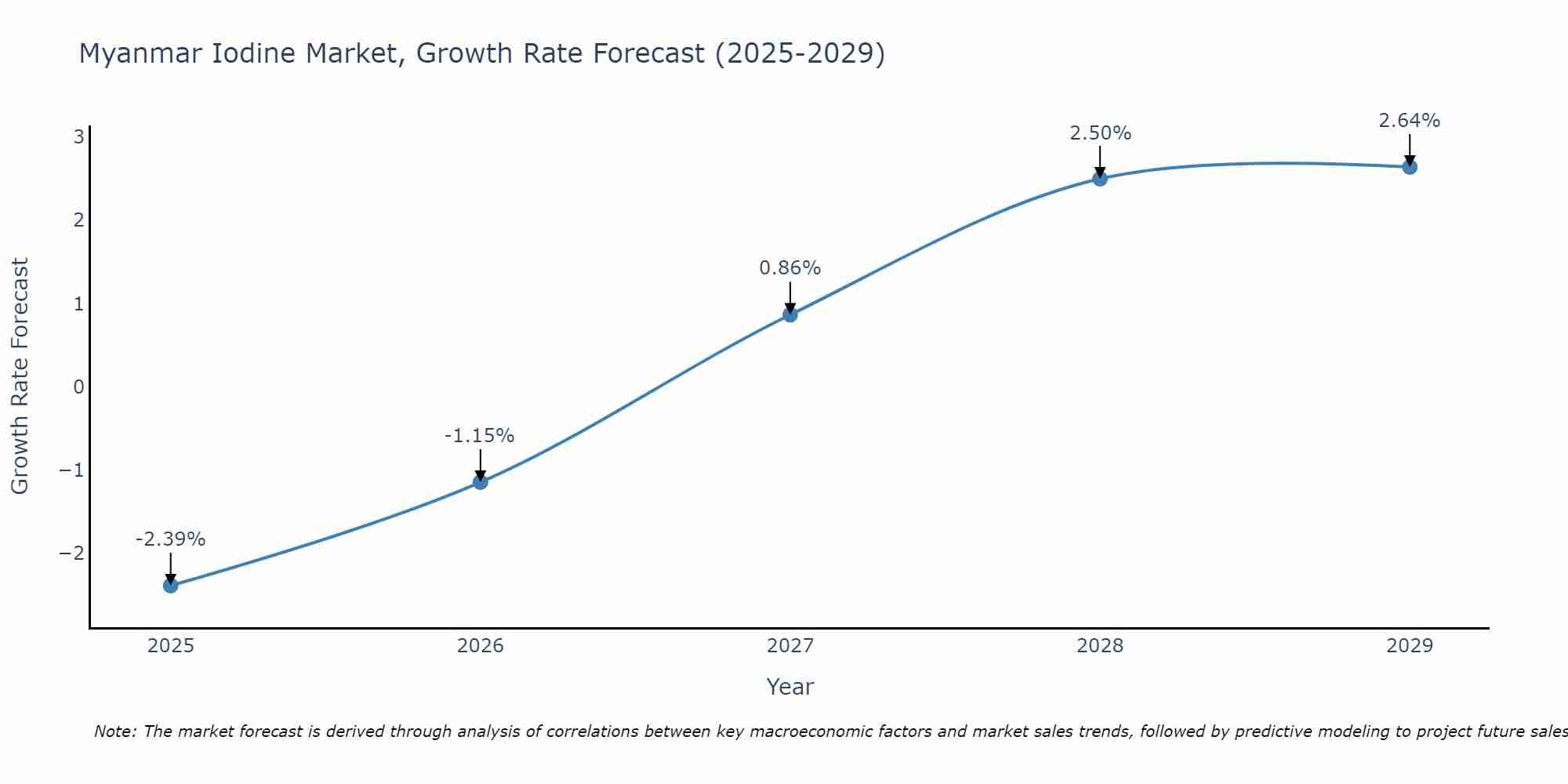
The Myanmar Iodine Market is likely to experience consistent growth rate gains over the period 2025 to 2029. The growth rate starts at -2.39% in 2025 and reaches 2.64% by 2029.
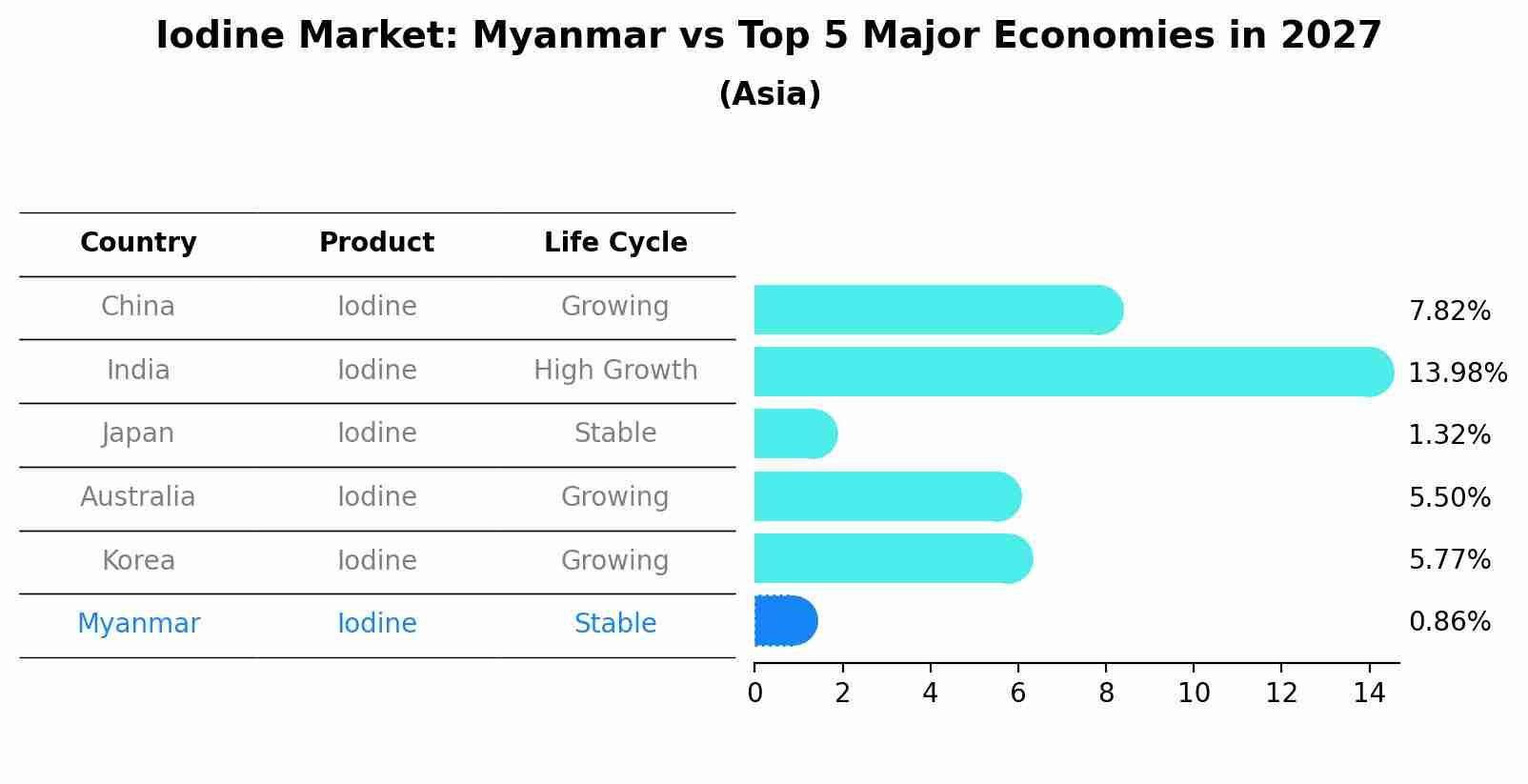
Iodine Market: Myanmar vs Top 5 Major Economies in 2027 (Asia)
In the Asia region, the Iodine market in Myanmar is projected to expand at a stable growth rate of 0.86% by 2027. The largest economy is China, followed by India, Japan, Australia and South Korea.
Myanmar Iodine Market Overview
Myanmar Iodine Market supplies iodine for various applications, including medical, nutritional, and industrial uses. Iodine is critical for thyroid health, antiseptic formulations, and as a catalyst in chemical reactions.
Drivers of the market
The growth of the healthcare and chemical industries drives the demand for iodine in Myanmar. Iodine is used in various applications, including pharmaceuticals, antiseptics, and nutritional supplements. The increasing awareness of iodine deficiency disorders and the importance of iodine in thyroid health fuel the demand for iodine-based products. Moreover, the use of iodine in industrial applications, such as catalysts and stabilizers, further contributes to market growth. Additionally, advancements in extraction and purification technologies enhance the availability and quality of iodine, stimulating market growth.
Challenges of the market
The iodine market in Myanmar encounters hurdles related to mining regulations and export restrictions. Limited access to iodine deposits and extraction technologies may restrict market growth, as mining companies may face bureaucratic hurdles and environmental regulations. Moreover, concerns about iodine purity, quality, and sustainability drive demand for more transparent and ethical sourcing practices, necessitating investment in mining standards and community engagement initiatives. Additionally, export restrictions and trade policies may pose challenges for iodine producers seeking to access international markets, impacting market expansion and revenue generation.
Government Policy of the market
To address iodine deficiency disorders and promote public health, the government has implemented policies to support the iodine market in Myanmar. These policies include regulations to mandate iodization of salt and other food products, initiatives to promote iodine supplementation in vulnerable populations, and measures to monitor iodine intake levels and assess the effectiveness of iodine fortification programs.
Key Highlights of the Report:
- Myanmar Iodine Market Outlook
- Market Size of Myanmar Iodine Market, 2024
- Forecast of Myanmar Iodine Market, 2031
- Historical Data and Forecast of Myanmar Iodine Revenues & Volume for the Period 2021-2031
- Myanmar Iodine Market Trend Evolution
- Myanmar Iodine Market Drivers and Challenges
- Myanmar Iodine Price Trends
- Myanmar Iodine Porter's Five Forces
- Myanmar Iodine Industry Life Cycle
- Historical Data and Forecast of Myanmar Iodine Market Revenues & Volume By Source for the Period 2021-2031
- Historical Data and Forecast of Myanmar Iodine Market Revenues & Volume By Caliche Ore for the Period 2021-2031
- Historical Data and Forecast of Myanmar Iodine Market Revenues & Volume By Underground Brines for the Period 2021-2031
- Historical Data and Forecast of Myanmar Iodine Market Revenues & Volume By Recycling for the Period 2021-2031
- Historical Data and Forecast of Myanmar Iodine Market Revenues & Volume By Seaweeds for the Period 2021-2031
- Historical Data and Forecast of Myanmar Iodine Market Revenues & Volume By Form for the Period 2021-2031
- Historical Data and Forecast of Myanmar Iodine Market Revenues & Volume By Organic Compounds for the Period 2021-2031
- Historical Data and Forecast of Myanmar Iodine Market Revenues & Volume By Inorganic Salts & Complexes for the Period 2021-2031
- Historical Data and Forecast of Myanmar Iodine Market Revenues & Volume By Elemental & Isotopes for the Period 2021-2031
- Historical Data and Forecast of Myanmar Iodine Market Revenues & Volume By Application for the Period 2021-2031
- Historical Data and Forecast of Myanmar Iodine Market Revenues & Volume By X-Ray Contrast Media for the Period 2021-2031
- Historical Data and Forecast of Myanmar Iodine Market Revenues & Volume By Pharmaceuticals for the Period 2021-2031
- Historical Data and Forecast of Myanmar Iodine Market Revenues & Volume By Optical Polarizing Films for the Period 2021-2031
- Historical Data and Forecast of Myanmar Iodine Market Revenues & Volume By Catalyst in Polymer Processing for the Period 2021-2031
- Historical Data and Forecast of Myanmar Iodine Market Revenues & Volume By Animal Feed for the Period 2021-2031
- Historical Data and Forecast of Myanmar Iodine Market Revenues & Volume By Fluorochemicals for the Period 2021-2031
- Historical Data and Forecast of Myanmar Iodine Market Revenues & Volume By Human Nutrition for the Period 2021-2031
- Historical Data and Forecast of Myanmar Iodine Market Revenues & Volume By Others for the Period 2021-2031
- Myanmar Iodine Import Export Trade Statistics
- Market Opportunity Assessment By Source
- Market Opportunity Assessment By Form
- Market Opportunity Assessment By Application
- Myanmar Iodine Top Companies Market Share
- Myanmar Iodine Competitive Benchmarking By Technical and Operational Parameters
- Myanmar Iodine Company Profiles
- Myanmar Iodine Key Strategic Recommendations






































