Myanmar LED Professional Lighting Market Summary
The myanmar led professional lighting market was estimated at USD 252 Million in 2025 and is projected to reach USD 337 Million by 2032, growing at a CAGR of 5.2% from 2026 to 2032.
Myanmar LED Professional Lighting Market Year-wise Growth Rate and Key Drivers
This graph highlights how the Myanmar LED Professional Lighting Market has steadily grown over the past five years, supported by major growth factors.
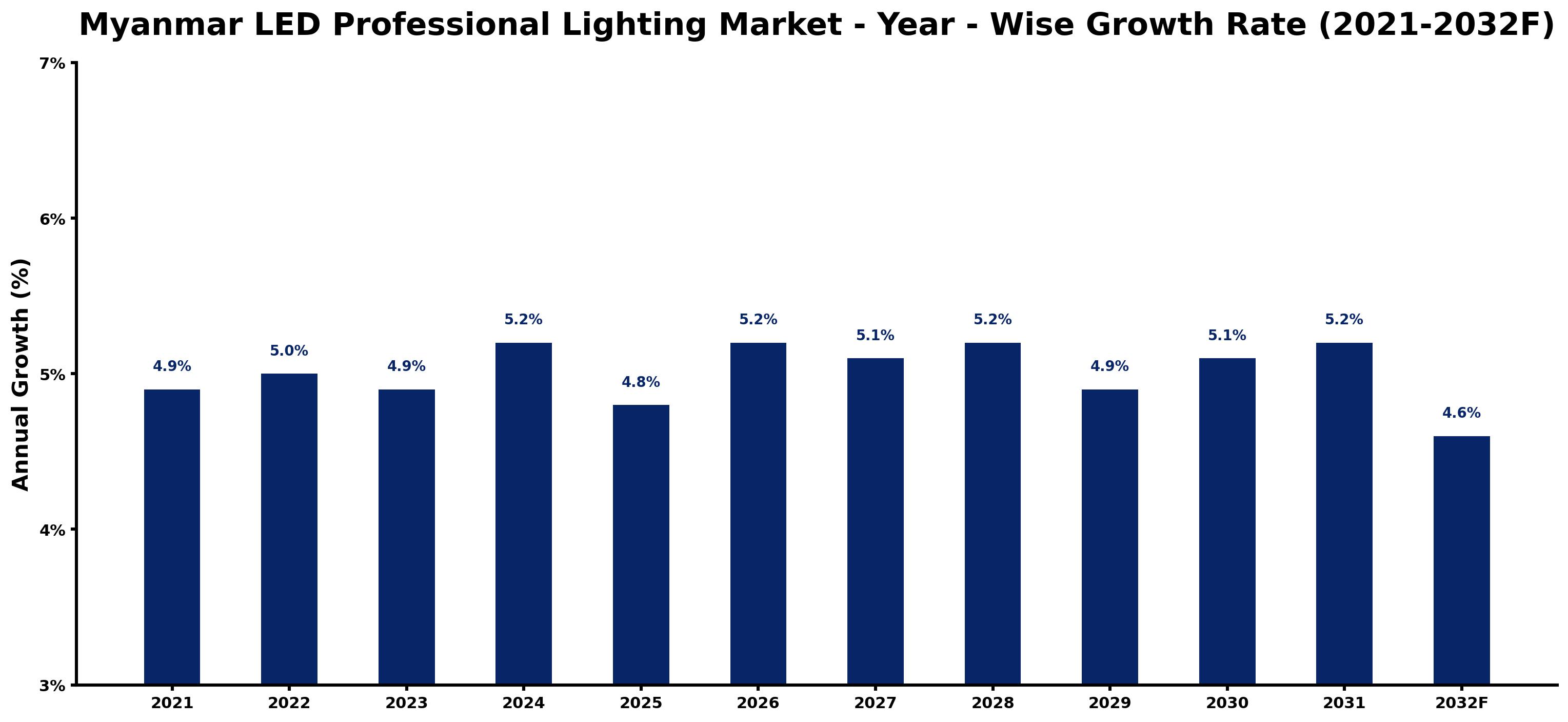
The table below presents the year wise growth rates along with the key drivers influencing the market
| Year | Growth Rate | Major Drivers |
| 2021 | 4.9% | Post-lockdown recovery spurred infrastructure investments, enhancing demand for LED lighting solutions. |
| 2022 | 5.0% | Rural electrification projects initiated, boosting the need for efficient lighting alternatives. |
| 2023 | 4.9% | Local manufacturers emerging, fostering competitive pricing within the LED lighting sector. |
| 2024 | 5.2% | Urbanization trends create demand for smart city projects, integrating LED technologies. |
| 2025 | 4.8% | Increased awareness of energy efficiency attracts investments in sustainable lighting options. |
| 2026 | 5.2% | Construction of commercial spaces accelerates, requiring modern lighting installations. |
| 2027 | 5.1% | Retail sector expansion contributes significantly to increased LED lighting purchase volumes. |
| 2028 | 5.2% | Technological advancements in LED efficiency motivate upgrades in existing lighting infrastructure. |
| 2029 | 4.9% | Healthcare facilities enhance patient experiences through improved LED lighting environments. |
| 2030 | 5.1% | Tourism sector revitalization leads to higher lighting expectations in hospitality venues. |
| 2031 | 5.2% | Enhanced connectivity and digitalization facilitates smart lighting solutions adoption. |
| 2032 | 4.6% | A growing middle class demands aesthetically pleasing and energy-efficient lighting designs. |
Note - Market size estimations and growth projections presented in this report are based on 6Wresearch's advanced forecasting approach, validated with industry datasets as of June 2026.
Myanmar LED Professional Lighting Market Synopsis
The Myanmar LED Professional Lighting Market is projected to reach 5.2% and witness significant growth during the forecast period (2026-2032). The landscape of lighting in Myanmar is undergoing a transformation, driven by substantial investments in the power sector and an increasing emphasis on sustainable energy consumption. This market dynamics not only reflects the broader commitment towards modernization in infrastructure but also indicates a strategic pivot towards energy-efficient solutions in various applications, including commercial, residential, and industrial settings.
Myanmar LED Professional Lighting Market Growth Drivers
The growth of the Myanmar LED Professional Lighting Market is influenced by several key drivers that foster an environment conducive to investment and development. First, the significant investment in the power sector in recent years has improved infrastructure capabilities, thereby enhancing the need for advanced lighting solutions. Second, the government's goal of achieving 100% electrification of households is driving demand for reliable and efficient lighting systems. Third, the adoption of renewable energy sources further boosts the market as it complements the overall sustainability objectives of the country.
- The rising demand for energy-efficient solutions has led to an increased focus on LED technology, which provides longer lifespans and lower energy consumption.
- Urbanization is accelerating in major cities like Yangon and Mandalay, catalyzing the need for enhanced lighting in both public and private sectors.
- The ongoing development of green building projects corresponds with global sustainability trends, thereby creating robust opportunities for LED lighting solutions.
- Government initiatives aimed at improving energy efficiency are encouraging businesses to upgrade their lighting systems, leading to market growth.
- The integration of smart technologies in lighting systems is paving the way for innovations, further propelling the demand for professional-grade lighting solutions.
Myanmar LED Professional Lighting Market Trends and Opportunities
As Myanmar embraces modernization, the LED professional lighting market is witnessing several emerging trends that indicate a shift in consumer preferences and technological advancements. One significant trend is the acceleration of smart lighting solutions that offer greater control and customization for users. Moreover, an increasing consciousness towards environmental sustainability is prompting businesses to invest in energy-efficient lighting options, making LEDs a preferred choice.
- There is a growing trend towards the adoption of smart city initiatives, which includes integrating LED lighting with IoT technologies for improved energy management.
- Increased collaboration between various sectors is fostering innovative approaches to lighting design that align with environmental sustainability goals.
- Sourcing locally produced materials for manufacturing LED lights is gaining traction, which helps to stimulate the local economy and reduce dependency on imports.
- Consumers are becoming more informed about energy consumption, leading to increased demand for products that highlight energy-saving benefits.
- The popularity of aesthetic and functional lighting designs in residential and commercial sectors is expanding the scope for LED applications, driving the market further.
Myanmar LED Professional Lighting Market Challenges and Restraints
Despite the positive outlook for the Myanmar LED Professional Lighting Market, several challenges could hinder market growth. One of the primary challenges is the insufficient infrastructure that still exists in rural areas, which may limit the penetration of advanced lighting solutions. Additionally, the cost of transitioning from traditional lighting to LED solutions can be a barrier for many businesses.
- The lack of awareness and understanding of LED technology among some consumer segments can slow down adoption rates.
- Supply chain disruptions can impact the availability of components necessary for manufacturing LED systems.
- The regulatory environment may present hurdles, with inconsistent policies affecting market entry for new players.
- Competition from alternative lighting solutions, such as compact fluorescent lamps, could pose a challenge to the LED market.
- Market players may face challenges in maintaining product quality and standards amid increasing demand and competition.
Myanmar LED Professional Lighting Market Government Investment and Initiatives
The government of Myanmar is actively involved in promoting the growth of the LED professional lighting market through various initiatives and investment plans. In recent years, the government has set ambitious targets for electrification, pushing for 100% coverage across all households. This initiative indirectly supports the demand for LED lighting solutions, which are seen as essential in achieving energy-efficient household setups.
- Government policies aimed at improving energy efficiency encourage both public and private sectors to invest in LED technologies.
- Public spending on renewable energy projects is increasingly allocated to upgrading lighting infrastructure, particularly in urban settings.
- Incentives for energy-efficient technologies are part of broader environmental policies, promoting the adoption of LEDs across different sectors.
- Collaborations with international organizations aim to secure funding and technical support for enhancing the lighting infrastructure in Myanmar.
- Public awareness campaigns about energy conservation highlight the benefits of LED lighting, thereby fostering consumer demand.
Myanmar LED Professional Lighting Market Latest Developments (May 2025 - June 2026)
During the period from May 2025 to June 2026, the Myanmar LED Professional Lighting Market has experienced a notable shift in focus towards sustainable practices and advanced technologies. There has been an increased alignment of lighting solutions with sustainability objectives, reflecting a global trend towards energy-efficient systems. Developments in smart lighting technology have also taken precedence, with various stakeholders exploring the integration of IoT components into LED systems.
- Government initiatives focusing on urban infrastructure enhancement have underscored the need for upgraded lighting solutions, leading to increased project financing.
- Research and development efforts aimed at improving the performance and lifespan of LED products have gained momentum across the market.
- Partnerships between local authorities and international organizations have been pivotal in financing renewable energy projects, including LED installations.
- Consumer education has become an essential focus, with various outreach programs designed to promote the benefits of LED lighting over traditional systems.
- The trend towards energy-efficient public lighting systems has resulted in pilot projects being launched in multiple urban areas, showcasing the effectiveness of LED technology.
Myanmar LED Professional Lighting Market - Key Attractiveness of the Report
- 10 Years of Market Numbers
- Historical Data Starting from 2022 to 2025
- Base Year: 2025
- Forecast Data until 2032
- Key Performance Indicators Impacting the Market
- Major Upcoming Developments and Projects
Key Highlights of the Report:
- Myanmar LED Professional Lighting Market Outlook
- Market Size of Myanmar LED Professional Lighting Market, 2025
- Forecast of Myanmar LED Professional Lighting Market, 2032
- Historical Data and Forecast of Myanmar LED Professional Lighting Revenues & Volume for the Period 2022-2032
- Myanmar LED Professional Lighting Market Trend Evolution
- Myanmar LED Professional Lighting Market Drivers and Challenges
- Myanmar LED Professional Lighting Price Trends
- Myanmar LED Professional Lighting Porter's Five Forces
- Myanmar LED Professional Lighting Industry Life Cycle
- Historical Data and Forecast of Myanmar LED Professional Lighting Market Revenues & Volume By Product Type for the Period 2022-2032
- Historical Data and Forecast of Myanmar LED Professional Lighting Market Revenues & Volume By LED Bulbs for the Period 2022-2032
- Historical Data and Forecast of Myanmar LED Professional Lighting Market Revenues & Volume By LED Fixtures for the Period 2022-2032
- Historical Data and Forecast of Myanmar LED Professional Lighting Market Revenues & Volume By Bare LED Tubes for the Period 2022-2032
- Historical Data and Forecast of Myanmar LED Professional Lighting Market Revenues & Volume By LED Down lights for the Period 2022-2032
- Historical Data and Forecast of Myanmar LED Professional Lighting Market Revenues & Volume By Applications for the Period 2022-2032
- Historical Data and Forecast of Myanmar LED Professional Lighting Market Revenues & Volume By Indoor for the Period 2022-2032
- Historical Data and Forecast of Myanmar LED Professional Lighting Market Revenues & Volume By Outdoor for the Period 2022-2032
- Historical Data and Forecast of Myanmar LED Professional Lighting Market Revenues & Volume By Automotive for the Period 2022-2032
- Historical Data and Forecast of Myanmar LED Professional Lighting Market Revenues & Volume By Backlighting for the Period 2022-2032
- Myanmar LED Professional Lighting Import Export Trade Statistics
- Market Opportunity Assessment By Product Type
- Market Opportunity Assessment By Applications
- Myanmar LED Professional Lighting Top Companies Market Share
- Myanmar LED Professional Lighting Competitive Benchmarking By Technical and Operational Parameters
- Myanmar LED Professional Lighting Company Profiles
- Myanmar LED Professional Lighting Key Strategic Recommendations
Market Covered
This report offers a comprehensive study of the subsequent market segments:
By Product Type
- LED Bulbs
- LED Fixtures
- Bare LED Tubes
- LED Down lights
By Applications
- Indoor, Outdoor
- Automotive
- Backlighting






































