Myanmar Managed Services Market Size & Growth Rate (2026-2032)
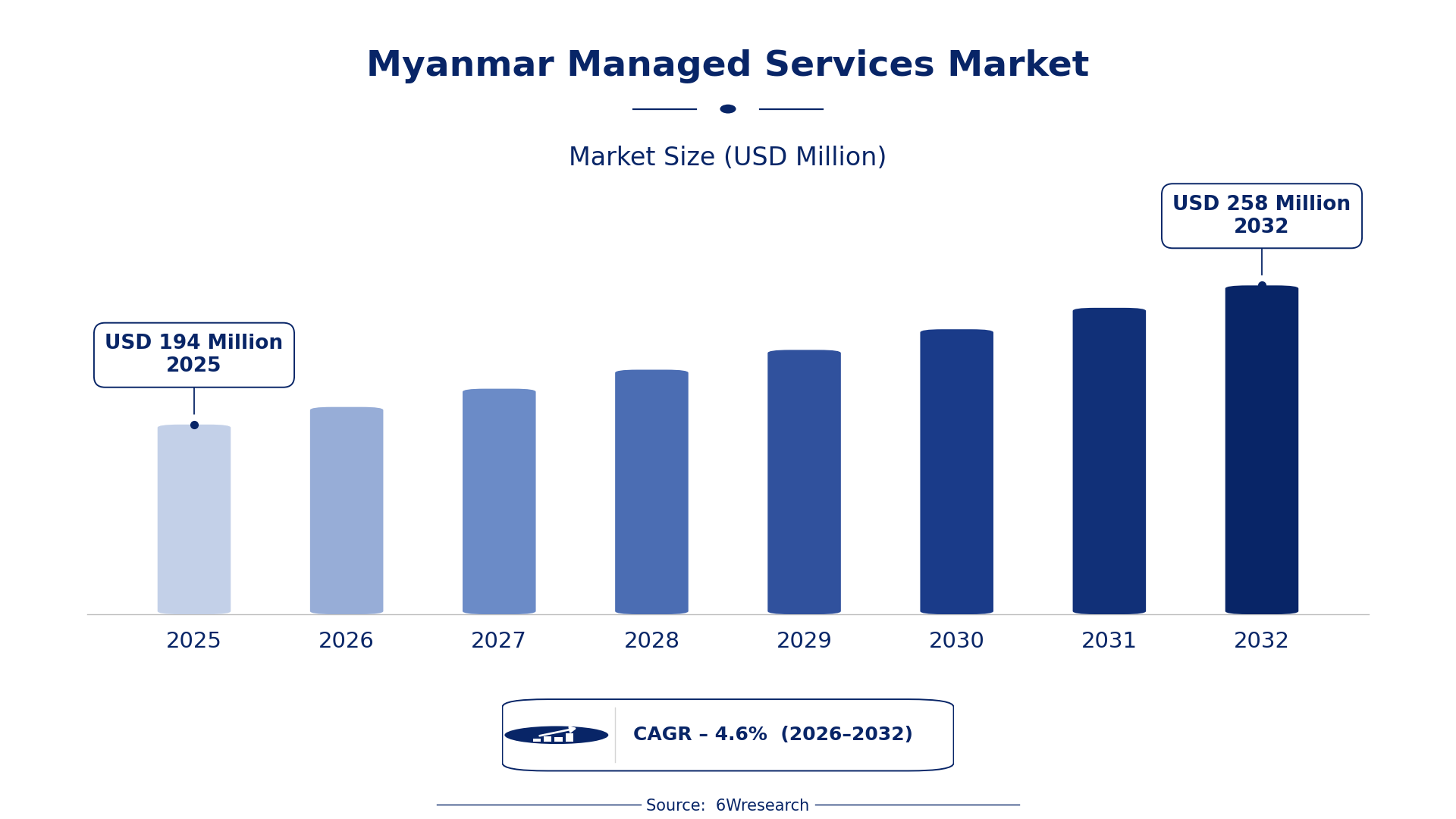
The Myanmar Managed Services Market was estimated at USD 194 Million in 2025 and is projected to reach USD 258 Million by 2032, growing at a CAGR of 4.6% from 2026 to 2032.
Myanmar Managed Services Market Synopsis
The Myanmar Managed Services Market is gaining traction as businesses increasingly recognize the value of outsourcing IT functions. While digitalization initiatives have sparked recent growth, the market is set to evolve as organizations seek more specialized and comprehensive managed services tailored to their specific needs.
As the country witnesses a surge in internet adoption and cloud technology utilization, demand for services such as cybersecurity, cloud management, and data analytics is expected to rise. However, the journey is not without hurdles, as infrastructure limitations and cybersecurity concerns linger, posing challenges to widespread implementation.
Myanmar Managed Services Market Year-wise Growth Rate and Key Drivers
This graph illustrates the annual growth rates of the Myanmar Managed Services Market from 2021 to 2032, highlighting a steady upward trajectory and projected expansion over the forecast period.
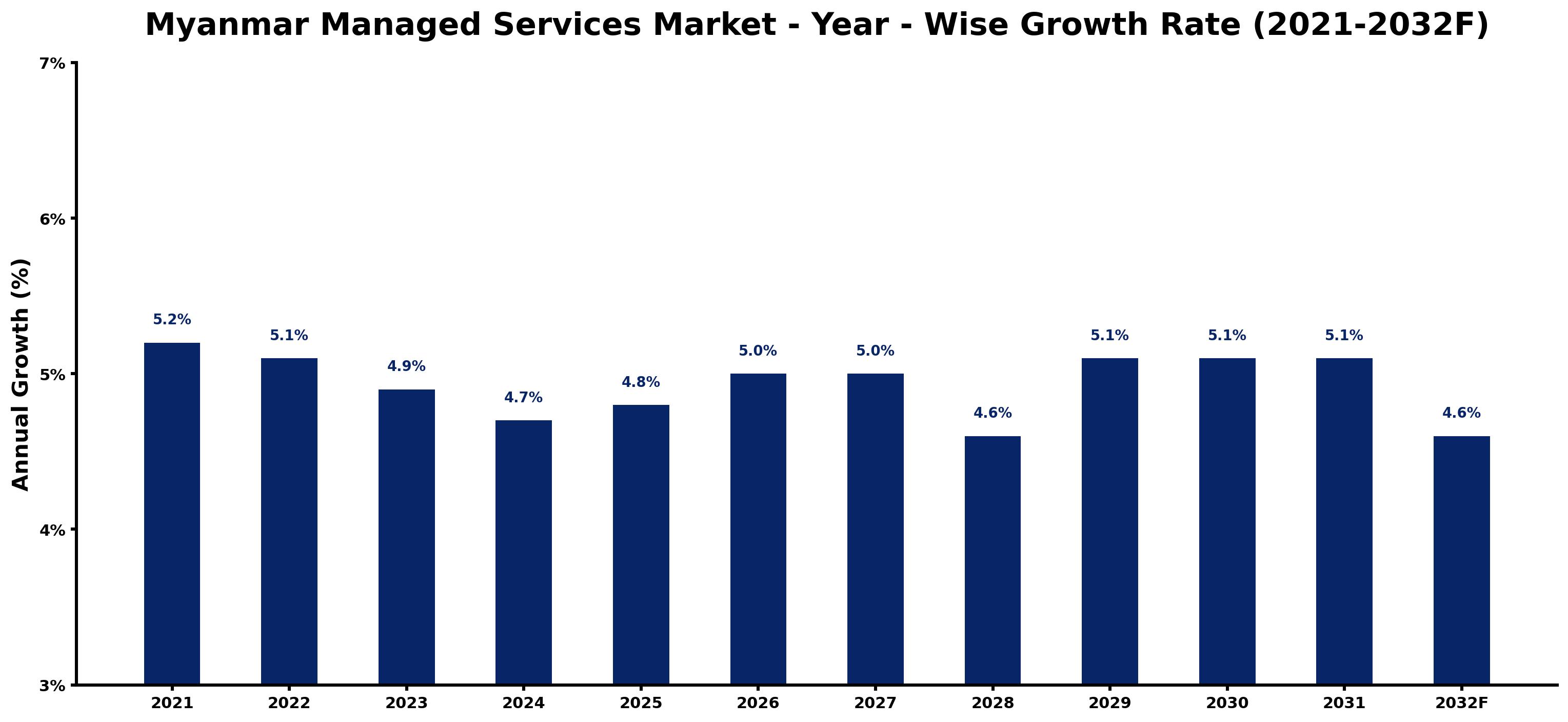
The table below presents the year‑wise growth rates along with the key drivers influencing the market
| Year | Growth Rate | Major Drivers |
| 2021 | 5.2% | Increased demand for IT services post-pandemic recovery. |
| 2022 | 5.1% | Growing interest in cloud computing among local enterprises. |
| 2023 | 4.9% | Rising e-commerce sector driving managed IT service needs. |
| 2024 | 4.7% | Local startups seeking scalable IT infrastructure solutions. |
| 2025 | 4.8% | Government digitalization strategy boosting IT service adoption. |
| 2026 | 5.0% | Surge in remote work creating demand for managed services. |
| 2027 | 5.0% | Expanding financial services sector needing robust IT support. |
| 2028 | 4.6% | Increased cybersecurity awareness among businesses driving growth. |
| 2029 | 5.1% | Rising number of SMEs investing in IT management. |
| 2030 | 5.1% | Supportive regulations enhancing data management service demand. |
| 2031 | 5.1% | Growing digital literacy encouraging managed service utilization. |
| 2032 | 4.6% | Investment in smart technologies necessitating expert IT management. |
Note: Market size estimations and growth projections presented in this report are based on 6Wresearch's proprietary forecasting methodology, utilizing the latest available industry data, government publications, and primary research inputs.
Myanmar Managed Services Market Key Takeaways
Below are some of the specific key takeaways from the market, including:
- Businesses are increasingly opting for managed services to enhance operational efficiency and reduce costs.
- Cloud-based solutions are driving demand, with a focus on agility and scalability.
- Data analytics and artificial intelligence are gaining traction for business decision-making.
- Investment opportunities are significant in cybersecurity and cloud computing.
- Government initiatives are aimed at improving infrastructure and attracting foreign investment.
Evaluation of Restraints in Myanmar Managed Services Market
The Myanmar Managed Services Market faces several key restraints that inhibit its full potential. A lack of awareness and understanding of managed services among businesses leads to slow adoption rates. Coupled with this is a shortage of skilled IT professionals who can implement and manage these services effectively.
on top of that, concerns over data security and regulatory compliance present significant challenges. The existing infrastructure, especially in remote areas, is often inadequate, limiting the effective delivery of managed services. Finally, ongoing political and economic instability adds an additional layer of uncertainty for businesses operating in this environment.
Myanmar Managed Services Market Trends
A notable trend in the Myanmar Managed Services Market is the growing demand for cloud-based solutions. Businesses are increasingly prioritizing agility and cost-efficiency, leading managed service providers to enhance their offerings in cloud migration and support. The integration of data analytics and AI into service portfolios is also becoming more common, enabling companies to derive actionable insights.
As digital transformation accelerates across various sectors, there is a marked shift towards specialized managed services that cater to specific industry needs. This evolution indicates a maturing market where businesses are no longer looking for generic solutions but are instead seeking tailored services that align with their operational goals.
Myanmar Managed Services Market Opportunities
The Myanmar Managed Services Market is ripe with investment opportunities, particularly in the realms of managed IT services, cloud computing, and cybersecurity. With the government’s push for digital transformation, there is a pressing need for reliable IT infrastructure and services.
Investors can benefit by collaborating with local firms to expand service offerings or introducing innovative technologies tailored to the local market. As businesses look to improve their operational efficiency and compliance, the demand for managed services will continue to surge, providing a lucrative avenue for growth.
Government Initiatives in the Myanmar Managed Services Market
Government policies are actively shaping the Myanmar Managed Services Market, focusing on attracting foreign investment and enhancing digital connectivity. Efforts to improve infrastructure through various initiatives are crucial in fostering a conducive environment for managed service providers.
- A national digital infrastructure upgrade program is currently underway, aimed at improving internet access across urban and rural areas.
- The Myanmar Investment Law was recently revised to offer better tax incentives for foreign investors looking to enter the managed services market.
- Ongoing initiatives include the establishment of training programs designed to address the skills gap in IT services.
- Upcoming policies are set to streamline regulatory frameworks to enhance transparency and compliance in data management.
Future Insights of the Myanmar Managed Services Market
Looking ahead to 2026-2032, the Myanmar Managed Services Market is expected to flourish, driven by the continuous adoption of digital technologies and the growing demand for cost-effective IT solutions. The complexity of IT infrastructure will necessitate specialized expertise, further propelling the market’s growth.
Service providers will need to adapt their offerings to meet the evolving needs of businesses, focusing on agility and compliance. As the market matures, there will be opportunities for expansion and diversification, particularly in areas like cybersecurity and data analytics.
Myanmar Managed Services Market Latest Developments
Recent developments in the Myanmar Managed Services Market reflect a positive trajectory as businesses and service providers adjust to emerging demands. The last 12-14 months have seen significant activity, particularly in cloud services and cybersecurity enhancements.
- A major technology vendor launched a new cybersecurity service in early 2025, designed to cater specifically to small and medium enterprises.
- Several local IT firms have begun partnerships to expand cloud service offerings, which are currently underway and expected to enhance service availability.
- In Q3 2025, an initiative aimed at improving data backup solutions was rolled out, receiving positive feedback from the business community.
- Plans for a national cybersecurity awareness campaign are scheduled to commence by mid-2026, aimed at educating businesses on best practices.
Myanmar Managed Services Market - Key Attractiveness of the Report
- 10 Years of Market Numbers
- Historical Data Starting from 2022 to 2025
- Base Year: 2025
- Forecast Data until 2032
- Key Performance Indicators Impacting the Market
- Major Upcoming Developments and Projects
Key Highlights of the Report:
- Myanmar Managed Services Market Outlook
- Market Size of Myanmar Managed Services Market, 2025
- Forecast of Myanmar Managed Services Market, 2032
- Historical Data and Forecast of Myanmar Managed Services Revenues & Volume for the Period 2022-2032F
- Myanmar Managed Services Market Trend Evolution
- Myanmar Managed Services Market Drivers and Challenges
- Myanmar Managed Services Price Trends
- Myanmar Managed Services Porter's Five Forces
- Myanmar Managed Services Industry Life Cycle
- Historical Data and Forecast of Myanmar Managed Services Market Revenues & Volume By Service Type for the Period 2022-2032F
- Historical Data and Forecast of Myanmar Managed Services Market Revenues & Volume By Managed Security Services for the Period 2022-2032F
- Historical Data and Forecast of Myanmar Managed Services Market Revenues & Volume By Managed Network Services for the Period 2022-2032F
- Historical Data and Forecast of Myanmar Managed Services Market Revenues & Volume By Managed Data Center and IT Infrastructure Services for the Period 2022-2032F
- Historical Data and Forecast of Myanmar Managed Services Market Revenues & Volume By Managed Communication and Collaboration Services for the Period 2022-2032F
- Historical Data and Forecast of Myanmar Managed Services Market Revenues & Volume By Managed Mobility Services for the Period 2022-2032F
- Historical Data and Forecast of Myanmar Managed Services Market Revenues & Volume By Managed Information Services for the Period 2022-2032F
- Historical Data and Forecast of Myanmar Managed Services Market Revenues & Volume By Deployment Type for the Period 2022-2032F
- Historical Data and Forecast of Myanmar Managed Services Market Revenues & Volume By Cloud for the Period 2022-2032F
- Historical Data and Forecast of Myanmar Managed Services Market Revenues & Volume By On-Premises for the Period 2022-2032F
- Historical Data and Forecast of Myanmar Managed Services Market Revenues & Volume By Organization Size for the Period 2022-2032F
- Historical Data and Forecast of Myanmar Managed Services Market Revenues & Volume By Small and Medium-sized Enterprises (SMEs) for the Period 2022-2032F
- Historical Data and Forecast of Myanmar Managed Services Market Revenues & Volume By Large Enterprises for the Period 2022-2032F
- Historical Data and Forecast of Myanmar Managed Services Market Revenues & Volume By Vertical for the Period 2022-2032F
- Historical Data and Forecast of Myanmar Managed Services Market Revenues & Volume By BFSI for the Period 2022-2032F
- Historical Data and Forecast of Myanmar Managed Services Market Revenues & Volume By IT and Telecom for the Period 2022-2032F
- Historical Data and Forecast of Myanmar Managed Services Market Revenues & Volume By Retail and Consumer Goods for the Period 2022-2032F
- Historical Data and Forecast of Myanmar Managed Services Market Revenues & Volume By Manufacturing for the Period 2022-2032F
- Historical Data and Forecast of Myanmar Managed Services Market Revenues & Volume By Government for the Period 2022-2032F
- Historical Data and Forecast of Myanmar Managed Services Market Revenues & Volume By Healthcare and Life Sciences for the Period 2022-2032F
- Historical Data and Forecast of Myanmar Managed Services Market Revenues & Volume By Energy and Utilities for the Period 2022-2032F
- Historical Data and Forecast of Myanmar Managed Services Market Revenues & Volume By Media and Entertainment for the Period 2022-2032F
- Myanmar Managed Services Import Export Trade Statistics
- Market Opportunity Assessment By Service Type
- Market Opportunity Assessment By Deployment Type
- Market Opportunity Assessment By Organization Size
- Market Opportunity Assessment By Vertical
- Myanmar Managed Services Top Companies Market Share
- Myanmar Managed Services Competitive Benchmarking By Technical and Operational Parameters
- Myanmar Managed Services Company Profiles
- Myanmar Managed Services Key Strategic Recommendations






































