Myanmar Medical Tubing Market Size, Share & Growth Rate
The Myanmar Medical Tubing Market was estimated at USD 222 Million in 2025 and is projected to reach USD 311 Million by 2032, growing at a CAGR of 4.9% from 2026 to 2032. This growth trajectory is fueled by an increase in healthcare expenditures and a push for modernization within the healthcare infrastructure. Additionally, the expanding prevalence of chronic diseases is driving demand for advanced medical procedures that rely on high-quality medical tubing.
Myanmar Medical Tubing Market Year-wise Growth Rate and Key Drivers
This graph highlights how the Myanmar Medical Tubing Market has steadily grown over the years, supported by major growth factors.
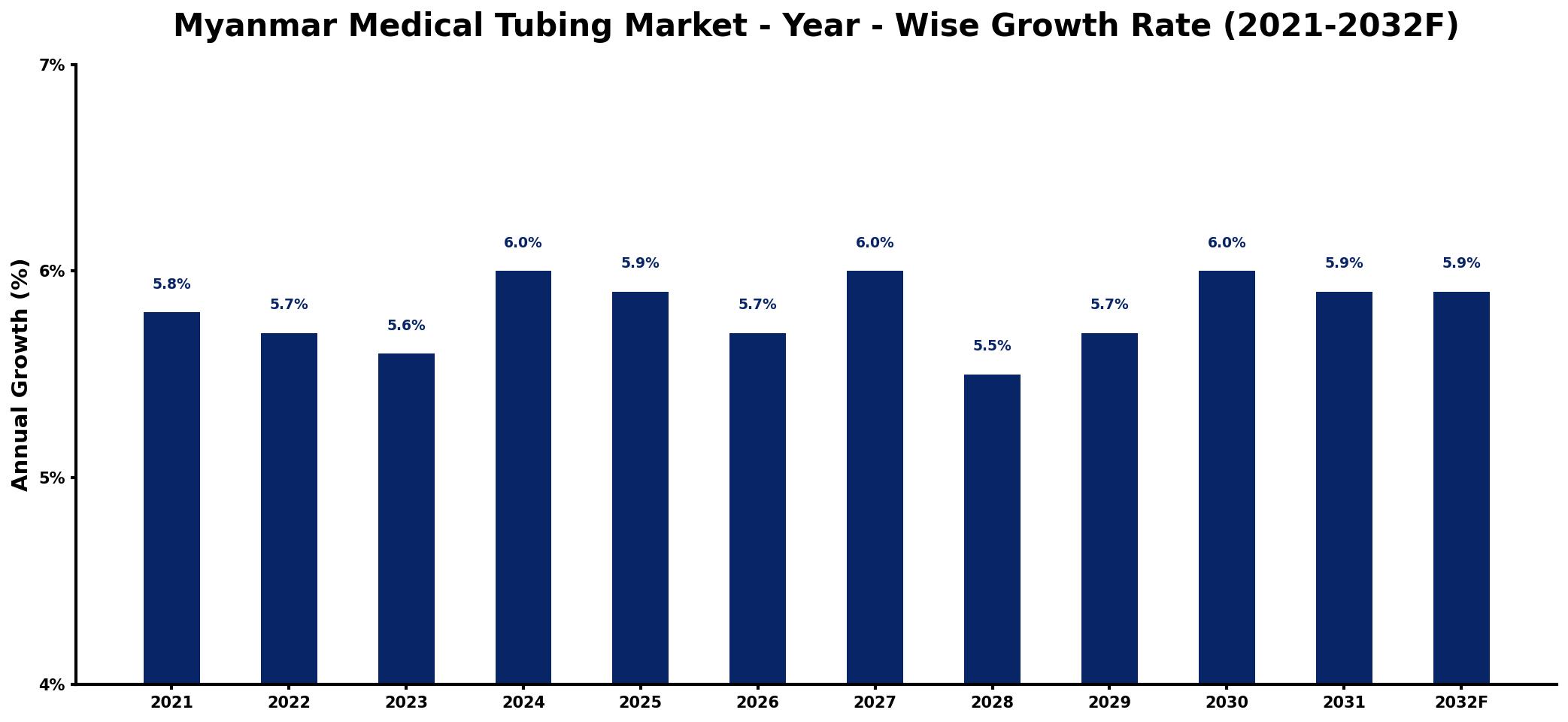
The table below presents the year‑wise growth rates along with the key drivers influencing the market
| Year | Growth Rate | Major Drivers |
| 2021 | 5.8% | Rising healthcare infrastructure investments |
| 2022 | 5.7% | Increased demand for surgical supplies |
| 2023 | 5.6% | Expansion of diagnostic services facilities |
| 2024 | 6.0% | Growth in outpatient care centers |
| 2025 | 5.9% | Advancements in healthcare technology |
| 2026 | 5.7% | Surge in chronic disease management |
| 2027 | 6.0% | Increase in health awareness campaigns |
| 2028 | 5.5% | Development of telemedicine services |
| 2029 | 5.7% | Rising demand for home healthcare |
| 2030 | 6.0% | strengthening underlying market demand |
| 2031 | 5.9% | expanding healthcare application demand |
| 2032 | 5.9% | growing emerging market penetration |
Note: Market size estimations and growth projections presented in this report are based on 6Wresearch's proprietary forecasting methodology, utilizing the latest available industry data, government publications, and primary research inputs.
Myanmar Medical Tubing Market Synopsis
In recent years, the Myanmar Medical Tubing Market has gained significant momentum, reflecting a broader transformation within the healthcare sector. While current demand is robust, the market is on the cusp of substantial growth as healthcare policies evolve and healthcare accessibility improves across the nation.
This market is responding dynamically to the rising need for products that facilitate minimally invasive procedures, as healthcare professionals increasingly recognize the critical role of medical tubing in effective patient care. As healthcare providers adopt international standards, the market is expected to further innovate and expand.
Myanmar Medical Tubing Market Key Takeaways
- The market is experiencing steady growth driven by rising healthcare expenditure and technological advancements.
- Demand for minimally invasive surgeries and intravenous therapy is significantly influencing market dynamics.
- Innovative materials like silicone and polyurethane are becoming preferred choices for medical tubing products.
- Government policies are increasingly aimed at promoting local manufacturing and ensuring product quality.
- Investment opportunities abound for those looking to engage in the expanding healthcare sector.
Evaluation of Restraints in Myanmar Medical Tubing Market
Despite its promising growth, the Myanmar Medical Tubing Market faces several significant restraints. Limited access to advanced manufacturing technologies hinders the production of high-quality medical tubing, while a lack of skilled workforce poses challenges in maintaining product standards. Additionally, regulatory frameworks are still evolving, and inconsistent supply chain infrastructures can lead to increased costs and delays in product availability. Addressing these constraints will be essential to unlock the market's full potential.
Myanmar Medical Tubing Market Trends
Current trends indicate a strong shift towards innovative materials and designs that enhance the functionality of medical tubing. Increasing awareness around infection control has spurred the adoption of antimicrobial and anti-kink tubing solutions, which are now becoming standard in healthcare facilities. Moreover, as healthcare providers aim to comply with stringent international regulatory standards, the demand for high-performance and biocompatible medical tubing products is expected to surge.
Myanmar Medical Tubing Market Opportunities
The Myanmar Medical Tubing Market presents a plethora of investment opportunities, particularly as healthcare infrastructure continues to develop. With a growing focus on enhancing healthcare quality, there is an increasing requirement for specialized medical tubing used in various applications, including drug delivery, diagnostics, and respiratory support. Establishing partnerships with local healthcare facilities and suppliers will be critical for accessing this evolving market.
Government Initiatives in the Myanmar Medical Tubing Market
The government of Myanmar is actively working to bolster the medical tubing market through policies aimed at enhancing local manufacturing capabilities. There are initiatives designed to provide incentives for local manufacturers while ensuring compliance with international quality standards. Monitoring the quality of imported medical tubing products is also a priority, as authorities strive to protect consumers and maintain high safety standards in healthcare.
Future Insights of the Myanmar Medical Tubing Market
Looking ahead to 2026-2032, the Myanmar Medical Tubing Market is positioned for consistent growth, driven primarily by advances in technology and increasing demand for medical devices. The growth of the healthcare sector is likely to continue unabated, and as chronic diseases become more prevalent, the reliance on high-quality medical tubing will only intensify. While challenges remain, the overall market outlook is optimistic, with significant opportunities for manufacturers and suppliers eager to capitalize on this transforming landscape.
Myanmar Medical Tubing Market Latest Developments (2025 - 2026)
Recent developments within the Myanmar Medical Tubing Market reflect a strong commitment to modernizing healthcare practices. Notably, there have been substantial advancements in the introduction of new materials and designs focused on improving biocompatibility and safety. Healthcare providers are increasingly prioritizing infection control measures, influencing a shift towards the adoption of advanced antimicrobial tubing solutions. Furthermore, government policies are beginning to streamline regulatory processes, facilitating smoother operations for manufacturers and distributors.
Myanmar Medical Tubing Market - Key Attractiveness of the Report
- 10 Years of Market Numbers
- Historical Data Starting from 2022 to 2025
- Base Year: 2025
- Forecast Data until 2032
- Key Performance Indicators Impacting the Market
- Major Upcoming Developments and Projects
Key Highlights of the Report:
- Myanmar Medical Tubing Market Outlook
- Market Size of Myanmar Medical Tubing Market, 2025
- Forecast of Myanmar Medical Tubing Market, 2032
- Historical Data and Forecast of Myanmar Medical Tubing Revenues & Volume for the Period 2022-2032F
- Myanmar Medical Tubing Market Trend Evolution
- Myanmar Medical Tubing Market Drivers and Challenges
- Myanmar Medical Tubing Price Trends
- Myanmar Medical Tubing Porter's Five Forces
- Myanmar Medical Tubing Industry Life Cycle
- Historical Data and Forecast of Myanmar Medical Tubing Market Revenues & Volume By Material for the Period 2022-2032F
- Historical Data and Forecast of Myanmar Medical Tubing Market Revenues & Volume By Plastics for the Period 2022-2032F
- Historical Data and Forecast of Myanmar Medical Tubing Market Revenues & Volume By Rubbers for the Period 2022-2032F
- Historical Data and Forecast of Myanmar Medical Tubing Market Revenues & Volume By Specialty Polymers for the Period 2022-2032F
- Historical Data and Forecast of Myanmar Medical Tubing Market Revenues & Volume By Structure for the Period 2022-2032F
- Historical Data and Forecast of Myanmar Medical Tubing Market Revenues & Volume By Single-lumen for the Period 2022-2032F
- Historical Data and Forecast of Myanmar Medical Tubing Market Revenues & Volume By Co-extruded for the Period 2022-2032F
- Historical Data and Forecast of Myanmar Medical Tubing Market Revenues & Volume By Multi-lumen for the Period 2022-2032F
- Historical Data and Forecast of Myanmar Medical Tubing Market Revenues & Volume By Tapered Or Bump Tubing for the Period 2022-2032F
- Historical Data and Forecast of Myanmar Medical Tubing Market Revenues & Volume By Braided Tubing for the Period 2022-2032F
- Historical Data and Forecast of Myanmar Medical Tubing Market Revenues & Volume By Application for the Period 2022-2032F
- Historical Data and Forecast of Myanmar Medical Tubing Market Revenues & Volume By Bulk Disposable Tubing for the Period 2022-2032F
- Historical Data and Forecast of Myanmar Medical Tubing Market Revenues & Volume By Catheters & Cannulas for the Period 2022-2032F
- Historical Data and Forecast of Myanmar Medical Tubing Market Revenues & Volume By Drug Delivery System for the Period 2022-2032F
- Historical Data and Forecast of Myanmar Medical Tubing Market Revenues & Volume By Special Applications for the Period 2022-2032F
- Myanmar Medical Tubing Import Export Trade Statistics
- Market Opportunity Assessment By Material
- Market Opportunity Assessment By Structure
- Market Opportunity Assessment By Application
- Myanmar Medical Tubing Top Companies Market Share
- Myanmar Medical Tubing Competitive Benchmarking By Technical and Operational Parameters
- Myanmar Medical Tubing Company Profiles
- Myanmar Medical Tubing Key Strategic Recommendations






































