Myanmar Metal Powder Market Size Growth Rate
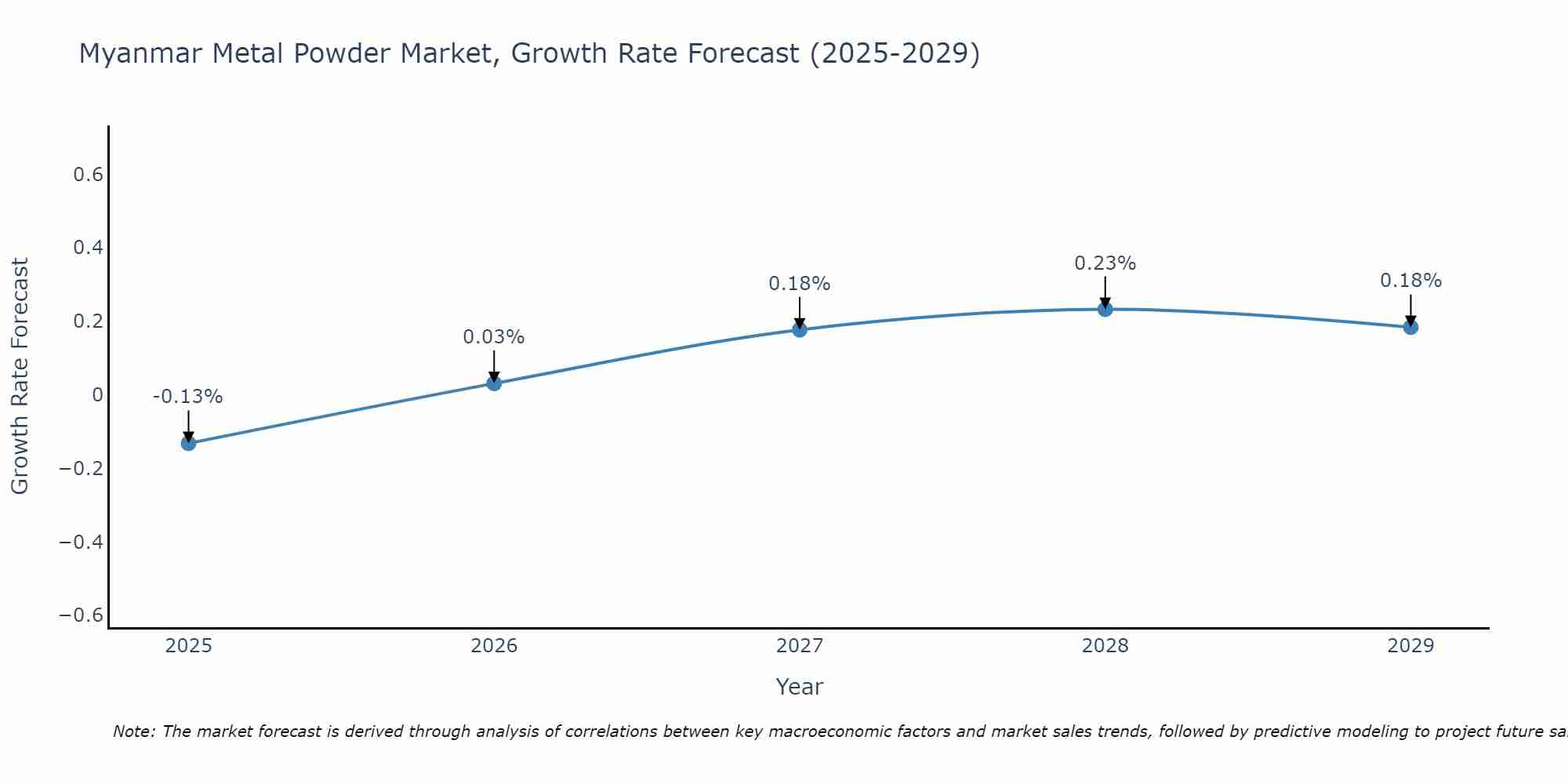
The Myanmar Metal Powder Market is projected to witness mixed growth rate patterns during 2025 to 2029. The growth rate begins at -0.13% in 2025, climbs to a high of 0.23% in 2028, and moderates to 0.18% by 2029.
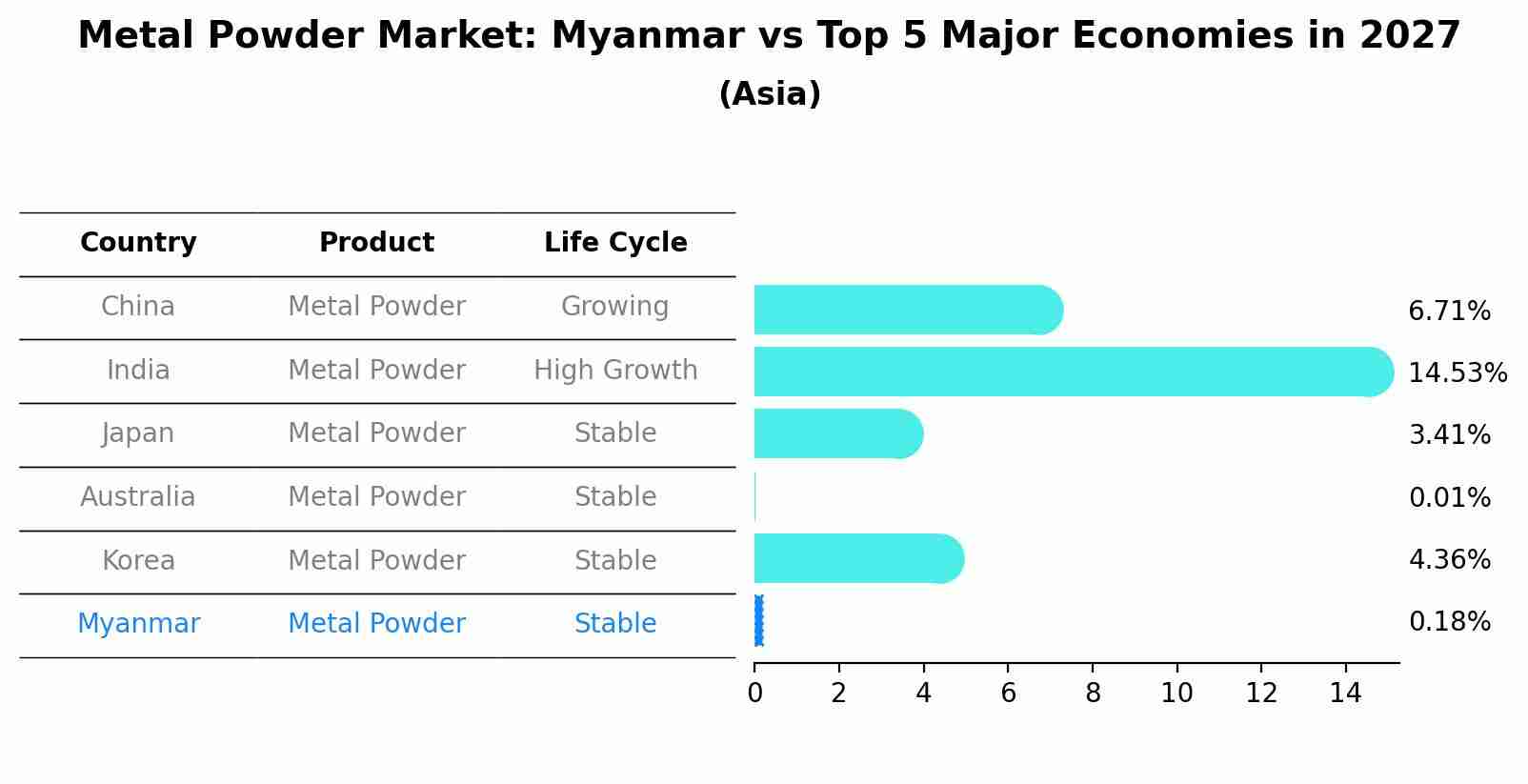
Metal Powder Market: Myanmar vs Top 5 Major Economies in 2027 (Asia)
By 2027, Myanmar's Metal Powder market is forecasted to achieve a stable growth rate of 0.18%, with China leading the Asia region, followed by India, Japan, Australia and South Korea.
Myanmar Metal Powder Market Overview
The metal powder market in Myanmar involves the production of fine metal particles used in powder metallurgy, additive manufacturing, and coating applications. The market is growing with the demand for advanced manufacturing techniques that require high-quality metal powders.
Drivers of the market
The Myanmar metal powder market is witnessing growth due to several driving factors. Firstly, the increasing demand for metal powders in additive manufacturing, also known as 3D printing, is driving market growth in Myanmar. Additionally, metal powders are widely used in industries such as automotive, aerospace, and electronics for manufacturing lightweight components with complex geometries. Moreover, advancements in metal powder production technologies, such as atomization and chemical vapor deposition, are enhancing process efficiency and product quality, thereby driving market growth. Furthermore, the growing emphasis on sustainable manufacturing practices and the adoption of metal powders for recycling applications are creating opportunities for market expansion in Myanmar.
Challenges of the market
The metal powder market in Myanmar is constrained by limited local production capabilities and reliance on imports, which can lead to supply chain disruptions and higher costs. High production costs associated with advanced powder metallurgy processes can deter investment. The market also faces competition from traditional manufacturing methods and from countries with more established metal powder industries. Additionally, there is a lack of awareness and understanding of the benefits of metal powders in various applications, affecting market penetration.
Government Policy of the market
Myanmar industrial policies support the production and use of metal powders in various manufacturing processes, including additive manufacturing and powder metallurgy. Regulations ensure product quality and safety, promote local production, and encourage research and development to improve powder production techniques.
Key Highlights of the Report:
- Myanmar Metal Powder Market Outlook
- Market Size of Myanmar Metal Powder Market, 2024
- Forecast of Myanmar Metal Powder Market, 2031
- Historical Data and Forecast of Myanmar Metal Powder Revenues & Volume for the Period 2021-2031
- Myanmar Metal Powder Market Trend Evolution
- Myanmar Metal Powder Market Drivers and Challenges
- Myanmar Metal Powder Price Trends
- Myanmar Metal Powder Porter's Five Forces
- Myanmar Metal Powder Industry Life Cycle
- Historical Data and Forecast of Myanmar Metal Powder Market Revenues & Volume By Material for the Period 2021-2031
- Historical Data and Forecast of Myanmar Metal Powder Market Revenues & Volume By Ferrous for the Period 2021-2031
- Historical Data and Forecast of Myanmar Metal Powder Market Revenues & Volume By Non-ferrous for the Period 2021-2031
- Historical Data and Forecast of Myanmar Metal Powder Market Revenues & Volume By Technology for the Period 2021-2031
- Historical Data and Forecast of Myanmar Metal Powder Market Revenues & Volume By Press & Sinter for the Period 2021-2031
- Historical Data and Forecast of Myanmar Metal Powder Market Revenues & Volume By Metal Injection Molding for the Period 2021-2031
- Historical Data and Forecast of Myanmar Metal Powder Market Revenues & Volume By Additive Manufacturing for the Period 2021-2031
- Historical Data and Forecast of Myanmar Metal Powder Market Revenues & Volume By Others for the Period 2021-2031
- Historical Data and Forecast of Myanmar Metal Powder Market Revenues & Volume By Application for the Period 2021-2031
- Historical Data and Forecast of Myanmar Metal Powder Market Revenues & Volume By Automotive for the Period 2021-2031
- Historical Data and Forecast of Myanmar Metal Powder Market Revenues & Volume By Aerospace & Defense for the Period 2021-2031
- Historical Data and Forecast of Myanmar Metal Powder Market Revenues & Volume By Healthcare for the Period 2021-2031
- Historical Data and Forecast of Myanmar Metal Powder Market Revenues & Volume By Others for the Period 2021-2031
- Myanmar Metal Powder Import Export Trade Statistics
- Market Opportunity Assessment By Material
- Market Opportunity Assessment By Technology
- Market Opportunity Assessment By Application
- Myanmar Metal Powder Top Companies Market Share
- Myanmar Metal Powder Competitive Benchmarking By Technical and Operational Parameters
- Myanmar Metal Powder Company Profiles
- Myanmar Metal Powder Key Strategic Recommendations






































