Myanmar Oil & Gas Pumps Market Size, Share & Growth Rate
The Myanmar Oil & Gas Pumps Market was estimated at USD 397 Million in 2025 and is projected to reach USD 552 Million by 2032, growing at a CAGR of 4.8% from 2026 to 2032. This growth trajectory is driven by robust investments in the oil and gas sector, alongside increased exploration activities aimed at harnessing the countrys vast hydrocarbon resources. The governments push for foreign investment and the modernization of infrastructure are pivotal in shaping this dynamic market.
Myanmar Oil & Gas Pumps Market Year-wise Growth Rate and Key Drivers
This graph highlights how the Myanmar Oil & Gas Pumps Market has steadily grown over the years, supported by major growth factors.
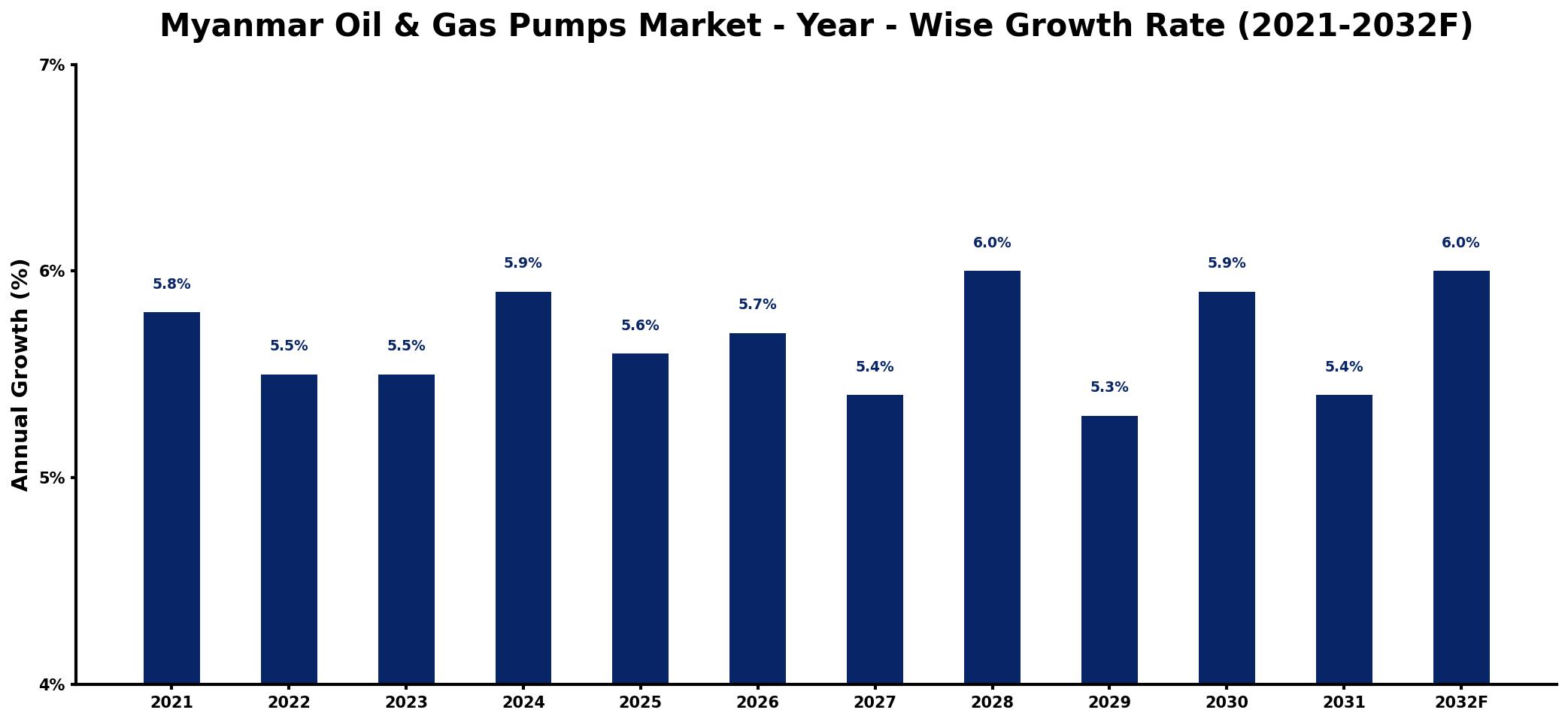
The table below presents the year‑wise growth rates along with the key drivers influencing the market
| Year | Growth Rate | Major Drivers |
| 2021 | 5.8% | Increased energy sector investments |
| 2022 | 5.5% | Growing industrial infrastructure projects |
| 2023 | 5.5% | Rising demand for renewable energy |
| 2024 | 5.9% | Expansion of transportation networks |
| 2025 | 5.6% | Strengthened government energy policies |
| 2026 | 5.7% | Surge in urban development initiatives |
| 2027 | 5.4% | Boost in foreign direct investments |
| 2028 | 6.0% | Higher consumer energy consumption |
| 2029 | 5.3% | Emergence of new industrial sectors |
| 2030 | 5.9% | Growing focus on sustainability practices |
| 2031 | 5.4% | Increased regional trade partnerships |
| 2032 | 6.0% | Advancements in technology adoption |
Note: Market size estimations and growth projections presented in this report are based on 6Wresearch's proprietary forecasting methodology, utilizing the latest available industry data, government publications, and primary research inputs.
Myanmar Oil & Gas Pumps Market Synopsis
In Myanmar, the oil and gas industry is heavily reliant on efficient pumping solutions, particularly centrifugal pumps, which are favored for their effectiveness in moving fluids across various applications like drilling and refining. The rising focus on improving operational efficiency amidst challenging environmental conditions places high-performance pumps in significant demand.
The local landscape has seen an influx of interest from foreign investors, stimulated by government incentives aimed at enhancing transparency and accountability in the sector. Consequently, there's a noteworthy trend towards customizing pump solutions to align with the unique operational requirements of oil and gas companies operating within Myanmar.
- The Myanmar Oil & Gas Pumps Market is poised for steady growth driven by a surge in exploration and production activities.
- Key trends include the adoption of advanced technologies such as smart pumps aimed at boosting efficiency and reducing downtime.
- There is a significant push towards environmentally sustainable practices within the pump manufacturing sector.
- Local partnerships are becoming essential for international companies seeking to penetrate this evolving market.
- Government policies are fostering a more transparent and inviting environment for foreign investment.
Despite the promising outlook, the Myanmar Oil & Gas Pumps Market faces notable challenges. Infrastructure inadequacies, such as underdeveloped transportation systems and unreliable power supplies, threaten operational efficiencies. Moreover, uncertainties surrounding regulatory frameworks can complicate compliance, making it imperative for companies to stay agile and well-connected with local stakeholders to navigate these complexities. Political instability further complicates the investment landscape, introducing an element of risk that requires careful management.
Current trends in the Myanmar Oil & Gas Pumps Market showcase an increasing demand for technologically advanced pumping solutions that can withstand the regions tough operating conditions. Companies are prioritizing investments in digital solutions that enhance operational efficiency and minimize maintenance costs. The growth of smart pump technologies is notable, as businesses strive for higher performance and reduced energy consumption while adhering to environmental regulations. Moreover, a shift towards sustainable practices is beginning to shape procurement strategies across the sector.
Opportunities abound in the Myanmar Oil & Gas Pumps Market, especially for manufacturers and distributors focusing on specialized pumps tailored to the oil and gas industry. As exploration activities expand, there is significant potential for investing in advanced manufacturing capabilities to produce high-efficiency pumps. Additionally, investment in R&D to develop innovative solutions that cater to the evolving needs of operators can yield favorable returns. Forming strategic collaborations with local companies can also enhance market penetration and facilitate growth.
The government of Myanmar has introduced various initiatives to enhance the Oil & Gas Pumps Market, primarily through regulatory frameworks that encourage foreign investment. The Oil and Gas Law serves as a cornerstone for governing exploration and production activities. Efforts to ensure transparency, such as requiring companies to disclose ownership and financial details, have been implemented to bolster investor confidence. Furthermore, production sharing contracts have been established to foster partnerships between local and international entities, aiming to drive sustainable development across the sector.
Looking ahead to 2026-2032, the Myanmar Oil & Gas Pumps Market is expected to witness moderate yet consistent growth. The combination of renewed foreign investment and the discovery of new oil reserves will fuel demand for efficient pumping solutions in extraction, transportation, and refining processes. However, stakeholders will need to remain vigilant to navigate the potential impacts of regulatory changes and political fluctuations. With the right strategies, this market is well-positioned for expansion driven by the country's growing energy demands.
Recently, the Myanmar Oil & Gas Pumps Market has seen increased activity as companies ramp up efforts to modernize their operations. Developments in pump technologies are being integrated into ongoing infrastructure projects, responding to the dual need for efficiency and sustainability. Local firms are engaging in partnerships with foreign entities to leverage advanced technologies and ensure compliance with the evolving regulatory landscape. This collaborative approach is aimed at enhancing the overall competitiveness of the sector.
- 10 Years of Market Numbers
- Historical Data Starting from 2022 to 2025
- Base Year: 2025
- Forecast Data until 2032
- Key Performance Indicators Impacting the Market
- Major Upcoming Developments and Projects
Key Highlights of the Report:
- Myanmar Oil & Gas Pumps Market Outlook
- Market Size of Myanmar Oil & Gas Pumps Market, 2025
- Forecast of Myanmar Oil & Gas Pumps Market, 2032
- Historical Data and Forecast of Myanmar Oil & Gas Pumps Revenues & Volume for the Period 2022-2032F
- Myanmar Oil & Gas Pumps Market Trend Evolution
- Myanmar Oil & Gas Pumps Market Drivers and Challenges
- Myanmar Oil & Gas Pumps Price Trends
- Myanmar Oil & Gas Pumps Porter's Five Forces
- Myanmar Oil & Gas Pumps Industry Life Cycle
- Historical Data and Forecast of Myanmar Oil & Gas Pumps Market Revenues & Volume By Type for the Period 2022-2032F
- Historical Data and Forecast of Myanmar Oil & Gas Pumps Market Revenues & Volume By Submersible Pumps for the Period 2022-2032F
- Historical Data and Forecast of Myanmar Oil & Gas Pumps Market Revenues & Volume By Non-submersible Pumps for the Period 2022-2032F
- Historical Data and Forecast of Myanmar Oil & Gas Pumps Market Revenues & Volume By Pump Type for the Period 2022-2032F
- Historical Data and Forecast of Myanmar Oil & Gas Pumps Market Revenues & Volume By Centrifugal Pump for the Period 2022-2032F
- Historical Data and Forecast of Myanmar Oil & Gas Pumps Market Revenues & Volume By Positive Displacement Pump for the Period 2022-2032F
- Historical Data and Forecast of Myanmar Oil & Gas Pumps Market Revenues & Volume By Cryogenic Pump for the Period 2022-2032F
- Historical Data and Forecast of Myanmar Oil & Gas Pumps Market Revenues & Volume By Application for the Period 2022-2032F
- Historical Data and Forecast of Myanmar Oil & Gas Pumps Market Revenues & Volume By Upstream for the Period 2022-2032F
- Historical Data and Forecast of Myanmar Oil & Gas Pumps Market Revenues & Volume By Midstream for the Period 2022-2032F
- Historical Data and Forecast of Myanmar Oil & Gas Pumps Market Revenues & Volume By Downstream for the Period 2022-2032F
- Myanmar Oil & Gas Pumps Import Export Trade Statistics
- Market Opportunity Assessment By Type
- Market Opportunity Assessment By Pump Type
- Market Opportunity Assessment By Application
- Myanmar Oil & Gas Pumps Top Companies Market Share
- Myanmar Oil & Gas Pumps Competitive Benchmarking By Technical and Operational Parameters
- Myanmar Oil & Gas Pumps Company Profiles
- Myanmar Oil & Gas Pumps Key Strategic Recommendations






































