Myanmar Optical Glass Market Size, Share & Growth Rate
The Myanmar Optical Glass Market was estimated at USD 203 Million in 2025 and is projected to reach USD 267 Million by 2032, growing at a CAGR of 4.0% from 2026 to 2032. This growth trajectory is primarily fueled by the increasing demand for high-quality optical components across telecommunications, electronics, and healthcare sectors. As the domestic manufacturing capabilities expand, the market is anticipated to benefit from a reduction in dependency on imports, thereby promoting local economic development.
Myanmar Optical Glass Market Year-wise Growth Rate and Key Drivers
This graph highlights how the Myanmar Optical Glass Market has steadily grown over the years, supported by major growth factors.
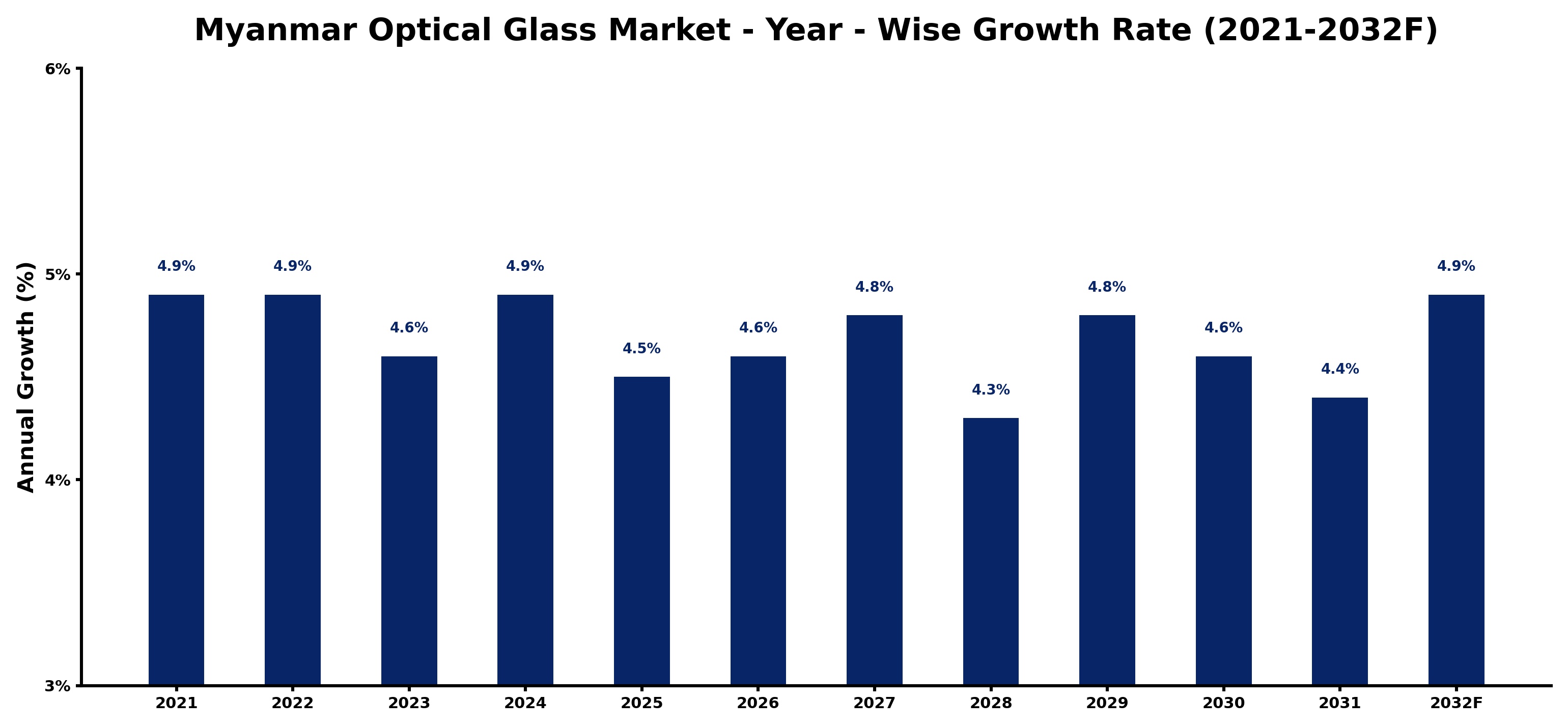
The table below presents the year‑wise growth rates along with the key drivers influencing the market
| Year | Growth Rate | Major Drivers |
| 2021 | 4.9% | Regional tourism development drives optical glass manufacturing investments |
| 2022 | 4.9% | Technology integration in glass manufacturing boosts export readiness and quality |
| 2023 | 4.6% | Local glass manufacturing investments boost supply chain resilience in Myanmar |
| 2024 | 4.9% | Precision lens manufacturing capacity upgrades drive export market competitiveness |
| 2025 | 4.5% | Investment in new glass manufacturing facilities boosts output capacity |
| 2026 | 4.6% | Local glass manufacturers upgrade facilities to meet export standards |
| 2027 | 4.8% | New glass manufacturing plant boosts local production capacity significantly |
| 2028 | 4.3% | Export driven investments in glass processing facilities enhance production capacity |
| 2029 | 4.8% | New glass manufacturing facilities boost regional export capabilities significantly |
| 2030 | 4.6% | Increased glass processing capacity bolsters local supply chain reliability |
| 2031 | 4.4% | Investment in modern machinery enhanced optical glass production capacity |
| 2032 | 4.9% | Advanced glass manufacturing techniques drive local optical quality enhancements |
Note - Market size estimations and growth projections presented in this report are based on 6Wresearch’s advanced forecasting approach, validated with industry datasets as of June 2026.
Myanmar Optical Glass Market Synopsis
The Myanmar Optical Glass Market is witnessing a surge in demand driven by advancements in telecommunications, notably the increased adoption of fiber optics and data transmission technologies. Additionally, healthcare sectors are increasingly reliant on precision optics for medical devices, creating a unique niche for optical glass applications.
The market remains largely import-driven due to limited domestic production. However, ongoing efforts to establish local manufacturing facilities signify a positive shift, aiming to not only meet local demand but also to serve export markets in the region.
Myanmar Optical Glass Market Key Takeaways
- The Myanmar Optical Glass Market is expected to grow steadily from USD 203 Million in 2025 to USD 267 Million by 2032.
- Increasing demand from key sectors such as telecommunications, healthcare, and electronics is a significant market driver.
- Investment in local manufacturing facilities is gaining momentum to reduce reliance on imports.
- Technological advancements and custom solutions are becoming crucial for competitive positioning.
- The government's supportive initiatives aim to enhance local production capabilities and attract foreign investments.
Evaluation of Restraints in Myanmar Optical Glass Market
The Myanmar Optical Glass Market is currently constrained by limited domestic production capacity and a heavy reliance on imports. This dependence results in vulnerability to global supply chain disruptions and fluctuating raw material prices. Additionally, the competition posed by lower-priced foreign products makes it challenging for local manufacturers to establish a significant foothold. There is also a shortage of skilled labor and advanced technological capabilities, further hindering growth. To navigate these restraints, companies may need to invest in R&D and develop robust supply chains.
Myanmar Optical Glass Market Trends
A notable trend within the Myanmar Optical Glass Market is the increasing adoption of advanced optical technologies, particularly high-quality lenses and filters used in various applications. Additionally, there is a growing emphasis on sustainable and environmentally-friendly optical glass materials, aligning with global movements towards green technology. The demand for customized optical solutions is also rising, driven by industries seeking specific applications that cater to their unique needs.
Myanmar Optical Glass Market Opportunities
With the growth of the Myanmar economy, the optical glass market presents lucrative investment opportunities. Establishing local production facilities could yield significant returns, especially given the current shortage of domestic suppliers. Furthermore, opportunities for exports to neighboring countries are emerging as regional demand for optical products increases. Companies can capitalize on the gap in the market by introducing innovative and high-quality optical solutions tailored for diverse industry applications.
Government Initiatives in the Myanmar Optical Glass Market
The Myanmar government has implemented various policies aimed at enhancing the optical glass market. Initiatives from the Ministry of Education and the Ministry of Industry are focused on supporting research and development in optical technologies. Import regulations and tax incentives have been introduced to promote domestic production, thereby safeguarding local manufacturers. These governmental efforts are designed to bolster innovation and attract foreign investment into the sector.
Future Insights of the Myanmar Optical Glass Market
Looking ahead to 2026-2032, the Myanmar Optical Glass Market is poised for growth, underpinned by advancements in technology and increasing consumer reliance on optical components. The rise of virtual and augmented reality technologies, along with a continued expansion in telecommunications, is set to drive demand. While challenges such as fluctuating raw material costs and competition persist, the overall market outlook remains optimistic, supported by evolving consumer needs and technological innovations.
Myanmar Optical Glass Market Latest Developments (May 2025 - June 2026)
In recent months, the Myanmar optical glass industry has seen an upsurge in investment interest from both local and foreign stakeholders. Initiatives to improve domestic production capabilities are underway, driven by a need to meet increasing demand across various sectors. Additionally, advancements in optical technology have led to the introduction of new product lines tailored for specific applications, enhancing the competitive landscape of the market.
Myanmar Optical Glass Market - Key Attractiveness of the Report
- 10 Years of Market Numbers
- Historical Data Starting from 2022 to 2025
- Base Year: 2025
- Forecast Data until 2032
- Key Performance Indicators Impacting the Market
- Major Upcoming Developments and Projects
Key Highlights of the Report:
- Myanmar Optical Glass Market Outlook
- Market Size of Myanmar Optical Glass Market, 2025
- Forecast of Myanmar Optical Glass Market, 2032
- Historical Data and Forecast of Myanmar Optical Glass Revenues & Volume for the Period 2022-2032F
- Myanmar Optical Glass Market Trend Evolution
- Myanmar Optical Glass Market Drivers and Challenges
- Myanmar Optical Glass Price Trends
- Myanmar Optical Glass Porter's Five Forces
- Myanmar Optical Glass Industry Life Cycle
- Historical Data and Forecast of Myanmar Optical Glass Market Revenues & Volume By Type for the Period 2022-2032F
- Historical Data and Forecast of Myanmar Optical Glass Market Revenues & Volume By Colorless for the Period 2022-2032F
- Historical Data and Forecast of Myanmar Optical Glass Market Revenues & Volume By Colored for the Period 2022-2032F
- Historical Data and Forecast of Myanmar Optical Glass Market Revenues & Volume By Supply Form for the Period 2022-2032F
- Historical Data and Forecast of Myanmar Optical Glass Market Revenues & Volume By Plate for the Period 2022-2032F
- Historical Data and Forecast of Myanmar Optical Glass Market Revenues & Volume By Round Plate for the Period 2022-2032F
- Historical Data and Forecast of Myanmar Optical Glass Market Revenues & Volume By Worked Rod for the Period 2022-2032F
- Historical Data and Forecast of Myanmar Optical Glass Market Revenues & Volume By Prism for the Period 2022-2032F
- Historical Data and Forecast of Myanmar Optical Glass Market Revenues & Volume By Others for the Period 2022-2032F
- Historical Data and Forecast of Myanmar Optical Glass Market Revenues & Volume By Application for the Period 2022-2032F
- Historical Data and Forecast of Myanmar Optical Glass Market Revenues & Volume By Consumer Optics for the Period 2022-2032F
- Historical Data and Forecast of Myanmar Optical Glass Market Revenues & Volume By Astronomy for the Period 2022-2032F
- Historical Data and Forecast of Myanmar Optical Glass Market Revenues & Volume By Industrial Equipment for the Period 2022-2032F
- Historical Data and Forecast of Myanmar Optical Glass Market Revenues & Volume By Medical & Biotech for the Period 2022-2032F
- Historical Data and Forecast of Myanmar Optical Glass Market Revenues & Volume By Electronics & Semiconductors for the Period 2022-2032F
- Historical Data and Forecast of Myanmar Optical Glass Market Revenues & Volume By Others for the Period 2022-2032F
- Myanmar Optical Glass Import Export Trade Statistics
- Market Opportunity Assessment By Type
- Market Opportunity Assessment By Supply Form
- Market Opportunity Assessment By Application
- Myanmar Optical Glass Top Companies Market Share
- Myanmar Optical Glass Competitive Benchmarking By Technical and Operational Parameters
- Myanmar Optical Glass Company Profiles
- Myanmar Optical Glass Key Strategic Recommendations






































