Myanmar Perfumes & Deodorants Market Summary
The myanmar perfumes & deodorants market was estimated at USD 429 Million in 2025 and is projected to reach USD 625 Million by 2032, growing at a CAGR of 6.2% from 2026 to 2032.
Myanmar Perfumes & Deodorants Market Year-wise Growth Rate and Key Drivers
This graph highlights how the Myanmar Perfumes & Deodorants Market has steadily grown over the past five years, supported by major growth factors.
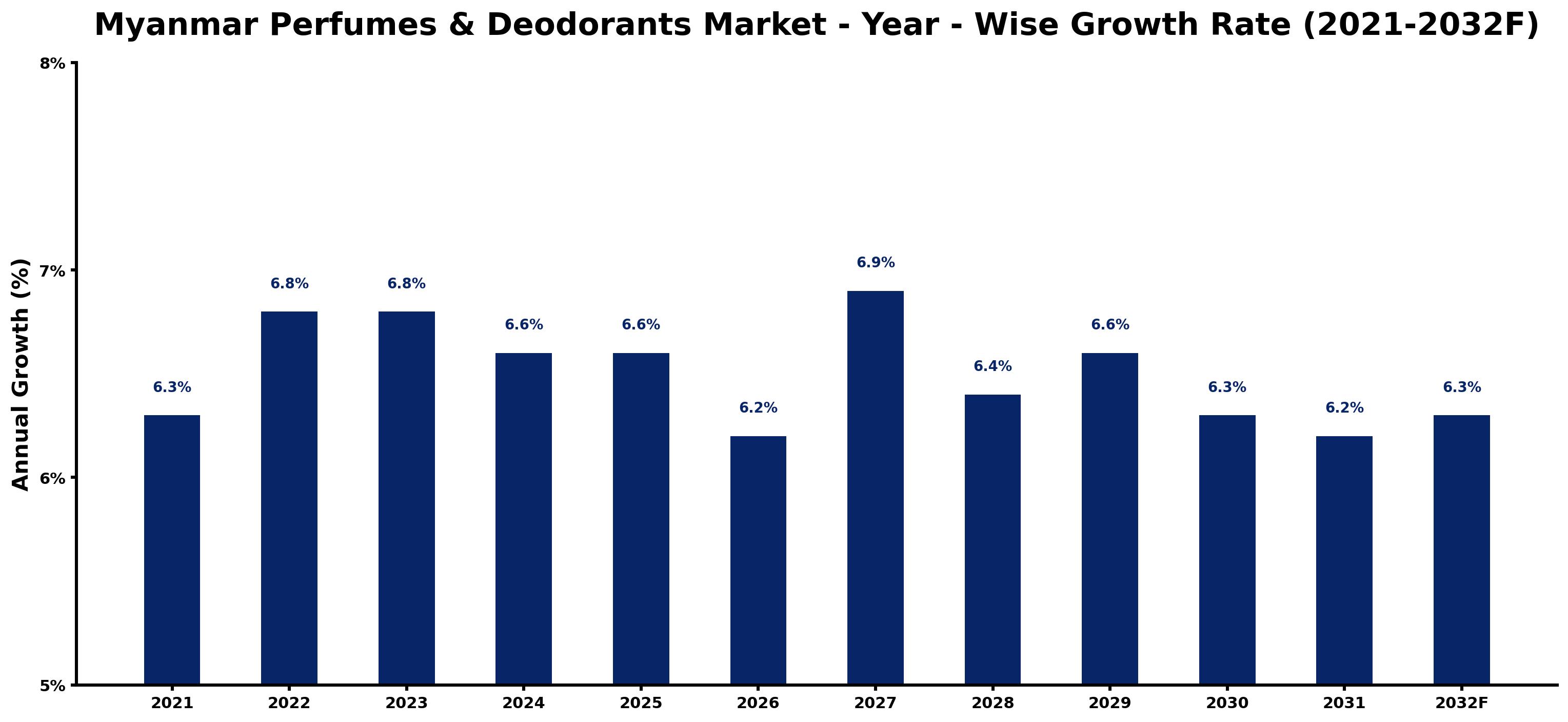
The table below presents the year wise growth rates along with the key drivers influencing the market
| Year | Growth Rate | Major Drivers |
| 2021 | 6.3% | Emerging middle class in Myanmar increasingly prioritizes personal grooming and self-care. |
| 2022 | 6.8% | Brand awareness campaigns highlight the unique scent profiles of local and international products. |
| 2023 | 6.8% | Retail sector recovery post-COVID-19 opens new channels for perfume and deodorant sales. |
| 2024 | 6.6% | Urbanization trends lead to higher demand for personal fragrances in metropolitan areas. |
| 2025 | 6.6% | Social media influencers trend perfumes, creating buzz among the younger demographic. |
| 2026 | 6.2% | Local manufacturers focus on sustainable sourcing to attract environmentally conscious consumers. |
| 2027 | 6.9% | E-commerce platforms expand, enabling easier access to diverse fragrance options for consumers. |
| 2028 | 6.4% | Rising disposable incomes result in increased spending on premium fragrance brands. |
| 2029 | 6.6% | Cultural festivities promote the gifting of perfumes, strengthening seasonal sales cycles. |
| 2030 | 6.3% | Corporate gifting trends emerge, enhancing the market for premium and bespoke fragrances. |
| 2031 | 6.2% | Health consciousness drives interest in natural and organic deodorant alternatives. |
| 2032 | 6.3% | Increased competition encourages innovation, leading to unique product offerings and collaborations. |
Note - Market size estimations and growth projections presented in this report are based on 6Wresearch's advanced forecasting approach, validated with industry datasets as of June 2026.
Myanmar Perfumes & Deodorants Market Synopsis
The Myanmar Perfumes Deodorants Market is projected to reach 6.2% and witness significant growth during the forecast period (2026-2032). This growth can be attributed to several factors influencing consumer behavior, including increasing urbanization, rising disposable incomes, and a growing production capacity for fragrances locally. As the market evolves, consumers are becoming more acquainted with global fragrance trends, leading to an uptick in demand for various perfumes and deodorants.
Myanmar Perfumes & Deodorants Market Growth Drivers
The growth of the Myanmar Perfumes & Deodorants Market is underpinned by multiple drivers that are reshaping consumer preferences. One of the primary factors is the surge in urbanization across the country, which has led to a shift in lifestyle and shopping habits. Additionally, as disposable incomes rise, consumers are more willing to splurge on luxury items, including perfumes and deodorants, further propelling market growth.
- The increase in local production capabilities has made fragrances more accessible at competitive prices, catering to a wider demographic.
- Urban consumers are increasingly influenced by global beauty trends, leading to heightened interest in diverse fragrance offerings.
- Higher levels of consumer spending are facilitated by government initiatives promoting luxury goods, enhancing market opportunities.
- The expansion of e-commerce platforms has enabled easier access to a variety of products, driving sales across different regions within Myanmar.
- Marketing efforts and brand awareness campaigns are significantly impacting consumer preferences, particularly among younger demographics.
Myanmar Perfumes & Deodorants Market Trends and Opportunities
The Myanmar Perfumes & Deodorants Market is experiencing several emerging trends that present unique opportunities for growth. With a growing appreciation for personal grooming and fragrance, brands can tap into various product innovations.
- There is a marked increase in demand for natural and organic perfumes and deodorants, driven by health-conscious consumers seeking safer alternatives.
- The popularity of niche and artisanal fragrances is rising, as consumers seek unique scents that reflect their personal identities.
- Innovative marketing strategies leveraging social media are enhancing brand engagement and customer interaction, particularly among younger consumers.
- Seasonal fragrance launches and limited-edition collections are becoming prevalent, catering to consumers' desires for exclusivity.
- The integration of technology in retail experiences, such as virtual try-ons, is enhancing customer engagement and influencing purchasing decisions.
Myanmar Perfumes & Deodorants Market Challenges and Restraints
Despite the overall positive outlook, the Myanmar Perfumes & Deodorants Market faces certain challenges that may hinder growth. The competitive landscape features numerous local players offering low-cost alternatives, which can impact market share for premium brands.
- Rising raw material costs, linked to economic instability, pose a significant challenge to manufacturers attempting to maintain profitability.
- The presence of counterfeit products in the market undermines consumer trust and can lead to brand dilution for legitimate players.
- Weak distribution networks in certain regions continue to limit product availability, affecting market penetration efforts.
- Economic uncertainties may lead to fluctuations in consumer spending, impacting overall market demand.
- Regulatory hurdles and compliance related to imported goods can complicate market entry for foreign brands.
Myanmar Perfumes & Deodorants Market Government Investment and Initiatives
The government in Myanmar has recognized the potential of the perfumes and deodorants market, implementing various investment strategies and initiatives to bolster growth. One significant aspect is the provision of tax exemptions on select luxury goods, aimed at stimulating consumer spending in this sector.
In addition, infrastructure improvements are being prioritized to enhance distribution channels, ensuring that products reach consumers more efficiently. The government is also exploring partnerships with private enterprises to foster innovation and development within the beauty and personal care segments, including fragrances. Efforts to promote local production are being emphasized to reduce dependency on imports, thereby aiming to boost the domestic economy.
Myanmar Perfumes & Deodorants Market Latest Developments (May 2025 - June 2026)
Recent months have seen significant developments in the Myanmar Perfumes & Deodorants Market, reflecting the sector's dynamism. Increased competition among both international and local brands has led to a flurry of new product launches, with many brands seeking to establish themselves in the growing e-commerce landscape.
Additionally, consumer preferences have shifted towards more sustainable and eco-friendly offerings, prompting brands to reformulate products accordingly. Marketing campaigns focusing on local culture and artistry have gained traction, resonating particularly with younger audiences seeking authenticity. The government's continued support for the beauty industry, alongside investments in retail infrastructure, is expected to further drive market momentum.
Myanmar Perfumes & Deodorants Market - Key Attractiveness of the Report
- 10 Years of Market Numbers
- Historical Data Starting from 2022 to 2025
- Base Year: 2025
- Forecast Data until 2032
- Key Performance Indicators Impacting the Market
- Major Upcoming Developments and Projects
Key Highlights of the Report:
- Myanmar Perfumes & Deodorants Market Outlook
- Market Size of Myanmar Perfumes & Deodorants Market, 2025
- Forecast of Myanmar Perfumes & Deodorants Market, 2032F
- Historical Data and Forecast of Myanmar Perfumes & Deodorants Revenues & Volume for the Period 2022-2032F
- Myanmar Perfumes & Deodorants Market Trend Evolution
- Myanmar Perfumes & Deodorants Market Drivers and Challenges
- Myanmar Perfumes & Deodorants Price Trends
- Myanmar Perfumes & Deodorants Porter's Five Forces
- Myanmar Perfumes & Deodorants Industry Life Cycle
- Historical Data and Forecast of Myanmar Perfumes & Deodorants Market Revenues & Volume By Product Types for the Period 2022-2032F
- Historical Data and Forecast of Myanmar Perfumes & Deodorants Market Revenues & Volume By Deodorants for the Period 2022-2032F
- Historical Data and Forecast of Myanmar Perfumes & Deodorants Market Revenues & Volume By Perfumes for the Period 2022-2032F
- Historical Data and Forecast of Myanmar Perfumes & Deodorants Market Revenues & Volume By Consumer Group for the Period 2022-2032F
- Historical Data and Forecast of Myanmar Perfumes & Deodorants Market Revenues & Volume By Men for the Period 2022-2032F
- Historical Data and Forecast of Myanmar Perfumes & Deodorants Market Revenues & Volume By Women for the Period 2022-2032F
- Historical Data and Forecast of Myanmar Perfumes & Deodorants Market Revenues & Volume By Unisex for the Period 2022-2032F
- Historical Data and Forecast of Myanmar Perfumes & Deodorants Market Revenues & Volume By Distribution Channel for the Period 2022-2032F
- Historical Data and Forecast of Myanmar Perfumes & Deodorants Market Revenues & Volume By Online for the Period 2022-2032F
- Historical Data and Forecast of Myanmar Perfumes & Deodorants Market Revenues & Volume By Offline for the Period 2022-2032F
- Historical Data and Forecast of Myanmar Perfumes & Deodorants Market Revenues & Volume By Price Segment for the Period 2022-2032F
- Historical Data and Forecast of Myanmar Perfumes & Deodorants Market Revenues & Volume By Premium for the Period 2022-2032F
- Historical Data and Forecast of Myanmar Perfumes & Deodorants Market Revenues & Volume By Mass for the Period 2022-2032F
- Myanmar Perfumes & Deodorants Import Export Trade Statistics
- Market Opportunity Assessment By Product Types
- Market Opportunity Assessment By Consumer Group
- Market Opportunity Assessment By Distribution Channel
- Market Opportunity Assessment By Price Segment
- Myanmar Perfumes & Deodorants Top Companies Market Share
- Myanmar Perfumes & Deodorants Competitive Benchmarking By Technical and Operational Parameters
- Myanmar Perfumes & Deodorants Company Profiles
- Myanmar Perfumes & Deodorants Key Strategic Recommendations






































