Myanmar Ploughing and Cultivating Machinery Market Size, Share & Growth Rate
The Myanmar Ploughing and Cultivating Machinery Market was estimated at USD 347 Million in 2025 and is projected to reach USD 485 Million by 2032, growing at a CAGR of 4.9% from 2026 to 2032. This robust growth trajectory is fueled by the increasing mechanization of farming practices as more farmers realize the efficiency benefits that modern machinery can bring. Government initiatives aimed at promoting sustainable agricultural practices further enhance this demand, creating a dynamic environment for manufacturers and suppliers in the market.
Myanmar Ploughing and Cultivating Machinery Market Year-wise Growth Rate and Key Drivers
This graph highlights how the Myanmar Ploughing and Cultivating Machinery Market has steadily grown over the years, supported by major growth factors.
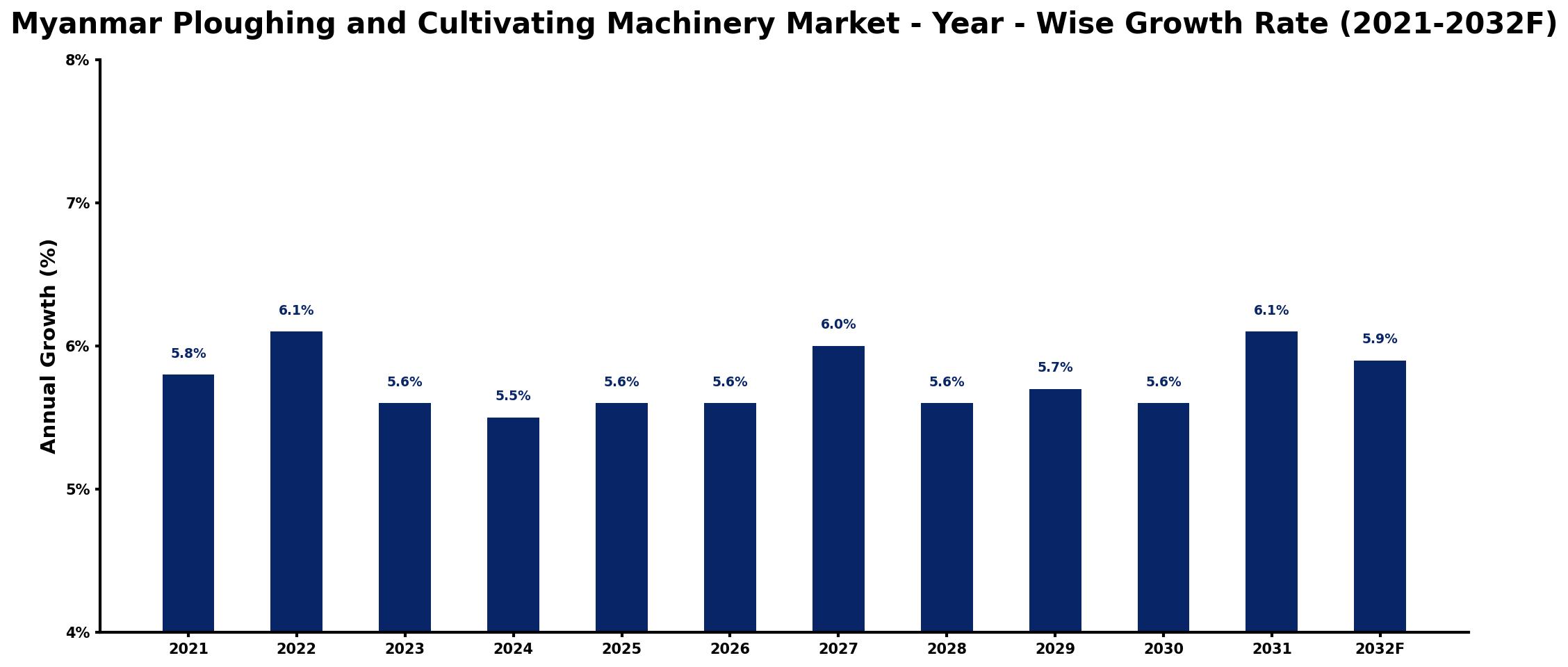
The table below presents the year‑wise growth rates along with the key drivers influencing the market
| Year | Growth Rate | Major Drivers |
| 2021 | 5.8% | Rising demand for agricultural technology |
| 2022 | 6.1% | Increase in rural investment programs |
| 2023 | 5.6% | Growing export opportunities for farmers |
| 2024 | 5.5% | Expansion of irrigation infrastructure projects |
| 2025 | 5.6% | Enhanced access to financing options |
| 2026 | 5.6% | Development of sustainable farming practices |
| 2027 | 6.0% | Government support for modern agriculture |
| 2028 | 5.6% | improved processing technologies adoption |
| 2029 | 5.7% | Growth in cooperative farming models |
| 2030 | 5.6% | Technological advancements in farming techniques |
| 2031 | 6.1% | strengthening international trade flows |
| 2032 | 5.9% | strengthening underlying market demand |
Note: Market size estimations and growth projections presented in this report are based on 6Wresearch's proprietary forecasting methodology, utilizing the latest available industry data, government publications, and primary research inputs.
Myanmar Ploughing and Cultivating Machinery Market Synopsis
In Myanmar, the demand for ploughing and cultivating machinery is increasingly shaped by the transition from traditional farming methods to more efficient mechanized solutions. The introduction of advanced technologies tailored to the local agricultural context is fostering improved productivity and yields, a necessity in a country where agriculture remains a cornerstone of the economy.
As the government champions agricultural modernization, the rise in awareness among farmers about the advantages of mechanization plays a crucial role in driving market expansion. This aligns with broader economic objectives, as the need to enhance food security becomes paramount amidst a rapidly growing population.
Myanmar Ploughing and Cultivating Machinery Market Key Takeaways
- The market is transitioning towards greater mechanization, with increasing adoption of advanced machinery.
- Government policies actively promote agricultural modernization and mechanization among farmers.
- Access to financing options is pivotal in facilitating the acquisition of modern agricultural equipment.
- Growing awareness of the efficiency and productivity benefits of mechanized farming is reshaping farmer behaviors.
- Investment opportunities exist for both domestic and international players looking to engage in local agricultural markets.
Evaluation of Restraints in Myanmar Ploughing and Cultivating Machinery Market
Despite the promising growth prospects, the Myanmar Ploughing and Cultivating Machinery Market is hindered by several real constraints. Limited financial accessibility, particularly for small-scale farmers, restricts their ability to invest in modern equipment. Inadequate infrastructure in rural areas further complicates the distribution and maintenance of machinery, while insufficient training and awareness among farmers slow down the transition to advanced farming methods. Together, these factors challenge the market's potential and highlight the necessity for targeted solutions.
Myanmar Ploughing and Cultivating Machinery Market Trends
Current trends indicate a significant shift towards precision farming techniques, driven by the demand for increased productivity and efficiency. Farmers are increasingly opting for sophisticated machinery that incorporates innovative technologies, enhancing their ability to manage crops more effectively. The rental market for farming equipment is also gaining traction, allowing farmers who cannot afford outright purchases to access modern machinery, thereby democratizing agricultural advancement across different economic strata.
Myanmar Ploughing and Cultivating Machinery Market Opportunities
Opportunities for investment in the Myanmar Ploughing and Cultivating Machinery Market abound, particularly as the government prioritizes agricultural modernization. Manufacturers can look to supply advanced ploughing and cultivating equipment tailored for local conditions. Additionally, establishing partnerships with local firms could enhance production capabilities while fostering technology transfer. This landscape offers a unique chance for growth, promising not just financial returns but also contributions to the broader development of Myanmar's agricultural sector.
Government Initiatives in the Myanmar Ploughing and Cultivating Machinery Market
The Myanmar government is actively pursuing policies to promote agricultural mechanization, recognizing its critical role in improving productivity. Various initiatives, including subsidies and incentives, have been established to encourage farmers to adopt modern machinery. Furthermore, regulations are in place to ensure the safety and quality of agricultural equipment. The government is also fostering collaborations with foreign entities to facilitate technology transfer, ultimately aiming to enhance the local manufacturing capabilities within this vital sector.
Future Insights of the Myanmar Ploughing and Cultivating Machinery Market
Looking ahead to 2026-2032, the Myanmar Ploughing and Cultivating Machinery Market is poised for substantial growth. Factors driving this include an increasing need for higher productivity levels and improved farm efficiencies, alongside the resolution of labor shortages through mechanization. As financing options improve and awareness of advanced equipment rises, the market is likely to overcome current barriers and expand. The trajectory suggests a robust future, anchored in both government support and evolving farmer needs.
Myanmar Ploughing and Cultivating Machinery Market Latest Developments (2025 - 2026)
Recent developments in the Myanmar Ploughing and Cultivating Machinery Market have seen a growing influx of innovative technologies aimed at enhancing agricultural efficiency. New partnerships have emerged between local manufacturers and international firms, fostering greater access to advanced machinery. Additionally, initiatives focusing on training and education for farmers regarding the benefits and usage of modern equipment have started to gain momentum, marking a significant step toward overcoming existing challenges in the market.
Myanmar Ploughing and Cultivating Machinery Market - Key Attractiveness of the Report
- 10 Years of Market Numbers
- Historical Data Starting from 2022 to 2025
- Base Year: 2025
- Forecast Data until 2032
- Key Performance Indicators Impacting the Market
- Major Upcoming Developments and Projects
Key Highlights of the Report:
- Myanmar Ploughing and Cultivating Machinery Market Outlook
- Market Size of Myanmar Ploughing and Cultivating Machinery Market, 2025
- Forecast of Myanmar Ploughing and Cultivating Machinery Market, 2032
- Historical Data and Forecast of Myanmar Ploughing and Cultivating Machinery Revenues & Volume for the Period 2022-2032F
- Myanmar Ploughing and Cultivating Machinery Market Trend Evolution
- Myanmar Ploughing and Cultivating Machinery Market Drivers and Challenges
- Myanmar Ploughing and Cultivating Machinery Price Trends
- Myanmar Ploughing and Cultivating Machinery Porter's Five Forces
- Myanmar Ploughing and Cultivating Machinery Industry Life Cycle
- Historical Data and Forecast of Myanmar Ploughing and Cultivating Machinery Market Revenues & Volume By Type for the Period 2022-2032F
- Historical Data and Forecast of Myanmar Ploughing and Cultivating Machinery Market Revenues & Volume By Ploughs for the Period 2022-2032F
- Historical Data and Forecast of Myanmar Ploughing and Cultivating Machinery Market Revenues & Volume By Harrows for the Period 2022-2032F
- Historical Data and Forecast of Myanmar Ploughing and Cultivating Machinery Market Revenues & Volume By Others for the Period 2022-2032F
- Historical Data and Forecast of Myanmar Ploughing and Cultivating Machinery Market Revenues & Volume By Application for the Period 2022-2032F
- Historical Data and Forecast of Myanmar Ploughing and Cultivating Machinery Market Revenues & Volume By Soil Loosening for the Period 2022-2032F
- Historical Data and Forecast of Myanmar Ploughing and Cultivating Machinery Market Revenues & Volume By Clod Size Reduction for the Period 2022-2032F
- Historical Data and Forecast of Myanmar Ploughing and Cultivating Machinery Market Revenues & Volume By Clod Sorting for the Period 2022-2032F
- Historical Data and Forecast of Myanmar Ploughing and Cultivating Machinery Market Revenues & Volume By Others for the Period 2022-2032F
- Myanmar Ploughing and Cultivating Machinery Import Export Trade Statistics
- Market Opportunity Assessment By Type
- Market Opportunity Assessment By Application
- Myanmar Ploughing and Cultivating Machinery Top Companies Market Share
- Myanmar Ploughing and Cultivating Machinery Competitive Benchmarking By Technical and Operational Parameters
- Myanmar Ploughing and Cultivating Machinery Company Profiles
- Myanmar Ploughing and Cultivating Machinery Key Strategic Recommendations






































