Myanmar Polyester Fabric Market Summary
The myanmar polyester fabric market was estimated at USD 419 Million in 2025 and is projected to reach USD 593 Million by 2032, growing at a CAGR of 5.8% from 2026 to 2032.
Myanmar Polyester Fabric Market Year-wise Growth Rate and Key Drivers
This graph highlights how the Myanmar Polyester Fabric Market has steadily grown over the past five years, supported by major growth factors.
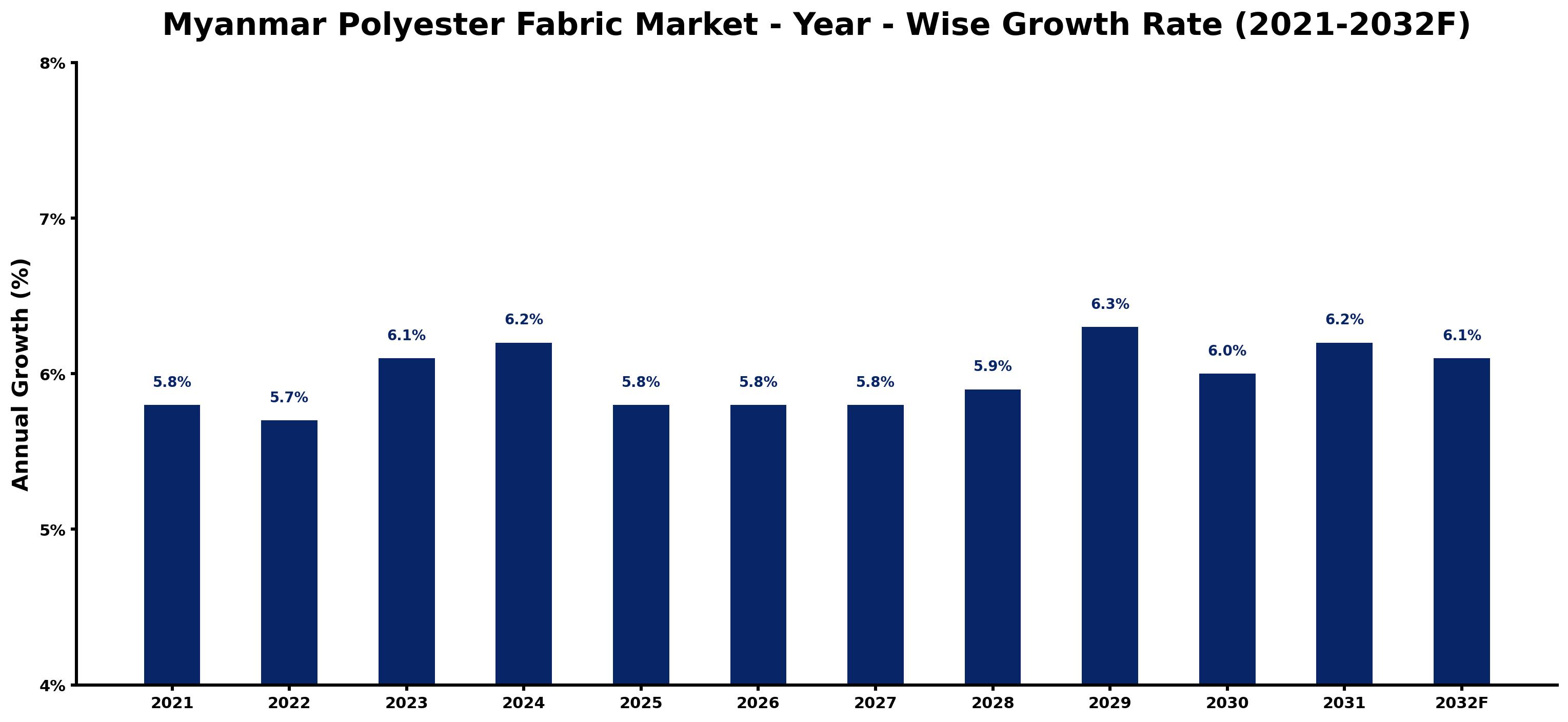
The table below presents the year wise growth rates along with the key drivers influencing the market
| Year | Growth Rate | Major Drivers |
| 2021 | 5.8% | Post-coup political stability leads to renewed industrial investments in textile manufacturing. |
| 2022 | 5.7% | Local garment production significantly increases, boosting demand for polyester fabric supplies. |
| 2023 | 6.1% | E-commerce platforms expand, driving online retail of polyester-based apparel and textiles. |
| 2024 | 6.2% | Regional supply chain diversifications enhance accessibility to polyester fabric resources. |
| 2025 | 5.8% | Sustainable fashion trends emerge, encouraging innovations in eco-friendly polyester production. |
| 2026 | 5.8% | International brands increasingly enter Myanmar, amplifying competition for polyester fabric producers. |
| 2027 | 5.8% | Infrastructure improvements facilitate quicker distribution channels for textile manufacturers. |
| 2028 | 5.9% | Consumer preference shifts towards affordable polyester blends, influencing production strategies. |
| 2029 | 6.3% | Growing urbanization leads to a heightened demand for versatile fashion textiles. |
| 2030 | 6.0% | Investments in technology streamline polyester production processes, reducing operational costs. |
| 2031 | 6.2% | Collaborations between local designers and fabric producers foster unique polyester collections. |
| 2032 | 6.1% | Global fashion trends pivot towards seasonal collections, elevating polyester textile demand. |
Note - Market size estimations and growth projections presented in this report are based on 6Wresearch's advanced forecasting approach, validated with industry datasets as of June 2026.
Myanmar Polyester Fabric Market Synopsis
The Myanmar Polyester Fabric Market is projected to reach 5.8% and witness significant growth during the forecast period (2026-2032). This growth is primarily driven by the increasing demand for textile products such as apparel, upholstery, linens, and other home furnishings. The sector has seen a rise in local manufacturing, with many small-scale factories engaging in the production of polyester fabrics for both domestic consumption and export purposes. Moreover, the favorable investment climate, accentuated by various government initiatives, is expected to facilitate continuous expansion in the market.
Myanmar Polyester Fabric Market Growth Drivers
The Myanmar Polyester Fabric Market is experiencing an upward trajectory, with several key drivers fueling its growth. Firstly, the burgeoning local manufacturing industry is enhancing the supply of polyester fabrics, catering to both local and international markets. Secondly, rising disposable incomes among consumers are leading to increased spending on textile products, thereby driving demand. Thirdly, the growing population and urbanization trends are generating a higher need for home furnishings and clothing, further propelling market expansion.
- Investment in modern manufacturing technologies is improving production efficiency and output quality.
- The increasing popularity of polyester due to its durability, affordability, and versatility is enhancing its adoption across various applications.
- Government support in the form of tax incentives and subsidies is nurturing the growth of local textile enterprises.
- Growing export opportunities for polyester fabrics are encouraging local manufacturers to scale their operations.
- Partnerships and collaborations between local manufacturers and foreign entities are facilitating the transfer of technology and know-how.
Myanmar Polyester Fabric Market Trends and Opportunities
As the Myanmar Polyester Fabric Market evolves, several trends are shaping its landscape. There is a noticeable shift towards sustainable and eco-friendly production practices, driven by increasing global consciousness regarding environmental issues. This trend presents opportunities for manufacturers to innovate and differentiate their offerings. Additionally, the rise of e-commerce is transforming how consumers purchase textile products, creating a new channel for market growth.
- The trend towards customization is gaining momentum, with consumers seeking unique and personalized fabric designs.
- Technological advancements in textile printing and finishing are allowing for more intricate designs and higher-quality outputs.
- Growing interest in athleisure and performance fabrics is expanding the application range of polyester materials.
- The shift towards online retailing is compelling manufacturers to enhance their digital presence and logistics capabilities.
- Collaborations with fashion designers and brands are opening new avenues for innovative textile applications.
Myanmar Polyester Fabric Market Challenges and Restraints
While the Myanmar Polyester Fabric Market presents substantial growth potential, it is not without challenges. One significant constraint is the volatility of raw material prices, which can impact production costs and profitability for manufacturers. Additionally, competition from alternative fabric types may pose a risk to polyester's market share. Labor-related issues, such as workers' rights and skills shortages, can also hinder operational efficiency in the textile sector.
- The fluctuating supply chain dynamics can lead to uncertainty in material availability, affecting production schedules.
- Regulatory hurdles and compliance requirements may pose challenges for local manufacturers, impacting their ability to expand operations.
- Consumer preferences may shift towards more sustainable options, questioning the long-term viability of traditional polyester products.
- Limited access to advanced technology and resources among smaller manufacturers could restrict growth potential.
- Economic fluctuations within Myanmar may render investment in the sector less stable, affecting future opportunities.
Myanmar Polyester Fabric Market Government Investment and Initiatives
The government of Myanmar has recognized the importance of the textile sector, particularly the polyester fabric market, as a crucial driver of economic growth. Various initiatives aimed at enhancing investment within the industry include tax breaks for new textile businesses and subsidies on raw materials, allowing manufacturers to reduce production costs. Furthermore, the government is focusing on developing infrastructure that supports the textile industry, including better access to trade routes and logistics. In addition, initiatives to foster skills development among the workforce are vital for ensuring that local labor is equipped to meet the demands of an evolving market landscape.
Myanmar Polyester Fabric Market Latest Developments (May 2025 - June 2026)
In the period from May 2025 to June 2026, the Myanmar Polyester Fabric Market has seen noteworthy developments. There has been an uptick in investments from foreign firms seeking to establish production facilities in Myanmar, reflecting the increasing attractiveness of the local market. Additionally, a number of local manufacturers have announced plans to expand their operations, focusing on capacity upgrades and advanced manufacturing technologies. Innovations in sustainable production practices are becoming more pronounced, with several companies introducing eco-friendly polyester fabric lines to cater to changing consumer preferences.
Myanmar Polyester Fabric Market - Key Attractiveness of the Report
- 10 Years of Market Numbers
- Historical Data Starting from 2022 to 2025
- Base Year: 2025
- Forecast Data until 2032
- Key Performance Indicators Impacting the Market
- Major Upcoming Developments and Projects
Key Highlights of the Report:
- Myanmar Polyester Fabric Market Outlook
- Market Size of Myanmar Polyester Fabric Market, 2025
- Forecast of Myanmar Polyester Fabric Market, 2032F
- Historical Data and Forecast of Myanmar Polyester Fabric Revenues & Volume for the Period 2022-2032F
- Myanmar Polyester Fabric Market Trend Evolution
- Myanmar Polyester Fabric Market Drivers and Challenges
- Myanmar Polyester Fabric Price Trends
- Myanmar Polyester Fabric Porter's Five Forces
- Myanmar Polyester Fabric Industry Life Cycle
- Historical Data and Forecast of Myanmar Polyester Fabric Market Revenues & Volume By Type for the Period 2022-2032F
- Historical Data and Forecast of Myanmar Polyester Fabric Market Revenues & Volume By PET for the Period 2022-2032F
- Historical Data and Forecast of Myanmar Polyester Fabric Market Revenues & Volume By PCDT for the Period 2022-2032F
- Historical Data and Forecast of Myanmar Polyester Fabric Market Revenues & Volume By Applications for the Period 2022-2032F
- Historical Data and Forecast of Myanmar Polyester Fabric Market Revenues & Volume By Carpets & Rugs for the Period 2022-2032F
- Historical Data and Forecast of Myanmar Polyester Fabric Market Revenues & Volume By Non-Woven Fabrics Fiberfill for the Period 2022-2032F
- Historical Data and Forecast of Myanmar Polyester Fabric Market Revenues & Volume By Apparels for the Period 2022-2032F
- Historical Data and Forecast of Myanmar Polyester Fabric Market Revenues & Volume By Home Textiles for the Period 2022-2032F
- Historical Data and Forecast of Myanmar Polyester Fabric Market Revenues & Volume By Others? for the Period 2022-2032F
- Myanmar Polyester Fabric Import Export Trade Statistics
- Market Opportunity Assessment By Type
- Market Opportunity Assessment By Applications
- Myanmar Polyester Fabric Top Companies Market Share
- Myanmar Polyester Fabric Competitive Benchmarking By Technical and Operational Parameters
- Myanmar Polyester Fabric Company Profiles
- Myanmar Polyester Fabric Key Strategic Recommendations






































