Myanmar Quartz Market Size Growth Rate
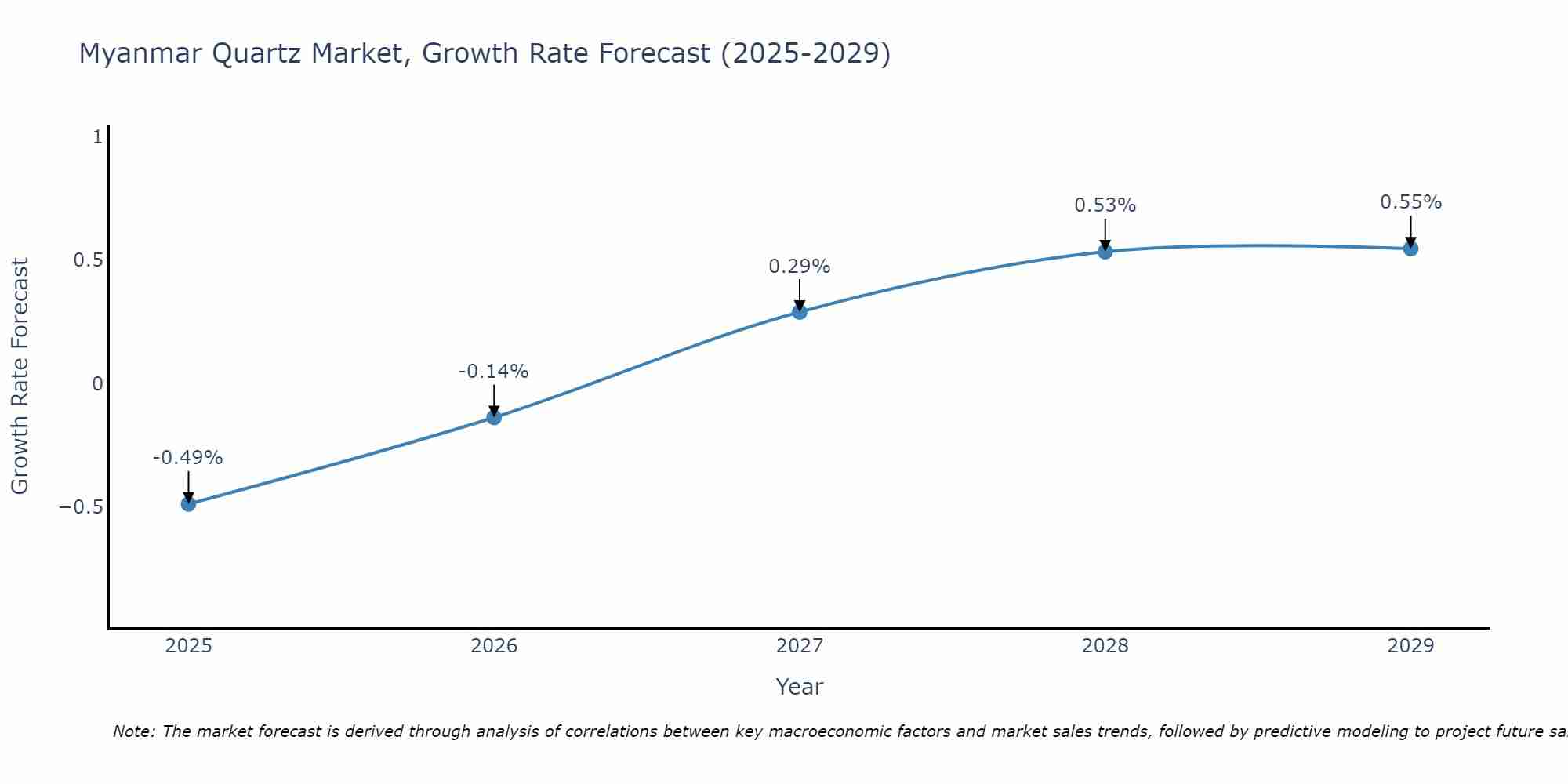
The Myanmar Quartz Market is likely to experience consistent growth rate gains over the period 2025 to 2029. The growth rate starts at -0.49% in 2025 and reaches 0.55% by 2029.
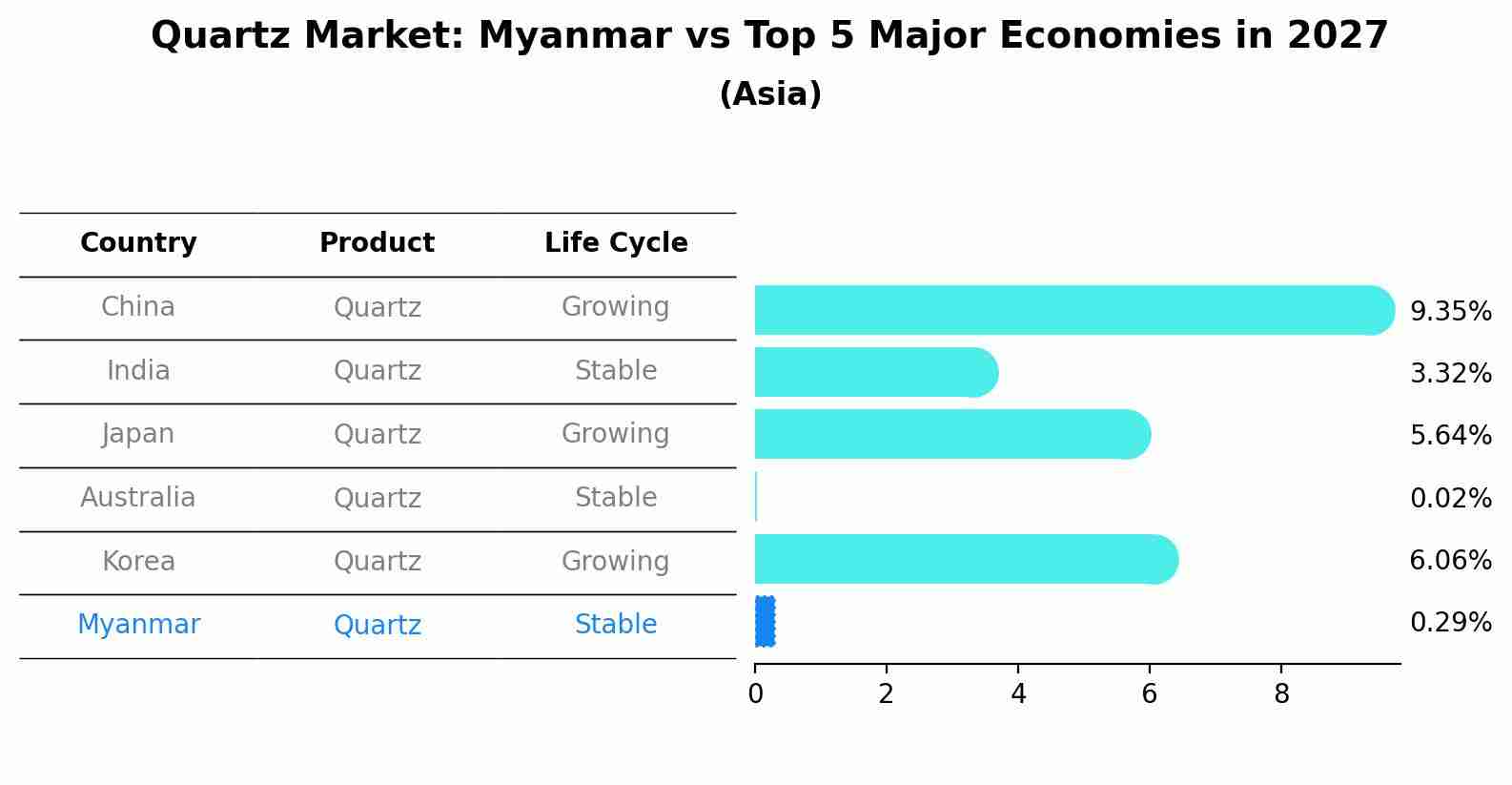
Quartz Market: Myanmar vs Top 5 Major Economies in 2027 (Asia)
The Quartz market in Myanmar is projected to grow at a stable growth rate of 0.29% by 2027, highlighting the country's increasing focus on advanced technologies within the Asia region, where China holds the dominant position, followed closely by India, Japan, Australia and South Korea, shaping overall regional demand.
myanmar quartz market Synopsis
The quartz market in Myanmar is expected to witness a CAGR of 6.1% during the forecast period (2020-2026). Increasing demand for quartz products from various end-user industries such as electronics, automotive, and construction are driving the growth of this market. Furthermore, rising investments in infrastructure development and increasing urbanization will propel the growth of this industry further over the coming years. Additionally, government initiatives worldwide to reduce environmental impacts by using sustainable materials has led to increased focus on natural resources like quartz which will drive its usage across multiple industries drastically.
Key Highlights of the Report:
- Myanmar Quartz Market Outlook
- Market Size of Myanmar Quartz Market, 2019
- Forecast of Myanmar Quartz Market, 2026
- Historical Data and Forecast of Myanmar Quartz Revenues & Volume for the Period 2016 - 2026
- Myanmar Quartz Market Trend Evolution
- Myanmar Quartz Market Drivers and Challenges
- Myanmar Quartz Price Trends
- Myanmar Quartz Porter's Five Forces
- Myanmar Quartz Industry Life Cycle
- Historical Data and Forecast of Myanmar Quartz Market Revenues & Volume By Product Type for the Period 2016 - 2026
- Historical Data and Forecast of Myanmar Quartz Market Revenues & Volume By Quartz Surface and Tile for the Period 2016 - 2026
- Historical Data and Forecast of Myanmar Quartz Market Revenues & Volume By High-purity Quartz for the Period 2016 - 2026
- Historical Data and Forecast of Myanmar Quartz Market Revenues & Volume By Quartz Glass for the Period 2016 - 2026
- Historical Data and Forecast of Myanmar Quartz Market Revenues & Volume By Quartz Crystal for the Period 2016 - 2026
- Historical Data and Forecast of Myanmar Quartz Market Revenues & Volume By Quartz Sand for the Period 2016 - 2026
- Historical Data and Forecast of Myanmar Quartz Market Revenues & Volume By Others for the Period 2016 - 2026
- Historical Data and Forecast of Myanmar Quartz Market Revenues & Volume By End-users for the Period 2016 - 2026
- Historical Data and Forecast of Myanmar Quartz Market Revenues & Volume By Electronics and Semiconductor for the Period 2016 - 2026
- Historical Data and Forecast of Myanmar Quartz Market Revenues & Volume By Solar for the Period 2016 - 2026
- Historical Data and Forecast of Myanmar Quartz Market Revenues & Volume By Buildings and Construction for the Period 2016 - 2026
- Historical Data and Forecast of Myanmar Quartz Market Revenues & Volume By Medical for the Period 2016 - 2026
- Historical Data and Forecast of Myanmar Quartz Market Revenues & Volume By Optics and Telecommunication for the Period 2016 - 2026
- Historical Data and Forecast of Myanmar Quartz Market Revenues & Volume By Other for the Period 2016 - 2026
- Myanmar Quartz Import Export Trade Statistics
- Market Opportunity Assessment By Product Type
- Market Opportunity Assessment By End-users
- Myanmar Quartz Top Companies Market Share
- Myanmar Quartz Competitive Benchmarking By Technical and Operational Parameters
- Myanmar Quartz Company Profiles
- Myanmar Quartz Key Strategic Recommendations






































