Myanmar Recycled Plastics Market Size, Share & Growth Rate
The Myanmar Recycled Plastics Market was estimated at USD 211 Million in 2025 and is projected to reach USD 293 Million by 2032, growing at a CAGR of 4.8% from 2026 to 2032. This growth trajectory is primarily fueled by an escalating awareness of environmental sustainability among consumers and businesses alike, coupled with government initiatives that encourage recycling and the adoption of eco-friendly practices. The increasing demand for recycled plastics in sectors like packaging, construction, and automotive further enhances the market's expansion potential.
Myanmar Recycled Plastics Market Year-wise Growth Rate and Key Drivers
This graph highlights how the Myanmar Recycled Plastics Market has steadily grown over the years, supported by major growth factors.
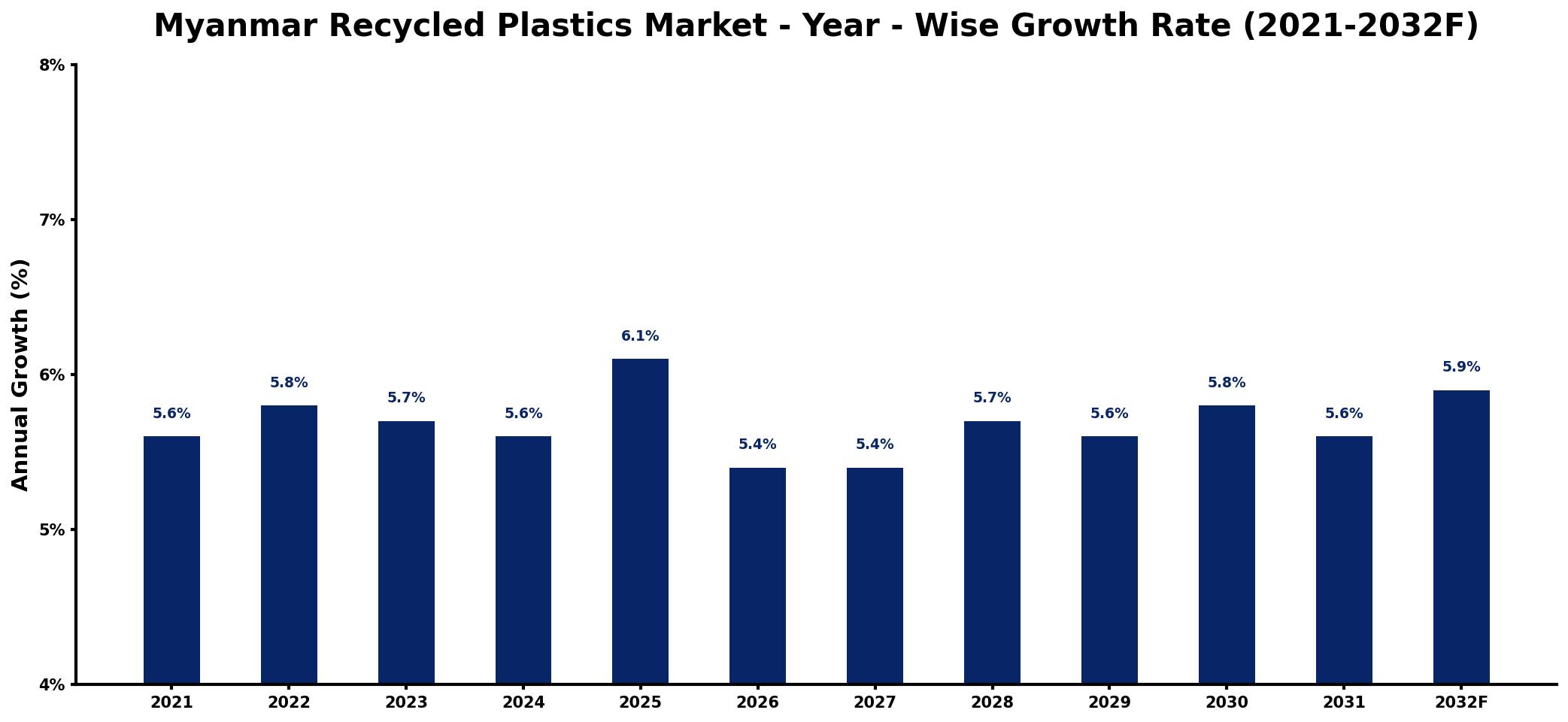
The table below presents the year‑wise growth rates along with the key drivers influencing the market
| Year | Growth Rate | Major Drivers |
| 2021 | 5.6% | Increased consumer awareness initiatives |
| 2022 | 5.8% | Government policies promoting sustainability |
| 2023 | 5.7% | Rising demand from packaging sector |
| 2024 | 5.6% | Expansion of collection networks |
| 2025 | 6.1% | Growing investment in processing facilities |
| 2026 | 5.4% | Emerging markets adopting alternatives |
| 2027 | 5.4% | Strong collaborations between industries |
| 2028 | 5.7% | Enhanced recycling technologies development |
| 2029 | 5.6% | Higher corporate responsibility standards |
| 2030 | 5.8% | Increased export opportunities emerging |
| 2031 | 5.6% | Strengthened community recycling programs |
| 2032 | 5.9% | Advancements in waste management systems |
Note: Market size estimations and growth projections presented in this report are based on 6Wresearch's proprietary forecasting methodology, utilizing the latest available industry data, government publications, and primary research inputs.
Myanmar Recycled Plastics Market Synopsis
The Myanmar recycled plastics market is witnessing a pivotal transformation, driven by rising environmental concerns and a push for sustainable practices. Recent government policies have catalyzed the adoption of recycling initiatives, signaling a shift in how waste is managed in the country.
Despite its promising prospects, the market faces considerable challenges. The informal nature of recycling operations and a lack of robust infrastructure hinder optimal efficiency, making it essential for stakeholders to develop innovative solutions to overcome these hurdles.
Myanmar Recycled Plastics Market Key Takeaways
- Demand for recycled plastics is on the rise, particularly in packaging, automotive, and construction industries.
- Government policies promoting recycling and sustainability are shaping market dynamics and investment opportunities.
- Investment in advanced recycling technologies is critical to improving the quality of recycled products.
- The market is hindered by inadequate waste management systems and limited technological capabilities.
- Collaboration among stakeholders will be essential to address challenges and foster market growth.
Evaluation of Restraints in Myanmar Recycled Plastics Market
The Myanmar Recycled Plastics Market is grappling with several constraints that undermine its potential. One of the most significant barriers is the limited collection and sorting infrastructure, which hampers the efficiency of recycling operations. The informal recycling sector further complicates this issue, often leading to inconsistent quality and inefficiencies in the supply chain. Furthermore, the lack of public awareness and financial incentives for recycling contributes to low participation rates. Coupled with an abundance of inexpensive virgin plastics, these factors challenge the competitiveness of recycled products in the marketplace.
Myanmar Recycled Plastics Market Trends
Several noteworthy trends are shaping the Myanmar recycled plastics market. The increasing demand for sustainable packaging solutions reflects a global shift toward environmental consciousness, prompting businesses to seek recycled alternatives. Additionally, technological advancements in recycling processes are enhancing the quality and performance of recycled materials, making them more appealing to manufacturers. Theres also a notable emphasis on developing collection and recycling infrastructure, which is vital for meeting the growing demand for recycled products. These trends are poised to accelerate market growth as industries adapt to evolving consumer preferences.
Myanmar Recycled Plastics Market Opportunities
The Myanmar recycled plastics market presents several exciting investment opportunities for stakeholders. With the government implementing bans on single-use plastics and promoting recycling programs, there is an undeniable demand for recycled plastics across various sectors. Investors can explore the establishment of recycling facilities or forge partnerships with local collectors and processors to streamline operations. Furthermore, advancements in recycling technologies offer avenues for enhancing processing efficiency and product quality. The potential for exporting recycled plastics to neighboring countries further enhances the market's attractiveness.
Government Initiatives in the Myanmar Recycled Plastics Market
The government of Myanmar has taken proactive steps to foster a sustainable recycled plastics market. Initiatives include the promotion of comprehensive recycling programs and the introduction of regulatory frameworks aimed at managing plastic waste. The ban on single-use plastics is a cornerstone of this strategy, driving businesses and consumers toward sustainable alternatives. Additionally, the government provides tax breaks and incentives for enterprises that utilize recycled materials in their products, thereby encouraging a shift toward environmentally friendly practices.
Future Insights of the Myanmar Recycled Plastics Market
Looking ahead to 2026-2032, the Myanmar recycled plastics market appears poised for substantial growth, driven by an increasing emphasis on sustainability and government support for recycling initiatives. As industries adopt stricter regulations and commit to reducing plastic waste, the demand for recycled plastics will likely surge. However, significant investments in waste management infrastructure and technological innovations will be crucial for overcoming existing challenges. If executed effectively, these efforts will propel the market into a new era of growth, fundamentally transforming how plastics are perceived and utilized.
Myanmar Recycled Plastics Market Latest Developments (2025 - 2026)
Recent developments in the Myanmar recycled plastics market indicate a significant pivot toward sustainability, driven by both public and private sector initiatives. Stakeholders are actively investing in new recycling technologies that promise to improve the efficiency and effectiveness of plastic waste management. Additionally, collaborative efforts among businesses are emerging, with a focus on improving supply chain processes and addressing infrastructure limitations. Such developments signal a commitment to enhancing the overall capacity of the recycled plastics market in Myanmar.
Myanmar Recycled Plastics Market - Key Attractiveness of the Report
- 10 Years of Market Numbers
- Historical Data Starting from 2022 to 2025
- Base Year: 2025
- Forecast Data until 2032
- Key Performance Indicators Impacting the Market
- Major Upcoming Developments and Projects
Key Highlights of the Report:
- Myanmar Recycled Plastics Market Outlook
- Market Size of Myanmar Recycled Plastics Market, 2025
- Forecast of Myanmar Recycled Plastics Market, 2032
- Historical Data and Forecast of Myanmar Recycled Plastics Revenues & Volume for the Period 2022-2032F
- Myanmar Recycled Plastics Market Trend Evolution
- Myanmar Recycled Plastics Market Drivers and Challenges
- Myanmar Recycled Plastics Price Trends
- Myanmar Recycled Plastics Porter's Five Forces
- Myanmar Recycled Plastics Industry Life Cycle
- Historical Data and Forecast of Myanmar Recycled Plastics Market Revenues & Volume By Plastic Type for the Period 2022-2032F
- Historical Data and Forecast of Myanmar Recycled Plastics Market Revenues & Volume By Polyethylene Terephthalate (Pet) for the Period 2022-2032F
- Historical Data and Forecast of Myanmar Recycled Plastics Market Revenues & Volume By High Density Polyethylene (Hdpe) for the Period 2022-2032F
- Historical Data and Forecast of Myanmar Recycled Plastics Market Revenues & Volume By Polypropylene (Pp) for the Period 2022-2032F
- Historical Data and Forecast of Myanmar Recycled Plastics Market Revenues & Volume By Low Density Polyethylene (Ldpe) for the Period 2022-2032F
- Historical Data and Forecast of Myanmar Recycled Plastics Market Revenues & Volume By Others for the Period 2022-2032F
- Historical Data and Forecast of Myanmar Recycled Plastics Market Revenues & Volume By Application for the Period 2022-2032F
- Historical Data and Forecast of Myanmar Recycled Plastics Market Revenues & Volume By Non-food Contact Packaging for the Period 2022-2032F
- Historical Data and Forecast of Myanmar Recycled Plastics Market Revenues & Volume By Food Contact Packaging for the Period 2022-2032F
- Historical Data and Forecast of Myanmar Recycled Plastics Market Revenues & Volume By Construction for the Period 2022-2032F
- Historical Data and Forecast of Myanmar Recycled Plastics Market Revenues & Volume By Automotive for the Period 2022-2032F
- Historical Data and Forecast of Myanmar Recycled Plastics Market Revenues & Volume By Others for the Period 2022-2032F
- Historical Data and Forecast of Myanmar Recycled Plastics Market Revenues & Volume By Raw Material for the Period 2022-2032F
- Historical Data and Forecast of Myanmar Recycled Plastics Market Revenues & Volume By Plastic Bottles for the Period 2022-2032F
- Historical Data and Forecast of Myanmar Recycled Plastics Market Revenues & Volume By Plastic Films for the Period 2022-2032F
- Historical Data and Forecast of Myanmar Recycled Plastics Market Revenues & Volume By Rigid Plastic And Foam for the Period 2022-2032F
- Historical Data and Forecast of Myanmar Recycled Plastics Market Revenues & Volume By Fibres for the Period 2022-2032F
- Historical Data and Forecast of Myanmar Recycled Plastics Market Revenues & Volume By Others for the Period 2022-2032F
- Myanmar Recycled Plastics Import Export Trade Statistics
- Market Opportunity Assessment By Plastic Type
- Market Opportunity Assessment By Application
- Market Opportunity Assessment By Raw Material
- Myanmar Recycled Plastics Top Companies Market Share
- Myanmar Recycled Plastics Competitive Benchmarking By Technical and Operational Parameters
- Myanmar Recycled Plastics Company Profiles
- Myanmar Recycled Plastics Key Strategic Recommendations






































