Myanmar Secondhand Apparel Market Size, Share & Growth Rate
The Myanmar Secondhand Apparel Market was estimated at USD 1316 Million in 2025 and is projected to reach USD 1880 Million by 2032, growing at a CAGR of 5.2% from 2026 to 2032. This robust growth is primarily driven by an increasingly discerning middle-class population seeking affordable, stylish clothing options while embracing sustainable fashion practices. As consumer awareness of environmental issues continues to rise, the demand for secondhand apparel is expected to solidify its position within Myanmar's vibrant fashion landscape.
Myanmar Secondhand Apparel Market Year-wise Growth Rate and Key Drivers
This graph highlights how the Myanmar Secondhand Apparel Market has steadily grown over the years, supported by major growth factors.
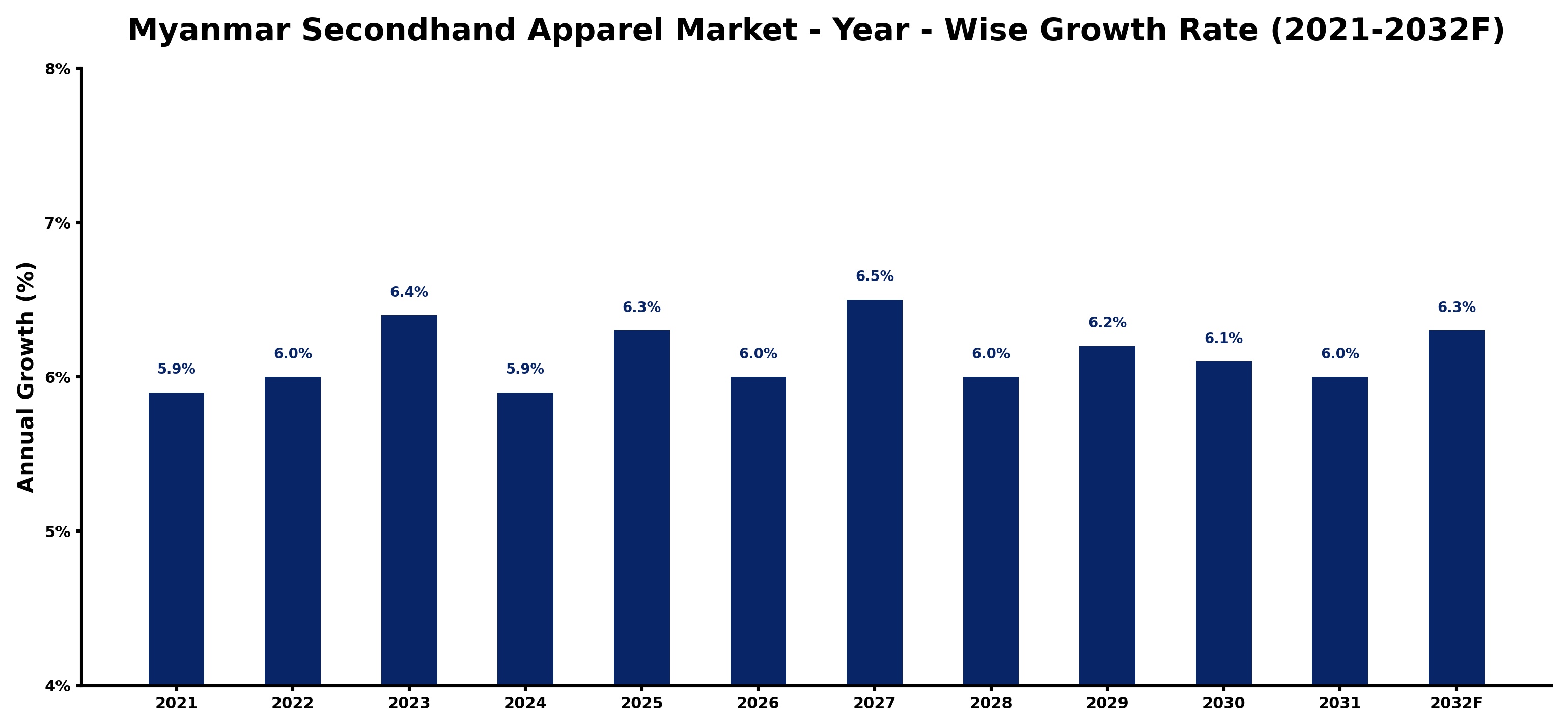
The table below presents the year‑wise growth rates along with the key drivers influencing the market
| Year | Growth Rate | Major Drivers |
| 2021 | 5.9% | Government infrastructure modernization initiatives |
| 2022 | 6.0% | Growing renewable energy integration projects |
| 2023 | 6.4% | Expansion of manufacturing activities |
| 2024 | 5.9% | Expansion of commercial construction activities |
| 2025 | 6.3% | Expansion of commercial construction activities |
| 2026 | 6.0% | Expansion of transportation and logistics networks |
| 2027 | 6.5% | Increasing smart city development projects |
| 2028 | 6.0% | Expansion of commercial construction activities |
| 2029 | 6.2% | Expansion of transportation and logistics networks |
| 2030 | 6.1% | Expansion of transportation and logistics networks |
| 2031 | 6.0% | Increasing adoption of advanced technologies |
| 2032 | 6.3% | Growing renewable energy integration projects |
Note - Market size estimations and growth projections presented in this report are based on 6Wresearch's advanced forecasting approach, validated with industry datasets as of June 2026.
Myanmar Secondhand Apparel Market Synopsis
A surge in thrift shopping, especially among the youth demographic, signifies a cultural shift towards valuing unique, pre-owned clothing. Additionally, the proliferation of online marketplaces has enhanced access to a vast array of gently-used apparel, aligning perfectly with the rising trend of sustainable consumerism.
The physical presence of thrift stores and local markets has also evolved, offering consumers tactile experiences while browsing pre-loved garments. This multi-channel approach is pivotal for building consumer trust and loyalty, ensuring a solid foundation for sustained market growth.
Myanmar Secondhand Apparel Market Key Takeaways
- The increasing middle-class population is a significant driver of demand for affordable secondhand clothing.
- Online platforms and social media are revolutionizing how consumers buy and sell pre-owned apparel in Myanmar.
- Sustainability concerns are shaping shopping preferences, pushing more consumers toward thrift shopping.
- The lack of regulation poses challenges but also opportunities for establishing quality standards within the market.
- Investment in upcycling and partnerships with local artisans can enhance the appeal of secondhand apparel.
Evaluation of Restraints in Myanmar Secondhand Apparel Market
The Myanmar Secondhand Apparel Market faces several constraints that may inhibit its growth potential. The absence of robust regulations has led to the proliferation of counterfeit and low-quality items, damaging the credibility of authentic sellers. Furthermore, many consumers still favor new items due to cultural preferences, hindering the acceptance of secondhand clothing as a mainstream choice. Infrastructure challenges, such as inadequate transportation and storage facilities, complicate the efficient distribution of secondhand apparel. Lastly, the lack of standardized sizing can result in customer dissatisfaction and increased returns, which complicates the shopping experience for potential buyers.
Myanmar Secondhand Apparel Market Trends
Emerging trends in the Myanmar Secondhand Apparel Market reflect a growing appetite for sustainability, with consumers increasingly prioritizing eco-friendly choices. The rise of thrift shopping as a social experience is becoming more pronounced, with individuals seeking out unique pieces that tell a story. Additionally, the influence of online platforms has transformed how consumers interact with secondhand clothing, offering them greater convenience and access. Social media campaigns centered around sustainable fashion are also helping to reshape consumer perceptions, encouraging a lifestyle that values recycling and reuse.
Myanmar Secondhand Apparel Market Opportunities
Investment opportunities abound within the Myanmar Secondhand Apparel Market, particularly in the realm of digital commerce. Establishing platforms focused on the seamless exchange of secondhand clothing can cater to the rising demand for convenience. Additionally, opening physical thrift stores in urban centers can tap into the local market while providing an experiential shopping environment. Collaborations with local designers to upcycle garments offer a unique way to attract environmentally conscious consumers, further strengthening the market's appeal. The wholesale distribution of secondhand apparel to smaller retailers could also be a lucrative avenue, capitalizing on the growing trend of sustainable fashion.
Government Initiatives in the Myanmar Secondhand Apparel Market
The Myanmar government has recognized the potential of the secondhand apparel market and has implemented various policies to regulate it. These include import restrictions on used clothing aimed at safeguarding local garment manufacturers, as well as guidelines focused on maintaining quality and safety standards for imported secondhand goods. By imposing taxes and tariffs on secondhand clothing, the government seeks to foster local production and curb excessive reliance on imports, ensuring consumer safety while promoting ethical fashion practices.
Future Insights of the Myanmar Secondhand Apparel Market
Looking ahead to 2026-2032, the Myanmar Secondhand Apparel Market is poised for promising growth, propelled by an increasing consumer inclination toward sustainability and affordability. The digital transformation, driven by e-commerce, is likely to amplify market dynamics, making secondhand clothing more accessible than ever. As the global movement toward ethical fashion gains momentum, Myanmar's secondhand apparel sector is well-positioned to capitalize on this trend, establishing a robust platform for both consumers and investors in the years to come.
Myanmar Secondhand Apparel Market Latest Developments (May 2025 - June 2026)
Recent developments within the Myanmar Secondhand Apparel Market reflect an increasing focus on sustainability and consumer engagement. Various organizations have begun to host thrift fairs and community events, aimed at raising awareness about the benefits of secondhand shopping. Additionally, local artisans are increasingly collaborating with thrift stores to create upcycled fashion lines, highlighting the fusion of creativity and sustainability. Moreover, the ongoing evolution of online platforms has led to enhanced user experiences, driving greater consumer participation in the secondhand market.
Myanmar Secondhand Apparel Market - Key Attractiveness of the Report
- 10 Years of Market Numbers
- Historical Data Starting from 2022 to 2025
- Base Year: 2025
- Forecast Data until 2032
- Key Performance Indicators Impacting the Market
- Major Upcoming Developments and Projects
Key Highlights of the Report:
- Myanmar Secondhand Apparel Market Outlook
- Market Size of Myanmar Secondhand Apparel Market, 2025
- Forecast of Myanmar Secondhand Apparel Market, 2032
- Historical Data and Forecast of Myanmar Secondhand Apparel Revenues & Volume for the Period 2022-2032F
- Myanmar Secondhand Apparel Market Trend Evolution
- Myanmar Secondhand Apparel Market Drivers and Challenges
- Myanmar Secondhand Apparel Price Trends
- Myanmar Secondhand Apparel Porter's Five Forces
- Myanmar Secondhand Apparel Industry Life Cycle
- Historical Data and Forecast of Myanmar Secondhand Apparel Market Revenues & Volume By Sector for the Period 2022-2032F
- Historical Data and Forecast of Myanmar Secondhand Apparel Market Revenues & Volume By Resale for the Period 2022-2032F
- Historical Data and Forecast of Myanmar Secondhand Apparel Market Revenues & Volume By Traditional Thrift Stores and Donations for the Period 2022-2032F
- Historical Data and Forecast of Myanmar Secondhand Apparel Market Revenues & Volume By Product Type for the Period 2022-2032F
- Historical Data and Forecast of Myanmar Secondhand Apparel Market Revenues & Volume By Dresses & Tops for the Period 2022-2032F
- Historical Data and Forecast of Myanmar Secondhand Apparel Market Revenues & Volume By Shirts & T-shirts for the Period 2022-2032F
- Historical Data and Forecast of Myanmar Secondhand Apparel Market Revenues & Volume By Sweaters, Coats & Jackets for the Period 2022-2032F
- Historical Data and Forecast of Myanmar Secondhand Apparel Market Revenues & Volume By Jeans & Pants for the Period 2022-2032F
- Historical Data and Forecast of Myanmar Secondhand Apparel Market Revenues & Volume By Others for the Period 2022-2032F
- Historical Data and Forecast of Myanmar Secondhand Apparel Market Revenues & Volume By Target Population for the Period 2022-2032F
- Historical Data and Forecast of Myanmar Secondhand Apparel Market Revenues & Volume By Men for the Period 2022-2032F
- Historical Data and Forecast of Myanmar Secondhand Apparel Market Revenues & Volume By Women for the Period 2022-2032F
- Historical Data and Forecast of Myanmar Secondhand Apparel Market Revenues & Volume By Kids for the Period 2022-2032F
- Historical Data and Forecast of Myanmar Secondhand Apparel Market Revenues & Volume By Sales Channel for the Period 2022-2032F
- Historical Data and Forecast of Myanmar Secondhand Apparel Market Revenues & Volume By Wholesalers/Distributors for the Period 2022-2032F
- Historical Data and Forecast of Myanmar Secondhand Apparel Market Revenues & Volume By Hypermarkets/Supermarkets for the Period 2022-2032F
- Historical Data and Forecast of Myanmar Secondhand Apparel Market Revenues & Volume By Multi-brand Stores for the Period 2022-2032F
- Historical Data and Forecast of Myanmar Secondhand Apparel Market Revenues & Volume By Independent Small Stores for the Period 2022-2032F
- Historical Data and Forecast of Myanmar Secondhand Apparel Market Revenues & Volume By Departmental Stores for the Period 2022-2032F
- Historical Data and Forecast of Myanmar Secondhand Apparel Market Revenues & Volume By Online Retailers for the Period 2022-2032F
- Historical Data and Forecast of Myanmar Secondhand Apparel Market Revenues & Volume By Others for the Period 2022-2032F
- Myanmar Secondhand Apparel Import Export Trade Statistics
- Market Opportunity Assessment By Sector
- Market Opportunity Assessment By Product Type
- Market Opportunity Assessment By Target Population
- Market Opportunity Assessment By Sales Channel
- Myanmar Secondhand Apparel Top Companies Market Share
- Myanmar Secondhand Apparel Competitive Benchmarking By Technical and Operational Parameters
- Myanmar Secondhand Apparel Company Profiles
- Myanmar Secondhand Apparel Key Strategic Recommendations






































