Myanmar Solenoid Valve Market Size, Share & Growth Rate
The Myanmar Solenoid Valve Market was estimated at USD 1207 Million in 2025 and is projected to reach USD 1739 Million by 2032, growing at a CAGR of 5.4% from 2026 to 2032. This upward trajectory is fueled by the nation's rapid industrialization, particularly in manufacturing and infrastructure, as well as a notable increase in automation across various sectors. The adoption of energy-efficient technologies further drives demand, reflecting a broader trend towards modernizing industrial processes in Myanmar.
Myanmar Solenoid Valve Market Year-wise Growth Rate and Key Drivers
This graph highlights how the Myanmar Solenoid Valve Market has steadily grown over the years, supported by major growth factors.
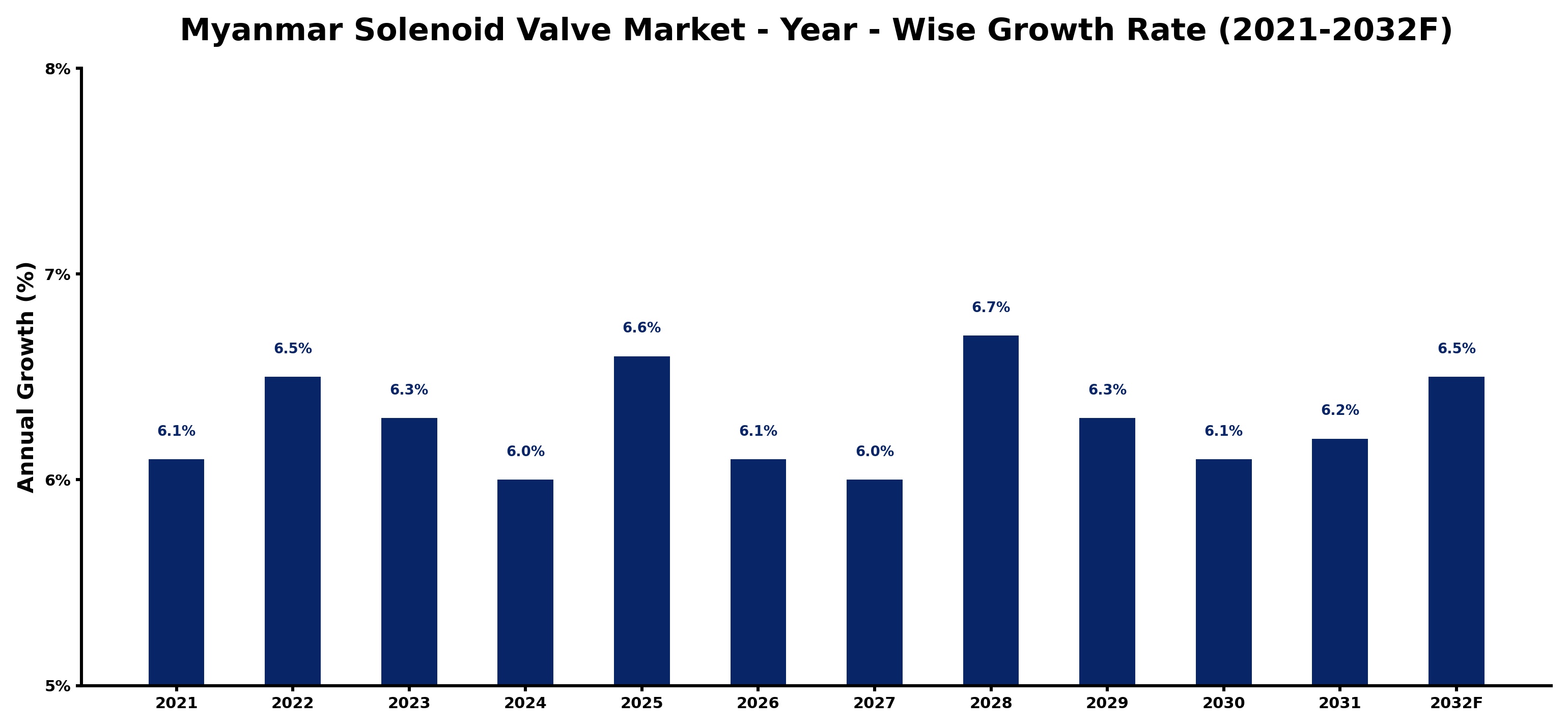
The table below presents the year‑wise growth rates along with the key drivers influencing the market
| Year | Growth Rate | Major Drivers |
| 2021 | 6.1% | Rapid growth in telecom and data center sectors |
| 2022 | 6.5% | Increasing industrial automation investments |
| 2023 | 6.3% | Expansion of transportation and logistics networks |
| 2024 | 6.0% | Growing urbanization and commercial development |
| 2025 | 6.6% | Growing urbanization and commercial development |
| 2026 | 6.1% | Expansion of transportation and logistics networks |
| 2027 | 6.0% | Expansion of manufacturing activities |
| 2028 | 6.7% | Increasing industrial infrastructure investments |
| 2029 | 6.3% | Growing renewable energy integration projects |
| 2030 | 6.1% | Expansion of transportation and logistics networks |
| 2031 | 6.2% | Increasing smart city development projects |
| 2032 | 6.5% | Expansion of manufacturing activities |
Note - Market size estimations and growth projections presented in this report are based on 6Wresearch's advanced forecasting approach, validated with industry datasets as of June 2026.
Myanmar Solenoid Valve Market Synopsis
The demand for solenoid valves in Myanmar is on the rise, particularly due to their critical role in sectors such as water treatment and automotive manufacturing. As industries pivot towards automation, the need for reliable and efficient flow control solutions has never been greater, positioning solenoid valves as essential components of modern industrial operations.
Moreover, the expanding agricultural sector is increasingly recognizing the importance of solenoid valves for irrigation systems, further enhancing market opportunities. The current climate encourages innovation and adaptation, with numerous domestic and international manufacturers seeking to establish a foothold in this growing market.
Myanmar Solenoid Valve Market Key Takeaways
- The Myanmar Solenoid Valve Market is poised for significant growth, driven by industrial modernization and increased automation.
- Rising demands in water treatment, automotive, and agricultural sectors are enhancing market potential.
- Government policies promoting foreign investment are creating a more favorable business environment for solenoid valve manufacturers.
- Challenges related to product awareness and regulatory standards persist, impacting market dynamics.
- Investment opportunities abound for stakeholders looking to capitalize on infrastructure improvements and technological advancements.
Evaluation of Restraints in Myanmar Solenoid Valve Market
The Myanmar Solenoid Valve Market is grappling with a few notable restraints that could hamper its progress. One significant factor is the limited awareness and understanding of solenoid valve technology among end-users, resulting in a slower adoption rate across various industries. Furthermore, the absence of standardized regulations and quality control measures raises concerns regarding product reliability, creating potential barriers for companies looking to build a reputation in this market. Additionally, infrastructure challenges and fluctuating political conditions deter investors and complicate operational execution, ultimately affecting growth prospects.
Myanmar Solenoid Valve Market Trends
Several key trends are shaping the Myanmar Solenoid Valve Market, reflecting broader shifts in industrial practices. Increasingly, industries are embracing automation technologies, as solenoid valves are vital in managing the flow of gases and liquids efficiently. This trend correlates with rising energy efficiency demands, as manufacturers look for innovative and eco-friendly valve solutions. Additionally, there is a noticeable move towards localization among manufacturers, with more companies investing in domestic production capabilities to better cater to the unique needs of the local market.
Myanmar Solenoid Valve Market Opportunities
The Myanmar Solenoid Valve Market is ripe with opportunities for investment and growth. The ongoing expansion in sectors like manufacturing and agriculture offers substantial demand for solenoid valves, particularly for applications such as fluid control and HVAC systems. Furthermore, the government's ongoing initiatives to enhance infrastructure and attract foreign investments signify a supportive landscape for market entry. Companies that strategically partner with local distributors or focus on R&D in advanced valve technologies can significantly leverage these favorable conditions.
Government Initiatives in the Myanmar Solenoid Valve Market
The Myanmar government has taken proactive steps to foster the solenoid valve market's growth by implementing policies aimed at stimulating foreign direct investment in manufacturing. These initiatives include tax incentives for companies that invest in advanced technologies and support for research and development activities focused on valve innovation. Additionally, improvements in infrastructure and logistics are underway, contributing to a more conducive environment for business operations within the solenoid valve sector.
Future Insights of the Myanmar Solenoid Valve Market
Looking ahead to 2026-2032, the Myanmar Solenoid Valve Market appears set for a phase of steady growth, underpinned by the country's continued industrial development and the integration of advanced technologies across sectors. The ongoing focus on energy-efficient solutions and infrastructure expansion will likely catalyze further demand for solenoid valves. However, the market must navigate through potential economic uncertainties and political instability, which could influence overall market dynamics. Ultimately, with the right strategies and partnerships, the market's growth potential remains robust.
Myanmar Solenoid Valve Market Latest Developments (May 2025 - June 2026)
Recent developments in the Myanmar Solenoid Valve Market indicate a shift towards greater innovation and energy efficiency. Many manufacturers are focusing on developing smarter, more adaptable solenoid valves that can easily integrate with automation systems. Furthermore, there has been a surge in collaborative efforts among local firms and international partners aimed at enhancing production capabilities and expanding market reach. These dynamics are expected to play a crucial role in shaping the competitive landscape in the coming years.
Myanmar Solenoid Valve Market - Key Attractiveness of the Report
- 10 Years of Market Numbers
- Historical Data Starting from 2022 to 2025
- Base Year: 2025
- Forecast Data until 2032
- Key Performance Indicators Impacting the Market
- Major Upcoming Developments and Projects
Key Highlights of the Report:
- Myanmar Solenoid Valve Market Outlook
- Market Size of Myanmar Solenoid Valve Market, 2025
- Forecast of Myanmar Solenoid Valve Market, 2032
- Historical Data and Forecast of Myanmar Solenoid Valve Revenues & Volume for the Period 2022-2032F
- Myanmar Solenoid Valve Market Trend Evolution
- Myanmar Solenoid Valve Market Drivers and Challenges
- Myanmar Solenoid Valve Price Trends
- Myanmar Solenoid Valve Porter's Five Forces
- Myanmar Solenoid Valve Industry Life Cycle
- Historical Data and Forecast of Myanmar Solenoid Valve Market Revenues & Volume By Body Material for the Period 2022-2032F
- Historical Data and Forecast of Myanmar Solenoid Valve Market Revenues & Volume By Stainless Steel for the Period 2022-2032F
- Historical Data and Forecast of Myanmar Solenoid Valve Market Revenues & Volume By Brass for the Period 2022-2032F
- Historical Data and Forecast of Myanmar Solenoid Valve Market Revenues & Volume By Aluminium for the Period 2022-2032F
- Historical Data and Forecast of Myanmar Solenoid Valve Market Revenues & Volume By Plastic for the Period 2022-2032F
- Historical Data and Forecast of Myanmar Solenoid Valve Market Revenues & Volume By Valve Design Type for the Period 2022-2032F
- Historical Data and Forecast of Myanmar Solenoid Valve Market Revenues & Volume By 2-way for the Period 2022-2032F
- Historical Data and Forecast of Myanmar Solenoid Valve Market Revenues & Volume By 3-way for the Period 2022-2032F
- Historical Data and Forecast of Myanmar Solenoid Valve Market Revenues & Volume By 4-way for the Period 2022-2032F
- Historical Data and Forecast of Myanmar Solenoid Valve Market Revenues & Volume By 5-way for the Period 2022-2032F
- Historical Data and Forecast of Myanmar Solenoid Valve Market Revenues & Volume By Industry for the Period 2022-2032F
- Historical Data and Forecast of Myanmar Solenoid Valve Market Revenues & Volume By Oil & Gas for the Period 2022-2032F
- Historical Data and Forecast of Myanmar Solenoid Valve Market Revenues & Volume By Chemical & Petrochemical for the Period 2022-2032F
- Historical Data and Forecast of Myanmar Solenoid Valve Market Revenues & Volume By Water & Wastewater for the Period 2022-2032F
- Historical Data and Forecast of Myanmar Solenoid Valve Market Revenues & Volume By Food & Beverages for the Period 2022-2032F
- Historical Data and Forecast of Myanmar Solenoid Valve Market Revenues & Volume By Power Generation for the Period 2022-2032F
- Historical Data and Forecast of Myanmar Solenoid Valve Market Revenues & Volume By Pharmaceuticals for the Period 2022-2032F
- Historical Data and Forecast of Myanmar Solenoid Valve Market Revenues & Volume By Automotive for the Period 2022-2032F
- Historical Data and Forecast of Myanmar Solenoid Valve Market Revenues & Volume By Others for the Period 2022-2032F
- Myanmar Solenoid Valve Import Export Trade Statistics
- Market Opportunity Assessment By Body Material
- Market Opportunity Assessment By Valve Design Type
- Market Opportunity Assessment By Industry
- Myanmar Solenoid Valve Top Companies Market Share
- Myanmar Solenoid Valve Competitive Benchmarking By Technical and Operational Parameters
- Myanmar Solenoid Valve Company Profiles
- Myanmar Solenoid Valve Key Strategic Recommendations






































