Myanmar Telehealth Market Summary
The myanmar telehealth market was estimated at USD 269 Million in 2025 and is projected to reach USD 374 Million by 2032, growing at a CAGR of 5.4% from 2026 to 2032.
Myanmar Telehealth Market Year-wise Growth Rate and Key Drivers
This graph highlights how the Myanmar Telehealth Market has steadily grown over the past five years, supported by major growth factors.
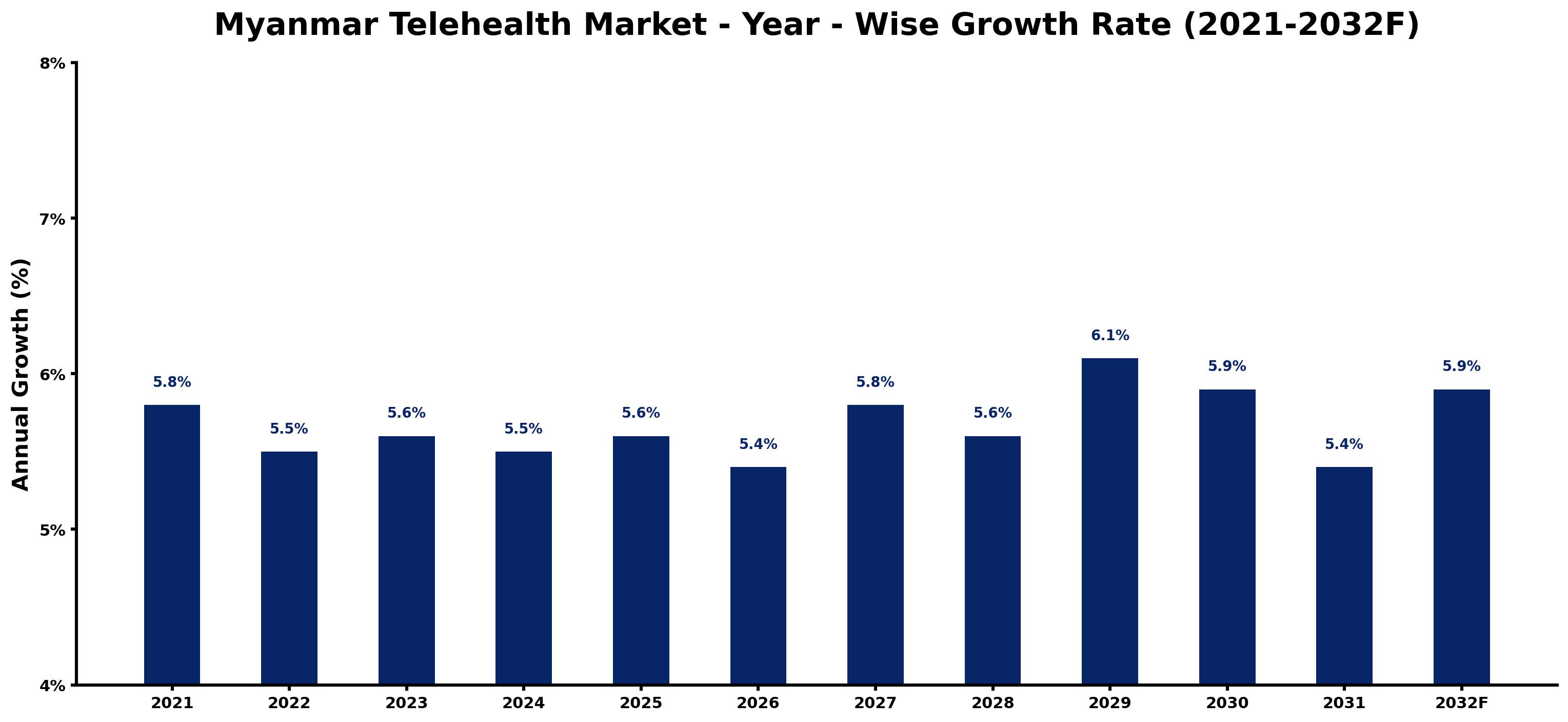
The table below presents the year wise growth rates along with the key drivers influencing the market
| Year | Growth Rate | Major Drivers |
| 2021 | 5.8% | Telehealth services gained traction as healthcare facilities struggled with pandemic pressures. |
| 2022 | 5.5% | Increased smartphone penetration provided easier access to telehealth platforms across the country. |
| 2023 | 5.6% | Investment in internet infrastructure improved connectivity, enabling more remote consultations. |
| 2024 | 5.5% | Patient awareness campaigns highlighted the benefits of telehealth for rural communities. |
| 2025 | 5.6% | Local tech startups introduced innovative telehealth solutions tailored for Myanmar's cultural context. |
| 2026 | 5.4% | Partnerships between healthcare providers and tech companies expanded service offerings and accessibility. |
| 2027 | 5.8% | Telehealth regulatory frameworks began emerging, enhancing provider and patient confidence in services. |
| 2028 | 5.6% | Integration of AI-driven tools streamlined diagnostics and treatment options within telehealth platforms. |
| 2029 | 6.1% | Corporate wellness programs incorporated telehealth, focusing on employee health and productivity. |
| 2030 | 5.9% | Investment in training healthcare professionals boosted the quality of virtual consultations. |
| 2031 | 5.4% | User-friendly interfaces and multilingual support attracted diverse patient demographics to telehealth. |
| 2032 | 5.9% | Ecosystem collaborations between stakeholders fostered innovation and sustainability in telehealth services. |
Note - Market size estimations and growth projections presented in this report are based on 6Wresearch's advanced forecasting approach, validated with industry datasets as of June 2026.
Myanmar Telehealth Market Synopsis
The Myanmar Telehealth Market is projected to reach 5.4% and witness significant growth during the forecast period (2026-2032). The anticipated expansion is primarily driven by the increasing advent of digitalization within the healthcare sector. With a current market value forecasted to be in the double-digit billion range, the Myanmar Telehealth Market is expected to escalate into a triple-digit revenue scenario over the next decade. This upward trajectory is closely linked to the rising adoption of virtual healthcare platforms and the profound need for better medical facilities, particularly for the aging population.
Myanmar Telehealth Market Growth Drivers
The growth of the Myanmar Telehealth Market is underpinned by several crucial drivers:
- The increasing prevalence of chronic diseases among the population necessitates more accessible healthcare solutions, making telehealth an attractive option.
- The aging population, which significantly impacts healthcare costs, represents a substantial segment of telehealth beneficiaries, demanding enhanced medical services.
- Cost-efficiency and reduced time associated with traveling for healthcare consultations favor telehealth adoption among urban and suburban patients.
- Technological advancements in telemedicine tools and platforms facilitate smoother integration of these solutions into everyday healthcare practices.
- Shifts in lifestyle and patient expectations heighten the demand for digital health services, pushing healthcare providers to adapt and innovate rapidly.
Myanmar Telehealth Market Investment Opportunities
The Myanmar Telehealth Market presents compelling investment opportunities due to its projected growth prospects:
- Investments in telehealth infrastructure, such as reliable internet connectivity and advanced telehealth platforms, are critical in bridging the healthcare accessibility gap.
- Healthcare providers can explore partnerships with technology firms to enhance service offerings and improve patient engagement through mobile applications.
- Capitalizing on the growing demand for remote monitoring tools can aid in addressing chronic health conditions effectively and efficiently.
- Government initiatives aiming to digitize healthcare services create a favorable environment for both local and foreign investors.
- The rise in patient data analytics and health information exchange presents opportunities to improve care coordination and patient outcomes.
Myanmar Telehealth Market Government Investment and Initiatives
The government of Myanmar has recognized the potential of telehealth as a crucial component of healthcare reform and development. This strategic focus has led to various initiatives aimed at fostering the growth of the telehealth market:
- The government has initiated policies to promote digital technologies in healthcare to enhance service delivery and accessibility, particularly in rural areas.
- Public spending in healthcare infrastructure is being channeled towards improving digital platforms and telemedicine services.
- Collaborations with international partners are being encouraged to bring in best practices and technological expertise in telehealth.
- Incentives for startups and innovations in the telehealth space are being rolled out to stimulate market entry and growth.
- The establishment of training programs focused on digital health competencies is part of the effort to elevate the skill levels of healthcare providers and technicians.
Myanmar Telehealth Market Latest Developments (May 2025 - June 2026)
During the period from May 2025 to June 2026, the Myanmar Telehealth Market has experienced several notable developments:
- A surge in digital health startups has been observed, focusing on telemedicine platforms that cater specifically to local needs and cultural contexts.
- Innovative remote consultation services have been launched, incorporating advanced communication technologies to enhance patient-provider interactions.
- Increased awareness campaigns about the benefits of telehealth have led to higher public acceptance and utilization of these services.
- Partnerships between healthcare providers and technology developers have been established to enhance service quality and expand service offerings.
- The government has introduced new regulations aimed at standardizing telehealth practices, ensuring quality and security in patient data management.
Myanmar Telehealth Market - Key Attractiveness of the Report
- 10 Years of Market Numbers
- Historical Data Starting from 2022 to 2025
- Base Year: 2025
- Forecast Data until 2032
- Key Performance Indicators Impacting the Market
- Major Upcoming Developments and Projects
Key Highlights of the Report:
- Myanmar Telehealth Market Overview
- Myanmar Telehealth Market Outlook
- Myanmar Telehealth Market Forecast
- Historical Data of Myanmar Telehealth Market Revenues & Volume for the Period 2022-2032F
- Myanmar Telehealth Market Size and Myanmar Telehealth Market Forecast of Revenues & Volume, Until 2032F
- Historical Data of Myanmar Telehealth Market Revenues & Volume, by Types, for the Period 2022-2032F
- Market Size & Forecast of Myanmar Telehealth Market Revenues & Volume, by Types, Until 2032F
- Historical Data of Myanmar Telehealth Market Revenues, by Component, for the Period 2022-2032F
- Market Size & Forecast of Myanmar Telehealth Market Revenues, by Component, Until 2032F
- Historical Data of Central Region Telehealth Market Revenues, for the Period 2022-2032F
- Market Size & Forecast of Central Region Telehealth Market Revenues, Until 2032F
- Historical Data of Western Region Telehealth Market Revenues, for the Period 2022-2032F
- Market Size & Forecast of Western Region Telehealth Market Revenues, Until 2032F
- Historical Data of Southern Region Telehealth Market Revenues, for the Period 2022-2032F
- Market Size & Forecast of Southern Region Telehealth Market Revenues, Until 2032F
- Historical Data of Eastern Region Telehealth Market Revenues, for the Period 2022-2032F
- Market Size & Forecast of Eastern Region Telehealth Market Revenues, Until 2032F
- Market Drivers and Restraints
- Myanmar Telehealth Market Trends and Industry Life Cycle
- Porter’s Five Force Analysis
- Market Opportunity Assessment
- Myanmar Telehealth Market Share, By Players
- Myanmar Telehealth Market Share, By Regions
- Myanmar Telehealth Market Overview on Competitive Benchmarking
- Company Profiles
- Key Strategic Recommendations
Markets Covered
The Myanmar Telehealth Market report provides a detailed analysis of the following market segments:
- By Types:
- Tele Hospitals
- Tele Homes
- mHealth (Mobile Health)
- By Component:
- Product
- Hardware
- Software
- Other Types
- Services
- Teleradiology
- Telecardiology
- Teledermatology
- Telepsychiatry
- Other Services
- Product






































