Cambodia Telehealth Market Summary
The cambodia telehealth market was estimated at USD 380 Million in 2025 and is projected to reach USD 538 Million by 2032, growing at a CAGR of 6.2% from 2026 to 2032.
Cambodia Telehealth Market Year-wise Growth Rate and Key Drivers
This graph highlights how the Cambodia Telehealth Market has steadily grown over the past five years, supported by major growth factors.
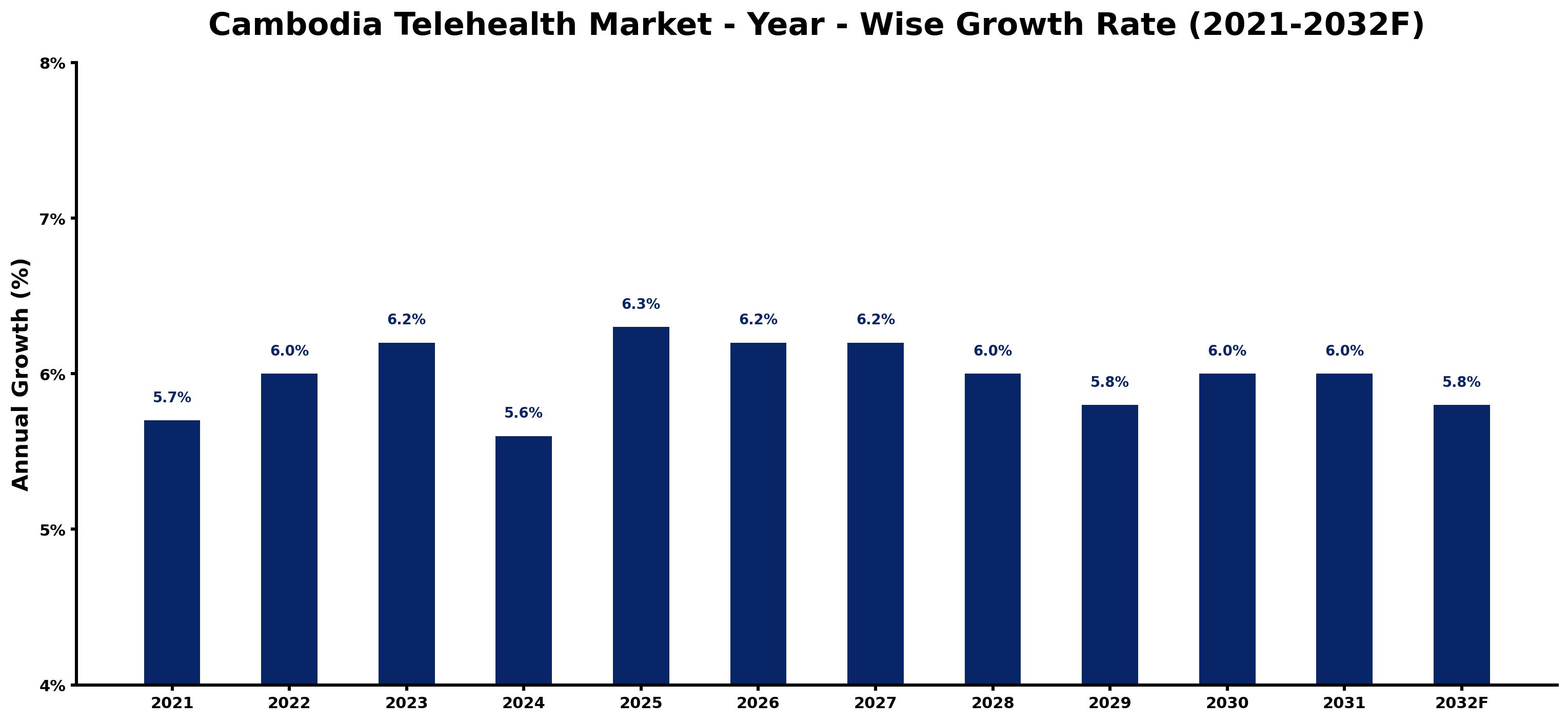
The table below presents the year wise growth rates along with the key drivers influencing the market
| Year | Growth Rate | Major Drivers |
| 2021 | 5.7% | Telehealth services emerged as a solution during widespread healthcare access challenges. |
| 2022 | 6.0% | Local startups began leveraging mobile technology to reach underserved populations effectively. |
| 2023 | 6.2% | Consumer awareness about telehealth benefits increased amid ongoing global health concerns. |
| 2024 | 5.6% | Healthcare providers focused on improving digital infrastructure to enhance patient experiences. |
| 2025 | 6.3% | Investment in telehealth platforms attracted significant funding from regional venture capitalists. |
| 2026 | 6.2% | Collaboration between local governments and tech firms led to innovative telehealth solutions. |
| 2027 | 6.2% | Rising smartphone penetration enabled broader access to telehealth services across demographics. |
| 2028 | 6.0% | Partnerships with international health organizations bolstered credibility in Cambodian telehealth offerings. |
| 2029 | 5.8% | Data privacy concerns prompted enhanced security measures in telehealth platforms and services. |
| 2030 | 6.0% | Telehealth education programs flourished, preparing new professionals for digital healthcare roles. |
| 2031 | 6.0% | Consumer preferences shifted towards integrated health solutions combining telehealth and in-person care. |
| 2032 | 5.8% | Sustainability in healthcare practices became a priority, influencing telehealth service offerings. |
Note - Market size estimations and growth projections presented in this report are based on 6Wresearch's advanced forecasting approach, validated with industry datasets as of June 2026.
Cambodia Telehealth Market Synopsis
The Cambodia Telehealth Market is projected to reach 6.2% and witness significant growth during the forecast period (2026-2032). This growth is anticipated due to the rapid digitization of healthcare services and the increasing demand for remote consultations. The shift towards virtual healthcare platforms is driven by the need to enhance access to medical services, particularly for the geriatric population, which constitutes a substantial portion of healthcare expenditure. By leveraging telehealth technologies, Cambodia aims to address the pressing challenges within its healthcare system while facilitating improved patient outcomes.
Cambodia Telehealth Market Growth Drivers
Several factors are fueling the expansion of the Cambodia Telehealth Market. Key growth drivers include:
- The increasing prevalence of chronic diseases necessitates ongoing healthcare support, which telehealth platforms can effectively provide through remote monitoring and consultations.
- The aging population in Cambodia consumes a significant proportion of healthcare resources, highlighting the need for efficient service delivery models that can alleviate the burden on traditional healthcare systems.
- Government initiatives aimed at enhancing digital infrastructure and healthcare services are fostering an environment conducive to telehealth adoption.
- Technological advancements in telecommunications are improving internet connectivity and accessibility in rural areas, enabling remote consultations and expanding the reach of healthcare services.
- The recent global health crisis has underscored the importance of telehealth solutions, prompting both providers and patients to embrace virtual healthcare models as a viable alternative to in-person visits.
Cambodia Telehealth Market Challenges and Restraints
Despite the promising opportunities within the Cambodia Telehealth Market, certain challenges may impede its growth. Some of the notable restraints include:
- Limited awareness and understanding of telehealth services among both healthcare providers and patients can hinder widespread adoption.
- Infrastructure challenges, particularly in rural areas, may affect the reliability of telehealth services, necessitating ongoing improvements to telecommunications networks.
- Regulatory frameworks governing telehealth practices are still evolving, which may create uncertainties and legal challenges for service providers.
- Concerns regarding data privacy and security pose significant hurdles, as both patients and providers must ensure compliance with regulations to safeguard sensitive information.
- The initial costs associated with deploying telehealth technologies can deter investment, particularly among smaller healthcare facilities operating on tight budgets.
Cambodia Telehealth Market Government Investment and Initiatives
The Cambodian government has recognized the potential of telehealth in improving healthcare access and outcomes. Several initiatives have been implemented to promote the sector, including:
- Public investments in digital infrastructure aimed at improving internet connectivity and availability of technology in underserved areas, enabling broader access to telehealth services.
- Policies that encourage collaboration between public and private sectors to develop innovative telehealth solutions tailored to the unique needs of the population.
- Training programs focused on enhancing the digital literacy of healthcare professionals to ensure they are equipped to utilize telehealth technologies effectively.
- Funding and grants aimed specifically at facilitating research and development of telehealth platforms that address local healthcare challenges.
- Regulatory frameworks aimed at supporting the legal and operational aspects of telehealth services, ensuring they can be safely and effectively delivered to patients.
Cambodia Telehealth Market Latest Developments (May 2025 - June 2026)
Recent developments within the Cambodia Telehealth Market point towards a dynamic and rapidly evolving landscape. Over the period from May 2025 to June 2026, the following trends have emerged:
- An increase in partnerships between healthcare institutions and technology firms aimed at enhancing telehealth service delivery through innovative digital solutions.
- The introduction of new telehealth platforms designed to cater specifically to the needs of various demographic groups, including the elderly and those with chronic conditions.
- Government-led initiatives focused on expanding telehealth access in rural communities, ensuring that underserved populations receive adequate healthcare support.
- Ongoing research into the effectiveness of telehealth solutions has led to the refinement of practices, resulting in improved patient satisfaction and outcomes.
- The emergence of awareness campaigns aimed at educating the public about the benefits of telehealth, contributing to greater acceptance and utilization of remote healthcare services.
Cambodia Telehealth Market - Key Attractiveness of the Report
- 10 Years of Market Numbers
- Historical Data Starting from 2022 to 2025
- Base Year: 2025
- Forecast Data until 2032
- Key Performance Indicators Impacting the Market
- Major Upcoming Developments and Projects
Key Highlights of the Report:
- Cambodia Telehealth Market Overview
- Cambodia Telehealth Market Outlook
- Cambodia Telehealth Market Forecast
- Historical Data of Cambodia Telehealth Market Revenues & Volume for the Period 2022-2032F
- Cambodia Telehealth Market Size and Cambodia Telehealth Market Forecast of Revenues & Volume, Until 2032F
- Historical Data of Cambodia Telehealth Market Revenues & Volume, by Types, for the Period 2022-2032F
- Market Size & Forecast of Cambodia Telehealth Market Revenues & Volume, by Types, Until 2032F
- Historical Data of Cambodia Telehealth Market Revenues, by Component, for the Period 2022-2032F
- Market Size & Forecast of Cambodia Telehealth Market Revenues, by Component, Until 2032F
- Historical Data of Central Region Telehealth Market Revenues, for the Period 2022-2032F
- Market Size & Forecast of Central Region Telehealth Market Revenues, Until 2032F
- Historical Data of Western Region Telehealth Market Revenues, for the Period 2022-2032F
- Market Size & Forecast of Western Region Telehealth Market Revenues, Until 2032F
- Historical Data of Southern Region Telehealth Market Revenues, for the Period 2022-2032F
- Market Size & Forecast of Southern Region Telehealth Market Revenues, Until 2032F
- Historical Data of Eastern Region Telehealth Market Revenues, for the Period 2022-2032F
- Market Size & Forecast of Eastern Region Telehealth Market Revenues, Until 2032F
- Market Drivers and Restraints
- Cambodia Telehealth Market Trends and Industry Life Cycle
- Porter’s Five Force Analysis
- Market Opportunity Assessment
- Cambodia Telehealth Market Share, By Players
- Cambodia Telehealth Market Share, By Regions
- Cambodia Telehealth Market Overview on Competitive Benchmarking
- Company Profiles
- Key Strategic Recommendations
Markets Covered
The Cambodia Telehealth Market report provides a detailed analysis of the following market segments:
- By Types:
- Tele Hospitals
- Tele Homes
- mHealth (Mobile Health)
- By Component:
- Product
- Hardware
- Software
- Other Types
- Services
- Teleradiology
- Telecardiology
- Teledermatology
- Telepsychiatry
- Other Services
- Product






































