Myanmar Titanium Market Summary
The myanmar titanium market was estimated at USD 777 Million in 2025 and is projected to reach USD 1126 Million by 2032, growing at a CAGR of 6.7% from 2026 to 2032.
Myanmar Titanium Market Year-wise Growth Rate and Key Drivers
This graph highlights how the Myanmar Titanium Market has steadily grown over the past five years, supported by major growth factors.
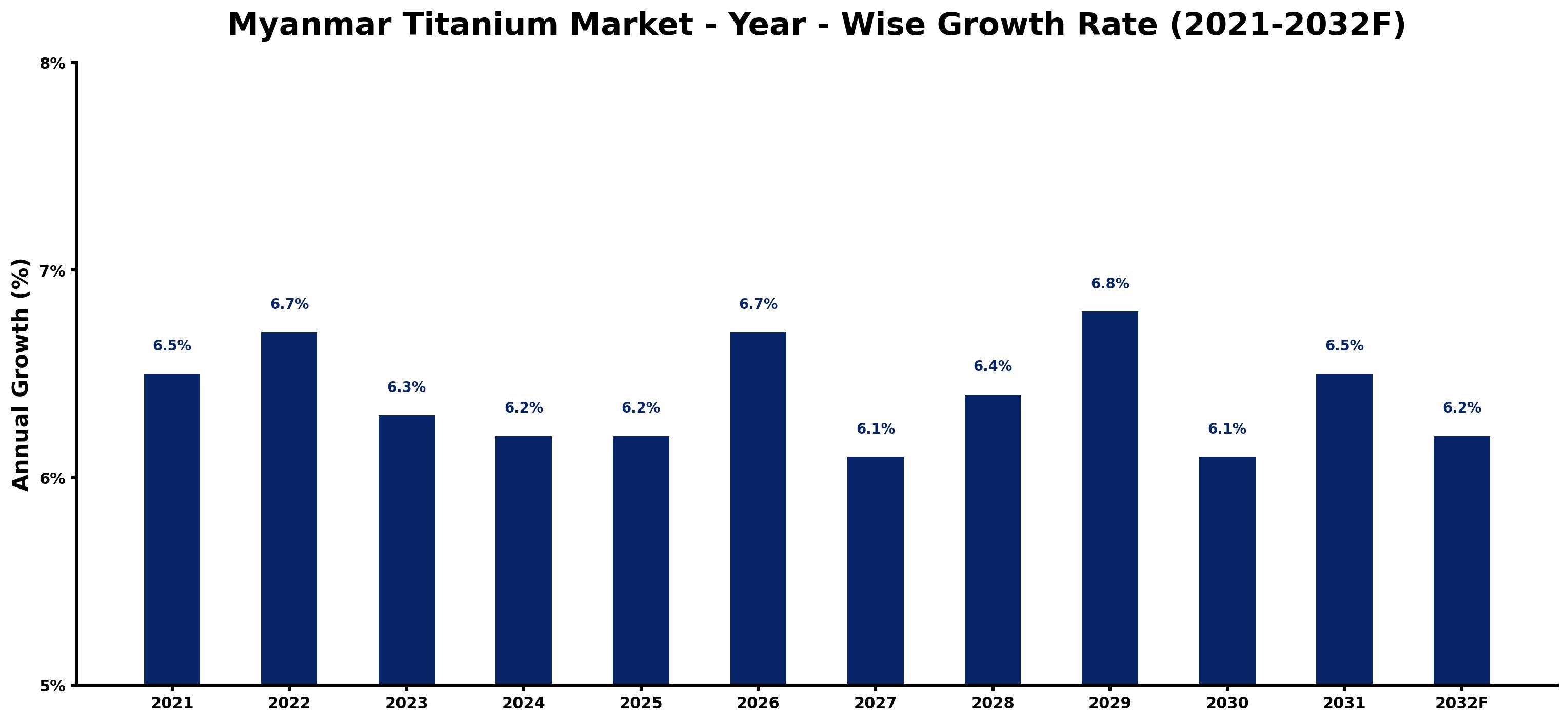
The table below presents the year wise growth rates along with the key drivers influencing the market
| Year | Growth Rate | Major Drivers |
| 2021 | 6.5% | Market recovery efforts spotlight titanium's lightweight properties boosting industrial applications. |
| 2022 | 6.7% | Infrastructure projects ramping up in Myanmar promote greater titanium demand across sectors. |
| 2023 | 6.3% | Manufacturers recognize titanium's corrosion resistance, attracting interest from the construction industry. |
| 2024 | 6.2% | Increased foreign investment leads to enhanced production capabilities for titanium suppliers. |
| 2025 | 6.2% | Emerging technologies create new uses for titanium in medical and aerospace applications. |
| 2026 | 6.7% | Local enterprises explore titanium recycling, reducing costs and environmental footprints significantly. |
| 2027 | 6.1% | Partnerships with international firms unlock advanced processing techniques for Myanmar's titanium. |
| 2028 | 6.4% | Educational initiatives develop skilled workforce, addressing industry needs for titanium production. |
| 2029 | 6.8% | Rising energy costs urge industries to adopt titanium components for improved efficiency. |
| 2030 | 6.1% | Regional trade agreements facilitate easier access to titanium imports and exports. |
| 2031 | 6.5% | Sustainability trends push businesses to switch to titanium for eco-friendly practices. |
| 2032 | 6.2% | Technological advancements in mining enhance titanium extraction, increasing availability in Myanmar. |
Note - Market size estimations and growth projections presented in this report are based on 6Wresearch's advanced forecasting approach, validated with industry datasets as of June 2026.
Myanmar Titanium Market Synopsis
The Myanmar Titanium Market is projected to reach 6.7% and witness significant growth during the forecast period (2026-2032). This growth is primarily driven by the burgeoning demand from various industrial applications, including aerospace, automotive, and construction. Myanmar's vast titanium ore deposits, particularly in its coastal regions, position the nation as a vital player within the global titanium market.
Myanmar Titanium Market Growth Drivers
Several factors are catalyzing the expansion of the Myanmar Titanium Market. Firstly, increasing industrial applications of titanium are propelling demand. The aerospace sector, known for requiring lightweight yet durable materials, is a significant consumer. Secondly, the automotive industry is increasingly utilizing titanium components for weight reduction, which enhances fuel efficiency. Thirdly, the ongoing construction boom in Myanmar elevates the use of titanium in various building materials.
- Infrastructure developments are contributing to a higher need for titanium-based products, as more companies aim to enhance their product offerings.
- The rising consumer preference for sustainable and long-lasting materials in manufacturing is creating more opportunities for titanium applications.
- Technological advancements in titanium extraction and processing are improving output efficiency and product quality.
- Interest in renewable energy applications, such as solar and wind energy, is boosting the demand for titanium in manufacturing energy systems.
- The potential for exporting titanium products in international markets further enhances growth opportunities for Myanmar's titanium sector.
Myanmar Titanium Market Trends and Opportunities
The Myanmar Titanium Market is currently observing notable trends that contribute to its growth trajectory. The increasing shift towards lightweight and durable materials across industries is becoming a benchmark for product development. Innovations in titanium production technologies are aiding in meeting this growing demand more efficiently. Furthermore, the emphasis on sustainable practices is reshaping the market's operational dynamics.
- Manufacturers are investing in research and development to enhance the performance characteristics of titanium-based products.
- The use of titanium in eco-friendly applications, including green energy production, is gaining momentum.
- There is an increasing emphasis on recycling titanium materials, which resonates with sustainability efforts.
- Partnerships and collaborations within the industry are on the rise to tackle processing limitations and improve technology accessibility.
- The expansion of industrial sectors in Myanmar opens new avenues for the incorporation of titanium in niche markets.
Myanmar Titanium Market Challenges and Restraints
Despite its growth potential, the Myanmar Titanium Market faces several challenges. The first major constraint is the limited processing capabilities within the country, hindering the effective sourcing and production of titanium products. Additionally, there exists a lack of advanced technology and expertise needed for efficient titanium extraction. Regulatory uncertainties also create a complex operating environment for both domestic and foreign entities.
- Competitive pressures from established global players further constrain Myanmar's position in the international titanium market.
- Environmental concerns related to titanium mining operations necessitate improved sustainable practices, complicating compliance for local companies.
- The necessity for substantial investments in infrastructure to support mining and processing operations poses a significant challenge.
- The fluctuating global market conditions can adversely influence the pricing and demand for titanium products in Myanmar.
- Political and economic instability may impact investor confidence, further affecting market dynamics.
Myanmar Titanium Market Investment Opportunities
Investment opportunities within the Myanmar Titanium Market appear promising due to the country's rich mineral resources. As industrial development continues to thrive, there is a growing demand for titanium products such as titanium dioxide and titanium metal across various sectors. Investors are encouraged to explore opportunities in titanium mining, extraction, and processing.
- With the global shift towards sustainable practices, there is potential in utilizing titanium for the production of renewable energy systems.
- Opportunities abound in establishing processing facilities to enhance local manufacturing capabilities.
- Value-added product manufacturing in sectors such as aerospace and automotive provides further avenues for investment.
- There is a growing need for investment in research and development to innovate and improve manufacturing processes.
- Partnerships with international entities could facilitate knowledge transfer and technology access necessary for market advancement.
Myanmar Titanium Market Government Investment and Initiatives
The government of Myanmar has instituted regulations that govern the titanium market, focusing on sustainable practices and responsible mining. Licensing requirements for companies operating in titanium extraction aim to ensure compliance with environmental standards. Additionally, the government is actively encouraging foreign investments in the sector to enhance the industrial infrastructure.
- Public spending is directed towards developing mining infrastructure to optimize extraction and processing activities.
- Strategic development plans are in place to promote sustainable mining practices, mitigating environmental impacts.
- Authorities are working to streamline regulatory frameworks to foster a more favorable investment climate.
- Export regulations are designed to optimize the economic benefits derived from titanium resources while maintaining sustainability.
- Government initiatives are focused on improving education and training programs to enhance local expertise in titanium extraction and processing.
Myanmar Titanium Market Latest Developments (May 2025 - June 2026)
In the period between May 2025 and June 2026, the Myanmar Titanium Market has seen several notable trends. There has been an increased focus on expanding the processing capabilities within the country, aimed at enhancing the value captured from local resources. Additionally, the industry is witnessing a greater emphasis on sustainable practices, with companies adopting eco-friendly mining methods. This shift is crucial to align with global environmental standards, making Myanmar's titanium market more attractive to international investors.
- Efforts to streamline regulatory processes have begun, fostering a more conducive environment for business operations.
- Collaboration between mining companies and local governments has increased, promoting sustainable mining initiatives.
- Technological advancements have led to improved efficiency in titanium extraction and processing techniques.
- There has been a notable rise in public-private partnerships aimed at enhancing infrastructure dedicated to titanium mining.
- The overall sentiment within the market has shifted positively, driven by increased foreign investment interest.
Myanmar Titanium Market - Key Attractiveness of the Report
- 10 Years of Market Numbers
- Historical Data Starting from 2022 to 2025
- Base Year: 2025
- Forecast Data until 2032
- Key Performance Indicators Impacting the Market
- Major Upcoming Developments and Projects
Key Highlights of the Report:
- Myanmar Titanium Market Outlook
- Market Size of Myanmar Titanium Market, 2025
- Forecast of Myanmar Titanium Market, 2032F
- Historical Data and Forecast of Myanmar Titanium Revenues & Volume for the Period 2022-2032F
- Myanmar Titanium Market Trend Evolution
- Myanmar Titanium Market Drivers and Challenges
- Myanmar Titanium Price Trends
- Myanmar Titanium Porter's Five Forces
- Myanmar Titanium Industry Life Cycle
- Historical Data and Forecast of Myanmar Titanium Market Revenues & Volume By Product Types for the Period 2022-2032F
- Historical Data and Forecast of Myanmar Titanium Market Revenues & Volume By Titanium Concentrate for the Period 2022-2032F
- Historical Data and Forecast of Myanmar Titanium Market Revenues & Volume By Titanium tetrachloride for the Period 2022-2032F
- Historical Data and Forecast of Myanmar Titanium Market Revenues & Volume By Titanium Sponge for the Period 2022-2032F
- Historical Data and Forecast of Myanmar Titanium Market Revenues & Volume By Ferrotitanium for the Period 2022-2032F
- Historical Data and Forecast of Myanmar Titanium Market Revenues & Volume By Titanium pigment for the Period 2022-2032F
- Historical Data and Forecast of Myanmar Titanium Market Revenues & Volume By Others for the Period 2022-2032F
- Historical Data and Forecast of Myanmar Titanium Market Revenues & Volume By Applications for the Period 2022-2032F
- Historical Data and Forecast of Myanmar Titanium Market Revenues & Volume By Aerospace & Marine for the Period 2022-2032F
- Historical Data and Forecast of Myanmar Titanium Market Revenues & Volume By Industrial for the Period 2022-2032F
- Historical Data and Forecast of Myanmar Titanium Market Revenues & Volume By Medical for the Period 2022-2032F
- Historical Data and Forecast of Myanmar Titanium Market Revenues & Volume By Energy for the Period 2022-2032F
- Historical Data and Forecast of Myanmar Titanium Market Revenues & Volume By Pigments, Additives & Coatings for the Period 2022-2032F
- Historical Data and Forecast of Myanmar Titanium Market Revenues & Volume By Papers & Plastics for the Period 2022-2032F
- Historical Data and Forecast of Myanmar Titanium Market Revenues & Volume By Others for the Period 2022-2032F
- Myanmar Titanium Import Export Trade Statistics
- Market Opportunity Assessment By Product Types
- Market Opportunity Assessment By Applications
- Myanmar Titanium Top Companies Market Share
- Myanmar Titanium Competitive Benchmarking By Technical and Operational Parameters
- Myanmar Titanium Company Profiles
- Myanmar Titanium Key Strategic Recommendations






































