Myanmar Two Wheeler Market Summary
The myanmar two wheeler market was estimated at USD 1168 Million in 2025 and is projected to reach USD 1693 Million by 2032, growing at a CAGR of 6.6% from 2026 to 2032.
Myanmar Two Wheeler Market Year-wise Growth Rate and Key Drivers
This graph highlights how the Myanmar Two Wheeler Market has steadily grown over the past five years, supported by major growth factors.
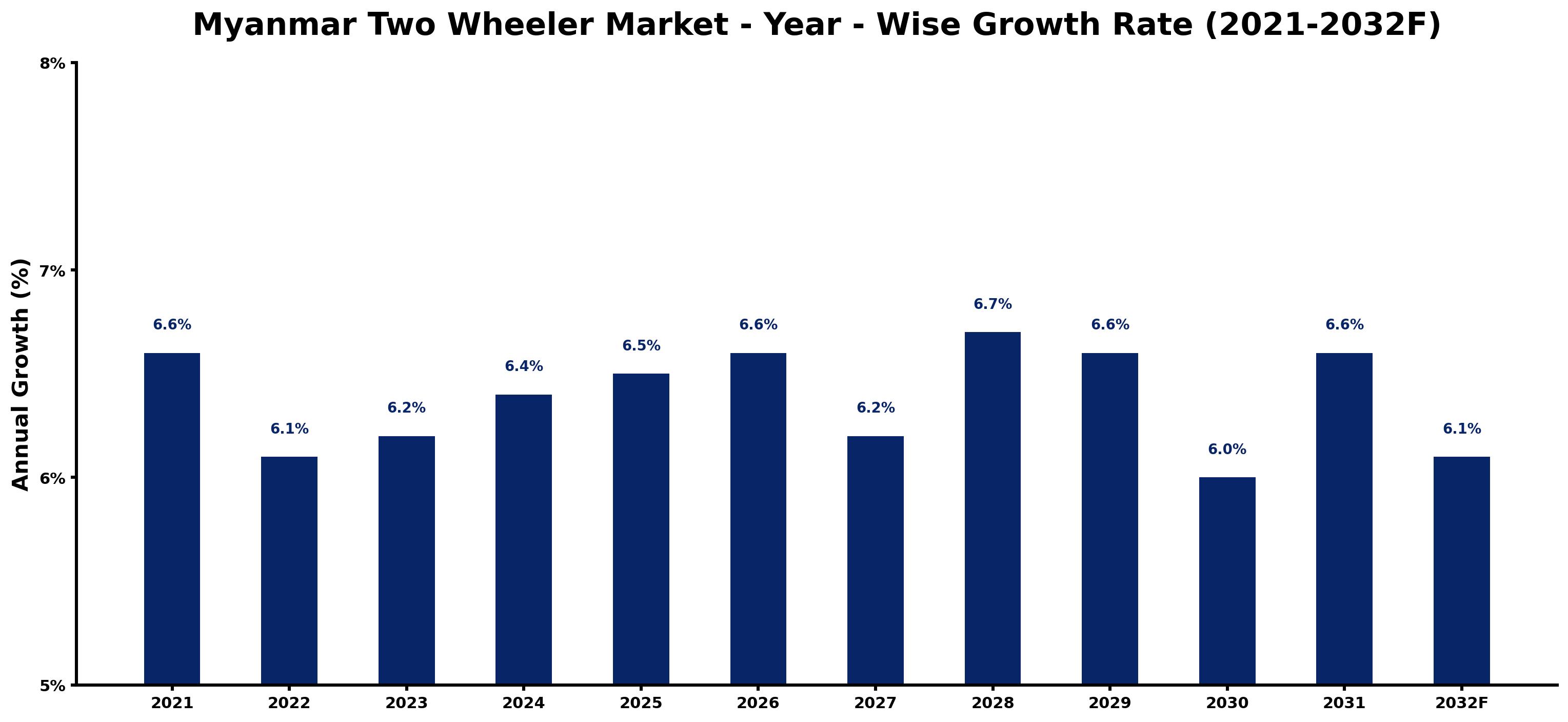
The table below presents the year wise growth rates along with the key drivers influencing the market
| Year | Growth Rate | Major Drivers |
| 2021 | 6.6% | Urbanization trends in Myanmar are creating higher demand for affordable transportation options. |
| 2022 | 6.1% | Increased disposable incomes enable more consumers to consider two-wheelers for commuting. |
| 2023 | 6.2% | Rising fuel prices prompt many to look for more fuel-efficient commuting alternatives. |
| 2024 | 6.4% | Investment in road infrastructure improves accessibility, promoting two-wheeler usage nationwide. |
| 2025 | 6.5% | Young population demographics favor two-wheelers over traditional vehicles for personal mobility. |
| 2026 | 6.6% | Technological innovations in vehicles enhance safety, attracting more buyers to two-wheelers. |
| 2027 | 6.2% | E-commerce growth leads to increased delivery services relying on two-wheeler logistics. |
| 2028 | 6.7% | Environmental concerns encourage consumers to choose two-wheelers, which typically emit less pollution. |
| 2029 | 6.6% | Competing mobility solutions emerge, pushing two-wheeler manufacturers to innovate rapidly. |
| 2030 | 6.0% | Rural electrification initiatives boost electric two-wheeler adoption in previously underserved areas. |
| 2031 | 6.6% | Financing options for two-wheeler purchases expand, making ownership accessible to many. |
| 2032 | 6.1% | Local manufacturing developments reduce costs, encouraging widespread availability of two-wheelers. |
Note - Market size estimations and growth projections presented in this report are based on 6Wresearch's advanced forecasting approach, validated with industry datasets as of June 2026.
Myanmar Two Wheeler Market Synopsis
The Myanmar Two Wheeler Market is projected to reach 6.6% and witness significant growth during the forecast period (2026-2032). This growth can be attributed to several transformative factors, including rising disposable incomes and a shift in consumer lifestyles towards more convenient and cost-effective modes of transportation. The increasing acceptance of two-wheelers as a practical solution has further solidified their position in the market.
Myanmar Two Wheeler Market Growth Drivers
The growth of the Myanmar two wheeler market is propelled by a confluence of economic and social trends. Firstly, the surge in disposable incomes is a primary driver, allowing a larger segment of the population to afford personal transportation. Secondly, changing lifestyles, particularly in urban areas, have resulted in a preference for two-wheelers over traditional public transport due to their convenience and maneuverability in congested traffic.
- Increasing urbanization has led to a rise in the number of daily commuters, enhancing the demand for efficient transport solutions.
- Government initiatives promoting two-wheelers, such as subsidies and easier financing options, are making ownership more accessible.
- The cultural shift towards embracing two-wheelers as a viable alternative to cars is also catalyzing market growth.
- Technological advancements, especially in electric mobility, are generating new interest and opportunities within the sector.
- Competitive pricing strategies from local manufacturers are helping to diversify the market and attract new consumers.
Myanmar Two Wheeler Market Challenges and Restraints
Despite robust growth potential, the Myanmar two wheeler market faces several challenges that could impede its trajectory. One significant barrier is the infrastructure inadequacy in many regions, particularly in rural areas where road quality can limit the practicality of two-wheelers.
- Safety concerns related to traffic regulations and rider training remain prominent, posing a risk to widespread adoption.
- Economic fluctuations can influence consumer spending patterns, making potential buyers hesitant to invest in two-wheelers.
- Lack of access to reliable service and maintenance facilities can deter ownership, particularly in less urbanized locations.
- Environmental concerns regarding emissions from traditional two-wheelers may shift consumer preference towards more sustainable options.
- Competition from alternative modes of transport, including ride-sharing services, could undermine growth in the sector.
Myanmar Two Wheeler Market Trends and Opportunities
The Myanmar two wheeler market is evolving in response to both consumer preferences and technological advancements. Emerging trends indicate a noticeable shift towards electric vehicles, spurred by environmental considerations and government incentives aimed at reducing pollution.
- Electric two-wheelers are gaining traction, driven by increased consumer awareness regarding sustainability.
- Urban areas are witnessing a rise in smart transportation solutions, integrating technology with traditional mobility.
- Online platforms for purchasing two-wheelers are becoming more prevalent, enhancing accessibility for buyers.
- Increased focus on safety features and rider education programs is likely to improve overall market conditions.
- Partnerships between local governments and private sectors are fostering infrastructure development to support the growing two wheeler market.
Myanmar Two Wheeler Market Government Investment and Initiatives
The Myanmar government has recognized the growing significance of the two wheeler market as a vital component of its transportation strategy. Various initiatives have been launched to bolster market growth, including easy financing schemes aimed at improving affordability for consumers.
- Tax incentives for manufacturers and consumers purchasing electric two-wheelers are aimed at promoting greener transportation.
- Investment in road infrastructure improvements is being prioritized to facilitate safer riding conditions for two-wheeler users.
- Public campaigns on road safety and responsible riding practices are being implemented to enhance rider awareness.
- Collaboration with international organizations for technology transfer is intended to modernize the two wheeler manufacturing sector.
- Upgrading licensing and registration processes is being explored to streamline operations and improve market accessibility.
Myanmar Two Wheeler Market Latest Developments (May 2025 - June 2026)
Recent developments in the Myanmar two wheeler market highlight a dynamic response to consumer needs and government policies. The influx of electric two-wheelers is indicative of a broader strategy to promote environmentally friendly transport solutions. Regulatory frameworks are evolving to accommodate these advancements while ensuring safety and compliance in the market.
- The government has initiated pilot programs to test electric vehicle infrastructure in urban centers, setting the stage for broader adoption.
- New partnerships are being formed between local governments and NGOs focused on promoting safe riding practices.
- Industry stakeholders are increasingly advocating for clearer safety regulations to protect riders and encourage responsible ownership.
- Emerging startups are introducing innovative business models, such as ride-sharing platforms specifically for two-wheelers.
- Consumer feedback mechanisms are being emphasized, allowing companies to adapt offerings to better meet market demands.
Myanmar Two Wheeler Market - Key Attractiveness of the Report
- 10 Years of Market Numbers
- Historical Data Starting from 2022 to 2025
- Base Year: 2025
- Forecast Data until 2032
- Key Performance Indicators Impacting the Market
- Major Upcoming Developments and Projects
Key Highlights of the Report:
- Myanmar Two Wheeler Market Outlook
- Market Size of Myanmar Two Wheeler Market, 2025
- Forecast of Myanmar Two Wheeler Market, 2032F
- Historical Data and Forecast of Myanmar Two Wheeler Revenues & Volume for the Period 2022-2032F
- Myanmar Two Wheeler Market Trend Evolution
- Myanmar Two Wheeler Market Drivers and Challenges
- Myanmar Two Wheeler Price Trends
- Myanmar Two Wheeler Porter's Five Forces
- Myanmar Two Wheeler Industry Life Cycle
- Historical Data and Forecast of Myanmar Two Wheeler Market Revenues & Volume By Vehicle Type for the Period 2022-2032F
- Historical Data and Forecast of Myanmar Two Wheeler Market Revenues & Volume By Motorcycle for the Period 2022-2032F
- Historical Data and Forecast of Myanmar Two Wheeler Market Revenues & Volume By Scooter/Moped for the Period 2022-2032F
- Historical Data and Forecast of Myanmar Two Wheeler Market Revenues & Volume By Engine Capacity for the Period 2022-2032F
- Historical Data and Forecast of Myanmar Two Wheeler Market Revenues & Volume By Up to 125cc for the Period 2022-2032F
- Historical Data and Forecast of Myanmar Two Wheeler Market Revenues & Volume By 126-250cc for the Period 2022-2032F
- Historical Data and Forecast of Myanmar Two Wheeler Market Revenues & Volume By 251-500cc for the Period 2022-2032F
- Historical Data and Forecast of Myanmar Two Wheeler Market Revenues & Volume By Above 500cc for the Period 2022-2032F
- Myanmar Two Wheeler Import Export Trade Statistics
- Market Opportunity Assessment By Vehicle Type
- Market Opportunity Assessment By Engine Capacity
- Myanmar Two Wheeler Top Companies Market Share
- Myanmar Two Wheeler Competitive Benchmarking By Technical and Operational Parameters
- Myanmar Two Wheeler Company Profiles
- Myanmar Two Wheeler Key Strategic Recommendations






































