Myanmar Vetiver Oil Market Size, Share & Growth Rate
The Myanmar Vetiver Oil Market was estimated at USD 424 Million in 2025 and is projected to reach USD 597 Million by 2032, growing at a CAGR of 5.0% from 2026 to 2032. This growth trajectory is fueled by a rising consumer preference for natural and organic ingredients across various applications, particularly in the cosmetics and aromatherapy sectors. Furthermore, the global push towards sustainable and eco-friendly products is creating fertile ground for the vetiver oil market, driving both local and international demand.
Myanmar Vetiver Oil Market Year-wise Growth Rate and Key Drivers
This graph highlights how the Myanmar Vetiver Oil Market has steadily grown over the years, supported by major growth factors.
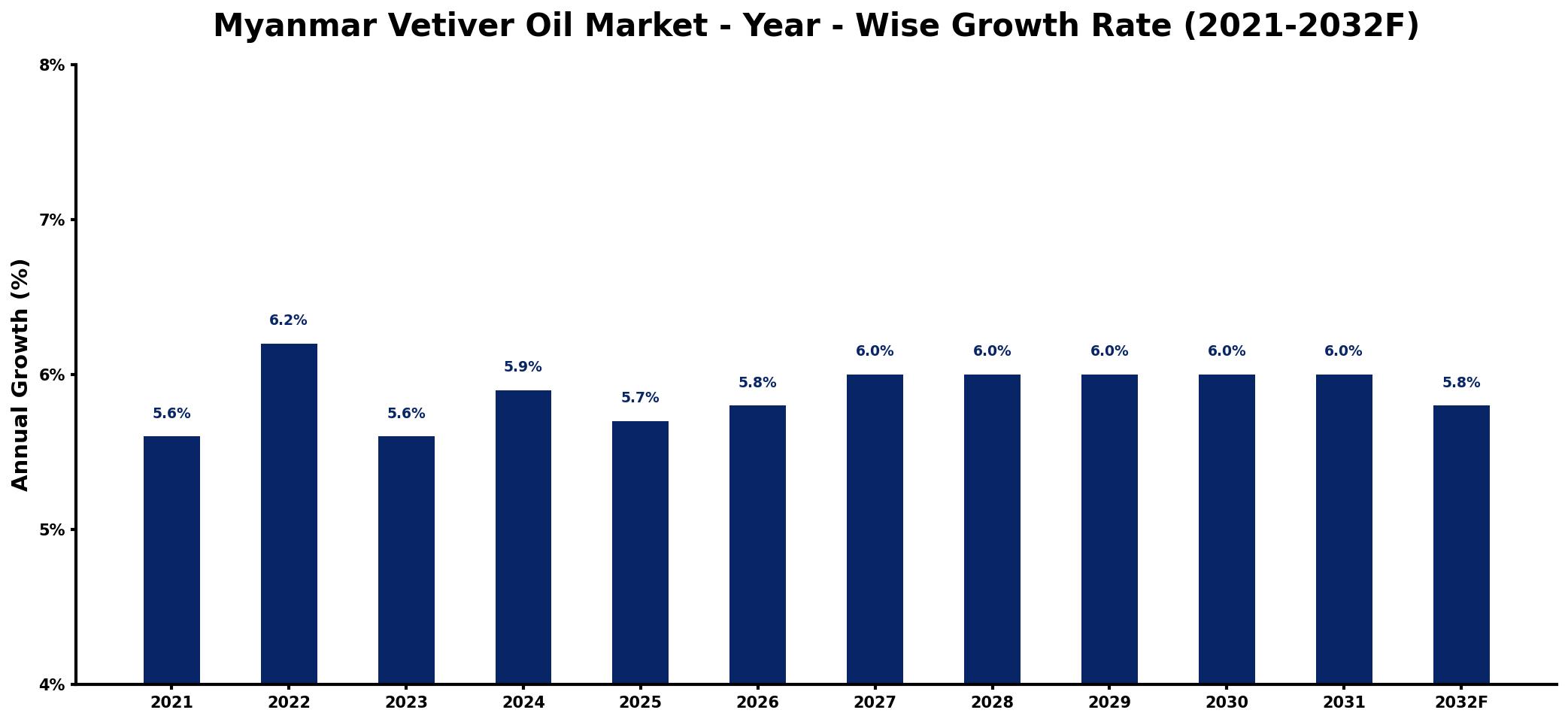
The table below presents the year‑wise growth rates along with the key drivers influencing the market
| Year | Growth Rate | Major Drivers |
| 2021 | 5.6% | rising demand in fragrance sector |
| 2022 | 6.2% | expansion of organic farming initiatives |
| 2023 | 5.6% | increased investment in sustainable practices |
| 2024 | 5.9% | growing popularity in aromatherapy applications |
| 2025 | 5.7% | enhanced distribution channels emerging |
| 2026 | 5.8% | stronger global market penetration strategies |
| 2027 | 6.0% | increased collaboration with cosmetic brands |
| 2028 | 6.0% | broader acceptance in wellness industries |
| 2029 | 6.0% | growing interest from eco-conscious consumers |
| 2030 | 6.0% | expansion into new geographical markets |
| 2031 | 6.0% | rising exports to international markets |
| 2032 | 5.8% | increased research on therapeutic benefits |
Note: Market size estimations and growth projections presented in this report are based on 6Wresearch's proprietary forecasting methodology, utilizing the latest available industry data, government publications, and primary research inputs.
Myanmar Vetiver Oil Market Synopsis
Recent momentum in the Myanmar Vetiver Oil Market has been marked by increasing demand for vetiver oil in perfumery and personal care products. However, as the market expands, challenges related to quality control and market access remain significant, potentially hindering optimal growth.
Looking ahead, the market is expected to pivot towards enhanced sustainability practices and technological innovations in extraction processes. As awareness of vetiver oils benefits rises, and with supportive governmental initiatives, Myanmar's position as a key player in the global vetiver oil market could solidify further.
Myanmar Vetiver Oil Market Key Takeaways
- The market is driven by rising consumer preferences for natural and organic products.
- Technological advancements in extraction methods are beginning to reshape production standards.
- Government initiatives aim to bolster cultivation and processing capabilities in the sector.
- Quality assurance remains a critical concern affecting competitive positioning in international markets.
- The expansion of global aromatherapy trends is expected to stimulate further growth in the vetiver oil segment.
Evaluation of Restraints in Myanmar Vetiver Oil Market
Despite the promising outlook, the Myanmar Vetiver Oil Market faces notable restraints. A primary concern is the inconsistent quality of raw materials, which impacts product reliability and consumer trust. Farmers often struggle with access to advanced extraction technologies, limiting their efficiency and product quality. Additionally, the lack of organized market structures hampers farmers' ability to secure fair pricing for their crops, leading to instability in earnings. Compounding these issues is a relative absence of effective marketing and branding strategies, which further restricts the markets ability to compete on a global scale.
Myanmar Vetiver Oil Market Trends
Current trends indicate a significant shift towards organic and sustainably sourced vetiver oil, particularly as consumers become more discerning regarding product ingredients. The growth of the wellness sector has led to heightened interest in aromatherapy, further enhancing the demand for high-quality vetiver oil. Additionally, technological innovations, such as improved extraction methods, are helping to enhance the oil's quality while reducing waste. As these trends continue to evolve, they will likely redefine the landscape of the Myanmar Vetiver Oil Market.
Myanmar Vetiver Oil Market Opportunities
Investment opportunities within the Myanmar Vetiver Oil Market are promising, particularly in the areas of sustainable farming practices and advanced processing technologies. As international markets increasingly seek responsibly sourced vetiver oil, Myanmar can position itself as a leading supplier. Moreover, enhanced branding and marketing initiatives focusing on the unique characteristics of Myanmars vetiver can carve out a niche in the competitive global arena. Collaborations with international partners could also facilitate technology transfer and skills development, further unlocking the market's potential.
Government Initiatives in the Myanmar Vetiver Oil Market
The Myanmar government has taken proactive steps to promote the vetiver oil sector through various supportive initiatives. This includes financial incentives aimed at encouraging the cultivation and processing of vetiver plants. Government policies focus on funding research that explores sustainable extraction methods and best practices, as well as promoting the export of high-quality vetiver oil. Such initiatives are crucial to enhancing the overall market structure and ensuring fair benefits for local farmers.
Future Insights of the Myanmar Vetiver Oil Market
As we look forward to 2026-2032, the Myanmar Vetiver Oil Market is poised for transformative growth. With the ongoing global shift towards natural and eco-friendly products, the demand for vetiver oil is expected to surge, particularly in cosmetics and wellness applications. Technological advancements and improved extraction methods will likely enhance product quality, addressing current challenges. Additionally, the alignment of government policies with market needs will foster a more organized and profitable environment for farmers, paving the way for Myanmars emergence as a key player in the global vetiver oil market.
Myanmar Vetiver Oil Market Latest Developments (2025 - 2026)
In recent months, the Myanmar Vetiver Oil Market has seen a strategic focus on improving extraction technologies and marketing efforts. Several initiatives aimed at educating farmers on best practices have been launched, aimed at boosting the quality of vetiver oil produced. Moreover, the international demand for sustainably sourced oils is prompting local producers to enhance their branding strategies. As a result, the market is gradually transforming, becoming more competitive on the international stage.
Myanmar Vetiver Oil Market - Key Attractiveness of the Report
- 10 Years of Market Numbers
- Historical Data Starting from 2022 to 2025
- Base Year: 2025
- Forecast Data until 2032
- Key Performance Indicators Impacting the Market
- Major Upcoming Developments and Projects
Key Highlights of the Report:
- Myanmar Vetiver Oil Market Outlook
- Market Size of Myanmar Vetiver Oil Market, 2025
- Forecast of Myanmar Vetiver Oil Market, 2032
- Historical Data and Forecast of Myanmar Vetiver Oil Revenues & Volume for the Period 2022-2032F
- Myanmar Vetiver Oil Market Trend Evolution
- Myanmar Vetiver Oil Market Drivers and Challenges
- Myanmar Vetiver Oil Price Trends
- Myanmar Vetiver Oil Porter's Five Forces
- Myanmar Vetiver Oil Industry Life Cycle
- Historical Data and Forecast of Myanmar Vetiver Oil Market Revenues & Volume By Application for the Period 2022-2032F
- Historical Data and Forecast of Myanmar Vetiver Oil Market Revenues & Volume By Medical for the Period 2022-2032F
- Historical Data and Forecast of Myanmar Vetiver Oil Market Revenues & Volume By Food & Beverage for the Period 2022-2032F
- Historical Data and Forecast of Myanmar Vetiver Oil Market Revenues & Volume By Spa & Relaxation for the Period 2022-2032F
- Myanmar Vetiver Oil Import Export Trade Statistics
- Market Opportunity Assessment By Application
- Myanmar Vetiver Oil Top Companies Market Share
- Myanmar Vetiver Oil Competitive Benchmarking By Technical and Operational Parameters
- Myanmar Vetiver Oil Company Profiles
- Myanmar Vetiver Oil Key Strategic Recommendations






































