Myanmar Video Game Market Summary
The myanmar video game market was estimated at USD 447 Million in 2025 and is projected to reach USD 588 Million by 2032, growing at a CAGR of 4.5% from 2026 to 2032.
Myanmar Video Game Market Year-wise Growth Rate and Key Drivers
This graph highlights how the Myanmar Video Game Market has steadily grown over the past five years, supported by major growth factors.
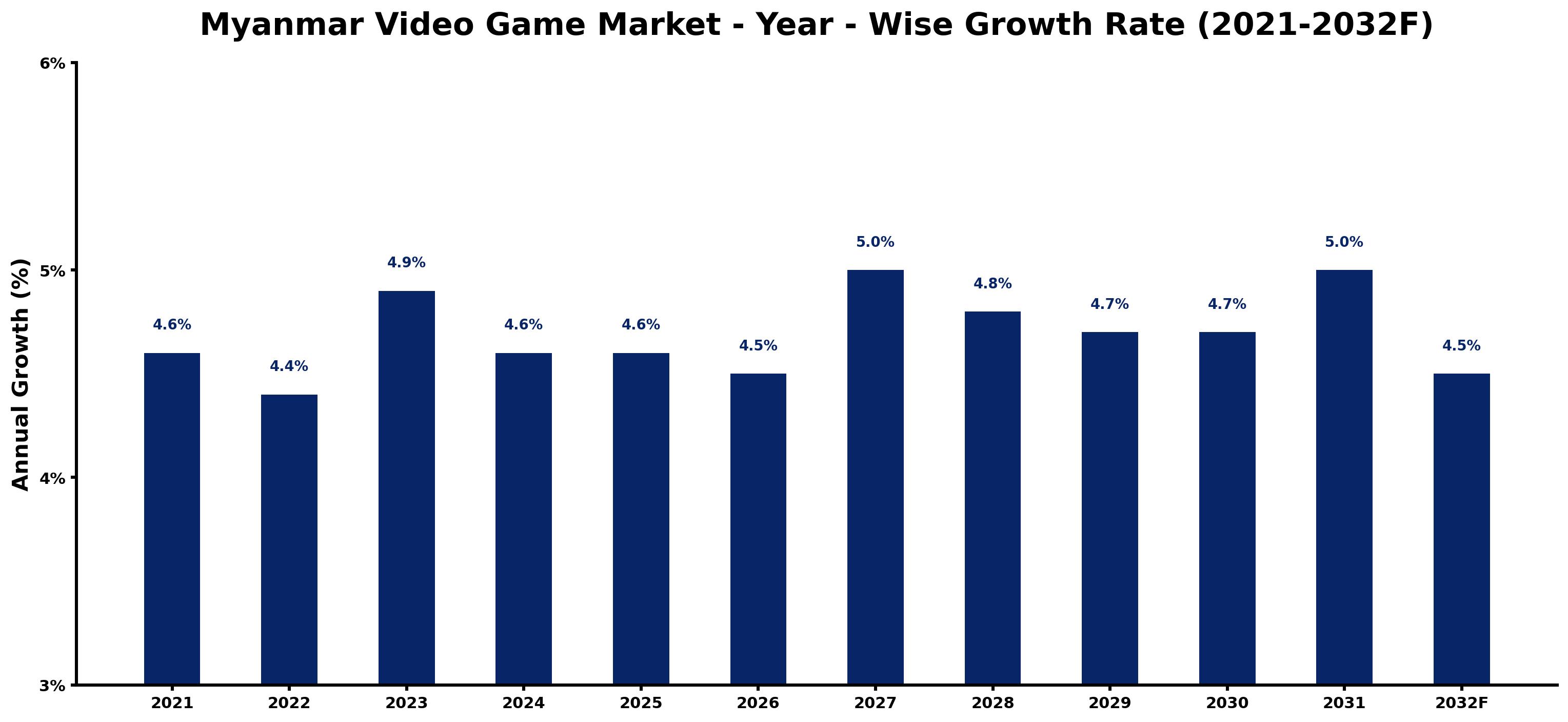
The table below presents the year wise growth rates along with the key drivers influencing the market
| Year | Growth Rate | Major Drivers |
| 2021 | 4.6% | Mobile penetration reached unprecedented levels, unlocking gaming potential across diverse demographics. |
| 2022 | 4.4% | Indigenous game developers began creating locally relevant content, enhancing player engagement significantly. |
| 2023 | 4.9% | Internet infrastructure improvements facilitated smoother online experiences, attracting more competitive gamers. |
| 2024 | 4.6% | Youth culture increasingly embraces gaming, leading to higher acceptance among parents and communities. |
| 2025 | 4.6% | E-sports tournaments gained traction, fostering community spirit and increasing investment in gaming. |
| 2026 | 4.5% | Cross-platform gaming options became mainstream, appealing to a broader audience and driving participation. |
| 2027 | 5.0% | Mobile payment solutions flourished, simplifying transactions and boosting in-game purchases significantly. |
| 2028 | 4.8% | Local partnerships with global gaming entities introduced better resources and advanced technologies. |
| 2029 | 4.7% | Emerging VR and AR experiences transformed traditional gaming dynamics, captivating tech-savvy audiences. |
| 2030 | 4.7% | The entertainment sector embraced gaming, integrating it into cultural events and festivals nationwide. |
| 2031 | 5.0% | Educational institutions recognized gaming's potential, developing curriculums around game design and development. |
| 2032 | 4.5% | Sustainability trends influenced developers to create eco-friendly gaming environments and narratives. |
Note - Market size estimations and growth projections presented in this report are based on 6Wresearch's advanced forecasting approach, validated with industry datasets as of June 2026.
Myanmar Video Game Market Synopsis
The Myanmar Video Game Market is projected to reach 4.5% and witness significant growth during the forecast period (2026-2032). The landscape of this market is evolving, driven by recent governmental reforms and an increasing appetite for digital entertainment among the youth demographic. The relaxation of foreign investment restrictions has opened the doors for international players, injecting competition and fostering innovation in gaming products and services.
Myanmar Video Game Market Growth Drivers
Several factors are propelling the growth of the Myanmar Video Game Market. First, the surge in smartphone penetration is a pivotal driver, as mobile devices become the primary platform for gaming. Second, the rising disposable incomes among the younger population enable more consumers to invest in gaming content. Third, the increasing availability of mobile internet services, despite existing challenges, enhances the accessibility of online gaming. Fourth, the cultural shift towards gaming as a legitimate form of entertainment fosters a growing community of gamers. Lastly, the influx of international gaming companies stimulates local talent development and encourages the creation of localized content, further driving market demand.
Myanmar Video Game Market Challenges and Restraints
While the Myanmar Video Game Market is set for growth, several challenges remain. Limited access to gaming hardware and software hampers the market, as slow internet connectivity and underdeveloped infrastructure restrict online gaming experiences. Additionally, high import taxes on gaming consoles make them unaffordable for many potential consumers, limiting market access. Furthermore, cultural factors may also play a role in the slow adoption of certain gaming genres that are popular in other regions. Lastly, ongoing political instability can pose risks for foreign investment and market sustainability.
Myanmar Video Game Market Trends and Opportunities
Key trends are emerging within the Myanmar Video Game Market that indicate potential opportunities for growth. The increasing popularity of mobile gaming is leading to the development of more diverse game genres appealing to local preferences. Additionally, there is a noticeable trend towards user-generated content and community-driven game development, which fosters a sense of ownership among gamers. The rise of eSports is capturing the interest of younger audiences, creating opportunities for sponsorships and live events. Moreover, partnerships between local developers and international publishers are becoming more common, enabling knowledge transfer and resource sharing. Finally, as the market matures, there is an opportunity for educational games that can engage users while addressing skill gaps in various sectors.
Myanmar Video Game Market Government Investment and Initiatives
The government of Myanmar is beginning to recognize the potential of the video game market as a contributor to economic growth. Recent initiatives focus on fostering a conducive environment for technology and digital innovation. Public spending is being directed towards improving digital infrastructure, which is essential for supporting online gaming experiences. Additionally, the government has expressed interest in collaboration with industry stakeholders to enhance educational programs related to game development. Incentives for local startups in the tech sector could also potentially benefit the gaming industry by encouraging new entrants and increasing competition.
Myanmar Video Game Market Latest Developments (May 2025 - June 2026)
In the period from May 2025 to June 2026, the Myanmar Video Game Market witnessed several significant developments. The government has continued to promote digital literacy programs, which are crucial for empowering young entrepreneurs in game development. Additionally, the market saw a rise in local game studios creating content tailored to Myanmar's culture, which has garnered positive consumer response. Moreover, there has been an increase in collaborative events such as gaming festivals and competitions, further enriching the gaming culture in the country. Notably, the advancements in mobile technology have led to the launch of innovative gaming applications that leverage local stories and folklore, distinguishing Myanmar's offerings in the global market.
Myanmar Video Game Market - Key Attractiveness of the Report
- 10 Years of Market Numbers
- Historical Data Starting from 2022 to 2025
- Base Year: 2025
- Forecast Data until 2032
- Key Performance Indicators Impacting the Market
- Major Upcoming Developments and Projects
Key Highlights of the Report:
- Myanmar Video Game Market Outlook
- Market Size of Myanmar Video Game Market, 2025
- Forecast of Myanmar Video Game Market, 2032F
- Historical Data and Forecast of Myanmar Video Game Revenues & Volume for the Period 2022-2032F
- Myanmar Video Game Market Trend Evolution
- Myanmar Video Game Market Drivers and Challenges
- Myanmar Video Game Price Trends
- Myanmar Video Game Porter's Five Forces
- Myanmar Video Game Industry Life Cycle
- Historical Data and Forecast of Myanmar Video Game Market Revenues & Volume By Device for the Period 2022-2032F
- Historical Data and Forecast of Myanmar Video Game Market Revenues & Volume By Console for the Period 2022-2032F
- Historical Data and Forecast of Myanmar Video Game Market Revenues & Volume By Mobile for the Period 2022-2032F
- Historical Data and Forecast of Myanmar Video Game Market Revenues & Volume By Computer for the Period 2022-2032F
- Historical Data and Forecast of Myanmar Video Game Market Revenues & Volume By Type for the Period 2022-2032F
- Historical Data and Forecast of Myanmar Video Game Market Revenues & Volume By Online for the Period 2022-2032F
- Historical Data and Forecast of Myanmar Video Game Market Revenues & Volume By Offline for the Period 2022-2032F
- Myanmar Video Game Import Export Trade Statistics
- Market Opportunity Assessment By Device
- Market Opportunity Assessment By Type
- Myanmar Video Game Top Companies Market Share
- Myanmar Video Game Competitive Benchmarking By Technical and Operational Parameters
- Myanmar Video Game Company Profiles
- Myanmar Video Game Key Strategic Recommendations






































