Myanmar Wheat Starch Market Size, Share & Growth Rate
The Myanmar Wheat Starch Market was estimated at USD 326 Million in 2025 and is projected to reach USD 428 Million by 2032, growing at a CAGR of 4.0% from 2026 to 2032. This growth trajectory is propelled by the surging demand for processed food products and the burgeoning food processing sector in Myanmar. Rising disposable income levels, coupled with a shift towards convenience foods, underscore the increasing consumer preference that significantly impacts market dynamics.
Myanmar Wheat Starch Market Year-wise Growth Rate and Key Drivers
This graph highlights how the Myanmar Wheat Starch Market has steadily grown over the years, supported by major growth factors.
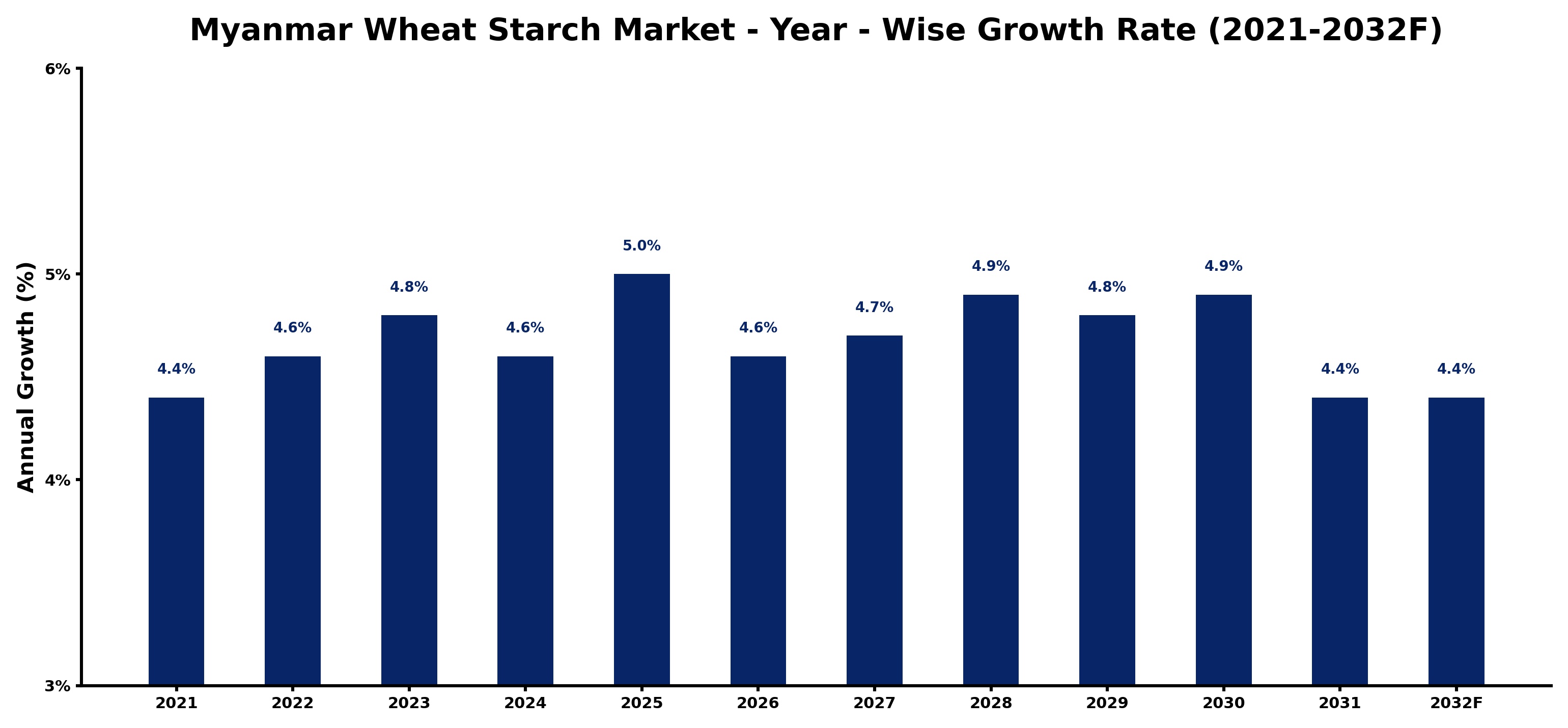
The table below presents the year‑wise growth rates along with the key drivers influencing the market
| Year | Growth Rate | Major Drivers |
| 2021 | 4.4% | Rising demand for gluten alternatives |
| 2022 | 4.6% | Increased health awareness among consumers |
| 2023 | 4.8% | Food processing innovation enhanced quality |
| 2024 | 4.6% | Growing bakery sector expanded usage |
| 2025 | 5.0% | Rising popularity of gluten-free products |
| 2026 | 4.6% | Investment in food technology increased |
| 2027 | 4.7% | Export opportunities expanded significantly |
| 2028 | 4.9% | Consumer preference for local sourcing |
| 2029 | 4.8% | Sustainability trends drove product interest |
| 2030 | 4.9% | Increased collaboration with food manufacturers |
| 2031 | 4.4% | Diversification of product applications grew |
| 2032 | 4.4% | Enhanced marketing strategies attracted consumers |
Note - Market size estimations and growth projections presented in this report are based on 6Wresearch’s advanced forecasting approach, validated with industry datasets as of June 2026.
Myanmar Wheat Starch Market Synopsis
Currently, the Myanmar wheat starch market is on an upward trend, driven by a growing awareness of its versatile applications across multiple industries, including food and beverage. The market is experiencing an influx of innovations as manufacturers adapt their offerings to meet evolving consumer expectations for quality and health benefits.
Furthermore, the increasing consumer inclination towards gluten-free options in food products is fostering greater acceptance of wheat starch. This shift not only enhances market growth but also offers opportunities for new entrants to explore and expand their reach within the local landscape.
Myanmar Wheat Starch Market Key Takeaways
- The market is characterized by steady growth, attributed to the rising demand for processed food products.
- Increasing disposable income is empowering consumers to choose premium wheat starch options.
- Innovations in product offerings are helping manufacturers to cater to shifting consumer preferences.
- Government policies aimed at promoting local wheat production support market stability.
- The diverse applications of wheat starch across various industries enhance its market potential.
Evaluation of Restraints in Myanmar Wheat Starch Market
Despite its promising growth potential, the Myanmar wheat starch market faces significant challenges. High import costs and limited local supply due to dependence on imported wheat constrain production capabilities. Additionally, inadequate infrastructure and technology for efficient wheat starch production remain hurdles for industry players. Moreover, the fluctuating prices of raw materials pose an ongoing concern, impacting profitability and operational decisions. These factors necessitate a concerted effort from stakeholders to innovate and improve production processes.
Myanmar Wheat Starch Market Trends
One of the most notable trends is the rising consumer consciousness around health, with an increasing preference for gluten-free and natural food products. This shift has led to higher demand for wheat starch as a clean-label ingredient. Additionally, manufacturers are focusing on research and development to enhance the functionality and applications of wheat starch in various sectors, including food processing, pharmaceuticals, and cosmetics, thereby broadening its market appeal.
Myanmar Wheat Starch Market Opportunities
The market is rich with investment opportunities, particularly in the establishment of local wheat starch production facilities and distribution channels. The expanding food processing industry presents a significant avenue for growth. Investors are encouraged to explore partnerships with local suppliers and farmers, creating a synergy that supports sustainable production while meeting the rising demand for high-quality wheat starch products.
Government Initiatives in the Myanmar Wheat Starch Market
The Myanmar government is actively implementing initiatives to enhance domestic wheat production and reduce import dependency. This includes offering subsidies and technical assistance to local farmers. Regulations have also been introduced to uphold food safety and quality standards in the wheat starch market, aiming to foster a robust domestic industry capable of meeting local and international demands. These initiatives are crucial for establishing a sustainable framework for market growth.
Future Insights of the Myanmar Wheat Starch Market
Looking ahead to 2026-2032, the Myanmar wheat starch market is poised for continuous expansion. As urbanization progresses and consumer preferences increasingly favor convenience foods, the demand for wheat starch is expected to grow steadily. Furthermore, government efforts to bolster agricultural development and enhance production capabilities are likely to play a significant role in supporting this upward trend, despite potential challenges from raw material price fluctuations and competitive alternative starch sources.
Myanmar Wheat Starch Market Latest Developments (May 2025 - June 2026)
Recent developments in the Myanmar wheat starch market indicate a concerted push towards innovation and sustainability. There is a growing emphasis on quality enhancement and product diversification among manufacturers. Additionally, partnerships between local farmers and producers are being fostered to bolster supply chains, improve production efficiencies, and respond effectively to rising consumer demands. These trends reflect the market's adaptive strategies to navigate challenges and seize new opportunities.
Myanmar Wheat Starch Market - Key Attractiveness of the Report
- 10 Years of Market Numbers
- Historical Data Starting from 2022 to 2025
- Base Year: 2025
- Forecast Data until 2032
- Key Performance Indicators Impacting the Market
- Major Upcoming Developments and Projects
Key Highlights of the Report:
- Myanmar Wheat Starch Market Outlook
- Market Size of Myanmar Wheat Starch Market, 2025
- Forecast of Myanmar Wheat Starch Market, 2032
- Historical Data and Forecast of Myanmar Wheat Starch Revenues & Volume for the Period 2022-2032F
- Myanmar Wheat Starch Market Trend Evolution
- Myanmar Wheat Starch Market Drivers and Challenges
- Myanmar Wheat Starch Price Trends
- Myanmar Wheat Starch Porter's Five Forces
- Myanmar Wheat Starch Industry Life Cycle
- Historical Data and Forecast of Myanmar Wheat Starch Market Revenues & Volume By Type for the Period 2022-2032F
- Historical Data and Forecast of Myanmar Wheat Starch Market Revenues & Volume By Native Wheat Starch for the Period 2022-2032F
- Historical Data and Forecast of Myanmar Wheat Starch Market Revenues & Volume By Modified Wheat Starch for the Period 2022-2032F
- Historical Data and Forecast of Myanmar Wheat Starch Market Revenues & Volume By Grade for the Period 2022-2032F
- Historical Data and Forecast of Myanmar Wheat Starch Market Revenues & Volume By Food Grade for the Period 2022-2032F
- Historical Data and Forecast of Myanmar Wheat Starch Market Revenues & Volume By Industrial Grade for the Period 2022-2032F
- Historical Data and Forecast of Myanmar Wheat Starch Market Revenues & Volume By End-Users Industry for the Period 2022-2032F
- Historical Data and Forecast of Myanmar Wheat Starch Market Revenues & Volume By Food and Beverages for the Period 2022-2032F
- Historical Data and Forecast of Myanmar Wheat Starch Market Revenues & Volume By Cosmetics for the Period 2022-2032F
- Historical Data and Forecast of Myanmar Wheat Starch Market Revenues & Volume By Others for the Period 2022-2032F
- Myanmar Wheat Starch Import Export Trade Statistics
- Market Opportunity Assessment By Type
- Market Opportunity Assessment By Grade
- Market Opportunity Assessment By End-Users Industry
- Myanmar Wheat Starch Top Companies Market Share
- Myanmar Wheat Starch Competitive Benchmarking By Technical and Operational Parameters
- Myanmar Wheat Starch Company Profiles
- Myanmar Wheat Starch Key Strategic Recommendations






































