Myanmar Whiskey Market Size, Share & Growth Rate
The Myanmar Whiskey Market was estimated at USD 454 Million in 2025 and is projected to reach USD 617 Million by 2032, growing at a CAGR of 4.5% from 2026 to 2032. This growth trajectory is primarily fueled by rising disposable incomes, which empower consumers to indulge in premium whiskey brands. Additionally, the expanding hospitality sector is creating new avenues for whiskey consumption, further boosting the market.
Myanmar Whiskey Market Growth Rate Analysis (2021-2032)
The Myanmar whiskey market has exhibited stable growth, marked by annual increases of 5.2% in 2021, peaking at 5.6% in both 2025 and 2030. This expansion can be attributed to a rising consumer demand as domestic production flourishes and international brands gain a foothold. Government policies promoting local distilleries have further bolstered investments in infrastructure and technology, enhancing overall production capabilities. Despite minor fluctuations, including a decrease to 5.1% in 2023, the market remains resilient, supported by a growing middle class and a shift towards premium alcoholic beverages. With a projected growth rate of 5.1% in 2032, the sector is poised for continued development as it embraces digitalization and modernization.
Myanmar Whiskey Market Year-wise Growth Rate and Key Drivers
This graph highlights how the Myanmar Whiskey Market has steadily grown over the past five years, supported by major growth factors.
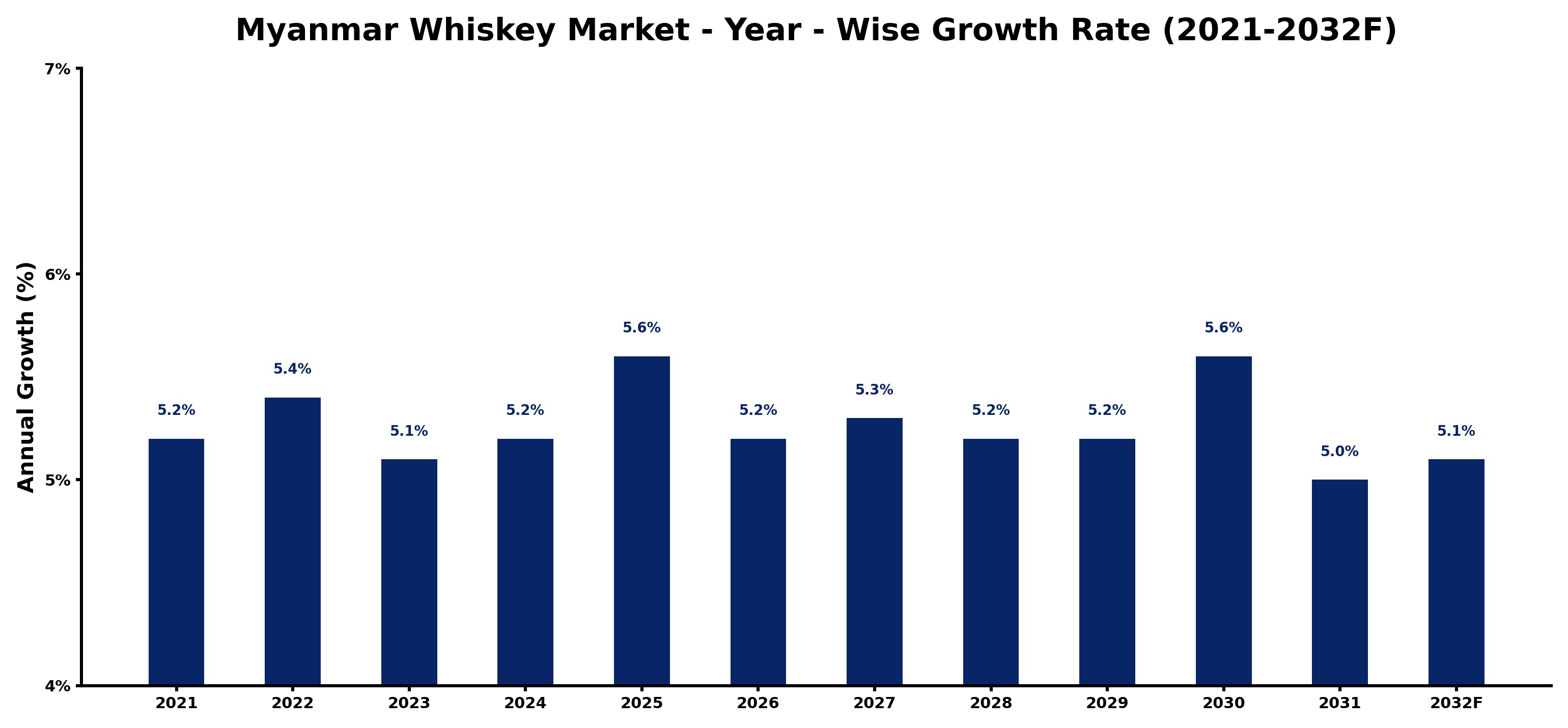
The table below presents the year‑wise growth rates along with the key drivers influencing the market
| Year | Growth Rate | Major Drivers |
| 2021 | 5.2% | Local production capacity increased |
| 2022 | 5.4% | Tourism recovery boosted sales |
| 2023 | 5.1% | E-commerce platforms expanded reach |
| 2024 | 5.2% | Brand collaborations enhanced visibility |
| 2025 | 5.6% | Consumer preference for premium products |
| 2026 | 5.2% | Social media marketing gained traction |
| 2027 | 5.3% | Whiskey tasting events attracted interest |
| 2028 | 5.2% | Craft distilleries emerged in market |
| 2029 | 5.2% | Export opportunities expanded significantly |
| 2030 | 5.6% | Sustainable practices gained consumer favor |
| 2031 | 5.0% | Retail partnerships enhanced distribution |
| 2032 | 5.1% | Cultural events promoted whiskey consumption |
Note - Market size estimations and growth projections presented in this report are based on 6Wresearch’s advanced forecasting approach, validated with industry datasets as of June 2026.
Myanmar Whiskey Market Synopsis
The whiskey market in Myanmar is currently witnessing a transformation driven by a burgeoning middle class eager for sophistication in their drinking choices. This shift aligns with global trends favoring premium spirits, highlighting the increasing demand for quality over quantity.
As the market evolves, consumers are becoming more discerning, gravitating toward craft and imported whiskeys that offer unique flavors and experiences. The interplay between traditional tastes and modern preferences is reshaping the landscape of whiskey consumption in Myanmar.
Myanmar Whiskey Market Key Takeaways
- The market is projected to grow steadily, reflecting an expanding consumer base for premium spirits.
- Increased disposable incomes are driving shifts toward high-quality whiskey options.
- The hospitality industry is a crucial catalyst for market expansion.
- Consumer education on whiskey is crucial for influencing purchasing decisions.
- Marketing strategies need to evolve to cater to diverse consumer preferences and increase brand awareness.
Evaluation of Restraints in Myanmar Whiskey Market
Despite the market's positive outlook, certain restraints pose challenges to its potential. Regulatory and taxation frameworks surrounding alcohol production significantly influence pricing structures and market accessibility. Additionally, intense competition from local brands, coupled with international players entering the market, complicates the landscape for new entrants. The necessity for improved marketing and distribution strategies is apparent, as these factors play a vital role in reaching wider consumer demographics.
Myanmar Whiskey Market Trends
Several trends are currently shaping the Myanmar whiskey market, with a notable shift towards craft distilleries that emphasize quality and local ingredients. Consumers are increasingly seeking whiskeys that offer unique narratives or heritage, reflecting a desire for authentic experiences. Furthermore, online retail channels are gaining traction, driven by the convenience they offer, particularly among younger demographics. As the market continues to develop, these trends are expected to further redefine consumer engagement with whiskey.
Myanmar Whiskey Market Opportunities
The opportunities for growth within the Myanmar whiskey market are substantial. One of the most promising avenues lies in the premium segment, where rising consumer affluence supports a surge in demand for high-end products. Moreover, tapping into the expanding tourism sector by creating whiskey experiences can significantly enhance brand visibility and consumer interest. As local distilleries gain recognition, there is also potential for export opportunities that could leverage Myanmar's unique flavor profiles.
Government Initiatives in the Myanmar Whiskey Market
The Myanmar government plays an essential role in shaping the whiskey market through regulatory frameworks designed to ensure product quality and consumer safety. Policies surrounding the licensing of distilleries and the regulation of alcohol production processes help maintain industry standards. Additionally, taxation measures are implemented to control alcohol consumption, balancing the need for public health with the promotion of responsible drinking.
Future Insights of the Myanmar Whiskey Market
Looking ahead to 2026-2032, the Myanmar whiskey market is poised for significant growth, fueled by changing consumer behaviors and increasing affluence. The shift toward premium products is expected to continue, with consumers actively seeking new experiences and flavors. Furthermore, the hospitality sector's expansion will likely provide a vital platform for whiskey brands to engage consumers and enhance market presence. As these dynamics evolve, the market's adaptability to trends will be crucial for sustained success.
Myanmar Whiskey Market Latest Developments (May 2025 - June 2026)
In recent months, the Myanmar whiskey market has seen a surge in new craft distilleries entering the scene, showcasing local ingredients and unique flavors that resonate with the evolving consumer preferences. Additionally, major events highlighting whiskey culture have been organized to educate consumers and promote brand engagement. The ongoing growth of e-commerce platforms is also making premium whiskey more accessible to a broader audience, reflecting a significant shift in purchasing behavior.
Myanmar Whiskey Market - Key Attractiveness of the Report
- 10 Years of Market Numbers
- Historical Data Starting from 2022 to 2025
- Base Year: 2025
- Forecast Data until 2032
- Key Performance Indicators Impacting the Market
- Major Upcoming Developments and Projects
Key Highlights of the Report:
- Myanmar Whiskey Market Outlook
- Market Size of Myanmar Whiskey Market, 2025
- Forecast of Myanmar Whiskey Market, 2032
- Historical Data and Forecast of Myanmar Whiskey Revenues & Volume for the Period 2022-2032F
- Myanmar Whiskey Market Trend Evolution
- Myanmar Whiskey Market Drivers and Challenges
- Myanmar Whiskey Price Trends
- Myanmar Whiskey Porter's Five Forces
- Myanmar Whiskey Industry Life Cycle
- Historical Data and Forecast of Myanmar Whiskey Market Revenues & Volume By Product Type for the Period 2022-2032F
- Historical Data and Forecast of Myanmar Whiskey Market Revenues & Volume By American Whisky for the Period 2022-2032F
- Historical Data and Forecast of Myanmar Whiskey Market Revenues & Volume By Irish Whisky for the Period 2022-2032F
- Historical Data and Forecast of Myanmar Whiskey Market Revenues & Volume By Scotch Whisky for the Period 2022-2032F
- Historical Data and Forecast of Myanmar Whiskey Market Revenues & Volume By Canadian Whisky for the Period 2022-2032F
- Historical Data and Forecast of Myanmar Whiskey Market Revenues & Volume By Others for the Period 2022-2032F
- Historical Data and Forecast of Myanmar Whiskey Market Revenues & Volume By Distribution Channel for the Period 2022-2032F
- Historical Data and Forecast of Myanmar Whiskey Market Revenues & Volume By On-trade for the Period 2022-2032F
- Historical Data and Forecast of Myanmar Whiskey Market Revenues & Volume By Off-trade for the Period 2022-2032F
- Myanmar Whiskey Import Export Trade Statistics
- Market Opportunity Assessment By Product Type
- Market Opportunity Assessment By Distribution Channel
- Myanmar Whiskey Top Companies Market Share
- Myanmar Whiskey Competitive Benchmarking By Technical and Operational Parameters
- Myanmar Whiskey Company Profiles
- Myanmar Whiskey Key Strategic Recommendations






































