Nepal Ascorbic Acid Market Size, Share & Growth Rate
The Nepal Ascorbic Acid Market was estimated at USD 351 Million in 2025 and is projected to reach USD 459 Million by 2032, growing at a CAGR of 3.9% from 2026 to 2032. This growth trajectory is largely fueled by an increasing consumer awareness of the health benefits of vitamin C, particularly in light of the ongoing emphasis on immunity. Ascorbic acid's versatile applications across various sectors, including food and beverage, pharmaceuticals, and cosmetics, further solidify its position as a crucial component in the Nepalese market.
Nepal Ascorbic Acid Market Year-wise Growth Rate and Key Drivers
This graph highlights how the Nepal Ascorbic Acid Market has steadily grown over the years, supported by major growth factors.
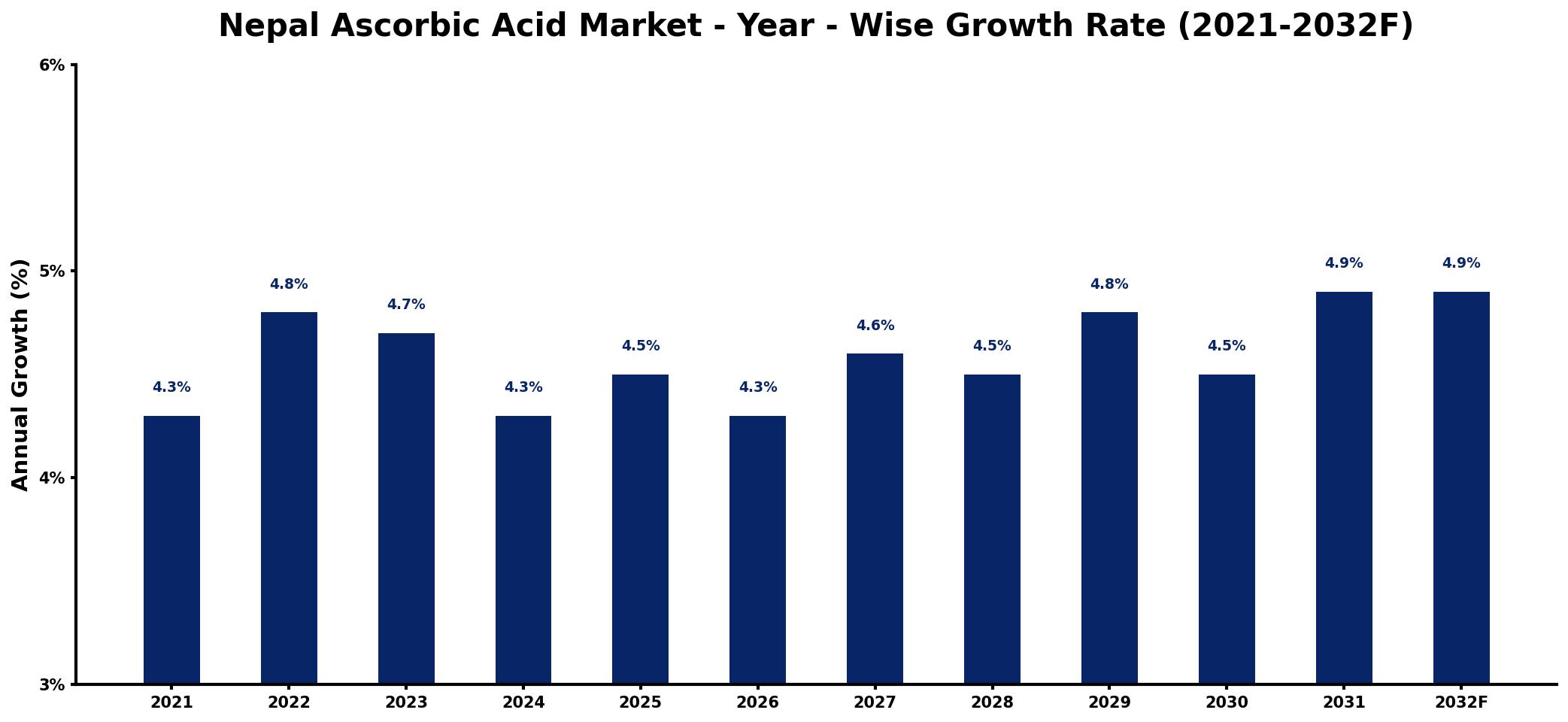
The table below presents the year‑wise growth rates along with the key drivers influencing the market
| Year | Growth Rate | Major Drivers |
| 2021 | 4.3% | Rising health consciousness among consumers |
| 2022 | 4.8% | Increased demand from pharmaceutical sector |
| 2023 | 4.7% | Growing popularity of dietary supplements |
| 2024 | 4.3% | Expansion of food fortification initiatives |
| 2025 | 4.5% | Surge in functional beverage market |
| 2026 | 4.3% | Higher investments in research development |
| 2027 | 4.6% | Emerging trends in organic products |
| 2028 | 4.5% | Strengthening distribution network efficiency |
| 2029 | 4.8% | Increased focus on preventive healthcare |
| 2030 | 4.5% | Growth of online retail channels |
| 2031 | 4.9% | Rising awareness of nutritional benefits |
| 2032 | 4.9% | Development of innovative product formulations |
Note: Market size estimations and growth projections presented in this report are based on 6Wresearch's proprietary forecasting methodology, utilizing the latest available industry data, government publications, and primary research inputs.
Nepal Ascorbic Acid Market Synopsis
Currently, the Nepal Ascorbic Acid market is witnessing a surge in demand, particularly for dietary supplements and fortified food products. This recent momentum contrasts with the market's earlier stagnation, indicating a shift driven by heightened health consciousness among consumers. Looking ahead, the market is expected to continue on this upward trend, supported by ongoing product innovation and increasing import activities from regional powerhouses.
The reliance on imports from countries such as China and India poses challenges for local production capacities. However, this dependence also opens doors for strategic partnerships and investment opportunities aimed at establishing local manufacturing facilities. As consumers continue to seek quality vitamin C products, the competitive landscape will likely intensify, prompting businesses to enhance their offerings and engage in effective marketing strategies.
Nepal Ascorbic Acid Market Key Takeaways
- Growing awareness of vitamin C's health benefits is driving demand across multiple sectors.
- The market is currently dominated by imports, indicating potential for local manufacturing growth.
- Increased focus on fortified products in food and beverages is enhancing market prospects.
- Health trends and changing lifestyles among consumers are major contributors to market expansion.
- Ongoing product innovation and competitive pricing are vital for companies aiming to succeed in the market.
Evaluation of Restraints in Nepal Ascorbic Acid Market
Despite the positive momentum, several factors continue to restrain the Nepal Ascorbic Acid market. Fluctuating raw material prices create uncertainty, impacting production costs and pricing strategies. Additionally, the country's inadequate infrastructure for storage and transportation can compromise product quality and delivery efficiency. Consumer awareness remains low, which further hampers market growth as potential customers may not fully understand the diverse applications and benefits of ascorbic acid. Lastly, regulatory hurdles add complexity for local manufacturers, making it essential for companies to develop strategic plans to navigate these challenges effectively.
Nepal Ascorbic Acid Market Trends
Several trends are emerging within the Nepal Ascorbic Acid market that could shape future demand. The COVID-19 pandemic has heightened consumer awareness regarding health and wellness, resulting in a surge in interest for vitamin C supplements. Concurrently, the food and beverage sector is increasingly incorporating ascorbic acid as both a preservative and antioxidant, catering to consumer preferences for fresher, longer-lasting products. Moreover, the pharmaceutical industry is expanding its use of ascorbic acid in various formulations, reflecting a broader trend toward functional health products.
Nepal Ascorbic Acid Market Opportunities
Opportunities abound in the Nepal Ascorbic Acid market, particularly for investors looking to establish or enhance production facilities. With rising disposable incomes and growing health consciousness, there is a significant market for dietary supplements and fortified products. Collaborating with local manufacturers to leverage ascorbic acid's properties can lead to innovative product development, especially in the cosmetics sector. The strategic geographical position of Nepal, adjacent to major markets in India and China, offers added advantages for distribution and export opportunities.
Government Initiatives in the Nepal Ascorbic Acid Market
The Nepalese government has instituted a range of policies aimed at fostering a robust ascorbic acid market. Regulatory measures by the Department of Drug Administration (DDA) ensure that all pharmaceutical products meet safety and quality standards. Importers and manufacturers are required to comply with Good Manufacturing Practices (GMP), and tariffs on imported ascorbic acid support local producers. These initiatives are designed to safeguard public health while simultaneously promoting self-sufficiency in the domestic market.
Future Insights of the Nepal Ascorbic Acid Market
Looking ahead to 2026-2032, the Nepal Ascorbic Acid Market is projected to experience steady growth, propelled by increasing consumer awareness of vitamin C's health benefits. As various industries, particularly food and beverage and pharmaceuticals, continue to expand, the demand for ascorbic acid will likely remain strong. Rising disposable incomes and a shift toward healthier lifestyles will further contribute to this growth. Furthermore, government initiatives aimed at bolstering domestic production capabilities could reduce dependency on imports and enhance market stability.
Nepal Ascorbic Acid Market Latest Developments (2025 - 2026)
In the latest developments within the Nepal Ascorbic Acid market, there has been an observable trend toward product innovation and enhanced distribution networks. Companies are investing in research and development to create high-quality, fortified products that cater to evolving consumer preferences. Additionally, the government has taken steps to streamline regulatory processes, facilitating smoother market entry for new products. These developments suggest a vibrant and dynamic market landscape poised for further growth.
Nepal Ascorbic Acid Market - Key Attractiveness of the Report
- 10 Years of Market Numbers
- Historical Data Starting from 2022 to 2025
- Base Year: 2025
- Forecast Data until 2032
- Key Performance Indicators Impacting the Market
- Major Upcoming Developments and Projects
Key Highlights of the Report:
- Nepal Ascorbic Acid Market Outlook
- Market Size of Nepal Ascorbic Acid Market, 2025
- Forecast of Nepal Ascorbic Acid Market, 2032
- Historical Data and Forecast of Nepal Ascorbic Acid Revenues & Volume for the Period 2022-2032F
- Nepal Ascorbic Acid Market Trend Evolution
- Nepal Ascorbic Acid Market Drivers and Challenges
- Nepal Ascorbic Acid Price Trends
- Nepal Ascorbic Acid Porter's Five Forces
- Nepal Ascorbic Acid Industry Life Cycle
- Historical Data and Forecast of Nepal Ascorbic Acid Market Revenues & Volume By Grade for the Period 2022-2032F
- Historical Data and Forecast of Nepal Ascorbic Acid Market Revenues & Volume By Food & Pharmaceutical for the Period 2022-2032F
- Historical Data and Forecast of Nepal Ascorbic Acid Market Revenues & Volume By Industrial for the Period 2022-2032F
- Historical Data and Forecast of Nepal Ascorbic Acid Market Revenues & Volume By Application for the Period 2022-2032F
- Historical Data and Forecast of Nepal Ascorbic Acid Market Revenues & Volume By Food & Beverages for the Period 2022-2032F
- Historical Data and Forecast of Nepal Ascorbic Acid Market Revenues & Volume By Pharmaceutical for the Period 2022-2032F
- Historical Data and Forecast of Nepal Ascorbic Acid Market Revenues & Volume By Cosmetics for the Period 2022-2032F
- Historical Data and Forecast of Nepal Ascorbic Acid Market Revenues & Volume By Chemicals for the Period 2022-2032F
- Historical Data and Forecast of Nepal Ascorbic Acid Market Revenues & Volume By Agriculture for the Period 2022-2032F
- Historical Data and Forecast of Nepal Ascorbic Acid Market Revenues & Volume By Others for the Period 2022-2032F
- Nepal Ascorbic Acid Import Export Trade Statistics
- Market Opportunity Assessment By Grade
- Market Opportunity Assessment By Application
- Nepal Ascorbic Acid Top Companies Market Share
- Nepal Ascorbic Acid Competitive Benchmarking By Technical and Operational Parameters
- Nepal Ascorbic Acid Company Profiles
- Nepal Ascorbic Acid Key Strategic Recommendations






































