Nepal Chatbot Market Size & Growth Rate (2026-2032)
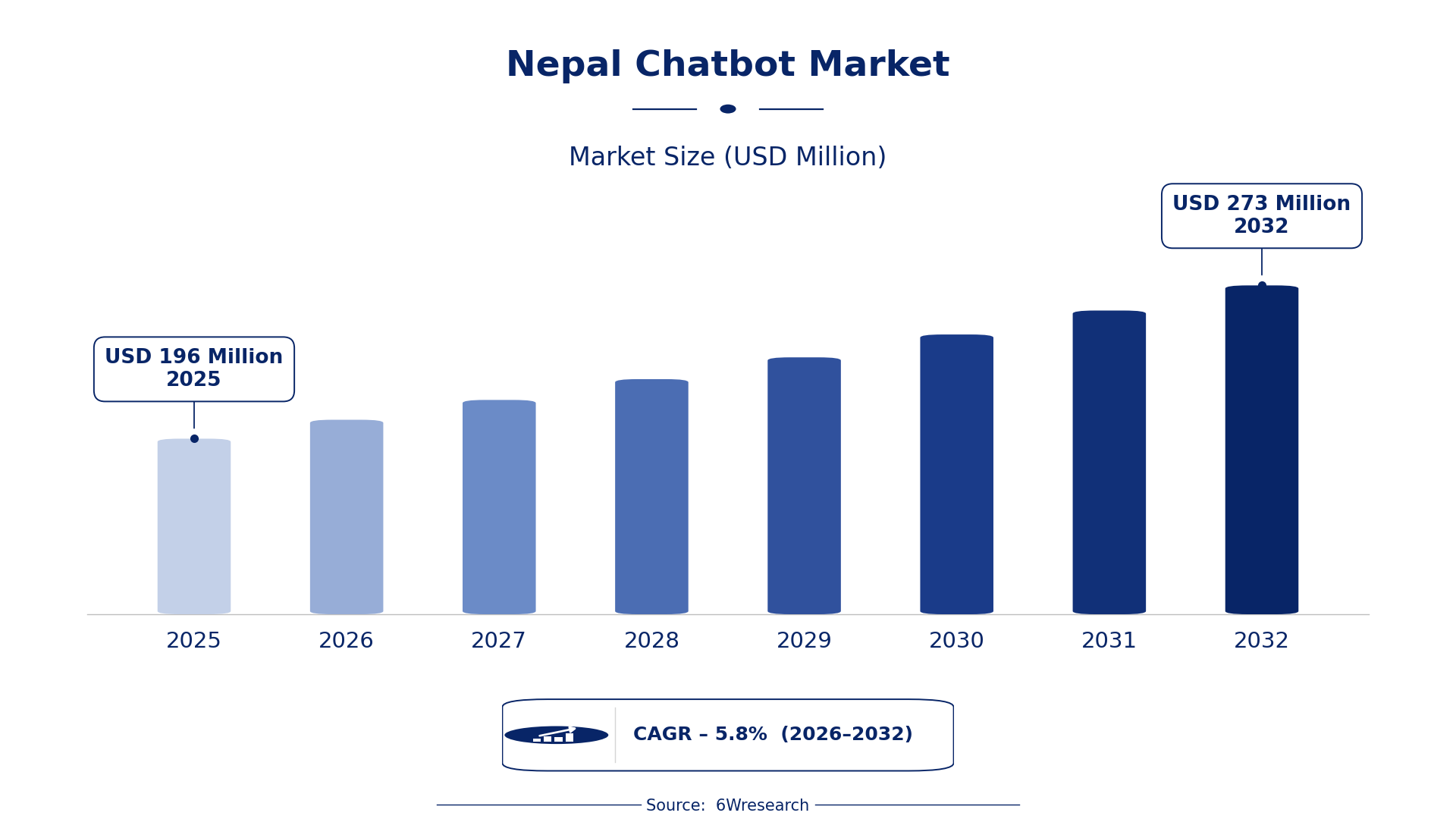
The Nepal Chatbot Market was estimated at USD 196 Million in 2025 and is projected to reach USD 273 Million by 2032, growing at a CAGR of 5.8% from 2026 to 2032.
Nepal Chatbot Market Synopsis
The surge in digital technology adoption in Nepal is driving demand for chatbot solutions, particularly in sectors like banking and e-commerce. As businesses increasingly recognize the efficiency benefits that chatbots provide, investments in AI-powered solutions are becoming commonplace.
In a country characterized by diverse languages and cultures, the development of multilingual chatbots is emerging as a key focus area. This trend not only enhances customer engagement but also addresses the unique needs of Nepal's varied population, positioning businesses to capture a broader market share.
Nepal Chatbot Market Year-wise Growth Rate and Key Drivers
This graph illustrates the annual growth rates of the Nepal Chatbot Market from 2021 to 2032, highlighting a steady upward trajectory and projected expansion over the forecast period.
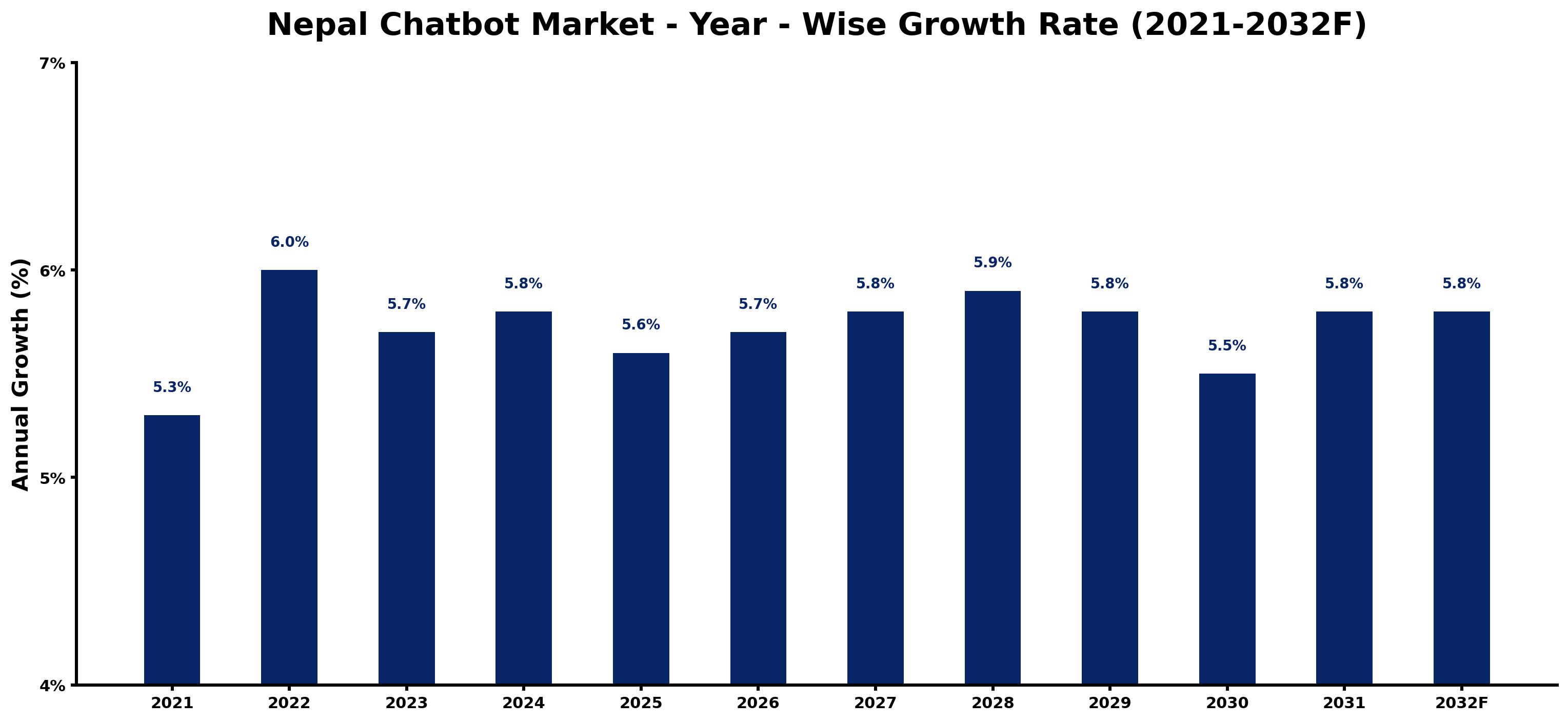
The table below presents the year‑wise growth rates along with the key drivers influencing the market
| Year | Growth Rate | Major Drivers |
| 2021 | 5.3% | Rise in local startups adopting AI-driven solutions. |
| 2022 | 6.0% | Government's Digital Nepal Framework promoting technology adoption. |
| 2023 | 5.7% | Increase in remote work driving chatbot usage. |
| 2024 | 5.8% | Tourism sector's demand for multilingual customer engagement. |
| 2025 | 5.6% | Growing e-commerce sector utilizing chatbots for sales support. |
| 2026 | 5.7% | Local universities enhancing AI curriculum for chatbot technology. |
| 2027 | 5.8% | Rising internet accessibility in rural areas boosts usage. |
| 2028 | 5.9% | Increased investment in fintech driving chatbot implementations. |
| 2029 | 5.8% | Regulatory encouragement for online business communication tools. |
| 2030 | 5.5% | Adoption of telemedicine increasing need for patient chatbots. |
| 2031 | 5.8% | Educational institutions adopting chatbots for administrative support. |
| 2032 | 5.8% | Local businesses enhancing customer satisfaction with AI solutions. |
Note: Market size estimations and growth projections presented in this report are based on 6Wresearch's proprietary forecasting methodology, utilizing the latest available industry data, government publications, and primary research inputs.
Nepal Chatbot Market Key Takeaways
Below are some of the specific key takeaways from the market, including:
- The increasing internet penetration in Nepal is creating a favorable environment for chatbot adoption.
- AI and machine learning technologies are enhancing chatbot capabilities, leading to more personalized user experiences.
- There is a growing trend toward developing multilingual chatbots to cater to Nepal's diverse linguistic landscape.
- Businesses are increasingly seeking cost-effective solutions for customer service, driving chatbot demand.
- Government initiatives aimed at promoting digital literacy support the growth of the chatbot market.
Evaluation of Restraints in Nepal Chatbot Market
Despite promising growth, the Nepal Chatbot Market faces notable constraints. A shortage of skilled developers and AI experts hampers the ability to create and maintain advanced chatbot systems. This talent gap is compounded by a general lack of awareness among businesses regarding the potential benefits of chatbots, which can hinder widespread adoption. on top of that, concerns over data privacy and the need for customized solutions that reflect local cultural nuances present additional hurdles for providers aiming to penetrate this market.
Nepal Chatbot Market Trends
Several trends are shaping the future of the Nepal Chatbot Market. Firstly, the integration of AI and machine learning is becoming critical for businesses looking to enhance user interaction. These technologies enable chatbots to deliver more efficient responses and tailored experiences. Additionally, the demand for chatbots in sectors like tourism and education is on the rise, as businesses seek to improve engagement and service delivery. This growing trend is indicative of the broader digital transformation occurring within various industries.
Nepal Chatbot Market Opportunities
The potential for growth in the Nepal Chatbot Market is substantial. Companies can explore opportunities in developing chatbots that support multiple languages, addressing the needs of diverse user bases. There’s also room for innovation in sectors such as healthcare, where chatbots can streamline patient interactions and appointment scheduling. As businesses become more aware of the cost-saving and customer engagement benefits of chatbots, investments in this technology are expected to increase, opening up additional avenues for service providers.
Government Initiatives in the Nepal Chatbot Market
Government policies play a crucial role in shaping the Nepal Chatbot Market. While there are no specific regulations targeting chatbots, the government’s focus on technological advancement and digital literacy indirectly fosters an environment conducive to growth. Initiatives aimed at enhancing digital infrastructure support the deployment and adoption of chatbot solutions, making it a key area for stakeholders.
- A national digital infrastructure upgrade programme, currently in its rollout phase, aims to enhance internet access across the country.
- The Digital Nepal Framework, an ongoing initiative, is designed to promote innovation in technology sectors, including chatbots.
- Recent policies to improve digital literacy are expected to facilitate greater awareness and usage of chatbot technologies among businesses and consumers.
- Plans for a public-private partnership are underway, targeting enhancements in telecom infrastructure to support more efficient digital services.
- Future initiatives may include regulatory frameworks to ensure data privacy in AI applications, which would be critical for the chatbot sector.
Future Insights of the Nepal Chatbot Market
Looking ahead to 2026-2032, the Nepal Chatbot Market is set for robust growth. The increasing reliance on AI technologies, coupled with the demand for personalized customer experiences, will likely drive market expansion. As businesses continue to adopt digital solutions for operational efficiency, chatbots will play an increasingly vital role in customer engagement strategies. The combination of technological advancements and supportive government policies will create a fertile environment for innovation and investment.
Nepal Chatbot Market Latest Developments
Recent developments in the Nepal Chatbot Market highlight an accelerating interest in AI-driven solutions. Over the past year, businesses have begun to prioritize customer engagement tools, leading to a surge in chatbot implementations across various sectors. This trend is indicative of a broader movement towards digitization.
- A leading regional operator launched a new AI-powered chatbot in early 2025, aimed at enhancing customer support for its e-commerce platform.
- An initiative that began in mid-2025 focuses on developing multilingual capabilities in chatbots, addressing the needs of Nepal's diverse population.
- A major technology vendor is currently testing advanced machine learning algorithms in chatbot interactions, expected to enhance personalization by late 2025.
- Upcoming plans for a chatbot service upgrade are expected to roll out in Q3 2026, aiming to integrate more comprehensive AI functionalities.
- Recent collaborations among tech startups have sparked new innovations in chatbot technology, with several pilot projects underway as of early 2026.
Nepal Chatbot Market - Key Attractiveness of the Report
- 10 Years of Market Numbers
- Historical Data Starting from 2022 to 2025
- Base Year: 2025
- Forecast Data until 2032
- Key Performance Indicators Impacting the Market
- Major Upcoming Developments and Projects
The development of multilingual chatbots presents a significant opportunity, given the country’s diverse languages. on top of that, sectors like healthcare and education are increasingly looking for chatbot solutions to enhance service delivery.
Key Highlights of the Report:
- Nepal Chatbot Market Outlook
- Market Size of Nepal Chatbot Market, 2025
- Forecast of Nepal Chatbot Market, 2032
- Historical Data and Forecast of Nepal Chatbot Revenues & Volume for the Period 2022-2032F
- Nepal Chatbot Market Trend Evolution
- Nepal Chatbot Market Drivers and Challenges
- Nepal Chatbot Price Trends
- Nepal Chatbot Porter's Five Forces
- Nepal Chatbot Industry Life Cycle
- Historical Data and Forecast of Nepal Chatbot Market Revenues & Volume By Component for the Period 2022-2032F
- Historical Data and Forecast of Nepal Chatbot Market Revenues & Volume By Solutions for the Period 2022-2032F
- Historical Data and Forecast of Nepal Chatbot Market Revenues & Volume By Services for the Period 2022-2032F
- Historical Data and Forecast of Nepal Chatbot Market Revenues & Volume By Type for the Period 2022-2032F
- Historical Data and Forecast of Nepal Chatbot Market Revenues & Volume By Rule Based for the Period 2022-2032F
- Historical Data and Forecast of Nepal Chatbot Market Revenues & Volume By AI Based for the Period 2022-2032F
- Historical Data and Forecast of Nepal Chatbot Market Revenues & Volume By Deployment Mode for the Period 2022-2032F
- Historical Data and Forecast of Nepal Chatbot Market Revenues & Volume By On-premises for the Period 2022-2032F
- Historical Data and Forecast of Nepal Chatbot Market Revenues & Volume By Cloud for the Period 2022-2032F
- Historical Data and Forecast of Nepal Chatbot Market Revenues & Volume By Channel Integration for the Period 2022-2032F
- Historical Data and Forecast of Nepal Chatbot Market Revenues & Volume By Websites for the Period 2022-2032F
- Historical Data and Forecast of Nepal Chatbot Market Revenues & Volume By Contact Centers for the Period 2022-2032F
- Historical Data and Forecast of Nepal Chatbot Market Revenues & Volume By Social Media for the Period 2022-2032F
- Historical Data and Forecast of Nepal Chatbot Market Revenues & Volume By Mobile Applications for the Period 2022-2032F
- Historical Data and Forecast of Nepal Chatbot Market Revenues & Volume By Organization Size for the Period 2022-2032F
- Historical Data and Forecast of Nepal Chatbot Market Revenues & Volume By Large Enterprises for the Period 2022-2032F
- Historical Data and Forecast of Nepal Chatbot Market Revenues & Volume By SMEs for the Period 2022-2032F
- Historical Data and Forecast of Nepal Chatbot Market Revenues & Volume By Business Function for the Period 2022-2032F
- Historical Data and Forecast of Nepal Chatbot Market Revenues & Volume By Information Technology Service Management for the Period 2022-2032F
- Historical Data and Forecast of Nepal Chatbot Market Revenues & Volume By Human Resources for the Period 2022-2032F
- Historical Data and Forecast of Nepal Chatbot Market Revenues & Volume By Sales and Marketing for the Period 2022-2032F
- Historical Data and Forecast of Nepal Chatbot Market Revenues & Volume By Finance for the Period 2022-2032F
- Historical Data and Forecast of Nepal Chatbot Market Revenues & Volume By Application for the Period 2022-2032F
- Historical Data and Forecast of Nepal Chatbot Market Revenues & Volume By Customer Service for the Period 2022-2032F
- Historical Data and Forecast of Nepal Chatbot Market Revenues & Volume By Personal Assistant for the Period 2022-2032F
- Historical Data and Forecast of Nepal Chatbot Market Revenues & Volume By Branding and Advertisement for the Period 2022-2032F
- Historical Data and Forecast of Nepal Chatbot Market Revenues & Volume By Customer Engagement and Retention for the Period 2022-2032F
- Historical Data and Forecast of Nepal Chatbot Market Revenues & Volume By Data Privacy and Compliance for the Period 2022-2032F
- Historical Data and Forecast of Nepal Chatbot Market Revenues & Volume By Employee Engagement and On Boarding for the Period 2022-2032F
- Historical Data and Forecast of Nepal Chatbot Market Revenues & Volume By Payment Processing for the Period 2022-2032F
- Historical Data and Forecast of Nepal Chatbot Market Revenues & Volume By Others for the Period 2022-2032F
- Historical Data and Forecast of Nepal Chatbot Market Revenues & Volume By Vertical for the Period 2022-2032F
- Historical Data and Forecast of Nepal Chatbot Market Revenues & Volume By BFSI for the Period 2022-2032F
- Historical Data and Forecast of Nepal Chatbot Market Revenues & Volume By IT and Telecom for the Period 2022-2032F
- Historical Data and Forecast of Nepal Chatbot Market Revenues & Volume By Retail and Ecommerce for the Period 2022-2032F
- Historical Data and Forecast of Nepal Chatbot Market Revenues & Volume By Healthcare and Life Sciences for the Period 2022-2032F
- Historical Data and Forecast of Nepal Chatbot Market Revenues & Volume By Transportation and Logistics for the Period 2022-2032F
- Historical Data and Forecast of Nepal Chatbot Market Revenues & Volume By Government for the Period 2022-2032F
- Historical Data and Forecast of Nepal Chatbot Market Revenues & Volume By Travel and Hospitality for the Period 2022-2032F
- Historical Data and Forecast of Nepal Chatbot Market Revenues & Volume By Media and Entertainment for the Period 2022-2032F
- Nepal Chatbot Import Export Trade Statistics
- Market Opportunity Assessment By Component
- Market Opportunity Assessment By Type
- Market Opportunity Assessment By Deployment Mode
- Market Opportunity Assessment By Channel Integration
- Market Opportunity Assessment By Organization Size
- Market Opportunity Assessment By Business Function
- Market Opportunity Assessment By Application
- Market Opportunity Assessment By Vertical
- Nepal Chatbot Top Companies Market Share
- Nepal Chatbot Competitive Benchmarking By Technical and Operational Parameters
- Nepal Chatbot Company Profiles
- Nepal Chatbot Key Strategic Recommendations






































