Nepal Coaxial Cables Market Summary
The nepal coaxial cables market was estimated at USD 279 Million in 2025 and is projected to reach USD 386 Million by 2032, growing at a CAGR of 5.9% from 2026 to 2032.
Nepal Coaxial Cables Market Year-wise Growth Rate and Key Drivers
This graph highlights how the Nepal Coaxial Cables Market has steadily grown over the past five years, supported by major growth factors.
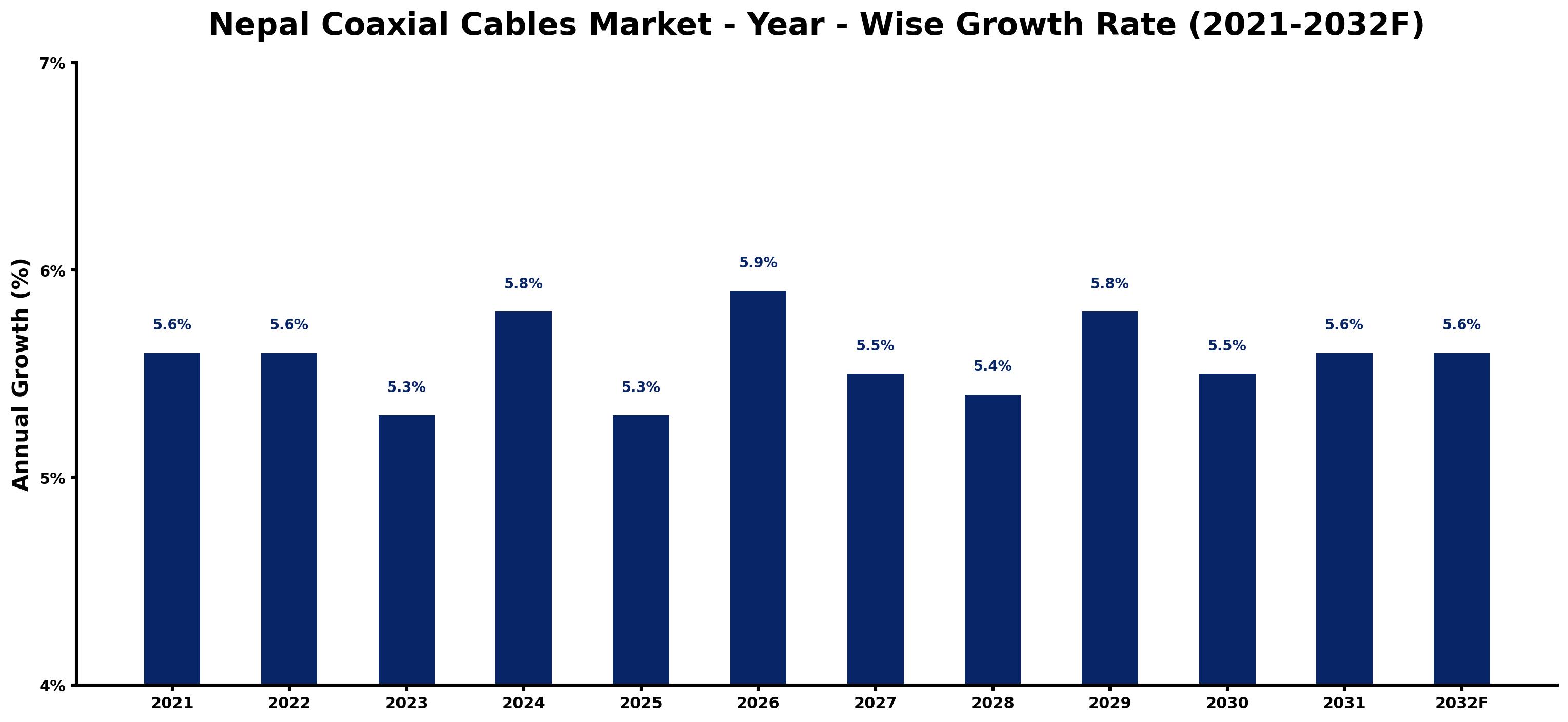
The table below presents the year wise growth rates along with the key drivers influencing the market
| Year | Growth Rate | Major Drivers |
| 2021 | 5.6% | Post-lockdown infrastructure projects resumed, boosting demand for reliable coaxial cables. |
| 2022 | 5.6% | Rural electrification initiatives highlighted the importance of efficient communication systems. |
| 2023 | 5.3% | Local manufacturers invested in quality improvement, enhancing cable performance and reliability. |
| 2024 | 5.8% | Emerging entertainment sectors increased the need for high-bandwidth coaxial installations. |
| 2025 | 5.3% | Urbanization trends prompted expansion in telecommunications infrastructure across major cities. |
| 2026 | 5.9% | Technological integrations in broadcasting necessitated upgraded coaxial cable systems. |
| 2027 | 5.5% | Telecom operators expanded fiber optic networks, complementing existing coaxial solutions. |
| 2028 | 5.4% | Increased competition in media service providers drove innovation in cable technology. |
| 2029 | 5.8% | Government policies favoring local sourcing benefited domestic coaxial cable manufacturers. |
| 2030 | 5.5% | Smart city projects demanded advanced coaxial solutions for seamless connectivity. |
| 2031 | 5.6% | International partnerships focused on knowledge transfer, enhancing local manufacturing capabilities. |
| 2032 | 5.6% | Growing consumer preferences for high-speed internet prioritized modern coaxial infrastructure. |
Note - Market size estimations and growth projections presented in this report are based on 6Wresearch's advanced forecasting approach, validated with industry datasets as of June 2026.
Nepal Coaxial Cables Market Synopsis
The Nepal Coaxial Cables Market is projected to reach 5.9% and witness significant growth during the forecast period (2026-2032). This growth is primarily fueled by the increasing demand for reliable high-speed internet and advanced television broadcasting services across the country. As Nepal's digital infrastructure expands, local manufacturers are stepping up to meet the demand within the telecommunications, broadcasting, and networking sectors. This dynamic market landscape reflects the country's ongoing digitalization efforts and the essential role of coaxial cables in supporting these technological advancements.
Nepal Coaxial Cables Market Growth Drivers
The growth of the Nepal Coaxial Cables Market is driven by several key factors:
- The increasing penetration of high-speed internet services in urban and rural areas significantly boosts the demand for quality coaxial cables.
- Ongoing investments in telecommunications infrastructure, including the rollout of 5G networks, necessitate high-performance cables to maintain connectivity and data transmission quality.
- The rise in digital media consumption, particularly cable TV subscriptions, is driving the need for reliable coaxial cables to enhance viewer experience.
- Residential and commercial construction projects are expanding, creating a demand for coaxial cables in various applications, from broadband to video surveillance systems.
- Consumer awareness is growing regarding the benefits of using high-quality coaxial cables, further enhancing market demand.
Nepal Coaxial Cables Market Trends and Opportunities
In recent years, the Nepal Coaxial Cables Market has demonstrated several notable trends:
- There is a marked shift towards the development of technologically advanced cables that offer improved durability, efficiency, and performance under various environmental conditions.
- Manufacturers are increasingly adopting eco-friendly production processes in response to rising environmental concerns, creating a sustainable product line that appeals to environmentally conscious consumers.
- The growth of smart home technologies is creating opportunities for coaxial cables to be integrated into advanced home networking systems.
- Partnerships between local manufacturers and international tech suppliers are emerging, leading to innovations in cable design and functionality.
- Market players are focusing on enhancing their distribution networks to meet the growing demand effectively, ensuring timely delivery and installation services.
Nepal Coaxial Cables Market Challenges and Restraints
While the market exhibits promising growth potential, it also faces several challenges:
- The proliferation of counterfeit coaxial cables poses a significant threat to genuine manufacturers, undermining trust and quality perceptions among consumers.
- Lack of standardized regulations and enforcement in the industry can lead to inconsistent product quality, making it difficult for consumers to discern between high and low-quality options.
- Limited consumer awareness regarding the importance of investing in high-quality coaxial cables for reliable connectivity presents a barrier for market expansion.
- Established players in the market dominate share, creating an environment where new entrants may encounter difficulties in gaining traction.
- Fluctuations in raw material prices can impact production costs, affecting pricing strategies and profit margins for manufacturers.
Nepal Coaxial Cables Market Investment Opportunities
Investment opportunities in the Nepal Coaxial Cables Market are on the rise, driven by factors such as:
- The escalating demand for high-speed internet services across Nepal, backed by government initiatives to improve connectivity, especially in rural regions.
- Increased investments in telecommunications infrastructure provide a fertile ground for the production and supply of high-quality coaxial cables.
- The construction boom in residential and commercial sectors presents multiple avenues for cable installation, enhancing market opportunities.
- The growing trend of smart home technologies creates a unique market niche, enabling companies to offer innovative solutions that integrate coaxial cables for connectivity.
- Potential partnerships with local distributors and manufacturers can amplify market reach and improve competitive positioning.
Nepal Coaxial Cables Market Government Investment and Initiatives
Government policies play a vital role in shaping the Nepal Coaxial Cables Market landscape. Several initiatives and regulations have been implemented to enhance the sector's growth:
- The government is focused on improving quality standards for coaxial cable production, mandating compliance among manufacturers to ensure product safety and reliability.
- Import and export regulations are in place, requiring companies to navigate licensing requirements and customs protocols, ensuring that all products meet national standards.
- Public spending on digital infrastructure projects supports the expansion of telecommunications networks, encouraging investments in coaxial cable manufacturing.
- Incentives for local manufacturers are being explored as part of broader economic policies to boost domestic production and reduce reliance on imported cables.
- Taxation policies are under review, affecting production costs and overall market dynamics, which could create both challenges and opportunities for businesses.
Nepal Coaxial Cables Market Latest Developments (May 2025 - June 2026)
The period between May 2025 and June 2026 has witnessed several developments in the Nepal Coaxial Cables Market. The drive towards digitalization has been intensified with new government initiatives aimed at improving internet connectivity nationwide. Manufacturers have responded to this push by focusing on product innovation, introducing more durable and efficient coaxial cable options.
Additionally, the industry has observed a rise in eco-friendly practices, aligning with global sustainability trends. Efforts to combat counterfeit products have gained traction, prompting calls for better regulatory oversight to safeguard genuine manufacturers. The increasing integration of smart technologies in households has further spurred the demand for high-quality coaxial cables, reflecting a market in transition towards smarter, more connected solutions.
Nepal Coaxial Cables Market - Key Attractiveness of the Report
- 10 Years of Market Numbers
- Historical Data Starting from 2022 to 2025
- Base Year: 2025
- Forecast Data until 2032
- Key Performance Indicators Impacting the Market
- Major Upcoming Developments and Projects
Key Highlights of the Report:
- Nepal Coaxial Cables Market Outlook
- Market Size of Nepal Coaxial Cables Market, 2025
- Forecast of Nepal Coaxial Cables Market, 2032F
- Historical Data and Forecast of Nepal Coaxial Cables Revenues & Volume for the Period 2022-2032F
- Nepal Coaxial Cables Market Trend Evolution
- Nepal Coaxial Cables Market Drivers and Challenges
- Nepal Coaxial Cables Price Trends
- Nepal Coaxial Cables Porter's Five Forces
- Nepal Coaxial Cables Industry Life Cycle
- Historical Data and Forecast of Nepal Coaxial Cables Market Revenues & Volume By Types for the Period 2022-2032F
- Historical Data and Forecast of Nepal Coaxial Cables Market Revenues & Volume By Hard-line Cable for the Period 2022-2032F
- Historical Data and Forecast of Nepal Coaxial Cables Market Revenues & Volume By Triaxial Cable for the Period 2022-2032F
- Historical Data and Forecast of Nepal Coaxial Cables Market Revenues & Volume By Twin Axial Cable for the Period 2022-2032F
- Historical Data and Forecast of Nepal Coaxial Cables Market Revenues & Volume By Applications for the Period 2022-2032F
- Historical Data and Forecast of Nepal Coaxial Cables Market Revenues & Volume By Internet Data Transfer for the Period 2022-2032F
- Historical Data and Forecast of Nepal Coaxial Cables Market Revenues & Volume By Video Distribution for the Period 2022-2032F
- Historical Data and Forecast of Nepal Coaxial Cables Market Revenues & Volume By Radio Distribution Frequency Transfer for the Period 2022-2032F
- Historical Data and Forecast of Nepal Coaxial Cables Market Revenues & Volume By Others for the Period 2022-2032F
- Historical Data and Forecast of Nepal Coaxial Cables Market Revenues & Volume By End-users for the Period 2022-2032F
- Historical Data and Forecast of Nepal Coaxial Cables Market Revenues & Volume By Cable Television Industry for the Period 2022-2032F
- Historical Data and Forecast of Nepal Coaxial Cables Market Revenues & Volume By Military and Aerospace for the Period 2022-2032F
- Historical Data and Forecast of Nepal Coaxial Cables Market Revenues & Volume By Internet Service Providers for the Period 2022-2032F
- Historical Data and Forecast of Nepal Coaxial Cables Market Revenues & Volume By Telephone Network Operators for the Period 2022-2032F
- Historical Data and Forecast of Nepal Coaxial Cables Market Revenues & Volume By Communication Equipment Manufactures for the Period 2022-2032F
- Nepal Coaxial Cables Import Export Trade Statistics
- Market Opportunity Assessment By Types
- Market Opportunity Assessment By Applications
- Market Opportunity Assessment By End-users
- Nepal Coaxial Cables Top Companies Market Share
- Nepal Coaxial Cables Competitive Benchmarking By Technical and Operational Parameters
- Nepal Coaxial Cables Company Profiles
- Nepal Coaxial Cables Key Strategic Recommendations






































