Dehydrated Vegetables Market: Nepal vs Top 5 Major Economies in 2027 (Asia)
By 2027, Nepal's Dehydrated Vegetables market is forecasted to achieve a high growth rate of 13.28%, with China leading the Asia region, followed by India, Japan, Australia and South Korea.
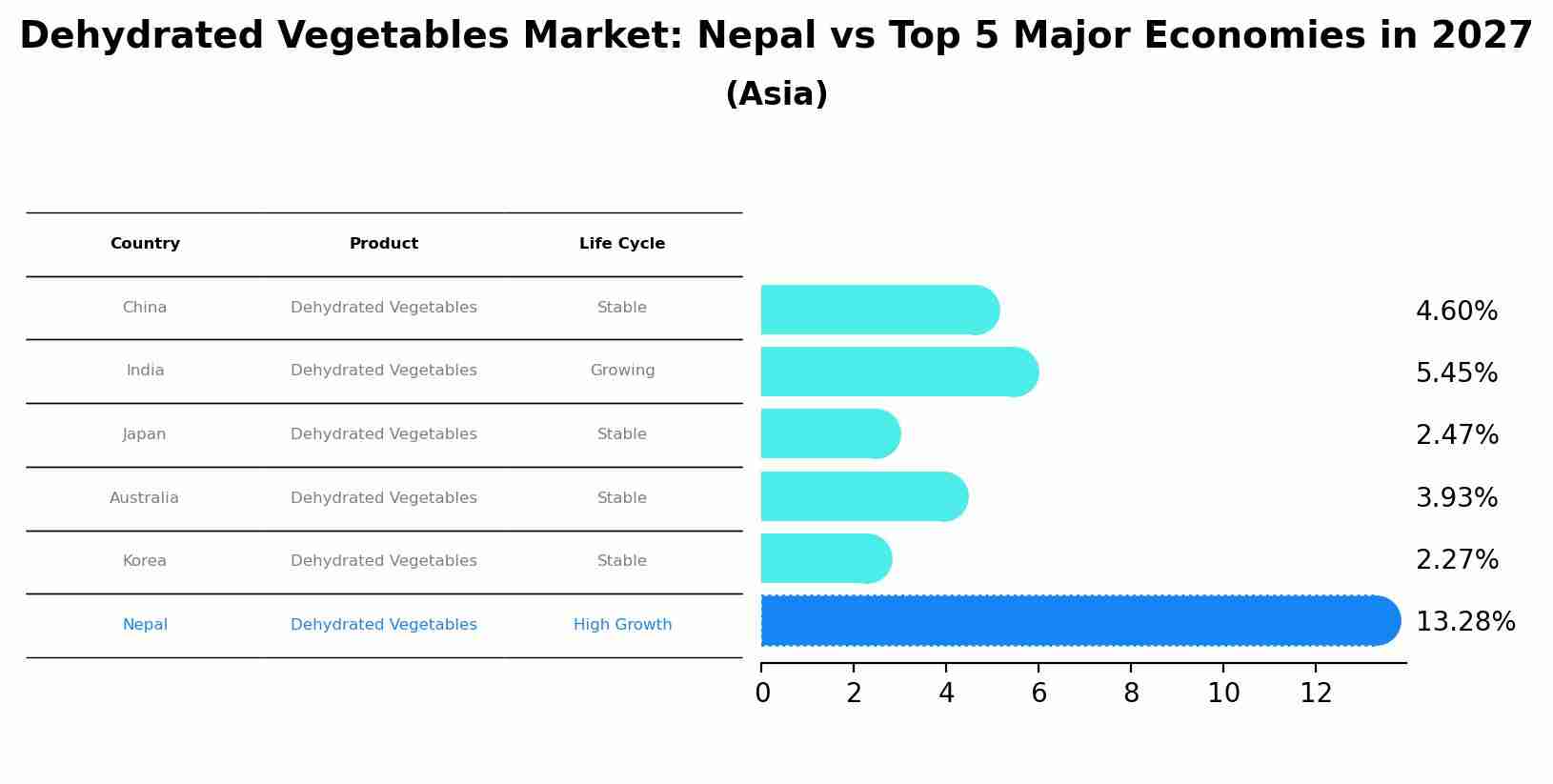
Nepal Dehydrated Vegetables Market Growth Rate
According to 6Wresearch internal database and industry insights, the Nepal Dehydrated Vegetables Market is projected to grow at a compound annual growth rate (CAGR) of 8.3% during the forecast period 2026–2032.
Topics Covered in the Nepal Dehydrated Vegetables Market Report
The Nepal Dehydrated Vegetables Market report thoroughly covers the market by product type, form, technology, distribution channel, and end‑use. It provides an unbiased and detailed analysis of ongoing market trends, opportunities, challenges, and market drivers, helping stakeholders align their strategies with current and future market dynamics.
Nepal Dehydrated Vegetables Market Highlights
| Report Name | Nepal Dehydrated Vegetables Market |
| Forecast Period | 2026–2032 |
| CAGR | 8.3% |
| Growing Sector | Convenience food sectors |
Nepal Dehydrated Vegetables Market Synopsis
The Nepal Dehydrated Vegetables Market is expected to witness strong growth driven by a growing preference for convenience foods, rising participation of women in the workforce, and the expansion of organized retail and e‑commerce channels. Increased awareness of the health and nutritional benefits of dehydrated vegetables has also boosted demand across households and commercial kitchens. With the food processing industry expanding in Nepal, the demand for dehydrated vegetables as raw materials is expected to rise significantly. Changing consumer lifestyles and busy schedules are further contributing to increased adoption of dehydrated vegetables.
Evaluation of Growth Drivers in Nepal Dehydrated Vegetables Market
Below mentioned are some prominent drivers and their influence on Nepal Dehydrated Vegetables Market dynamics:
| Drivers | Primary Segment Affected | Why It Matters (Evidence) |
| Convenience Food Demand | Powder and Granules | Urban consumers prefer ready‑to‑use dehydrated vegetables for quick meal preparation. |
| Health Awareness | All Forms | Growing health consciousness increases preference for nutritious dehydrated vegetables. |
| Retail Expansion | Supermarket & Hypermarket | Organized retail availability enhances product reach. |
| Online Shopping Growth | Online | E‑commerce platforms improve accessibility of dehydrated vegetable products |
The Nepal Dehydrated Vegetables Market is projected to grow at a CAGR of 8.3% from 2026 to 2032. The market is being spurred by changing lifestyles, rising health knowledge, and the growth of distribution channels such as supermarkets, hypermarkets, and online platforms. Rise in the food service sector and growing consumer preference for convenient meal solutions will continue to spur the market. Developments in dehydrated food processing technology and rising focus on sustainability are expected to further help in the Nepal Dehydrated Vegetables Market Growth.
Evaluation of Restraints in Nepal Dehydrated Vegetables Market
Below mentioned are some major restraints and their influence on Nepal Dehydrated Vegetables Market dynamics:
| Restraints | Primary Segment Affected | What This Means (Evidence) |
| Price Sensitivity | Small Retail Segments | Increasing costs of dehydrated vegetables compared to fresh produce may restrict the need among cost‑sensitive consumers. |
| Supply Chain Challenges | All Segments | Impact on timely delivery and product quality owing to inadequate cold chain and logistics infrastructure. |
| Limited Local Processing Capacity | Production | Limitations in supply growth owing to limited local dehydration facilities. |
| Consumer Preference for Fresh Produce | End‑use: Retail | Constrain in market growth in rural areas owing to cultural preference for fresh vegetables. |
Nepal Dehydrated Vegetables Market Challenges
The Nepal Dehydrated Vegetables Industry faces several challenges such as limited local processing infrastructure and inconsistent supply of raw vegetables due to seasonal variations. The preference for fresh produce among many consumers, especially in rural areas, may limit the market’s growth. Affect on product quality and obtainability owing to logistics and supply chain constraints, consisting of inadequate storage and transportation facilities and relatively higher costs of dehydrated products might deter cost‑sensitive consumer segments.
Nepal Dehydrated Vegetables Market Trends
Several notable trends are shaping the Nepal Dehydrated Vegetables Market dynamics:
- Convenience Eating: Rise in the need for ready‑to‑use dehydrated vegetables that decrease cooking time owing Busy lifestyles choices of consumers.
- Health‑Focused Consumption: As consumers are inclining towards healthier food options dehydrated vegetables with retained nutrients are getting popularity.
- Premium & Packaged Products: Consumer interest in high-quality dehydrated vegetable products is spurring owing to branding and attractive packaging.
- Expansion of E‑commerce: Dehydrated vegetable products are becoming more obtainable owing to rise in the reach of online platforms.
Investment Opportunities in the Nepal Dehydrated Vegetables Market
Some notable investment opportunities in the Nepal Dehydrated Vegetables Market are:
- Processing Facility Expansion: Fund allocation in local dehydration and processing facilities can align with the rising domestic requirements and decrease import dependence.
- Cold Chain Infrastructure: Creating robust cold chain solutions to augment logistics and maintain product quality.
- Product Innovation: To appeal health‑conscious consumers there is development in new dehydrated vegetable blends, organic offerings, and fortified products.
Top 5 Leading Players in the Nepal Dehydrated Vegetables Market
Below is the list of prominent companies leading in the Nepal Dehydrated Vegetables Market:
1. Paicho Pasal Pvt. Ltd.
| Company Name | Paicho Pasal Pvt. Ltd. |
|---|---|
| Established Year | 2015 |
| Headquarters | Kathmandu, Nepal |
| Official Website | - |
Paicho Pasal Pvt. Ltd. is a well recognized producer and supplier of dehydrated vegetable products in Nepal, providing a broad range of powdered, minced, and flaked vegetable options for both retail and food service segments.
2. Namche Wine Industries P. Ltd.
| Company Name | Namche Wine Industries P. Ltd. |
|---|---|
| Established Year | 2010 |
| Headquarters | Kathmandu, Nepal |
| Official Website | - |
Namche Wine Industries P. Ltd., though traditionally known for beverages, has diversified into dehydrated vegetable products and processed food ingredients, leveraging its established distribution network to increase its presence in the dehydrated foods market.
3. Himali Krishi Udhyog Pvt. Ltd.
| Company Name | Himali Krishi Udhyog Pvt. Ltd. |
|---|---|
| Established Year | 2012 |
| Headquarters | Pokhara, Nepal |
| Official Website | - |
Himali Krishi Udhyog specializes in the processing and dehydration of locally sourced vegetables, concentrating on quality and nutritional retention.
4. Pure Dry
| Company Name | Pure Dry |
|---|---|
| Established Year | 2018 |
| Headquarters | Chitwan, Nepal |
| Official Website | - |
Pure Dry is a dominant brand in the dehydrated foods segment, offering a range of products such as dehydrated carrots, peas, onions, and tomatoes.
5. Dynamic Mountain Organic Agro Company Pvt. Ltd.
| Company Name | Dynamic Mountain Organic Agro Company Pvt. Ltd. |
|---|---|
| Established Year | 2016 |
| Headquarters | Dhading, Nepal |
| Official Website | - |
Dynamic Mountain Organic Agro Company concentrates on organic dehydrated vegetables and agro products sourced from mountain regions.
Government Regulations Introduced in the Nepal Dehydrated Vegetables Market
According to Nepal’s government data, the Ministry of Agriculture and Livestock Development, has introduced standards for processed foods. It consist of dehydrated products to make sure safety, quality, and hygienic production. Initiatives like the National Agriculture Development Programme (NADP) support agribusiness development. To safeguard consumers food safety regulations under the Consumer Protection Act, make sure compliance with labelling and quality requirements and developments in dehydrated food processing technology is predicted to further accelerate market needs.
Future Insights of the Nepal Dehydrated Vegetables Market
The Nepal Dehydrated Vegetables Market is expected to grow steadily. It is spurred by increasing need for convenience foods, expanding retail and online distribution channels, and growing knowledge of nutritional benefits. Deployment of advanced dehydration technologies and rise of processing infrastructure will further augment product quality and market reach growth in the food service and processed food sectors will create additional opportunities for dehydrated vegetables as ingredients. Fund allocation in cold chain logistics and product innovation will support sustainable market development.
Market Segmentation Analysis
The report offers a comprehensive study of the following market segments and their leading categories:
By Product Type – Carrots to dominate the market
According to Ravi, Senior Research Analyst, 6Wresearch, Carrots are expected to lead the Nepal Dehydrated Vegetables Market Share owing to their widespread use across food preparation, high nutritional value, and consumer preference for carrot‑based dehydrated products.
By Form – Powder & Granules to dominate the market
Powder & Granules are anticipated to lead the market as this form provides convenience in storage and usage for both retail consumers and food processors, boosting demand.
By Technology – Vacuum Drying to dominate the market
Vacuum Drying is projected to lead owing to its ability to preserve maximum nutrients, colour, and flavour in dehydrated vegetables, making it favourable for high-quality product applications.
By Distribution Channel – Supermarket & Hypermarket to dominate the market
Supermarket & Hypermarket channels are anticipated to lead the distribution of dehydrated vegetable products owing to increasing inclination of consumer towards for modern retail outlets and the obtainability of distinctive product ranges.
By End‑use – Retail to dominate the market
The Retail segment is projected to lead the market due to the rising number of individual consumers purchasing dehydrated vegetables for home use and convenience cooking.
Key Attractiveness of the Report:
- 10 Years of Market Numbers.
- Historical Data Starting from 2022 to 2025.
- Base Year: 2025.
- Forecast Data until 2032.
- Key Performance Indicators Impacting the Market.
- Major Upcoming Developments and Projects.
Key Highlights of the Report:
- Nepal Dehydrated Vegetables Market Outlook
- Market Size of Nepal Dehydrated Vegetables Market, 2025
- Forecast of Nepal Dehydrated Vegetables Market, 2032
- Historical Data and Forecast of Nepal Dehydrated Vegetables Revenues & Volume for the Period 2022 - 2032
- Nepal Dehydrated Vegetables Market Trend Evolution
- Nepal Dehydrated Vegetables Market Drivers and Challenges
- Nepal Dehydrated Vegetables Price Trends
- Nepal Dehydrated Vegetables Porter's Five Forces
- Nepal Dehydrated Vegetables Industry Life Cycle
- Historical Data and Forecast of Nepal Dehydrated Vegetables Market Revenues & Volume By Product Type for the Period 2022 - 2032
- Historical Data and Forecast of Nepal Dehydrated Vegetables Market Revenues & Volume By Carrots for the Period 2022 - 2032
- Historical Data and Forecast of Nepal Dehydrated Vegetables Market Revenues & Volume By Beans for the Period 2022 - 2032
- Historical Data and Forecast of Nepal Dehydrated Vegetables Market Revenues & Volume By Onions for the Period 2022 - 2032
- Historical Data and Forecast of Nepal Dehydrated Vegetables Market Revenues & Volume By Tomatoes for the Period 2022 - 2032
- Historical Data and Forecast of Nepal Dehydrated Vegetables Market Revenues & Volume By Peas for the Period 2022 - 2032
- Historical Data and Forecast of Nepal Dehydrated Vegetables Market Revenues & Volume By Corn for the Period 2022 - 2032
- Historical Data and Forecast of Nepal Dehydrated Vegetables Market Revenues & Volume By Broccoli for the Period 2022 - 2032
- Historical Data and Forecast of Nepal Carrots Dehydrated Vegetables Market Revenues & Volume By Others for the Period 2022 - 2032
- Historical Data and Forecast of Nepal Dehydrated Vegetables Market Revenues & Volume By Form for the Period 2022 - 2032
- Historical Data and Forecast of Nepal Dehydrated Vegetables Market Revenues & Volume By Powder and Granules for the Period 2022 - 2032
- Historical Data and Forecast of Nepal Dehydrated Vegetables Market Revenues & Volume By Minced for the Period 2022 - 2032
- Historical Data and Forecast of Nepal Dehydrated Vegetables Market Revenues & Volume By Slices and Cubes for the Period 2022 - 2032
- Historical Data and Forecast of Nepal Dehydrated Vegetables Market Revenues & Volume By Chopped and Flakes for the Period 2022 - 2032
- Historical Data and Forecast of Nepal Dehydrated Vegetables Market Revenues & Volume By Others for the Period 2022 - 2032
- Historical Data and Forecast of Nepal Dehydrated Vegetables Market Revenues & Volume By Technology for the Period 2022 - 2032
- Historical Data and Forecast of Nepal Dehydrated Vegetables Market Revenues & Volume By Vacuum Drying for the Period 2022 - 2032
- Historical Data and Forecast of Nepal Dehydrated Vegetables Market Revenues & Volume By Air Drying for the Period 2022 - 2032
- Historical Data and Forecast of Nepal Dehydrated Vegetables Market Revenues & Volume By Freeze Drying for the Period 2022 - 2032
- Historical Data and Forecast of Nepal Dehydrated Vegetables Market Revenues & Volume By Drum Drying for the Period 2022 - 2032
- Historical Data and Forecast of Nepal Dehydrated Vegetables Market Revenues & Volume By Others for the Period 2022 - 2032
- Historical Data and Forecast of Nepal Dehydrated Vegetables Market Revenues & Volume By Distibution Channel for the Period 2022 - 2032
- Historical Data and Forecast of Nepal Dehydrated Vegetables Market Revenues & Volume By Supermarket and Hypermarket for the Period 2022 - 2032
- Historical Data and Forecast of Nepal Dehydrated Vegetables Market Revenues & Volume By Convenience Stores for the Period 2022 - 2032
- Historical Data and Forecast of Nepal Dehydrated Vegetables Market Revenues & Volume By Online for the Period 2022 - 2032
- Historical Data and Forecast of Nepal Dehydrated Vegetables Market Revenues & Volume By Others for the Period 2022 - 2032
- Historical Data and Forecast of Nepal Dehydrated Vegetables Market Revenues & Volume By Others for the Period 2022 - 2032
- Historical Data and Forecast of Nepal Dehydrated Vegetables Market Revenues & Volume By End-use for the Period 2022 - 2032
- Historical Data and Forecast of Nepal Dehydrated Vegetables Market Revenues & Volume By Retail for the Period 2022 - 2032
- Historical Data and Forecast of Nepal Dehydrated Vegetables Market Revenues & Volume By Food Service for the Period 2022 - 2032
- Historical Data and Forecast of Nepal Dehydrated Vegetables Market Revenues & Volume By Others for the Period 2022 - 2032
- Nepal Dehydrated Vegetables Import Export Trade Statistics
- Market Opportunity Assessment By Product Type
- Market Opportunity Assessment By Form
- Market Opportunity Assessment By Technology
- Market Opportunity Assessment By Distibution Channel
- Market Opportunity Assessment By End-use
- Nepal Dehydrated Vegetables Top Companies Market Share
- Nepal Dehydrated Vegetables Competitive Benchmarking By Technical and Operational Parameters
- Nepal Dehydrated Vegetables Company Profiles
- Nepal Dehydrated Vegetables Key Strategic Recommendations
Market Covered
The report offers a comprehensive study of the following Nepal Dehydrated Vegetables Market segments:
By Product Type
- Carrots
- Beans
- Onions
- Tomatoes
- Peas
- Corn
- Broccoli
- Others
By Form
- Powder & Granules
- Minced
- Slices & Cubes
- Chopped & Flakes
- Others
By Technology
- Vacuum Drying
- Air Drying
- Freeze Drying
- Drum Drying
- Others
By Distribution Channel
- Supermarket & Hypermarket
- Convenience Stores
- Online
- Others
By End‑use
- Retail
- Food Service
- Others






































