Nepal Digital Lending Market Size & Growth Rate (2026-2032)
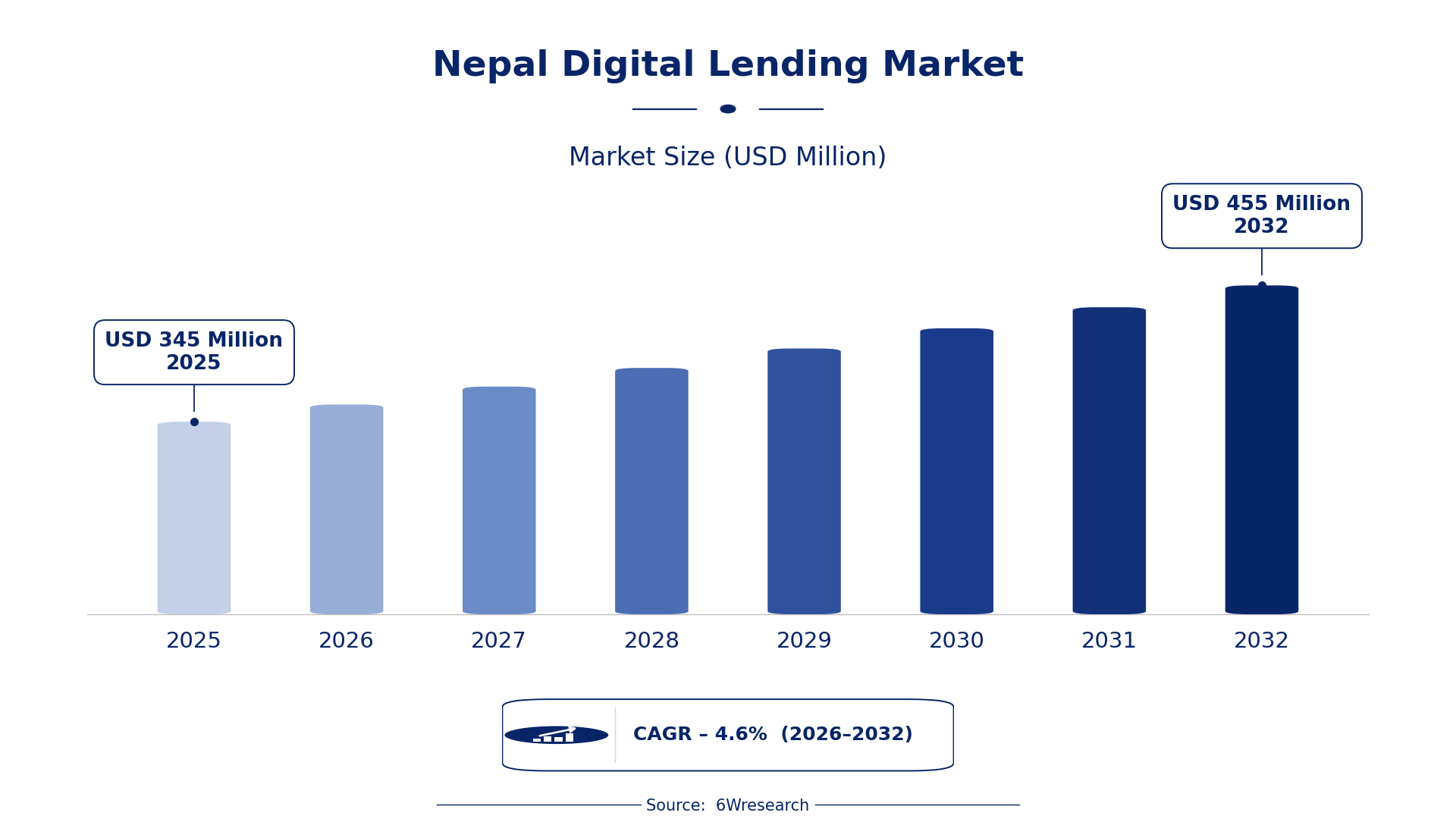
The Nepal Digital Lending Market was estimated at USD 345 Million in 2025 and is projected to reach USD 455 Million by 2032, growing at a CAGR of 4.6% from 2026 to 2032.
Nepal Digital Lending Market Synopsis
The Nepal digital lending market has surged in recent years, propelled by heightened internet accessibility and smartphone usage. This momentum is on track to continue as demand for financial services evolves, particularly among the unbanked and underbanked populations.
As traditional banking struggles to meet the needs of many, digital lending platforms are stepping in to bridge the gap. With ongoing regulatory developments aimed at ensuring responsible lending, the stage is set for a more inclusive financial environment that supports economic growth.
Nepal Digital Lending Market Year-wise Growth Rate and Key Drivers
This graph illustrates the annual growth rates of the Nepal Digital Lending Market from 2021 to 2032, highlighting a steady upward trajectory and projected expansion over the forecast period.
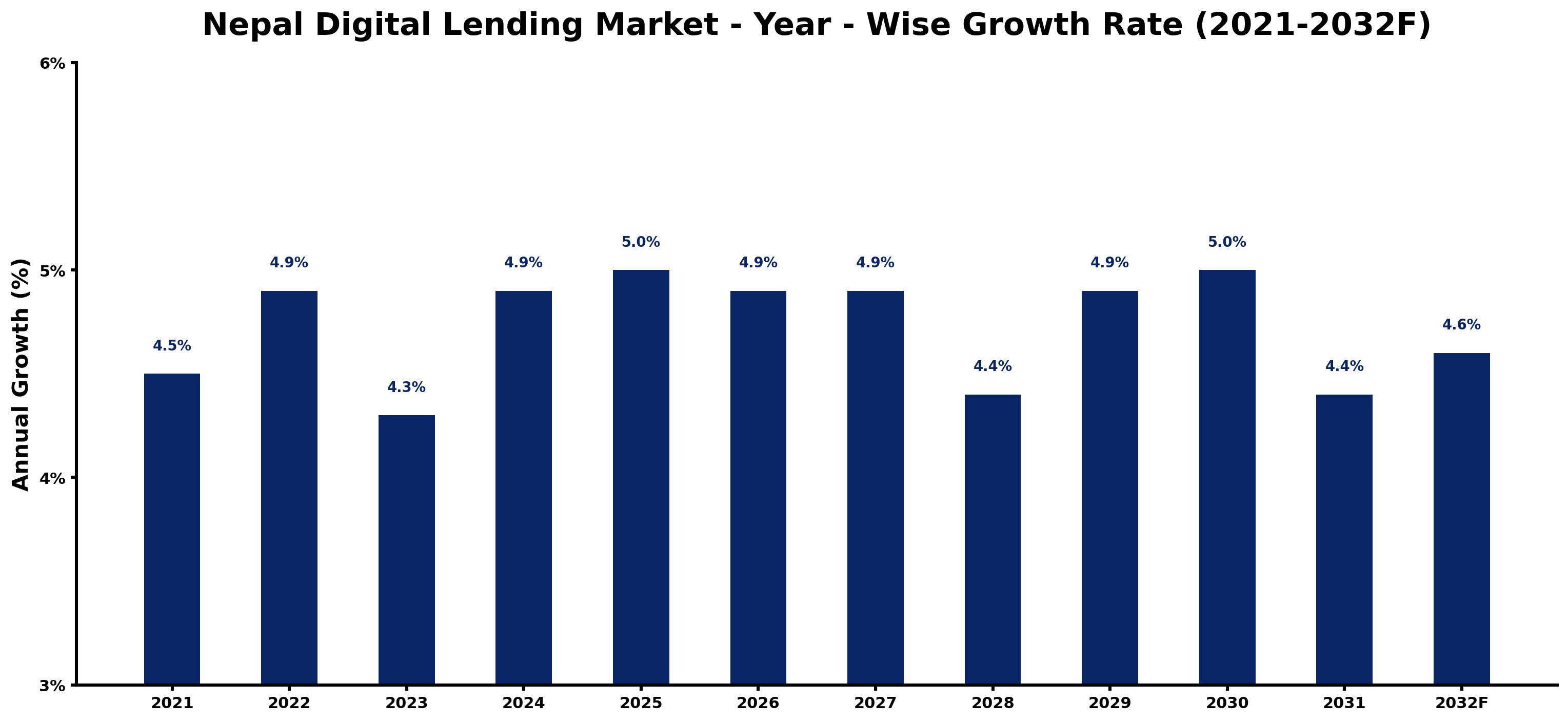
The table below presents the year‑wise growth rates along with the key drivers influencing the market
| Year | Growth Rate | Major Drivers |
| 2021 | 4.5% | Regulatory support from Nepal Rastra Bank for fintech. |
| 2022 | 4.9% | Rising smartphone penetration enhancing mobile lending access. |
| 2023 | 4.3% | Government initiatives promoting financial inclusion through digital loans. |
| 2024 | 4.9% | Increased digital literacy driving demand for online lending. |
| 2025 | 5.0% | Local partnerships boosting trust in digital loan services. |
| 2026 | 4.9% | Emerging entrepreneurs seeking quick funding via online platforms. |
| 2027 | 4.9% | COVID-19 recovery increasing reliance on digital financial solutions. |
| 2028 | 4.4% | Community-based lending apps gaining popularity in urban areas. |
| 2029 | 4.9% | Microfinance institutions adopting digital channels for efficiency. |
| 2030 | 5.0% | Young population favoring tech-driven financial services. |
| 2031 | 4.4% | Increased cybersecurity measures enhancing user confidence in lending. |
| 2032 | 4.6% | Local startups expanding service offerings in digital lending space. |
Note: Market size estimations and growth projections presented in this report are based on 6Wresearch's proprietary forecasting methodology, utilizing the latest available industry data, government publications, and primary research inputs.
Nepal Digital Lending Market Key Takeaways
Below are some of the specific key takeaways from the market, including:
- The Nepal digital lending market is primarily driven by fintech innovations targeting underserved demographics.
- Regulatory frameworks are evolving to foster responsible lending and consumer protection.
- Increased smartphone penetration is enhancing accessibility to digital lending services.
- COVID-19 has accelerated the shift towards digital financial solutions across the country.
- Investment in digital lending platforms is becoming increasingly attractive due to their growth potential.
Evaluation of Restraints in Nepal Digital Lending Market
Despite the promising growth trajectory, the Nepal digital lending market faces several constraints. Limited access to credit information and the absence of effective credit scoring systems complicate risk assessment, resulting in higher interest rates for borrowers. Regulatory hurdles also challenge the transparency and fairness of lending practices. Additionally, informal lending remains prevalent, which can erode trust in digital platforms. Data security and privacy concerns further impede broader adoption, highlighting the urgent need for comprehensive solutions to these challenges.
Nepal Digital Lending Market Trends
Several trends are shaping the Nepal digital lending market today. The rise of mobile wallets and digital payment platforms has streamlined the loan disbursement and repayment processes. Fintech companies are increasingly utilizing advanced analytics and machine learning to enhance their lending models, targeting rural populations effectively. The pandemic has ushered in a heightened preference for contactless transactions, pushing more consumers toward digital lending solutions. Regulatory adaptations are also creating an environment that encourages innovation while ensuring consumer protection.
Nepal Digital Lending Market Opportunities
Investment opportunities in the Nepal digital lending market are substantial. With a vast portion of the population lacking access to traditional banking, digital platforms can fill this gap by providing accessible credit solutions. The ongoing expansion of internet infrastructure and smartphone usage further supports this opportunity landscape. Investors can benefit from the rapid digitization of financial services, as fintech companies strive to reduce operational costs while reaching a wider audience.
Government Initiatives in the Nepal Digital Lending Market
The government of Nepal is actively shaping the digital lending market through a series of regulatory initiatives aimed at fostering innovation while protecting consumers. As digital lending becomes an integral part of the financial ecosystem, these policies are crucial for ensuring a balanced approach to growth and consumer rights.
- A regulatory framework established in 2025 mandates transparency in interest rates and lending terms for digital platforms.
- The Nepal Rastra Bank is currently working on guidelines to enhance data security and consumer protection in digital lending.
- A national financial literacy campaign launched in early 2025 aims to educate potential borrowers about digital lending options.
- Upcoming initiatives include a public-private partnership expected to expand digital infrastructure across rural areas by 2028.
- The government plans to introduce stricter compliance measures for digital lenders to mitigate risks associated with over-indebtedness.
Future Insights of the Nepal Digital Lending Market
Looking ahead to 2026-2032, the Nepal digital lending market is likely to undergo transformative changes. As technology continues to advance, digital lending platforms will diversify their offerings, catering to an increasingly sophisticated consumer base. Enhanced regulatory frameworks will play a critical role in shaping the market’s structure, fostering sustainable growth. With significant investment in digital infrastructure, the potential for financial inclusion remains high, setting the stage for a dynamic and evolving lending environment.
Nepal Digital Lending Market Latest Developments
Recent activity in the Nepal digital lending market indicates a strong focus on innovation and consumer engagement. Over the past 12-14 months, various initiatives have emerged, reflecting the sector's adaptability and growth potential.
- A major fintech company launched a new mobile app in Q2 2025, offering simplified loan applications and real-time approval notifications.
- An ongoing partnership between digital lenders and local banks aims to enhance credit assessment mechanisms, improving risk management.
- A planned upgrade of digital infrastructure is set to begin in late 2025, enhancing internet access in remote areas.
- A recent pilot program to provide microloans through mobile wallets successfully concluded in early 2025, showing promising results.
- Current efforts are underway to establish a national credit bureau by mid-2026, aimed at improving credit information availability.
Nepal Digital Lending Market - Key Attractiveness of the Report
- 10 Years of Market Numbers
- Historical Data Starting from 2022 to 2025
- Base Year: 2025
- Forecast Data until 2032
- Key Performance Indicators Impacting the Market
- Major Upcoming Developments and Projects
Key Highlights of the Report:
- Nepal Digital Lending Market Outlook
- Market Size of Nepal Digital Lending Market, 2025
- Forecast of Nepal Digital Lending Market, 2032
- Historical Data and Forecast of Nepal Digital Lending Revenues & Volume for the Period 2022-2032F
- Nepal Digital Lending Market Trend Evolution
- Nepal Digital Lending Market Drivers and Challenges
- Nepal Digital Lending Price Trends
- Nepal Digital Lending Porter's Five Forces
- Nepal Digital Lending Industry Life Cycle
- Historical Data and Forecast of Nepal Digital Lending Market Revenues & Volume By Offering for the Period 2022-2032F
- Historical Data and Forecast of Nepal Digital Lending Market Revenues & Volume By Solutions for the Period 2022-2032F
- Historical Data and Forecast of Nepal Digital Lending Market Revenues & Volume By Services for the Period 2022-2032F
- Historical Data and Forecast of Nepal Digital Lending Market Revenues & Volume By Deployment Mode for the Period 2022-2032F
- Historical Data and Forecast of Nepal Digital Lending Market Revenues & Volume By Cloud for the Period 2022-2032F
- Historical Data and Forecast of Nepal Digital Lending Market Revenues & Volume By On-premises for the Period 2022-2032F
- Historical Data and Forecast of Nepal Digital Lending Market Revenues & Volume By End User for the Period 2022-2032F
- Historical Data and Forecast of Nepal Digital Lending Market Revenues & Volume By Banks for the Period 2022-2032F
- Historical Data and Forecast of Nepal Digital Lending Market Revenues & Volume By Credit Unions for the Period 2022-2032F
- Historical Data and Forecast of Nepal Digital Lending Market Revenues & Volume By NBFCs for the Period 2022-2032F
- Nepal Digital Lending Import Export Trade Statistics
- Market Opportunity Assessment By Offering
- Market Opportunity Assessment By Deployment Mode
- Market Opportunity Assessment By End User
- Nepal Digital Lending Top Companies Market Share
- Nepal Digital Lending Competitive Benchmarking By Technical and Operational Parameters
- Nepal Digital Lending Company Profiles
- Nepal Digital Lending Key Strategic Recommendations






































