Nepal Enterprise AI Market Size & Growth Rate (2026-2032)
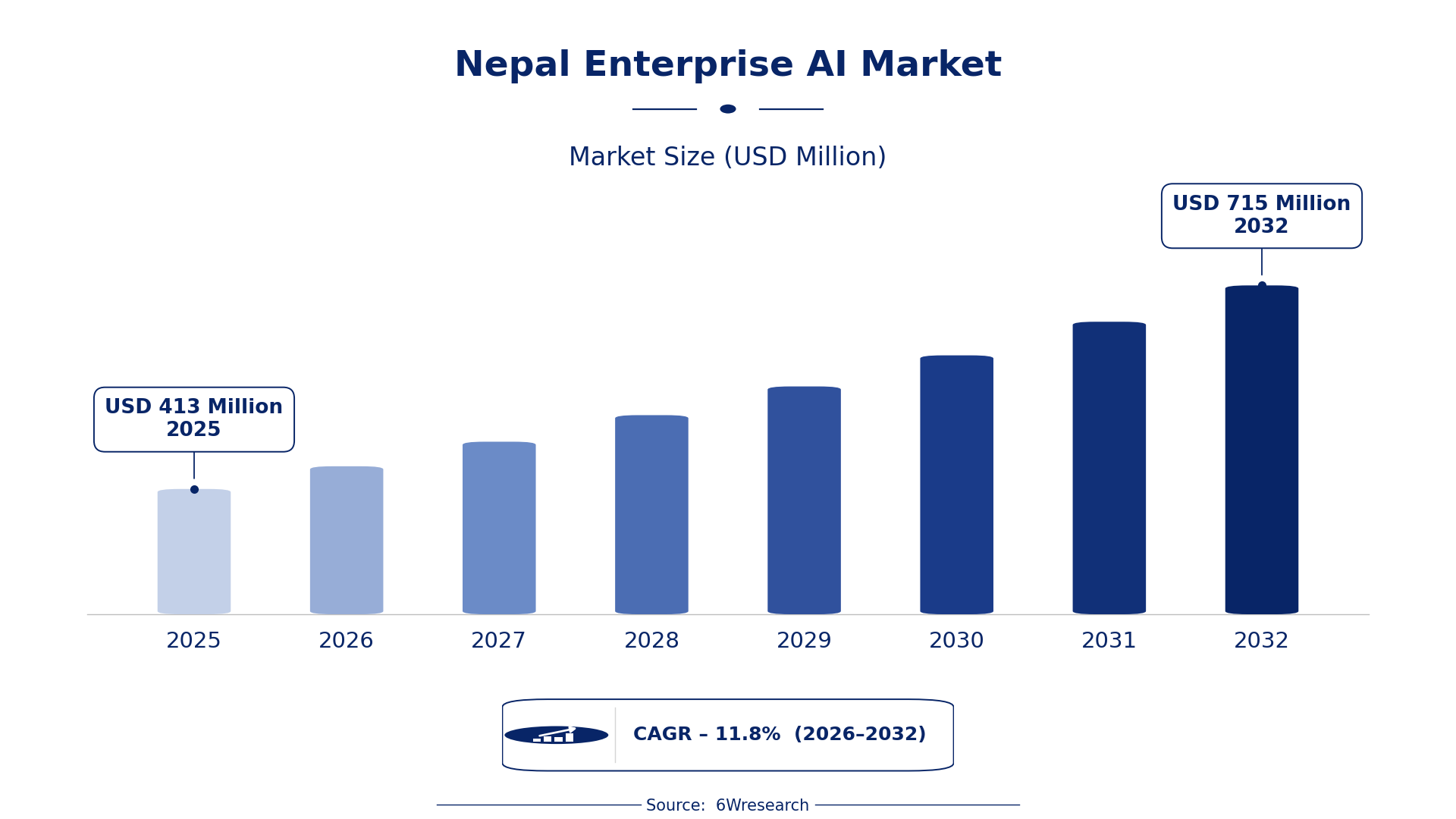
The Nepal Enterprise AI Market was estimated at USD 413 Million in 2025 and is projected to reach USD 715 Million by 2032, growing at a CAGR of 11.8% from 2026 to 2032.
Nepal Enterprise AI Market Synopsis
The surge in demand for automation and data analytics is reshaping the Nepal Enterprise AI market. Industries such as banking and healthcare are increasingly turning to AI solutions to improve operational efficiencies and enhance customer experiences.
Tailored AI solutions are becoming a necessity for enterprises seeking to maintain competitive advantages. The drive for predictive maintenance and intelligent decision-making is pushing local businesses to invest in advanced AI technologies.
Nepal Enterprise AI Market Year-wise Growth Rate and Key Drivers
This graph illustrates the annual growth rates of the Nepal Enterprise AI Market from 2021 to 2032, highlighting a steady upward trajectory and projected expansion over the forecast period.
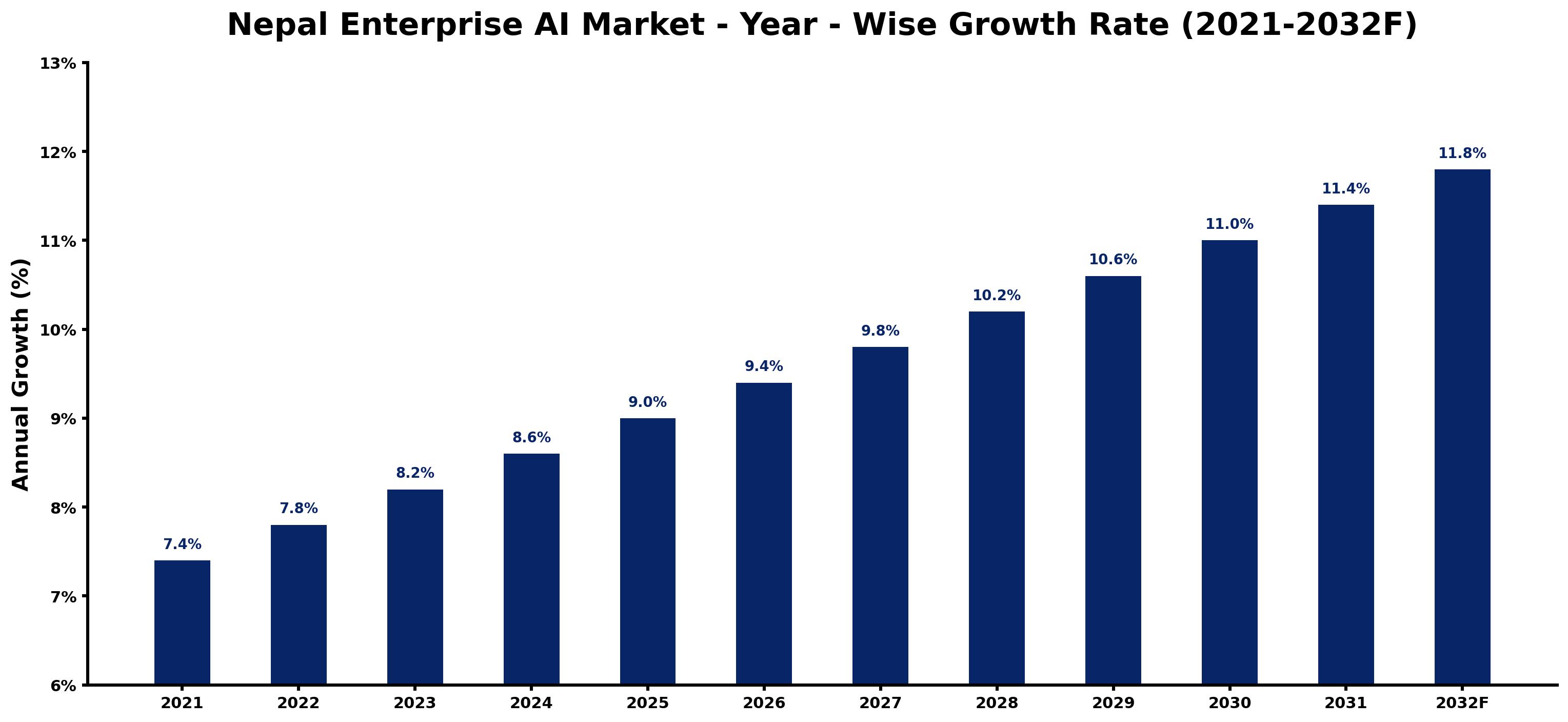
The table below presents the year‑wise growth rates along with the key drivers influencing the market
| Year | Growth Rate | Major Drivers |
| 2021 | 7.4% | Nepal Telecom's AI initiatives enhance customer service operations. |
| 2022 | 7.8% | Growing fintech sector adopts AI for fraud detection. |
| 2023 | 8.2% | Government's National Digital Framework drives AI adoption. |
| 2024 | 8.6% | Increased smartphone usage fuels AI-based app development. |
| 2025 | 9.0% | Local startups leverage AI for personalized marketing solutions. |
| 2026 | 9.4% | Rising e-commerce platforms integrate AI for consumer insights. |
| 2027 | 9.8% | Educational institutions implement AI for personalized learning. |
| 2028 | 10.2% | Tourism sector utilizes AI for enhanced visitor experiences. |
| 2029 | 10.6% | AI deployment in agriculture boosts crop yield predictive analytics. |
| 2030 | 11.0% | Smart city projects encourage AI in urban planning. |
| 2031 | 11.4% | Healthcare institutions adopt AI for patient diagnostic tools. |
| 2032 | 11.8% | Government collaborates with tech firms to advance AI policy. |
Note: Market size estimations and growth projections presented in this report are based on 6Wresearch's proprietary forecasting methodology, utilizing the latest available industry data, government publications, and primary research inputs.
Nepal Enterprise AI Market Key Takeaways
Below are some of the specific key takeaways from the market, including:
- The market is set for substantial growth, driven by increasing adoption of AI across diverse sectors.
- Customized AI solutions are becoming essential for meeting the unique needs of Nepalese enterprises.
- Challenges such as data privacy concerns and limited technical expertise continue to impede market growth.
- Government initiatives are actively promoting AI development and infrastructure improvements.
- Investment opportunities are emerging, particularly in finance, healthcare, and e-commerce sectors.
Evaluation of Restraints in Nepal Enterprise AI Market
Despite the promising growth trajectory, the Nepal Enterprise AI market faces significant hurdles. Limited access to advanced AI technologies hampers adoption, while inadequate infrastructure stifles implementation. A lack of awareness regarding AI's potential among businesses further complicates matters. Additionally, the high costs associated with AI deployment deter many enterprises from making the leap. These factors collectively create a challenging environment for market expansion.
Nepal Enterprise AI Market Trends
A number of trends are shaping the current state of the Nepal Enterprise AI market. The rise of AI-powered analytics is gaining traction, enabling data-driven decision-making across various sectors. Concurrently, businesses are increasingly integrating AI into customer service operations to enhance user experiences.
The deployment of AI-driven automation is also notable, streamlining operations and reducing costs. This shift towards tailored AI solutions reflects an understanding of local market conditions, making innovation a key driver of growth.
Nepal Enterprise AI Market Opportunities
The opportunities for growth within the Nepal Enterprise AI market are substantial. As businesses continue to embrace AI solutions, sectors such as finance, healthcare, and agriculture are likely to be at the forefront of this transformation. Investing in AI startups and collaborative ventures can yield significant returns, particularly as demand for innovative tools rises.
on top of that, partnerships with local enterprises to integrate AI technologies into existing systems will be critical in enhancing competitiveness and driving market growth.
Government Initiatives in the Nepal Enterprise AI Market
The Nepalese government is actively working to create a favorable environment for AI development within the enterprise sector. Through various policies and initiatives, the government is focusing on enhancing digital infrastructure and supporting innovation in AI technologies.
- A national digital infrastructure upgrade programme launched in 2023 aims to enhance connectivity across the country.
- The Nepal AI Strategy, introduced in early 2024, provides funding and resources for AI research and development.
- Currently underway is an initiative to promote data privacy and security, crucial for building trust in AI systems.
- Future plans include a public-private partnership aimed at expanding access to AI education and training by 2025.
- Ongoing efforts to establish regulatory frameworks are expected to streamline AI implementation processes across various sectors.
Future Insights of the Nepal Enterprise AI Market
Looking ahead, the Nepal Enterprise AI market is on track for steady growth between 2026 and 2032. As businesses increasingly recognize the value of AI, the demand for tailored solutions will only escalate. Government support for digital transformation initiatives will further catalyze this growth. Key sectors such as banking and healthcare are expected to lead the charge, presenting numerous opportunities for innovation and expansion.
Nepal Enterprise AI Market Latest Developments
In the past year, the Nepal Enterprise AI market has witnessed a surge in activity as businesses adapt to new technological advancements. Numerous initiatives and partnerships have emerged, aiming to capitalize on the growing demand for AI solutions.
- A major technology vendor initiated an AI training program for local businesses in early 2023, focusing on enhancing AI literacy and skills.
- In mid-2023, a collaborative project was launched between regional enterprises and educational institutions to develop AI-driven applications tailored for healthcare.
- A rollout of an AI-powered customer service platform is expected to begin in Q3 2024, targeting the retail sector.
- Currently underway, a research initiative aims to explore AI applications in agriculture, enhancing productivity and sustainability.
- Future plans include a new AI innovation hub set to launch in late 2025, designed to foster startups and drive technological advancements.
Nepal Enterprise AI Market - Key Attractiveness of the Report
- 10 Years of Market Numbers
- Historical Data Starting from 2022 to 2025
- Base Year: 2025
- Forecast Data until 2032
- Key Performance Indicators Impacting the Market
- Major Upcoming Developments and Projects
Key Highlights of the Report:
- Nepal Enterprise AI Market Outlook
- Market Size of Nepal Enterprise AI Market, 2025
- Forecast of Nepal Enterprise AI Market, 2032
- Historical Data and Forecast of Nepal Enterprise AI Revenues & Volume for the Period 2022-2032F
- Nepal Enterprise AI Market Trend Evolution
- Nepal Enterprise AI Market Drivers and Challenges
- Nepal Enterprise AI Price Trends
- Nepal Enterprise AI Porter's Five Forces
- Nepal Enterprise AI Industry Life Cycle
- Historical Data and Forecast of Nepal Enterprise AI Market Revenues & Volume By Component for the Period 2022-2032F
- Historical Data and Forecast of Nepal Enterprise AI Market Revenues & Volume By Solution for the Period 2022-2032F
- Historical Data and Forecast of Nepal Enterprise AI Market Revenues & Volume By Services for the Period 2022-2032F
- Historical Data and Forecast of Nepal Enterprise AI Market Revenues & Volume By Technology for the Period 2022-2032F
- Historical Data and Forecast of Nepal Enterprise AI Market Revenues & Volume By Machine learning and deep learning for the Period 2022-2032F
- Historical Data and Forecast of Nepal Enterprise AI Market Revenues & Volume By Natural Language Processing (NLP) for the Period 2022-2032F
- Historical Data and Forecast of Nepal Enterprise AI Market Revenues & Volume By Application Area for the Period 2022-2032F
- Historical Data and Forecast of Nepal Enterprise AI Market Revenues & Volume By Security and risk management for the Period 2022-2032F
- Historical Data and Forecast of Nepal Enterprise AI Market Revenues & Volume By Marketing management for the Period 2022-2032F
- Historical Data and Forecast of Nepal Enterprise AI Market Revenues & Volume By Customer support and experience for the Period 2022-2032F
- Historical Data and Forecast of Nepal Enterprise AI Market Revenues & Volume By Human resource and recruitment management for the Period 2022-2032F
- Historical Data and Forecast of Nepal Enterprise AI Market Revenues & Volume By Analytics application for the Period 2022-2032F
- Historical Data and Forecast of Nepal Enterprise AI Market Revenues & Volume By Process automation for the Period 2022-2032F
- Historical Data and Forecast of Nepal Enterprise AI Market Revenues & Volume By Deployment Type for the Period 2022-2032F
- Historical Data and Forecast of Nepal Enterprise AI Market Revenues & Volume By Cloud for the Period 2022-2032F
- Historical Data and Forecast of Nepal Enterprise AI Market Revenues & Volume By On-premises for the Period 2022-2032F
- Historical Data and Forecast of Nepal Enterprise AI Market Revenues & Volume By Organization Size for the Period 2022-2032F
- Historical Data and Forecast of Nepal Enterprise AI Market Revenues & Volume By Small and Medium-sized Businesses (SMBs) for the Period 2022-2032F
- Historical Data and Forecast of Nepal Enterprise AI Market Revenues & Volume By Large enterprises for the Period 2022-2032F
- Nepal Enterprise AI Import Export Trade Statistics
- Market Opportunity Assessment By Component
- Market Opportunity Assessment By Technology
- Market Opportunity Assessment By Application Area
- Market Opportunity Assessment By Deployment Type
- Market Opportunity Assessment By Organization Size
- Nepal Enterprise AI Top Companies Market Share
- Nepal Enterprise AI Competitive Benchmarking By Technical and Operational Parameters
- Nepal Enterprise AI Company Profiles
- Nepal Enterprise AI Key Strategic Recommendations






































