Nepal Fencing Market Size, Share & Growth Rate
The Nepal Fencing Market was estimated at USD 266 Million in 2025 and is projected to reach USD 356 Million by 2032, growing at a CAGR of 4.3% from 2026 to 2032. This growth trajectory is significantly driven by rapid urbanization, a surge in construction activities, and a heightened emphasis on security and privacy among property owners. Moreover, government initiatives to improve infrastructure and urban beautification are paving the way for increased fencing demand across both residential and commercial sectors.
Nepal Fencing Market Year-wise Growth Rate and Key Drivers
This graph highlights how the Nepal Fencing Market has steadily grown over the years, supported by major growth factors.
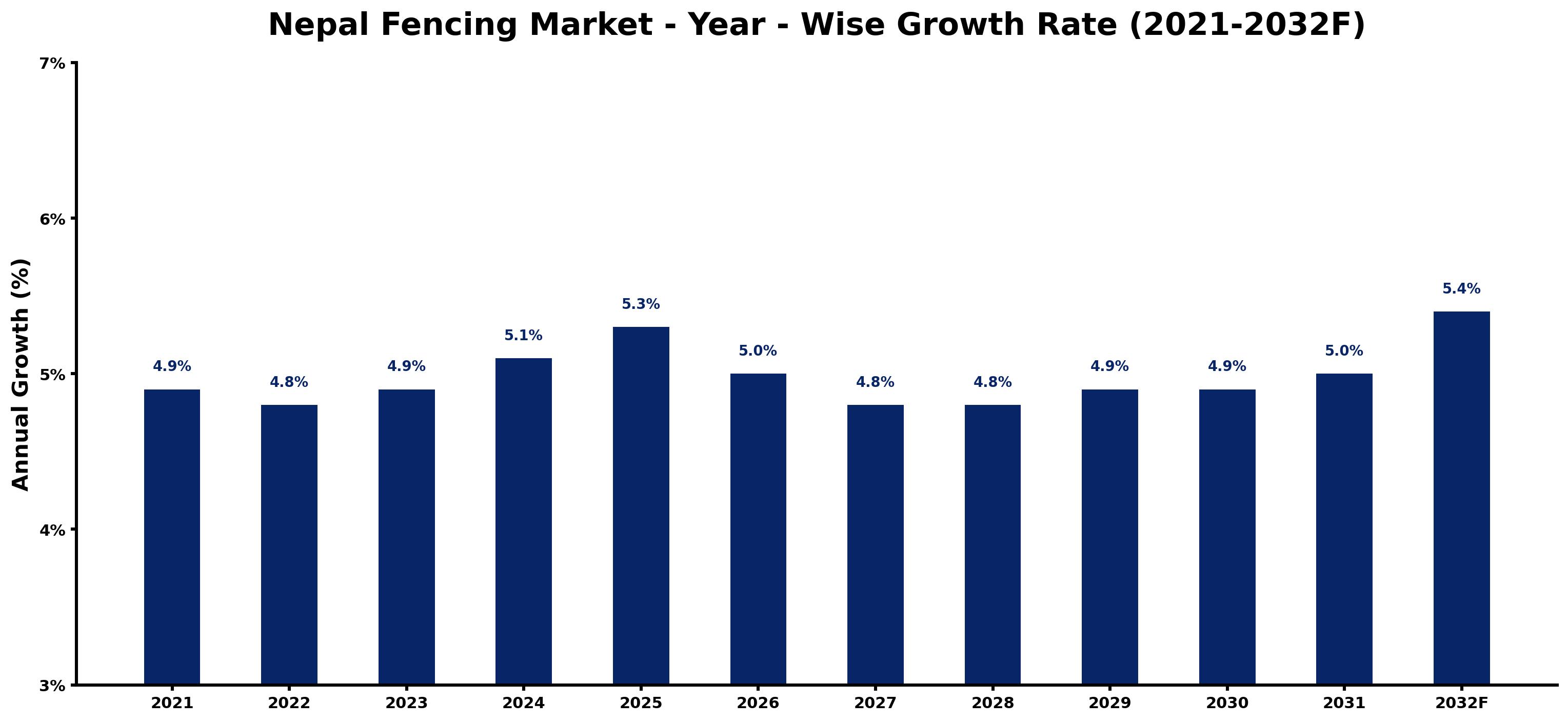
The table below presents the year‑wise growth rates along with the key drivers influencing the market
| Year | Growth Rate | Major Drivers |
| 2021 | 4.9% | Increasing industrial infrastructure investments |
| 2022 | 4.8% | Rising electricity demand across industries |
| 2023 | 4.9% | Rapid growth in telecom and data center sectors |
| 2024 | 5.1% | Increasing adoption of advanced technologies |
| 2025 | 5.3% | Growing renewable energy integration projects |
| 2026 | 5.0% | Expansion of transportation and logistics networks |
| 2027 | 4.8% | Growing urbanization and commercial development |
| 2028 | 4.8% | Expansion of commercial construction activities |
| 2029 | 4.9% | Government infrastructure modernization initiatives |
| 2030 | 4.9% | Expansion of commercial construction activities |
| 2031 | 5.0% | Rising electricity demand across industries |
| 2032 | 5.4% | Expansion of commercial construction activities |
Note - Market size estimations and growth projections presented in this report are based on 6Wresearch’s advanced forecasting approach, validated with industry datasets as of June 2026.
Nepal Fencing Market Synopsis
A notable trend within the Nepal fencing market is the increasing preference for durable and aesthetically pleasing materials. Consumers are gravitating towards options such as steel, aluminum, and PVC, which offer longevity and require minimal maintenance, thereby enhancing property value while ensuring security.
Additionally, there is a significant shift towards sustainable fencing solutions, driven by rising environmental awareness. Eco-friendly materials like bamboo and recycled plastics are becoming popular choices, reflecting the growing desire for environmentally responsible products that do not compromise on quality.
Nepal Fencing Market Key Takeaways
- The market is increasingly embracing eco-friendly and sustainable fencing solutions.
- Durability and low maintenance requirements are key factors influencing consumer choices.
- Urbanization and infrastructure projects are prime drivers of market growth.
- There is a growing awareness and demand for modern, stylish fencing designs.
- Local manufacturing policies are enhancing the availability of quality fencing products.
Evaluation of Restraints in Nepal Fencing Market
While the Nepal fencing market holds significant potential, it is hampered by certain challenges. A primary concern is the lack of consumer awareness regarding the diverse types of fencing materials available, which can impede informed purchasing decisions. Moreover, the variability in quality of materials and installation services affects overall market reliability. Economic instability and infrastructural limitations in various regions further complicate supply chain dynamics, leading to fluctuating pricing and availability. Lastly, navigating the regulatory landscape can pose hurdles for potential market entrants seeking compliance with local standards.
Nepal Fencing Market Trends
Current trends in the Nepal fencing market reveal a marked shift towards innovative and contemporary designs that blend functionality with aesthetics. Homeowners and businesses alike are favoring sleek, modern materials that not only provide security but also enhance visual appeal. The incorporation of smart technologies in fencing, such as automated gates and surveillance systems, is also gaining traction, catering to the needs of tech-savvy consumers. Additionally, the rising preference for sustainable materials aligns with the global push towards environmental conservation.
Nepal Fencing Market Opportunities
Investment opportunities abound in the Nepal fencing market, particularly for those focusing on high-quality and innovative fencing materials. Given the increasing urbanization and infrastructural developments, there is a growing market for premium fencing solutions that emphasize security and design. Additionally, the demand for eco-friendly products opens up avenues for investors interested in sustainable practices. Collaborating with local entities can provide valuable insights into consumer preferences and facilitate market entry.
Government Initiatives in the Nepal Fencing Market
The Nepali government is actively fostering a conducive environment for the fencing industry through various initiatives. Policies aimed at promoting local manufacturing of fencing materials are in place to reduce dependency on imports. Furthermore, the government is enforcing quality standards to ensure safety and durability in fencing products, thereby protecting consumers. Incentives and subsidies for manufacturers are also part of the strategy to stimulate industry growth and innovation.
Future Insights of the Nepal Fencing Market
Looking ahead to 2026-2032, the Nepal fencing market is set to experience robust growth driven by continued urban expansion and the increasing prioritization of property security. As construction projects multiply, the demand for fencing solutions will rise correspondingly. The trend towards innovative materials and smart technologies is likely to revolutionize the market, offering consumers enhanced options that cater to both aesthetic preferences and functional requirements. Overall, a favorable economic environment and government support will further bolster this growth trajectory.
Nepal Fencing Market Latest Developments (May 2025 - June 2026)
In recent months, the Nepal fencing market has seen significant developments as stakeholders increasingly focus on sustainability and technological integration. There has been a rise in initiatives aimed at educating consumers about the benefits of various fencing materials, particularly eco-friendly options. Additionally, local manufacturers are exploring partnerships to enhance their product offerings and improve supply chain efficiencies, reflecting a growing commitment to quality and innovation in the market.
Nepal Fencing Market - Key Attractiveness of the Report
- 10 Years of Market Numbers
- Historical Data Starting from 2022 to 2025
- Base Year: 2025
- Forecast Data until 2032
- Key Performance Indicators Impacting the Market
- Major Upcoming Developments and Projects
Key Highlights of the Report:
- Nepal Fencing Market Outlook
- Market Size of Nepal Fencing Market, 2025
- Forecast of Nepal Fencing Market, 2032
- Historical Data and Forecast of Nepal Fencing Revenues & Volume for the Period 2022-2032F
- Nepal Fencing Market Trend Evolution
- Nepal Fencing Market Drivers and Challenges
- Nepal Fencing Price Trends
- Nepal Fencing Porter's Five Forces
- Nepal Fencing Industry Life Cycle
- Historical Data and Forecast of Nepal Fencing Market Revenues & Volume By Material for the Period 2022-2032F
- Historical Data and Forecast of Nepal Fencing Market Revenues & Volume By Metal for the Period 2022-2032F
- Historical Data and Forecast of Nepal Fencing Market Revenues & Volume By Wood for the Period 2022-2032F
- Historical Data and Forecast of Nepal Fencing Market Revenues & Volume By Plastic & Composite for the Period 2022-2032F
- Historical Data and Forecast of Nepal Fencing Market Revenues & Volume By Concrete for the Period 2022-2032F
- Historical Data and Forecast of Nepal Fencing Market Revenues & Volume By Distribution Channel for the Period 2022-2032F
- Historical Data and Forecast of Nepal Fencing Market Revenues & Volume By Online for the Period 2022-2032F
- Historical Data and Forecast of Nepal Fencing Market Revenues & Volume By Retail for the Period 2022-2032F
- Historical Data and Forecast of Nepal Fencing Market Revenues & Volume By Installation for the Period 2022-2032F
- Historical Data and Forecast of Nepal Fencing Market Revenues & Volume By Do-It-Yourself for the Period 2022-2032F
- Historical Data and Forecast of Nepal Fencing Market Revenues & Volume By Contractor for the Period 2022-2032F
- Historical Data and Forecast of Nepal Fencing Market Revenues & Volume By Application for the Period 2022-2032F
- Historical Data and Forecast of Nepal Fencing Market Revenues & Volume By Residential for the Period 2022-2032F
- Historical Data and Forecast of Nepal Fencing Market Revenues & Volume By Agricultural for the Period 2022-2032F
- Historical Data and Forecast of Nepal Fencing Market Revenues & Volume By Industrial for the Period 2022-2032F
- Historical Data and Forecast of Nepal Fencing Market Revenues & Volume By End-users for the Period 2022-2032F
- Historical Data and Forecast of Nepal Fencing Market Revenues & Volume By Government for the Period 2022-2032F
- Historical Data and Forecast of Nepal Fencing Market Revenues & Volume By Petroleum & Chemicals for the Period 2022-2032F
- Historical Data and Forecast of Nepal Fencing Market Revenues & Volume By Military & Defense for the Period 2022-2032F
- Historical Data and Forecast of Nepal Fencing Market Revenues & Volume By Mining for the Period 2022-2032F
- Historical Data and Forecast of Nepal Fencing Market Revenues & Volume By Energy & Power for the Period 2022-2032F
- Historical Data and Forecast of Nepal Fencing Market Revenues & Volume By Transport for the Period 2022-2032F
- Historical Data and Forecast of Nepal Fencing Market Revenues & Volume By Others for the Period 2022-2032F
- Nepal Fencing Import Export Trade Statistics
- Market Opportunity Assessment By Material
- Market Opportunity Assessment By Distribution Channel
- Market Opportunity Assessment By Installation
- Market Opportunity Assessment By Application
- Market Opportunity Assessment By End-users
- Nepal Fencing Top Companies Market Share
- Nepal Fencing Competitive Benchmarking By Technical and Operational Parameters
- Nepal Fencing Company Profiles
- Nepal Fencing Key Strategic Recommendations






































