Nepal Industrial Furnace Market Size, Share & Growth Rate
The Nepal Industrial Furnace Market was estimated at USD 133 Million in 2025 and is projected to reach USD 144 Million by 2032, growing at a CAGR of 1.1% from 2026 to 2032. This steady growth trajectory is fueled by the expanding industrial sector in Nepal, particularly in metal fabrication, foundries, and glass manufacturing. As these industries modernize their operations, the demand for efficient and sustainable heating solutions is becoming increasingly crucial, propelling the market forward.
Nepal Industrial Furnace Market Year-wise Growth Rate and Key Drivers
This graph highlights how the Nepal Industrial Furnace Market has steadily grown over the years, supported by major growth factors.
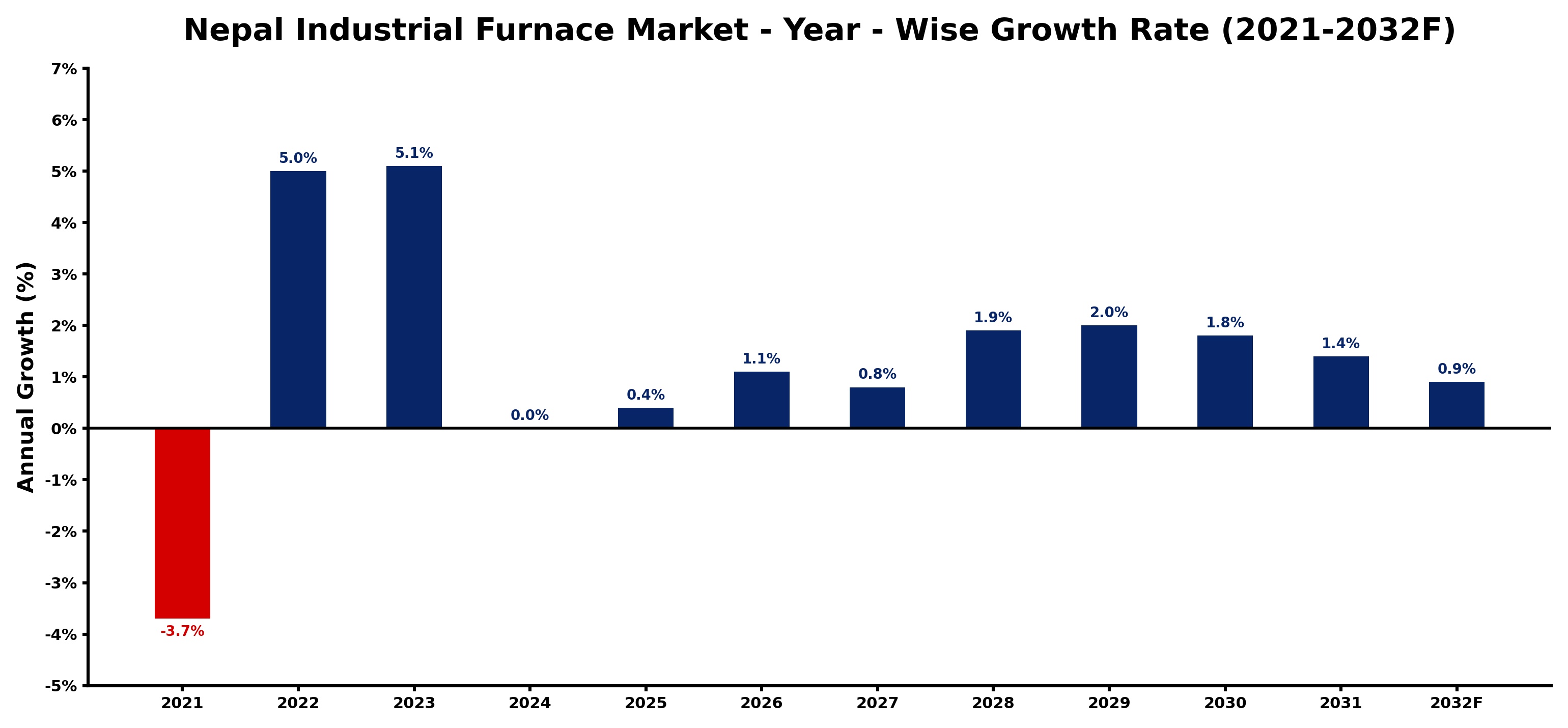
The table below presents the year‑wise growth rates along with the key drivers influencing the market
| Year | Growth Rate | Major Drivers |
| 2021 | -3.7% | Manufacturing slowdowns led to decreased demand for industrial furnaces |
| 2022 | 5.0% | Local manufacturing investments boosted steel production capabilities significantly |
| 2023 | 5.1% | Upgraded furnace technologies boosted local metal processing capabilities |
| 2024 | 0.0% | Increased local metalworking capabilities boosted furnace demand significantly |
| 2025 | 0.4% | Manufacturing investment surge boosts demand for industrial furnace technologies |
| 2026 | 1.1% | Government infrastructure projects boost demand for industrial furnace production |
| 2027 | 0.8% | Domestic steel production expansion drives demand for furnace technology |
| 2028 | 1.9% | Technology adoption in foundries improved energy efficiency and output |
| 2029 | 2.0% | High furnace efficiency drove demand for refractory material investments |
| 2030 | 1.8% | Furnace upgrades boost energy efficiency in steel production processes |
| 2031 | 1.4% | Steel production recovery drives demand for furnace technology upgrades |
| 2032 | 0.9% | Export driven demand for advanced furnace technology boosts local production |
Note - Market size estimations and growth projections presented in this report are based on 6Wresearch’s advanced forecasting approach, validated with industry datasets as of June 2026.
Nepal Industrial Furnace Market Synopsis
Recent momentum in the Nepal Industrial Furnace Market reflects a burgeoning interest in energy-efficient and environmentally friendly solutions. However, as industrial activities grow, there is a pressing need to upgrade outdated furnace technologies to meet modern operational demands. Moving forward, this market is expected to embrace innovation, aligning with global trends toward sustainability and efficiency.
The focus on customization is also reshaping the market landscape, with manufacturers tailoring products to meet specific industry needs. As the government pushes for infrastructure development and industrialization, the Nepal Industrial Furnace Market is poised for significant transformation, signaling a future defined by technological advancements and environmental considerations.
Nepal Industrial Furnace Market Key Takeaways
- The market is driven by expanding sectors such as metal fabrication and glass manufacturing.
- There is a notable trend toward energy-efficient and eco-friendly furnace technologies.
- Customization is becoming a key focus for manufacturers to address diverse industry requirements.
- Government initiatives are aimed at fostering industrial growth and modernization.
- Challenges include access to technology and skilled manpower, impacting overall efficiency.
Evaluation of Restraints in Nepal Industrial Furnace Market
Despite the promising outlook, the Nepal Industrial Furnace Market is not without its challenges. A significant hurdle is the limited access to modern technologies, resulting in many companies relying on outdated, inefficient designs. This technological lag can lead to increased operational costs and lower productivity. Furthermore, the shortage of skilled workers capable of operating and maintaining these furnaces exacerbates these inefficiencies. Compounding these issues is the inconsistent supply of electricity in the region, which affects the overall reliability and productivity of industrial operations.
Nepal Industrial Furnace Market Trends
Current trends highlight a shift towards advanced technologies, with electric and induction furnaces gaining traction due to their precision and control capabilities. The increasing emphasis on sustainability is prompting manufacturers to develop furnaces that not only minimize emissions but also reduce energy consumption. This trend aligns with global moves towards cleaner production processes, making it imperative for local industries to adopt such innovations. The demand for tailored solutions further emphasizes the need for manufacturers to remain agile and responsive to specific industry requirements.
Nepal Industrial Furnace Market Opportunities
The Nepal Industrial Furnace Market presents lucrative investment opportunities, especially as industrialization accelerates. The government's commitment to promoting local manufacturing and attracting foreign investments signals a bright future for businesses in this space. Prospective investors can explore various avenues, including the manufacture of electric arc furnaces and rotary kilns, to meet diverse industrial needs. Additionally, investing in research and development for energy-efficient technologies can position companies favorably in this evolving market landscape.
Government Initiatives in the Nepal Industrial Furnace Market
The Nepalese government is actively implementing policies aimed at fostering the growth of the industrial sector, which directly impacts the industrial furnace market. The Environmental Protection Act mandates that businesses comply with emissions standards and manage waste properly, enhancing sustainability efforts. Furthermore, the Industrial Enterprises Act provides various incentives for investment, ensuring that safety and quality standards are upheld in the operation of furnaces. The Department of Industry plays a crucial role in monitoring compliance, thereby promoting responsible industrial growth.
Future Insights of the Nepal Industrial Furnace Market
Looking ahead to 2026-2032, the Nepal Industrial Furnace Market is poised for steady growth, driven by ongoing industrialization and infrastructure development. As various sectors expand and modernize, the demand for advanced furnace technologies will likely increase. The trend towards automation and energy efficiency will continue to shape market dynamics, enabling businesses to enhance their production capabilities while minimizing environmental impact. However, it will be essential for stakeholders to navigate challenges, including fluctuating raw material costs and stringent regulatory frameworks, to fully leverage market potential.
Nepal Industrial Furnace Market Latest Developments (May 2025 - June 2026)
In the past year, the Nepal Industrial Furnace Market has seen significant movements toward embracing more sustainable practices. Industries are increasingly prioritizing energy-efficient furnace technologies as part of their commitment to reducing carbon footprints. Additionally, manufacturers are actively seeking partnerships with technology providers to innovate and integrate smart furnace systems that enhance efficiency and precision. These developments highlight a strong trend toward modernization, reflecting broader global objectives in industrial operations.
Nepal Industrial Furnace Market - Key Attractiveness of the Report
- 10 Years of Market Numbers
- Historical Data Starting from 2022 to 2025
- Base Year: 2025
- Forecast Data until 2032
- Key Performance Indicators Impacting the Market
- Major Upcoming Developments and Projects
Key Highlights of the Report:
- Nepal Industrial Furnace Market Outlook
- Market Size of Nepal Industrial Furnace Market, 2025
- Forecast of Nepal Industrial Furnace Market, 2032
- Historical Data and Forecast of Nepal Industrial Furnace Revenues & Volume for the Period 2022-2032F
- Nepal Industrial Furnace Market Trend Evolution
- Nepal Industrial Furnace Market Drivers and Challenges
- Nepal Industrial Furnace Price Trends
- Nepal Industrial Furnace Porter's Five Forces
- Nepal Industrial Furnace Industry Life Cycle
- Historical Data and Forecast of Nepal Industrial Furnace Market Revenues & Volume By Furnace Type for the Period 2022-2032F
- Historical Data and Forecast of Nepal Industrial Furnace Market Revenues & Volume By Gas/fuel Operated Industrial Furnace for the Period 2022-2032F
- Historical Data and Forecast of Nepal Industrial Furnace Market Revenues & Volume By Electrically Operated Industrial Furnace for the Period 2022-2032F
- Historical Data and Forecast of Nepal Industrial Furnace Market Revenues & Volume By Arrangement for the Period 2022-2032F
- Historical Data and Forecast of Nepal Industrial Furnace Market Revenues & Volume By Tube or Clamshell Type for the Period 2022-2032F
- Historical Data and Forecast of Nepal Industrial Furnace Market Revenues & Volume By Box Type for the Period 2022-2032F
- Historical Data and Forecast of Nepal Industrial Furnace Market Revenues & Volume By Bottom Loading & Car Bottom Furnace for the Period 2022-2032F
- Historical Data and Forecast of Nepal Industrial Furnace Market Revenues & Volume By Top Loading Furnace for the Period 2022-2032F
- Historical Data and Forecast of Nepal Industrial Furnace Market Revenues & Volume By Others for the Period 2022-2032F
- Historical Data and Forecast of Nepal Industrial Furnace Market Revenues & Volume By End-User for the Period 2022-2032F
- Historical Data and Forecast of Nepal Industrial Furnace Market Revenues & Volume By Metals & Mining for the Period 2022-2032F
- Historical Data and Forecast of Nepal Industrial Furnace Market Revenues & Volume By Transportation for the Period 2022-2032F
- Historical Data and Forecast of Nepal Industrial Furnace Market Revenues & Volume By Oil & Gas for the Period 2022-2032F
- Historical Data and Forecast of Nepal Industrial Furnace Market Revenues & Volume By Chemicals for the Period 2022-2032F
- Historical Data and Forecast of Nepal Industrial Furnace Market Revenues & Volume By Others for the Period 2022-2032F
- Nepal Industrial Furnace Import Export Trade Statistics
- Market Opportunity Assessment By Furnace Type
- Market Opportunity Assessment By Arrangement
- Market Opportunity Assessment By End-User
- Nepal Industrial Furnace Top Companies Market Share
- Nepal Industrial Furnace Competitive Benchmarking By Technical and Operational Parameters
- Nepal Industrial Furnace Company Profiles
- Nepal Industrial Furnace Key Strategic Recommendations






































