Nepal LED Professional Lighting Market Summary
The nepal led professional lighting market was estimated at USD 206 Million in 2025 and is projected to reach USD 275 Million by 2032, growing at a CAGR of 4.7% from 2026 to 2032.
Nepal LED Professional Lighting Market Year-wise Growth Rate and Key Drivers
This graph highlights how the Nepal LED Professional Lighting Market has steadily grown over the past five years, supported by major growth factors.
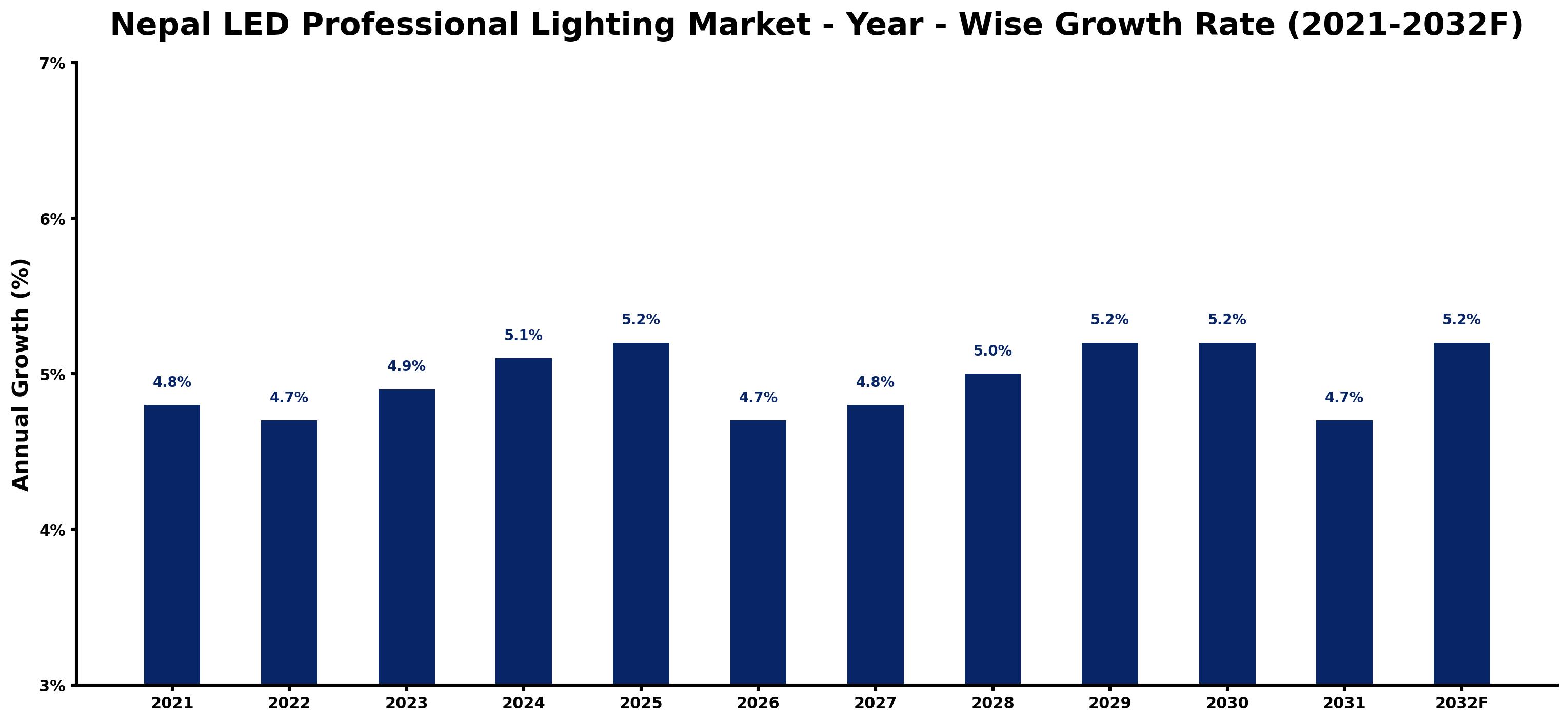
The table below presents the year wise growth rates along with the key drivers influencing the market
| Year | Growth Rate | Major Drivers |
| 2021 | 4.8% | Post-lockdown retail projects initiated a renewed focus on energy-efficient lighting solutions. |
| 2022 | 4.7% | Demand from hospitality businesses increased as tourism began to rebound post-pandemic. |
| 2023 | 4.9% | Local manufacturers expanded capabilities to meet rising expectations for quality LED products. |
| 2024 | 5.1% | Energy management systems saw integration with LED technology for enhanced operational efficiency. |
| 2025 | 5.2% | Urban development projects spurred investments in modern lighting infrastructure across cities. |
| 2026 | 4.7% | Smart city initiatives highlighted the need for adaptive and responsive lighting solutions. |
| 2027 | 4.8% | Corporate sustainability programs encouraged widespread adoption of eco-friendly lighting technologies. |
| 2028 | 5.0% | Technological innovations led to the emergence of advanced smart lighting control systems. |
| 2029 | 5.2% | Public awareness campaigns on energy conservation fostered interest in LED lighting options. |
| 2030 | 5.2% | Increased collaboration with international firms brought innovative lighting solutions to Nepal. |
| 2031 | 4.7% | As urban areas expand, demand for efficient outdoor lighting solutions continues to grow. |
| 2032 | 5.2% | Research and development efforts enhance the performance and longevity of LED products. |
Note - Market size estimations and growth projections presented in this report are based on 6Wresearch's advanced forecasting approach, validated with industry datasets as of June 2026.
Nepal LED Professional Lighting Market Synopsis
The Nepal LED Professional Lighting Market is projected to reach 4.7% and witness significant growth during the forecast period (2026-2032). This expansion is driven by increasing demand for energy-efficient lighting solutions as the country advances its infrastructure development. With rising construction activities, there has been a marked uptick in the necessity for efficient lighting options within both commercial and residential sectors. The evolution of LED technology has significantly impacted the landscape of professional lighting, introducing solutions that are not only energy-efficient but also durable and requiring less maintenance than traditional fixtures, such as halogen bulbs and fluorescent lamps.
Nepal LED Professional Lighting Market Growth Drivers
Several key factors are driving the growth of the Nepal LED Professional Lighting Market. Firstly, the global shift towards energy efficiency is influencing local demand, as consumers become more aware of energy costs and sustainability. Secondly, the ongoing construction boom in urban areas is amplifying the need for advanced lighting solutions. Thirdly, the technology advancements in LED lighting, including better luminous efficacy and fewer maintenance requirements, contribute to the increasing adoption of these products compared to traditional lighting. Furthermore, ongoing government initiatives focusing on energy efficiency and sustainability in Nepal are creating a favorable environment for LED commercial lighting adoption. Lastly, the rising trend towards smart city initiatives is positioning LED technology as a foundation for intelligent infrastructure, further enhancing its market attractiveness.
Nepal LED Professional Lighting Market Opportunities and Trends
The Nepal LED Professional Lighting Market is brimming with opportunities and evolving trends. The introduction of smart lighting systems that can be controlled remotely is gaining traction, driven by the growing popularity of smart homes and buildings. Additionally, the incorporation of IoT in lighting control is set to revolutionize how lighting is managed in commercial spaces. Moreover, the emergence of government-funded initiatives to promote renewable energy sources is likely to bolster the adoption of LED systems. Increasing investment in infrastructure projects is also expected to provide fertile ground for market growth. Another notable trend is the rising ecological consciousness among consumers, prompting a shift towards sustainable products, which positions LED lighting favorably in the eyes of environmentally aware buyers.
Nepal LED Professional Lighting Market Challenges and Restraints
Despite the promising growth prospects, the Nepal LED Professional Lighting Market faces certain challenges that could impede its expansion. A significant barrier is the initial cost associated with procuring LED lighting solutions, which may deter some consumers accustomed to lower-priced traditional options. Additionally, the lack of awareness regarding the long-term benefits of LED solutions poses a challenge, as many consumers remain uninformed of the potential savings on energy costs. Furthermore, supply chain disruptions, influenced by global economic conditions, can affect the availability of LED products in the market. Compounding these issues is the competition from cheaper, less efficient lighting solutions that may appeal to cost-conscious consumers. Lastly, the inadequate infrastructure for distribution and installation of advanced lighting solutions can potentially hinder market penetration.
Nepal LED Professional Lighting Market Government Investment and Initiatives
The government of Nepal is actively fostering the development of the LED Professional Lighting Market through various investment and policy initiatives aimed at promoting energy efficiency. Public spending on infrastructure development projects is increasingly incorporating LED lighting solutions as standard practice to reduce energy consumption and associated costs. Various governmental schemes are also incentivizing the adoption of energy-efficient lighting technologies in both the public and private sectors. Furthermore, awareness campaigns are underway to educate consumers about the benefits of switching to LED lighting, which is crucial for the overall growth of the market. Additionally, the government is collaborating with international organizations to enhance technology transfer and improve local manufacturing capabilities in the LED lighting sector. Overall, these initiatives are expected to support a more robust market environment for LED professional lighting solutions in Nepal.
Nepal LED Professional Lighting Market Latest Developments (May 2025 - June 2026)
In the period from May 2025 to June 2026, the Nepal LED Professional Lighting Market has witnessed pivotal developments that shape its trajectory. The focus on sustainability has intensified, leading to new partnerships aimed at expanding the reach of LED lighting solutions in both urban and rural areas. Technological advancements in LED efficiency and application versatility have made these products more appealing to a broader consumer base. Additionally, corporations and local governments are increasingly prioritizing energy management systems that incorporate LED technologies, demonstrating the shifting priorities towards energy-saving initiatives. The formation of new regulatory frameworks targeting energy efficiency standards is also noteworthy, as it provides a structured approach for manufacturers and consumers alike. Collectively, these developments signify a robust momentum towards establishing LED lighting as the preferred choice in Nepal.
Nepal LED Professional Lighting Market - Key Attractiveness of the Report
- 10 Years of Market Numbers
- Historical Data Starting from 2022 to 2025
- Base Year: 2025
- Forecast Data until 2032
- Key Performance Indicators Impacting the Market
- Major Upcoming Developments and Projects
Key Highlights of the Report:
- Nepal LED Professional Lighting Market Outlook
- Market Size of Nepal LED Professional Lighting Market, 2025
- Forecast of Nepal LED Professional Lighting Market, 2032
- Historical Data and Forecast of Nepal LED Professional Lighting Revenues & Volume for the Period 2022-2032
- Nepal LED Professional Lighting Market Trend Evolution
- Nepal LED Professional Lighting Market Drivers and Challenges
- Nepal LED Professional Lighting Price Trends
- Nepal LED Professional Lighting Porter's Five Forces
- Nepal LED Professional Lighting Industry Life Cycle
- Historical Data and Forecast of Nepal LED Professional Lighting Market Revenues & Volume By Product Type for the Period 2022-2032
- Historical Data and Forecast of Nepal LED Professional Lighting Market Revenues & Volume By LED Bulbs for the Period 2022-2032
- Historical Data and Forecast of Nepal LED Professional Lighting Market Revenues & Volume By LED Fixtures for the Period 2022-2032
- Historical Data and Forecast of Nepal LED Professional Lighting Market Revenues & Volume By Bare LED Tubes for the Period 2022-2032
- Historical Data and Forecast of Nepal LED Professional Lighting Market Revenues & Volume By LED Down lights for the Period 2022-2032
- Historical Data and Forecast of Nepal LED Professional Lighting Market Revenues & Volume By Applications for the Period 2022-2032
- Historical Data and Forecast of Nepal LED Professional Lighting Market Revenues & Volume By Indoor for the Period 2022-2032
- Historical Data and Forecast of Nepal LED Professional Lighting Market Revenues & Volume By Outdoor for the Period 2022-2032
- Historical Data and Forecast of Nepal LED Professional Lighting Market Revenues & Volume By Automotive for the Period 2022-2032
- Historical Data and Forecast of Nepal LED Professional Lighting Market Revenues & Volume By Backlighting for the Period 2022-2032
- Nepal LED Professional Lighting Import Export Trade Statistics
- Market Opportunity Assessment By Product Type
- Market Opportunity Assessment By Applications
- Nepal LED Professional Lighting Top Companies Market Share
- Nepal LED Professional Lighting Competitive Benchmarking By Technical and Operational Parameters
- Nepal LED Professional Lighting Company Profiles
- Nepal LED Professional Lighting Key Strategic Recommendations
Market Covered
This report offers a comprehensive study of the subsequent market segments:
By Product Type
- LED Bulbs
- LED Fixtures
- Bare LED Tubes
- LED Down lights
By Applications
- Indoor, Outdoor
- Automotive
- Backlighting






































