Nepal Manganese Mining Market Size, Share & Growth Rate
The Nepal Manganese Mining Market was estimated at USD 349 Million in 2025 and is projected to reach USD 487 Million by 2032, growing at a CAGR of 4.9% from 2026 to 2032. This growth trajectory is driven by rising global demand for manganese, particularly in the steel production sector, which is expected to expand significantly due to increasing infrastructure development and urbanization. Additionally, the emerging applications of manganese in batteries and electronics further enhance the markets potential.
Nepal Manganese Mining Market Year-wise Growth Rate and Key Drivers
This graph highlights how the Nepal Manganese Mining Market has steadily grown over the years, supported by major growth factors.
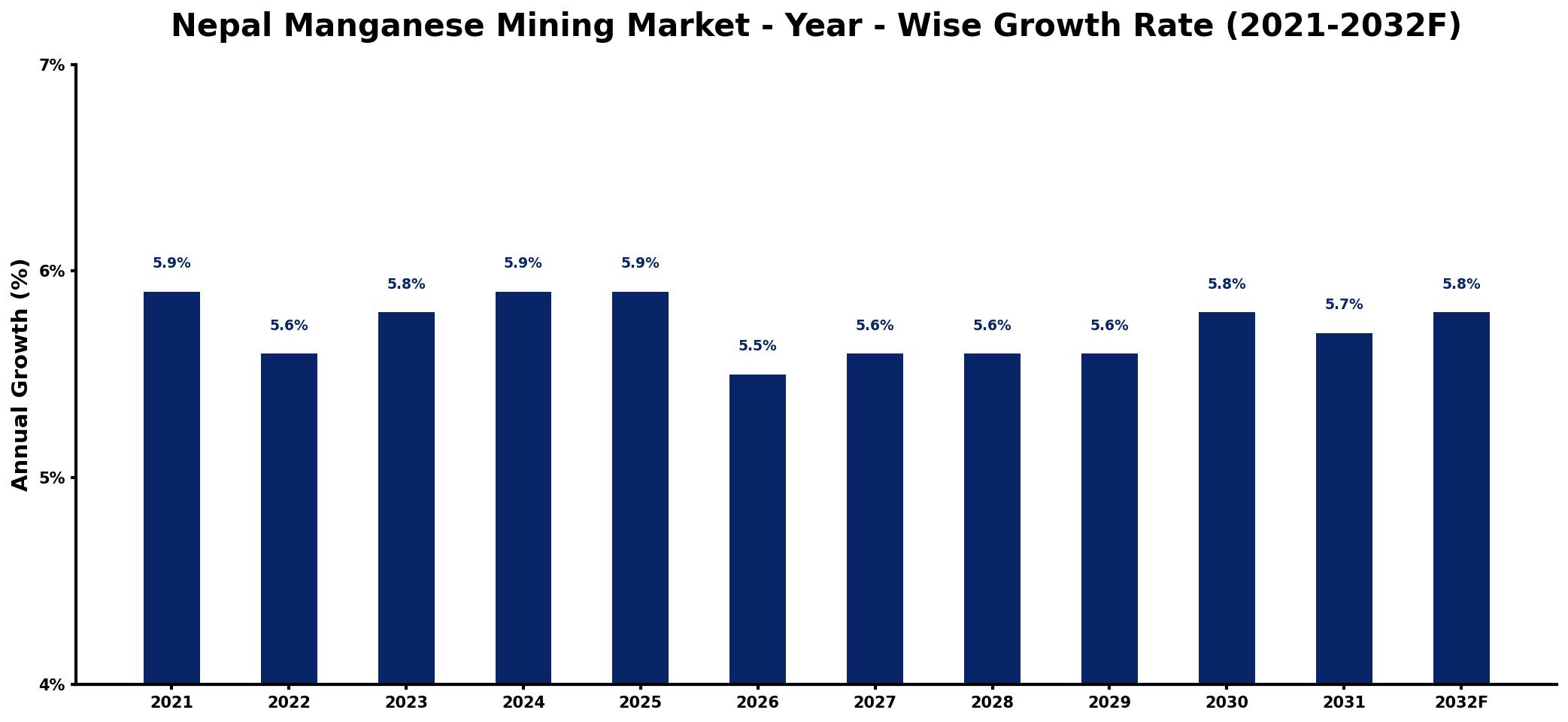
The table below presents the year‑wise growth rates along with the key drivers influencing the market
| Year | Growth Rate | Major Drivers |
| 2021 | 5.9% | Rising demand from construction sector |
| 2022 | 5.6% | Increased investments in infrastructure projects |
| 2023 | 5.8% | Growing battery production requirements |
| 2024 | 5.9% | Expansion of renewable energy initiatives |
| 2025 | 5.9% | Surge in automotive manufacturing activities |
| 2026 | 5.5% | rising end-use demand growth |
| 2027 | 5.6% | Higher demand from electronics industry |
| 2028 | 5.6% | Emergence of new industrial applications |
| 2029 | 5.6% | Strengthening international trade agreements |
| 2030 | 5.8% | Advancements in recycling technologies |
| 2031 | 5.7% | Growing awareness of sustainability practices |
| 2032 | 5.8% | Increased exploration and production investments |
Note: Market size estimations and growth projections presented in this report are based on 6Wresearch's proprietary forecasting methodology, utilizing the latest available industry data, government publications, and primary research inputs.
Nepal Manganese Mining Market Synopsis
The Dordi and Okhare regions of Nepal are becoming increasingly significant for manganese supply, boasting substantial deposits that attract both local and foreign mining interests. With advancements in mining technology, companies are positioning themselves to optimize the extraction processes and meet the growing demand for high-quality manganese.
As the demand for manganese intensifies in sectors like steel manufacturing and battery production, the necessity for sustainable and efficient mining practices is more critical than ever. This awareness is reshaping operational strategies within the industry, steering it towards modernization and eco-friendliness.
Nepal Manganese Mining Market Key Takeaways
- The market is witnessing a robust demand for manganese, particularly from the steel and battery manufacturing sectors.
- Infrastructure limitations and regulatory challenges remain barriers to market growth.
- Investment in sustainable mining technologies is becoming a focal point for market players.
- Government initiatives are geared towards facilitating foreign investment and enhancing local production capabilities.
- Partnerships and collaborations are increasingly common as companies seek to enhance their competitive edge.
Evaluation of Restraints in Nepal Manganese Mining Market
The Nepal manganese mining market faces significant hurdles that impede its progress. A major constraint is the inadequate infrastructure, which complicates logistics and increases operational costs. Regulatory frameworks also pose challenges; lengthy permitting processes and ambiguous land ownership rights deter potential investments. Moreover, illegal mining practices undermine the market's stability and sustainability, creating an uneven playing field for legitimate operations. Addressing these issues will require concerted efforts from both the government and industry stakeholders.
Nepal Manganese Mining Market Trends
The focus on technological advancement and sustainable mining practices is shaping the landscape of the Nepal manganese mining market. Companies are increasingly leveraging innovative techniques to enhance operational efficiency and minimize environmental impact. Additionally, there is a noticeable shift towards diversifying manganese products to cater to a broader array of industries, including agriculture and electronics. These trends underscore the commitment of industry players to adapt to changing market dynamics and consumer preferences.
Nepal Manganese Mining Market Opportunities
With rich manganese reserves and a favorable investment climate, Nepal presents numerous opportunities for growth in the mining sector. The increasing global demand for manganese, particularly as a critical input for steel and battery manufacturing, signals a lucrative path for prospective investors. Furthermore, government initiatives aimed at improving mining infrastructure and promoting sustainable practices will enhance operational viability, creating a robust environment for investment.
Government Initiatives in the Nepal Manganese Mining Market
The Nepalese government has implemented several policies to regulate the mining sector, including the Mineral Act, which governs the exploration and extraction of minerals like manganese. Environmental regulations are also in place to ensure that mining activities adhere to sustainable practices. Furthermore, the government is actively promoting domestic production and value addition, encouraging local beneficiation of manganese ore to bolster economic development. These initiatives are designed to attract foreign investment and foster a transparent mining environment.
Future Insights of the Nepal Manganese Mining Market
Looking ahead to 2026-2032, the Nepal manganese mining market is well-positioned for substantial growth driven by increasing demand in key industries. The continued expansion of the global steel market, coupled with the rise of electric vehicles and battery technologies, is set to propel manganese consumption. While regulatory challenges and infrastructure gaps remain, strategic investments in technology and sustainability will be pivotal in unlocking the markets full potential.
Nepal Manganese Mining Market Latest Developments (2025 - 2026)
Recent developments in the Nepal manganese mining market indicate a strong shift towards modernization and innovation. Mining companies are increasingly investing in advanced extraction technologies and exploring sustainable practices to enhance operational efficiency. Furthermore, collaborations between domestic and international firms are becoming more prevalent, aimed at leveraging expertise and resources to address existing market challenges. These trends highlight an evolving industry that is adapting to global demands while striving for sustainable growth.
Nepal Manganese Mining Market - Key Attractiveness of the Report
- 10 Years of Market Numbers
- Historical Data Starting from 2022 to 2025
- Base Year: 2025
- Forecast Data until 2032
- Key Performance Indicators Impacting the Market
- Major Upcoming Developments and Projects
Key Highlights of the Report:
- Nepal Manganese Mining Market Outlook
- Market Size of Nepal Manganese Mining Market, 2025
- Forecast of Nepal Manganese Mining Market, 2032
- Historical Data and Forecast of Nepal Manganese Mining Revenues & Volume for the Period 2022-2032F
- Nepal Manganese Mining Market Trend Evolution
- Nepal Manganese Mining Market Drivers and Challenges
- Nepal Manganese Mining Price Trends
- Nepal Manganese Mining Porter's Five Forces
- Nepal Manganese Mining Industry Life Cycle
- Historical Data and Forecast of Nepal Manganese Mining Market Revenues & Volume By Application for the Period 2022-2032F
- Historical Data and Forecast of Nepal Manganese Mining Market Revenues & Volume By Alloys for the Period 2022-2032F
- Historical Data and Forecast of Nepal Manganese Mining Market Revenues & Volume By Othes for the Period 2022-2032F
- Nepal Manganese Mining Import Export Trade Statistics
- Market Opportunity Assessment By Application
- Nepal Manganese Mining Top Companies Market Share
- Nepal Manganese Mining Competitive Benchmarking By Technical and Operational Parameters
- Nepal Manganese Mining Company Profiles
- Nepal Manganese Mining Key Strategic Recommendations






































