Nepal Natural Gum Market Size, Share & Growth Rate
The Nepal Natural Gum Market was estimated at USD 1097 Million in 2025 and is projected to reach USD 1597 Million by 2032, growing at a CAGR of 5.5% from 2026 to 2032. This growth trajectory is driven by an increasing shift towards natural and organic products across various sectors, including pharmaceuticals, food and beverages, and cosmetics. Moreover, rising consumer awareness regarding the health benefits of natural gums enhances demand, further propelling market expansion.
Nepal Natural Gum Market Year-wise Growth Rate and Key Drivers
This graph highlights how the Nepal Natural Gum Market has steadily grown over the years, supported by major growth factors.
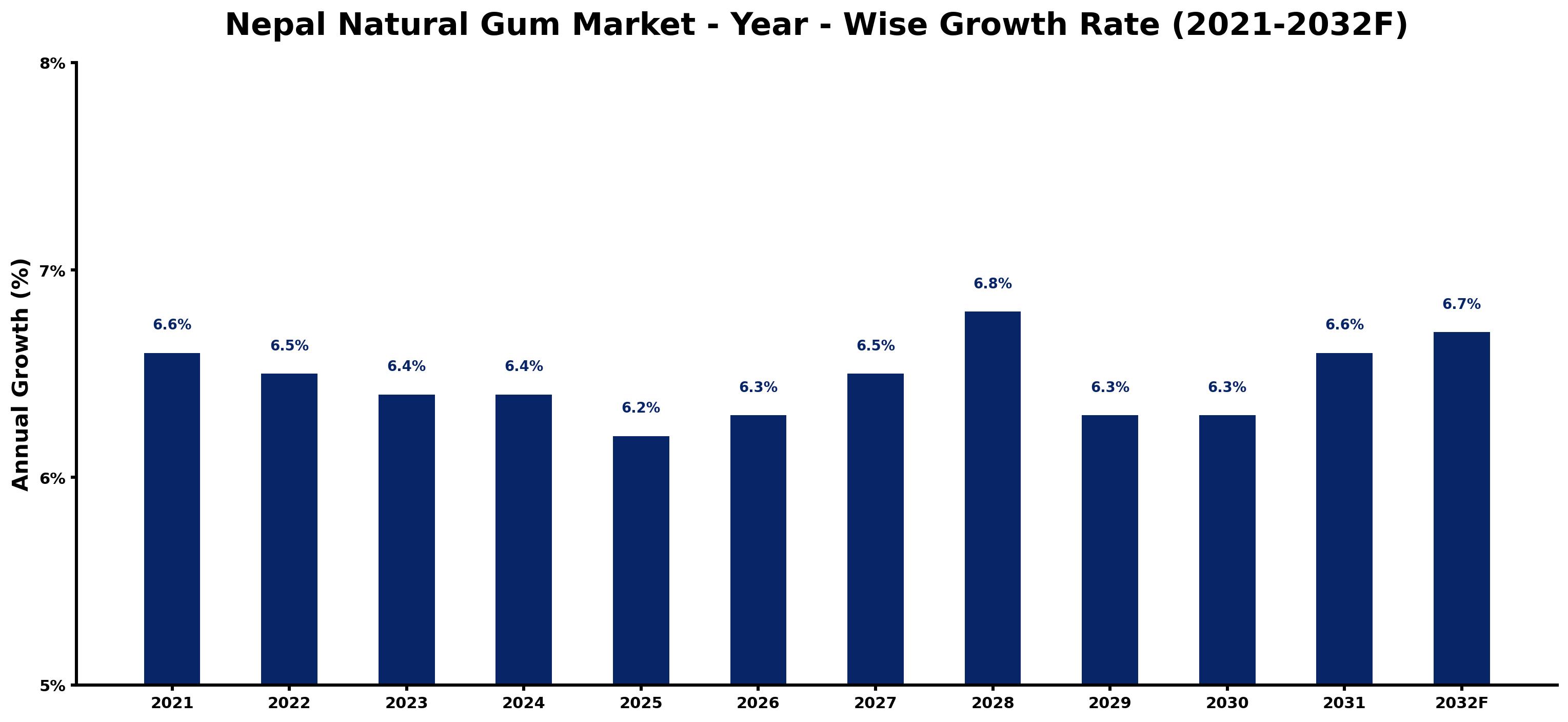
The table below presents the year‑wise growth rates along with the key drivers influencing the market
| Year | Growth Rate | Major Drivers |
| 2021 | 6.6% | Government infrastructure modernization initiatives |
| 2022 | 6.5% | Expansion of commercial construction activities |
| 2023 | 6.4% | Rising electricity demand across industries |
| 2024 | 6.4% | Expansion of transportation and logistics networks |
| 2025 | 6.2% | Increasing adoption of advanced technologies |
| 2026 | 6.3% | Growing urbanization and commercial development |
| 2027 | 6.5% | Increasing industrial automation investments |
| 2028 | 6.8% | Growing renewable energy integration projects |
| 2029 | 6.3% | Expansion of commercial construction activities |
| 2030 | 6.3% | Expansion of commercial construction activities |
| 2031 | 6.6% | Expansion of commercial construction activities |
| 2032 | 6.7% | Growing urbanization and commercial development |
Note - Market size estimations and growth projections presented in this report are based on 6Wresearch's advanced forecasting approach, validated with industry datasets as of June 2026.
Nepal Natural Gum Market Synopsis
Recently, the Nepal Natural Gum Market has gained notable momentum due to a growing preference for sustainable ingredients. However, despite this burgeoning interest, the market is only beginning to tap its potential on the international stage. As consumers globally gravitate toward eco-friendly products, Nepal's natural gum offerings are poised to meet this demand.
Looking ahead, the market's future is bright, driven by increasing investments in modern extraction techniques and the promotion of Nepal's unique natural resources. As the world leans towards clean-label products, the versatility of natural gums in diverse applications—from food to personal care—positions the market favorably for continued growth.
Nepal Natural Gum Market Key Takeaways
- The market is benefiting from the rising global demand for organic and clean-label products.
- Sal resin, primarily sourced from the Sal tree, is a significant contributor to the market.
- Investment in modern technologies could enhance production capacity and sustainability.
- Government policies are supportive of sustainable harvesting practices and community involvement.
- Research into improved extraction methods can drive product innovation and quality enhancement.
Evaluation of Restraints in Nepal Natural Gum Market
Despite the promising outlook, the Nepal Natural Gum Market faces critical restraints. The reliance on traditional harvesting methods and the prevailing environmental conditions significantly impact production capacity. Furthermore, the influx of cheaper synthetic alternatives and natural gums from abroad poses a competitive threat. Limited awareness surrounding the benefits and applications of local natural gums both domestically and internationally further hampers market growth. Addressing these barriers will require strategic investments in education, infrastructure, and technology.
Nepal Natural Gum Market Trends
Several trends are shaping the Nepal Natural Gum Market today. Notably, there is a growing consumer shift towards organic products driven by an increasing awareness of health benefits. This trend is complemented by the rising use of natural gums as stabilizers and emulsifiers in the food and beverage sector. Additionally, the popularity of vegan diets is fostering greater demand for plant-derived ingredients, including natural gums, which are recognized for their functional properties in food applications.
Nepal Natural Gum Market Opportunities
Investment opportunities within the Nepal Natural Gum Market abound, especially in production and processing innovations. Stakeholders can explore avenues for enhancing the extraction processes of abundant species like Shorea robusta and Acacia, thereby improving yield and quality. Furthermore, entering into global distribution partnerships could enhance market access, enabling local producers to capitalize on the increasing international demand for sustainable and natural products.
Government Initiatives in the Nepal Natural Gum Market
The government of Nepal has implemented various policies aimed at bolstering the natural gum market, promoting sustainable harvesting practices, and supporting local communities. Regulations are in place to ensure the responsible extraction of natural gums, thereby protecting both the environment and the livelihoods of local collectors. Initiatives offering technical assistance and training to gum harvesters further contribute to improving their techniques and economic stability. By encouraging the cultivation of gum-yielding trees on private lands through incentives, the government aims to enhance domestic production capabilities.
Future Insights of the Nepal Natural Gum Market
The future of the Nepal Natural Gum Market appears optimistic, underpinned by the increasing global shift towards natural and sustainable products. As consumers become more conscious of their choices, the demand for natural gums is expected to rise steadily. Factors such as the growing inclination for clean-label products, alongside the rich biodiversity of Nepal, place the country in a favorable position to emerge as a significant player in the global natural gum market. Innovations in product offerings and extraction methods will likely be crucial in harnessing this growth potential.
Nepal Natural Gum Market Latest Developments (May 2025 - June 2026)
The Nepal Natural Gum Market has seen a surge in interest from both local and international investors, fostering collaborative efforts to enhance production capacities. Recently, industry stakeholders have been working towards establishing more robust supply chains to mitigate inconsistencies in gum availability. Concurrently, marketing initiatives have been launched to promote the unique attributes of Nepal's natural gum products in global markets, aiming to capture the growing demand for eco-friendly alternatives.
Nepal Natural Gum Market - Key Attractiveness of the Report
- 10 Years of Market Numbers
- Historical Data Starting from 2022 to 2025
- Base Year: 2025
- Forecast Data until 2032
- Key Performance Indicators Impacting the Market
- Major Upcoming Developments and Projects
Key Highlights of the Report:
- Nepal Natural Gum Market Outlook
- Market Size of Nepal Natural Gum Market, 2025
- Forecast of Nepal Natural Gum Market, 2032
- Historical Data and Forecast of Nepal Natural Gum Revenues & Volume for the Period 2022-2032F
- Nepal Natural Gum Market Trend Evolution
- Nepal Natural Gum Market Drivers and Challenges
- Nepal Natural Gum Price Trends
- Nepal Natural Gum Porter's Five Forces
- Nepal Natural Gum Industry Life Cycle
- Historical Data and Forecast of Nepal Natural Gum Market Revenues & Volume By Product Type for the Period 2022-2032F
- Historical Data and Forecast of Nepal Natural Gum Market Revenues & Volume By Food Grade for the Period 2022-2032F
- Historical Data and Forecast of Nepal Natural Gum Market Revenues & Volume By Industry Grade for the Period 2022-2032F
- Historical Data and Forecast of Nepal Natural Gum Market Revenues & Volume By Application for the Period 2022-2032F
- Historical Data and Forecast of Nepal Natural Gum Market Revenues & Volume By Oil & Gas for the Period 2022-2032F
- Historical Data and Forecast of Nepal Natural Gum Market Revenues & Volume By Food & Beverages for the Period 2022-2032F
- Historical Data and Forecast of Nepal Natural Gum Market Revenues & Volume By Pharmaceutical for the Period 2022-2032F
- Historical Data and Forecast of Nepal Natural Gum Market Revenues & Volume By Cosmetics for the Period 2022-2032F
- Nepal Natural Gum Import Export Trade Statistics
- Market Opportunity Assessment By Product Type
- Market Opportunity Assessment By Application
- Nepal Natural Gum Top Companies Market Share
- Nepal Natural Gum Competitive Benchmarking By Technical and Operational Parameters
- Nepal Natural Gum Company Profiles
- Nepal Natural Gum Key Strategic Recommendations






































