Nepal Nutraceutical Products Market (2026-2032) | Trends, Share, Size, Companies, Analysis, Revenue, Industry, Forecast, Growth & Value
Market Forecast By Type (Food, Beverages, Dietary Supplements), By Source (Probiotics, Prebiotics, Vitamins, Minerals), By Distribution Channel (Conventional Stores, Specialty Stores, Drugstores & Pharmacies) And Competitive Landscape
| Product Code: ETC4541617 | Publication Date: Jul 2023 | Updated Date: Jul 2026 | Product Type: Report | |
| Publisher: 6Wresearch | Author: Vasudha | No. of Pages: 85 | No. of Figures: 45 | No. of Tables: 25 |
Nepal Nutraceutical Products Market Growth Rate
According to 6Wresearch internal database and industry insights, the Nepal Nutraceutical Products Market is growing at a compound annual growth rate (CAGR) of 8.2% during the forecast period (2026-2032).
Nepal Nutraceutical Products Market Year-wise Growth Rate and Key Drivers
This graph illustrates the annual growth rates of the Nepal Nutraceutical Products Market from 2022 to 2032, highlighting stable industrial expansion, infrastructure-driven demand, and increasing adoption of precision finishing solutions.
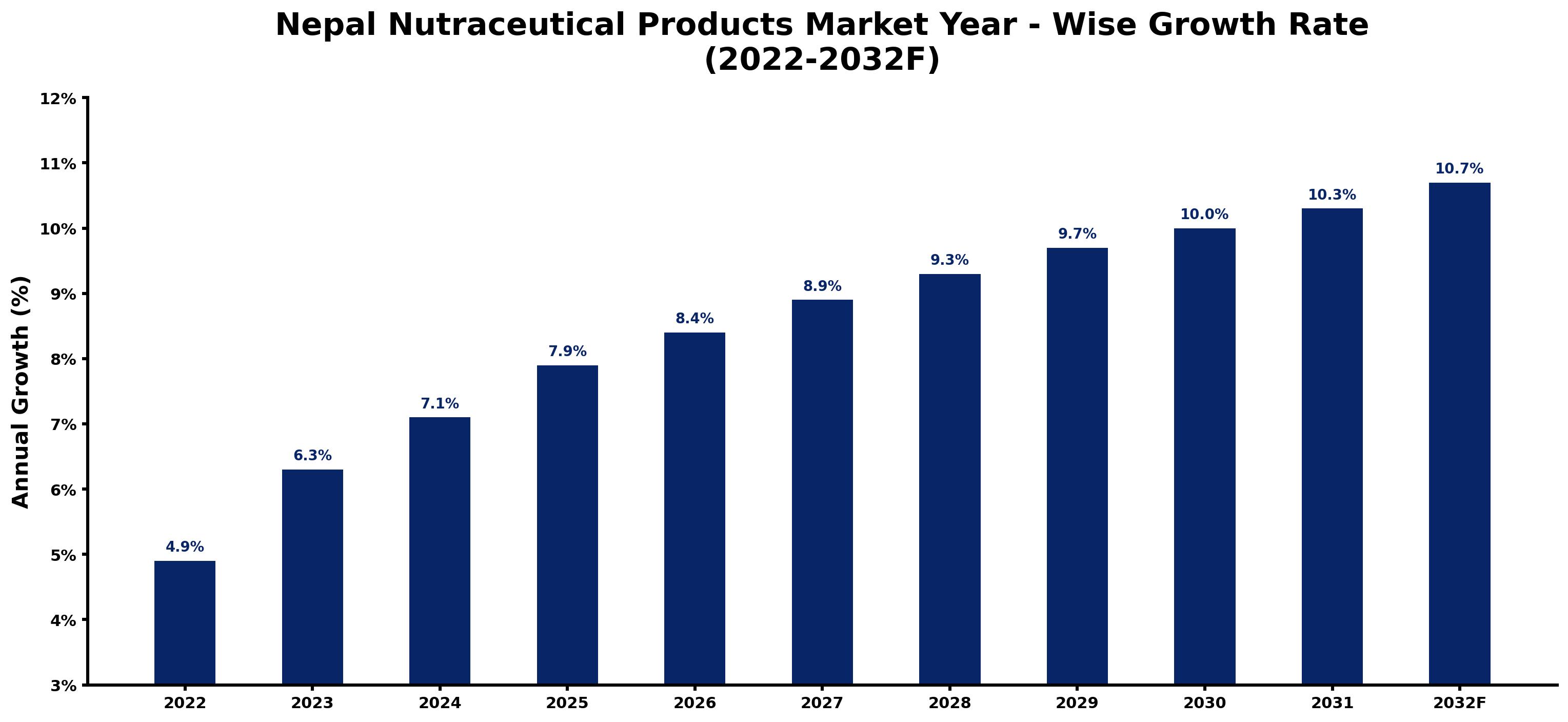
The following table summarizes the historical and forecasted growth rates of the Nepal Nutraceutical Products Market, along with the rationale behind each year’s performance.
| Year | Estimated Growth | Market Rationale |
| 2022 | 4.9% | Growth remained moderate as consumers became more health-conscious after the pandemic, while product availability was still limited outside major urban areas. |
| 2023 | 6.3% | Rising awareness of immunity-boosting supplements, increasing pharmacy distribution, and greater acceptance of vitamins and herbal nutraceuticals supported market expansion. |
| 2024 | 7.1% | Higher disposable incomes, expansion of organized retail, and growing demand for preventive healthcare products accelerated sales. |
| 2025 | 7.9% | Increasing availability of imported nutraceutical brands, expanding e-commerce platforms, and greater physician recommendations strengthened market demand. |
| 2026 | 8.4% | Growing consumer preference for functional foods, dietary supplements, and sports nutrition products supported steady market growth. |
| 2027 | 8.9% | Rising demand for plant-based and natural nutraceutical ingredients continued, although inflationary pressures slightly moderated consumer spending. |
| 2028 | 9.3% | Expansion of health and wellness retail channels, improved product accessibility, and increasing urban health awareness boosted market adoption. |
| 2029 | 9.7% | Market growth moderated slightly due to pricing pressure from imported products, while demand remained supported by preventive healthcare trends. |
| 2030 | 10% | Greater investment by domestic manufacturers, product innovation, and increasing penetration into semi-urban areas accelerated market expansion. |
| 2031 | 10.3% | Rising aging population, increasing prevalence of lifestyle diseases, and wider adoption of personalized nutrition sustained healthy demand. |
| 2032 | 10.7% | Continued consumer focus on wellness, stronger distribution networks, and expanding functional food consumption maintained long-term market growth. |
Topics Covered in the Nepal Nutraceutical Products Market Report
The Nepal Nutraceutical Products Market report thoroughly covers the market by types, sources, and distribution channels. The report provides an unbiased and detailed analysis of ongoing market trends, opportunities/high growth areas, and market drivers, which would help stakeholders devise and align their market strategies according to the current and future market dynamics.
Nepal Nutraceutical Products Market Highlights
| Report Name | Nepal Nutraceutical Products Market |
| Forecast Period | 2026-2032 |
| CAGR | 8.2% |
| Growing Sector | Health and Wellness |
Nepal Nutraceutical Products Market Synopsis
The Nepal Nutraceutical Products Market is set to experience notable growth due to increasing awareness and the increasing demand for preventive healthcare. With the rising e-commerce platforms and retail networks, consumers are becoming more aware of and receptive to various nutraceutical products that includes, dietary supplements, functional foods, and beverages. Moreover, increasing health consciousness and a growing preference for natural products further contributes to the rise of the nutraceutical sector.
Evaluation of Growth Drivers in the Nepal Nutraceutical Products Market
Below mentioned are some growth drivers and their impact on market dynamics:
| Drivers | Primary Segments Affected | Why It Matters |
| Government Support & Health Focus | Food, Beverages, Dietary Supplements | Boosts industry growth and public health initiatives. |
| Increased Health Consciousness | Dietary Supplements, Beverages | Leads demand for preventive health solutions. |
| E-commerce Expansion | All Segments | Improves product access and consumer convenience. |
| Rising Demand for Plant-Based Products | Food, Beverages | Link up growing consumer preference for sustainability. |
| Technological Advancements | All Segments | Enhances product quality and distribution efficiency. |
The Nepal Nutraceutical Products Market is projected to grow significantly with a CAGR of 8.2% during the forecast period of 2026-2032. The market is expanding, driven by a heightened public consciousness about health, an increasing appetite for preventive measures, and a pronounced trend toward plant-based and natural goods. Moreover, the market's evolution is being significantly influenced by government programs, coupled with the convenience of shopping both in stores and online. Consequently, the enduring popularity of nutraceuticals is certain to fuel further growth and change within the market. This growth will be supported by new product innovations and more ways for consumers to buy these products, which will increase their overall market presence.
Evaluation of Restraints in the Nepal Nutraceutical Products Market
Below mentioned are some major restraints and their influence on market dynamics:
| Restraints | Primary Segments Affected | What This Means |
| Regulatory Barriers | Dietary Supplements, Food | Regulatory complexities delay market entry and product approval. |
| Limited Consumer Awareness | All Segments | Impedes growth, as not all consumers are aware of the benefits of nutraceuticals. |
| High Product Prices | Dietary Supplements | Decreases market accessibility, especially in low-income regions. |
| Limited Distribution Channels | All Segments | Hinders availability in rural areas and affects sales growth. |
| Cultural Resistance | Food, Beverages | Slows down the acceptance of certain nutraceutical products. |
Nepal Nutraceutical Products Market Challenges
The Nepal Nutraceutical Products Market faces several challenges. Regulatory complexities slow down the quick approval and market entry of new products. Additionally, a lack of consumer understanding and a general lack of awareness about the benefits of nutraceuticals also hinder market growth. Additionally, high-cost products in the market and cultural resistance in some regions slowdowns the acceptance of nutraceuticals. Moreover, limited distribution channels in rural areas restrict product availability and delay market growth.
Nepal Nutraceutical Products Market Trends
Some major trends contributing to the Nepal Nutraceutical Products Market Growth are:
- Health-Conscious Consumer Trends: With the number of rising awareness of health and wellness, more people are seeking out nutraceutical products, including dietary supplements and functional foods.
- Plant-Based Nutraceuticals: With growing interest in vegan and plant-based diets, nutraceutical companies are focusing on developing plant-based supplements, beverages, and foods.
- Personalized Nutrition: Advances in genetics and health data are enabling personalized nutrition plans and products modify individual’s needs.
Investment Opportunities in the Nepal Nutraceutical Products Industry
Investment opportunities in the Nepal Nutraceutical Products Industry includes:
- E-commerce Platforms: For instance, they greatly expand the market's reach, making it easier for consumers to buy nutraceutical products. This expansion benefits everyone involved.
- Sustainable Production Practices: These approaches vibrate environmentally sound methods, echo with consumers who prioritize ethical products and aim to lessen their environmental footprint.
- Innovative Product Development: The shift toward individualized, specialized dietary approaches is transforming the health market, highlighting a growing consumer focus on organic product integrity.
Top 5 Leading Players in the Nepal Nutraceutical Products Market
Here are some top companies contributing to Nepal Nutraceutical Products Market Share:
1. Himalaya Drug Company
| Company Name | Himalaya Drug Company |
| Headquarters | Bangalore, India |
| Established | 1930 |
| Website | Click Here |
Himalaya Drug Company is a prominent player in the nutraceutical market, offering a wide range of herbal supplements, functional foods, and wellness products. They focus on research and development to ensure that their products meet the highest quality standards.
2. Nepal Nutraceuticals Pvt. Ltd.
| Company Name | Nepal Nutraceuticals Pvt. Ltd. |
| Headquarters | Kathmandu, Nepal |
| Established | 2005 |
| Website | - |
Nepal Nutraceuticals Pvt. Ltd. specializes in producing dietary supplements and functional foods with an emphasis on natural ingredients sourced from Nepal’s rich biodiversity. They are committed to promoting health and wellness through their products.
3. JayShree Healthcare Pvt. Ltd.
| Company Name | JayShree Healthcare Pvt. Ltd. |
| Headquarters | Bara, Nepal (Near Birgunj) |
| Established | 2024 |
| Website | Click Here |
The newest high-capacity contender. JayShree has rapidly gained market share by positioning itself as the most modern facility in the country, specializing in high-demand formats like soft-gel capsules, hard-gels, and powders. They are a primary choice for third-party contract manufacturing in the region.
4. Bhaskar Herbaceuticals Pvt. Ltd.
| Company Name | Bhaskar Herbaceuticals Pvt. Ltd. |
| Headquarters | Lalitpur, Nepal |
| Established | 2010 |
| Website | Click Here |
Notable for being the first WHO-GMP certified herbal company in Nepal. With a portfolio of over 350 products, they bridge the gap between traditional Ayurvedic "Classical" medicines and modern "Proprietary" nutraceuticals. They serve a massive domestic base of over 15 million customers.
5. Fleur Himalayan Limited
| Company Name | Fleur Himalayan Limited |
| Headquarters | Kathmandu, Nepal |
| Established | 1996 |
| Website | Click Here |
A domestic pioneer in high-standard herbal manufacturing. Operating from a 65,000 sq. ft. facility, they produce over 60 commercial products, ranging from immune boosters to animal health supplements. They are one of the few Nepalese nutraceutical firms with a significant presence on the Nepal Stock Exchange (NEPSE: FHL).
Government Regulations Introduced in the Nepal Nutraceutical Products Market
According to the Nepali government data, it has launched various initiatives to support the expansion of nutraceutical industry. The Ministry of Health and Population (MOHP) has introduced regulations to make sure that the nutraceutical products must meet safety and quality standards. Additionally, the government has implicated policies to support local production and exports of nutraceuticals. They make sure that manufacturers adhere to stringent standards of cleanliness and safety. The government has also provided incentives to companies that produce nutraceuticals with long-term practices.
Future Insights of the Nepal Nutraceutical Products Market
The outcome for the Nepal Nutraceutical Products Market is positive, with significant growth expected in the coming years. The market is led by increasing health awareness, a growing preference for plant-based products and government support for the nutraceutical industry. The rise of e-commerce platforms will further boost access to nutraceutical products across urban and rural areas. The demand for plant-based and organic products, combined with advancements in product innovation, will continue to drive market expansion.
Market Segmentation Analysis
The report offers a comprehensive study of the subsequent market segments and their leading categories.
Dietary Supplements to Dominate the Market- By Type
According to Kanak Phartiyal, Senior Research Analyst at 6wresearch, dietary supplements influence the market due to growing consumer awareness about the welfare of nutraceutical products for immunity and overall health. These products are increasingly adopted by consumers seeking proactive health management and prevent diseases.
Probiotics to Dominate the Market- By Source
Probiotics are currently leading the market, mainly due to being more popular in products that support digestive health and boost the immune system. They are widely used in many nutraceutical which greatly contributes to the market's growth.
Conventional Stores to Dominate the Market- By Distribution Channel
Conventional Stores are the most noteworthy distribution channel due to their wide accessibility and customer base. Consumers often prefer conventional stores for purchasing nutraceutical products because of the convenience and familiarity they offer.
Key Attractiveness of the Report
- 10 Years Market Numbers.
- Historical Data Starting from 2022 to 2025.
- Base Year: 2025
- Forecast Data until 2032.
- Key Performance Indicators Impacting the Market.
- Major Upcoming Developments and Projects.
Key Highlights of the Report:
- Nepal Nutraceutical Products Market Outlook
- Market Size of Nepal Nutraceutical Products Market, 2025
- Forecast of Nepal Nutraceutical Products Market, 2032
- Historical Data and Forecast of Nepal Nutraceutical Products Revenues & Volume for the Period 2022 - 2032
- Nepal Nutraceutical Products Market Trend Evolution
- Nepal Nutraceutical Products Market Drivers and Challenges
- Nepal Nutraceutical Products Price Trends
- Nepal Nutraceutical Products Porter's Five Forces
- Nepal Nutraceutical Products Industry Life Cycle
- Historical Data and Forecast of Nepal Nutraceutical Products Market Revenues & Volume By Type for the Period 2022 - 2032
- Historical Data and Forecast of Nepal Nutraceutical Products Market Revenues & Volume By Food for the Period 2022 - 2032
- Historical Data and Forecast of Nepal Nutraceutical Products Market Revenues & Volume By Beverages for the Period 2022 - 2032
- Historical Data and Forecast of Nepal Nutraceutical Products Market Revenues & Volume By Dietary Supplements for the Period 2022 - 2032
- Historical Data and Forecast of Nepal Nutraceutical Products Market Revenues & Volume By Source for the Period 2022 - 2032
- Historical Data and Forecast of Nepal Nutraceutical Products Market Revenues & Volume By Probiotics for the Period 2022 - 2032
- Historical Data and Forecast of Nepal Nutraceutical Products Market Revenues & Volume By Prebiotics for the Period 2022 - 2032
- Historical Data and Forecast of Nepal Nutraceutical Products Market Revenues & Volume By Vitamins for the Period 2022 - 2032
- Historical Data and Forecast of Nepal Nutraceutical Products Market Revenues & Volume By Minerals for the Period 2022 - 2032
- Historical Data and Forecast of Nepal Nutraceutical Products Market Revenues & Volume By Distribution Channel for the Period 2022 - 2032
- Historical Data and Forecast of Nepal Nutraceutical Products Market Revenues & Volume By Conventional Stores for the Period 2022 - 2032
- Historical Data and Forecast of Nepal Nutraceutical Products Market Revenues & Volume By Specialty Stores for the Period 2022 - 2032
- Historical Data and Forecast of Nepal Nutraceutical Products Market Revenues & Volume By Drugstores & Pharmacies for the Period 2022 - 2032
- Nepal Nutraceutical Products Import Export Trade Statistics
- Market Opportunity Assessment By Type
- Market Opportunity Assessment By Source
- Market Opportunity Assessment By Distribution Channel
- Nepal Nutraceutical Products Top Companies Market Share
- Nepal Nutraceutical Products Competitive Benchmarking By Technical and Operational Parameters
- Nepal Nutraceutical Products Company Profiles
- Nepal Nutraceutical Products Key Strategic Recommendations
Market Covered
The report subsequently covers the market by the following segments and subsegments:
By Type
- Food
- Beverages
- Dietary Supplements
By Source
- Probiotics
- Prebiotics
- Vitamins
- Minerals
By Distribution Channel
- Conventional Stores
- Specialty Stores
- Drugstores & Pharmacies
Nepal Nutraceutical Products Market (2026-2032): FAQs
The Nepal Nutraceutical Products Market is projected to grow at a CAGR of 8.2% during the forecast period 2026-2032.
Probiotics are leading the market because of their increasing popularity in products that support digestive health and boost the immune system.
The market is led by increased health consciousness and government support for the nutraceutical industry.
The key challenges includes regulatory barriers and cultural resistance to certain nutraceutical products.
6Wresearch actively monitors the Nepal Nutraceutical Products Market and publishes its comprehensive annual report, highlighting emerging trends, growth drivers, revenue analysis, and forecast outlook. Our insights help businesses to make data-backed strategic decisions with ongoing market dynamics. Our analysts track relevent industries related to the Nepal Nutraceutical Products Market, allowing our clients with actionable intelligence and reliable forecasts tailored to emerging regional needs.
Yes, we provide customisation as per your requirements. To learn more, feel free to contact us on sales@6wresearch.com
|
1 Executive Summary |
|
2 Introduction |
|
2.1 Key Highlights of the Report |
|
2.2 Report Description |
|
2.3 Market Scope & Segmentation |
|
2.4 Research Methodology |
|
2.5 Assumptions |
|
3 Nepal Nutraceutical Products Market Overview |
|
3.1 Nepal Country Macro Economic Indicators |
|
3.2 Nepal Nutraceutical Products Market Revenues & Volume, 2022 & 2032F |
|
3.3 Nepal Nutraceutical Products Market - Industry Life Cycle |
|
3.4 Nepal Nutraceutical Products Market - Porter's Five Forces |
|
3.5 Nepal Nutraceutical Products Market Revenues & Volume Share, By Type, 2022 & 2032F |
|
3.6 Nepal Nutraceutical Products Market Revenues & Volume Share, By Source, 2022 & 2032F |
|
3.7 Nepal Nutraceutical Products Market Revenues & Volume Share, By Distribution Channel, 2022 & 2032F |
|
4 Nepal Nutraceutical Products Market Dynamics |
|
4.1 Impact Analysis |
|
4.2 Market Drivers |
|
4.2.1 Growing awareness about health and wellness among consumers in Nepal |
|
4.2.2 Increasing disposable income leading to higher spending on preventive healthcare products |
|
4.2.3 Rise in demand for natural and organic products in the nutraceutical market in Nepal |
|
4.3 Market Restraints |
|
4.3.1 Lack of stringent regulations and quality control in the nutraceutical products market in Nepal |
|
4.3.2 Limited access to distribution channels and retail outlets for nutraceutical products |
|
4.3.3 Price sensitivity among consumers in Nepal affecting the adoption of premium nutraceutical products |
|
5 Nepal Nutraceutical Products Market Trends |
|
6 Nepal Nutraceutical Products Market, By Types |
|
6.1 Nepal Nutraceutical Products Market, By Type |
|
6.1.1 Overview and Analysis |
|
6.1.2 Nepal Nutraceutical Products Market Revenues & Volume, By Type, 2022 - 2032F |
|
6.1.3 Nepal Nutraceutical Products Market Revenues & Volume, By Food, 2022 - 2032F |
|
6.1.4 Nepal Nutraceutical Products Market Revenues & Volume, By Beverages, 2022 - 2032F |
|
6.1.5 Nepal Nutraceutical Products Market Revenues & Volume, By Dietary Supplements, 2022 - 2032F |
|
6.2 Nepal Nutraceutical Products Market, By Source |
|
6.2.1 Overview and Analysis |
|
6.2.2 Nepal Nutraceutical Products Market Revenues & Volume, By Probiotics, 2022 - 2032F |
|
6.2.3 Nepal Nutraceutical Products Market Revenues & Volume, By Prebiotics, 2022 - 2032F |
|
6.2.4 Nepal Nutraceutical Products Market Revenues & Volume, By Vitamins, 2022 - 2032F |
|
6.2.5 Nepal Nutraceutical Products Market Revenues & Volume, By Minerals, 2022 - 2032F |
|
6.3 Nepal Nutraceutical Products Market, By Distribution Channel |
|
6.3.1 Overview and Analysis |
|
6.3.2 Nepal Nutraceutical Products Market Revenues & Volume, By Conventional Stores, 2022 - 2032F |
|
6.3.3 Nepal Nutraceutical Products Market Revenues & Volume, By Specialty Stores, 2022 - 2032F |
|
6.3.4 Nepal Nutraceutical Products Market Revenues & Volume, By Drugstores & Pharmacies, 2022 - 2032F |
|
7 Nepal Nutraceutical Products Market Import-Export Trade Statistics |
|
7.1 Nepal Nutraceutical Products Market Export to Major Countries |
|
7.2 Nepal Nutraceutical Products Market Imports from Major Countries |
|
8 Nepal Nutraceutical Products Market Key Performance Indicators |
|
8.1 Consumer engagement on social media platforms for nutraceutical products |
|
8.2 Number of new product launches in the nutraceutical market in Nepal |
|
8.3 Percentage increase in the adoption of nutraceutical products among different age groups in Nepal |
|
9 Nepal Nutraceutical Products Market - Opportunity Assessment |
|
9.1 Nepal Nutraceutical Products Market Opportunity Assessment, By Type, 2022 & 2032F |
|
9.2 Nepal Nutraceutical Products Market Opportunity Assessment, By Source, 2022 & 2032F |
|
9.3 Nepal Nutraceutical Products Market Opportunity Assessment, By Distribution Channel, 2022 & 2032F |
|
10 Nepal Nutraceutical Products Market - Competitive Landscape |
|
10.1 Nepal Nutraceutical Products Market Revenue Share, By Companies, 2025 |
|
10.2 Nepal Nutraceutical Products Market Competitive Benchmarking, By Operating and Technical Parameters |
|
11 Company Profiles |
|
12 Recommendations |
|
13 Disclaimer |
Global Go To Market Strategy - 2030
Export potential enables firms to identify high-growth global markets with greater confidence by combining advanced trade intelligence with a structured quantitative methodology. The framework analyzes emerging demand trends and country-level import patterns while integrating macroeconomic and trade datasets such as GDP and population forecasts, bilateral import–export flows, tariff structures, elasticity differentials between developed and developing economies, geographic distance, and import demand projections. Using weighted trade values from 2020–2024 as the base period to project country-to-country export potential for 2030, these inputs are operationalized through calculated drivers such as gravity model parameters, tariff impact factors, and projected GDP per-capita growth. Through an analysis of hidden potentials, demand hotspots, and market conditions that are most favorable to success, this method enables firms to focus on target countries, maximize returns, and global expansion with data, backed by accuracy.
By factoring in the projected importer demand gap that is currently unmet and could be potential opportunity, it identifies the potential for the Exporter (Country) among 190 countries, against the general trade analysis, which identifies the biggest importer or exporter.
To discover high-growth global markets and optimize your business strategy:
Click Here
Pricing
- Single User License$ 1,995
- Department License$ 2,400
- Site License$ 3,120
- Global License$ 3,795

Leadership Perspectives from Industry Events
Search
Thought Leadership and Analyst Meet





Our Clients








6WResearch In News
- India Export Attractiveness Tracker 2026
- India Air Conditioner Market Set for Strong Rebound in 2026 After Weather-Led Correction and GST-Driven Recovery: 6Wresearch
- ADAS in India: How Automatic Emergency Braking, Blind Spot Detection & Driver Monitoring are Transforming Road Safety
- Doha a strategic location for EV manufacturing hub: IPA Qatar
- Demand for luxury TVs surging in the GCC, says Samsung
- Empowering Growth: The Thriving Journey of Bangladesh’s Cable Industry
Latest Reports
- Nicaragua RPG Gaming Market (2026-2032)
- New Zealand RPG Gaming Market (2026-2032)
- Netherlands RPG Gaming Market (2026-2032)
- Nauru RPG Gaming Market (2026-2032)
- Namibia RPG Gaming Market (2026-2032)
- Mozambique RPG Gaming Market (2026-2032)
- Montenegro RPG Gaming Market (2026-2032)
- Mongolia RPG Gaming Market (2026-2032)
- Monaco RPG Gaming Market (2026-2032)
- Micronesia RPG Gaming Market (2026-2032)
Industry Events and Analyst Meet

EV India Expo 2026

HIMTEX 2026

India Refining Summit 2026

India EV Show 2026

EV tech India Expo 2026
Whitepaper
- Middle East & Africa Commercial Security Market Click here to view more.
- Middle East & Africa Fire Safety Systems & Equipment Market Click here to view more.
- GCC Drone Market Click here to view more.
- Middle East Lighting Fixture Market Click here to view more.
- GCC Physical & Perimeter Security Market Click here to view more.


