Nepal Perfumes & Deodorants Market Summary
The nepal perfumes & deodorants market was estimated at USD 253 Million in 2025 and is projected to reach USD 337 Million by 2032, growing at a CAGR of 4.9% from 2026 to 2032.
Nepal Perfumes & Deodorants Market Year-wise Growth Rate and Key Drivers
This graph highlights how the Nepal Perfumes & Deodorants Market has steadily grown over the past five years, supported by major growth factors.
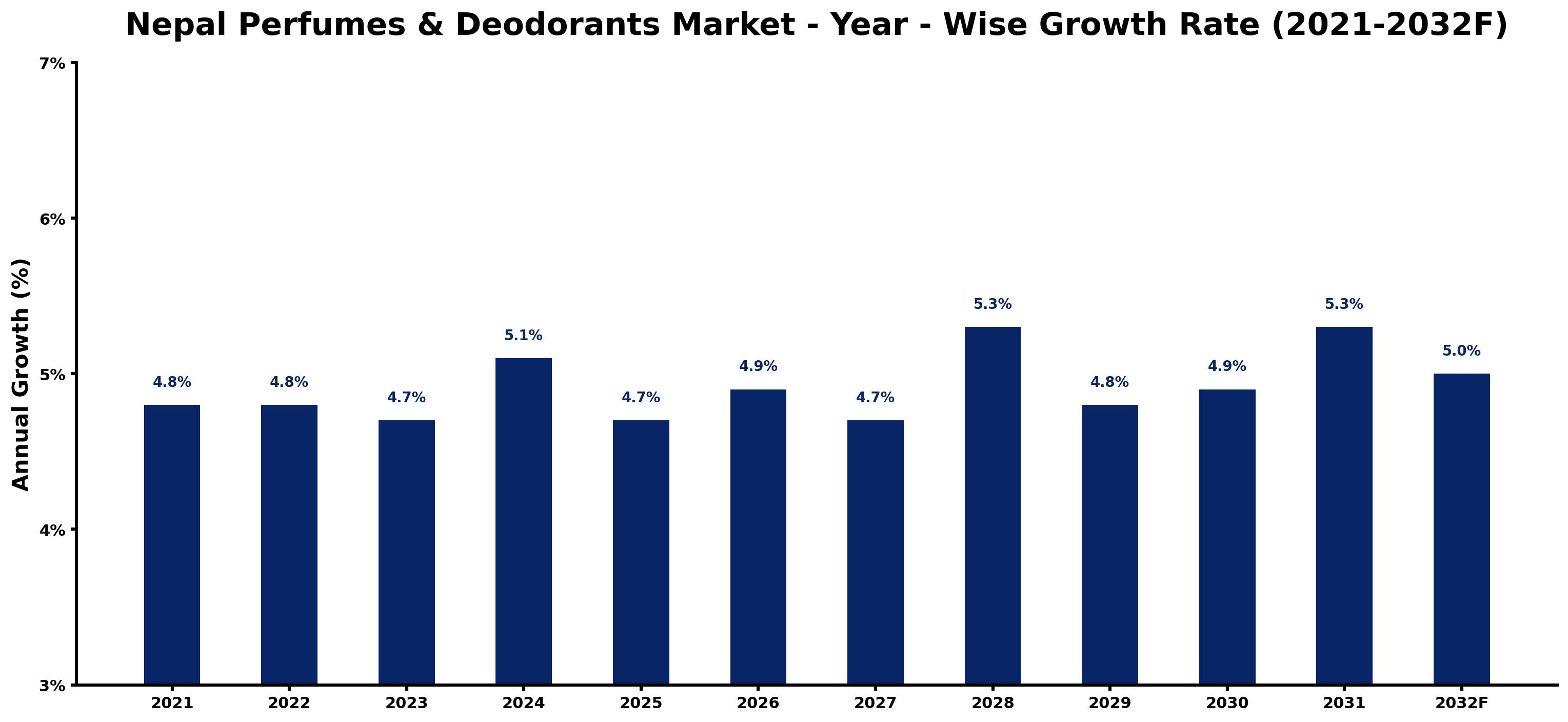
The table below presents the year wise growth rates along with the key drivers influencing the market
| Year | Growth Rate | Major Drivers |
| 2021 | 4.8% | Consumers gravitated towards personal hygiene products in response to heightened awareness. |
| 2022 | 4.8% | E-commerce platforms gained traction, significantly improving product accessibility across urban areas. |
| 2023 | 4.7% | Local brands began emerging, focusing on traditional scents combined with modern marketing strategies. |
| 2024 | 5.1% | International brands entered the market, increasing competition and diversifying product offerings. |
| 2025 | 4.7% | Rising disposable incomes motivated consumers to explore premium fragrance options and luxury items. |
| 2026 | 4.9% | Sustainability trends prompted brands to innovate with eco-friendly packaging and natural ingredients. |
| 2027 | 4.7% | Increasing tourism in Nepal stimulated demand for locally made fragrances among visitors. |
| 2028 | 5.3% | Social media campaigns connected consumers with niche brands, amplifying cultural and personal identity. |
| 2029 | 4.8% | Retail expansion into rural areas opened new customer segments previously overlooked by mainstream brands. |
| 2030 | 4.9% | Collaborations between local artisans and global companies showcased Nepal's unique cultural heritage. |
| 2031 | 5.3% | Cultural festivals and events fostered brand visibility, enhancing consumer engagement and loyalty. |
| 2032 | 5.0% | Emerging trends in wellness promoted aromatherapy products, integrating scents into holistic lifestyles. |
Note - Market size estimations and growth projections presented in this report are based on 6Wresearch's advanced forecasting approach, validated with industry datasets as of June 2026.
Nepal Perfumes & Deodorants Market Synopsis
The Nepal Perfumes Deodorants Market is projected to reach 4.9% and witness significant growth during the forecast period (2026-2032). This market is characterized by rising consumer awareness concerning personal hygiene and a notable increase in disposable incomes, which contribute to the overall market expansion. In addition, the growing demand for products formulated with natural ingredients is shifting consumer preferences towards organic options, vastly impacting the market landscape.
Nepal Perfumes & Deodorants Market Growth Drivers
Several factors are propelling the growth of the Nepal Perfumes & Deodorants Market. Firstly, the increasing disposable income among consumers enables them to invest in high-quality personal care products. Secondly, there is a growing awareness of personal hygiene that drives demand for perfumes and deodorants. Furthermore, a shift towards natural and organic ingredients reflects a broadening consumer preference, as individuals seek healthier alternatives over synthetic formulations. Additionally, the rise in urbanization and lifestyle changes among the younger demographic contribute significantly to the cultivation of this market.
Nepal Perfumes & Deodorants Market Trends and Opportunities
The Nepal Perfumes & Deodorants Market is experiencing transformative trends that indicate lucrative opportunities for growth. Notably, brands are increasingly focusing on sustainable and eco-friendly product formulations, tapping into the health-conscious consumer base. The incorporation of innovative packaging designs, aimed at enhancing aesthetic appeal and convenience, has also garnered attention. Moreover, the rise of e-commerce platforms provides a significant channel for brands to reach consumers effectively. Collaborations between local producers and global brands are on the rise, further stimulating market expansion.
Nepal Perfumes & Deodorants Market Challenges and Restraints
While promising growth exists in the Nepal Perfumes & Deodorants Market, several challenges may hinder market progress. The prevalence of counterfeit products undermines trust and quality perceptions among consumers. High competition levels and the presence of numerous brands make market differentiation challenging for new entrants. Additionally, fluctuating raw material prices can impact production costs and profit margins. There is also the challenge of establishing a loyal customer base in a diverse market, where consumer preferences are rapidly evolving.
Nepal Perfumes & Deodorants Market Regional Analysis
The geographical landscape of the Nepal Perfumes & Deodorants Market reveals significant opportunities for development. Urban areas, particularly in Kathmandu and Pokhara, showcase a higher demand for personal care products, driven by increased consumer spending. Moreover, rural regions present a growing market due to rising awareness about personal hygiene. The unique cultural practices and preferences across different regions require tailored marketing strategies, allowing brands to address varying consumer needs effectively.
Nepal Perfumes & Deodorants Market Government Investment and Initiatives
The government of Nepal has recognized the potential of the personal care sector, including perfumes and deodorants, and is formulating policies aimed at enhancing local production capacities. Investments in infrastructure development are also part of the strategy to support manufacturing industries, which includes private-sector collaborations. Additionally, the government is actively promoting awareness campaigns focused on hygiene, thus indirectly contributing to the demand for perfumes and deodorants. Various incentives for manufacturing and retail operations are being introduced to stimulate economic activities within the sector.
Nepal Perfumes & Deodorants Market Latest Developments (May 2025 - June 2026)
During the period from May 2025 to June 2026, the Nepal Perfumes & Deodorants Market has seen significant developments. A noticeable trend is the increased focus on digital marketing strategies, with brands shifting toward online platforms to reach a wider audience. Additions to product lines featuring natural ingredients have captured consumer attention and are gaining traction rapidly. Key industry participants have also engaged in strategic partnerships, aiming to enhance distribution channels and strengthen market presence. The introduction of regulatory frameworks governing product safety and quality has provided consumers with greater assurance regarding product integrity.
Nepal Perfumes & Deodorants Market - Key Attractiveness of the Report
- 10 Years of Market Numbers
- Historical Data Starting from 2022 to 2025
- Base Year: 2025
- Forecast Data until 2032
- Key Performance Indicators Impacting the Market
- Major Upcoming Developments and Projects
Key Highlights of the Report:
- Nepal Perfumes & Deodorants Market Outlook
- Market Size of Nepal Perfumes & Deodorants Market, 2025
- Forecast of Nepal Perfumes & Deodorants Market, 2032F
- Historical Data and Forecast of Nepal Perfumes & Deodorants Revenues & Volume for the Period 2022-2032F
- Nepal Perfumes & Deodorants Market Trend Evolution
- Nepal Perfumes & Deodorants Market Drivers and Challenges
- Nepal Perfumes & Deodorants Price Trends
- Nepal Perfumes & Deodorants Porter's Five Forces
- Nepal Perfumes & Deodorants Industry Life Cycle
- Historical Data and Forecast of Nepal Perfumes & Deodorants Market Revenues & Volume By Product Types for the Period 2022-2032F
- Historical Data and Forecast of Nepal Perfumes & Deodorants Market Revenues & Volume By Deodorants for the Period 2022-2032F
- Historical Data and Forecast of Nepal Perfumes & Deodorants Market Revenues & Volume By Perfumes for the Period 2022-2032F
- Historical Data and Forecast of Nepal Perfumes & Deodorants Market Revenues & Volume By Consumer Group for the Period 2022-2032F
- Historical Data and Forecast of Nepal Perfumes & Deodorants Market Revenues & Volume By Men for the Period 2022-2032F
- Historical Data and Forecast of Nepal Perfumes & Deodorants Market Revenues & Volume By Women for the Period 2022-2032F
- Historical Data and Forecast of Nepal Perfumes & Deodorants Market Revenues & Volume By Unisex for the Period 2022-2032F
- Historical Data and Forecast of Nepal Perfumes & Deodorants Market Revenues & Volume By Distribution Channel for the Period 2022-2032F
- Historical Data and Forecast of Nepal Perfumes & Deodorants Market Revenues & Volume By Online for the Period 2022-2032F
- Historical Data and Forecast of Nepal Perfumes & Deodorants Market Revenues & Volume By Offline for the Period 2022-2032F
- Historical Data and Forecast of Nepal Perfumes & Deodorants Market Revenues & Volume By Price Segment for the Period 2022-2032F
- Historical Data and Forecast of Nepal Perfumes & Deodorants Market Revenues & Volume By Premium for the Period 2022-2032F
- Historical Data and Forecast of Nepal Perfumes & Deodorants Market Revenues & Volume By Mass for the Period 2022-2032F
- Nepal Perfumes & Deodorants Import Export Trade Statistics
- Market Opportunity Assessment By Product Types
- Market Opportunity Assessment By Consumer Group
- Market Opportunity Assessment By Distribution Channel
- Market Opportunity Assessment By Price Segment
- Nepal Perfumes & Deodorants Top Companies Market Share
- Nepal Perfumes & Deodorants Competitive Benchmarking By Technical and Operational Parameters
- Nepal Perfumes & Deodorants Company Profiles
- Nepal Perfumes & Deodorants Key Strategic Recommendations






































