Nepal Point Of Sale Terminals Market Size, Share & Growth Rate
The Nepal Point Of Sale Terminals Market was estimated at USD 1081 Million in 2025 and is projected to reach USD 1543 Million by 2032, growing at a CAGR of 5.2% from 2026 to 2032. This growth trajectory is driven by an accelerating trend towards cashless transactions and robust government initiatives aimed at promoting digital payments. Furthermore, the expansion of the retail sector and the increasing sophistication of consumer preferences are encouraging businesses to adopt modern POS technologies.
Nepal Point Of Sale Terminals Market Year-wise Growth Rate and Key Drivers
This graph highlights how the Nepal Point Of Sale Terminals Market has steadily grown over the years, supported by major growth factors.
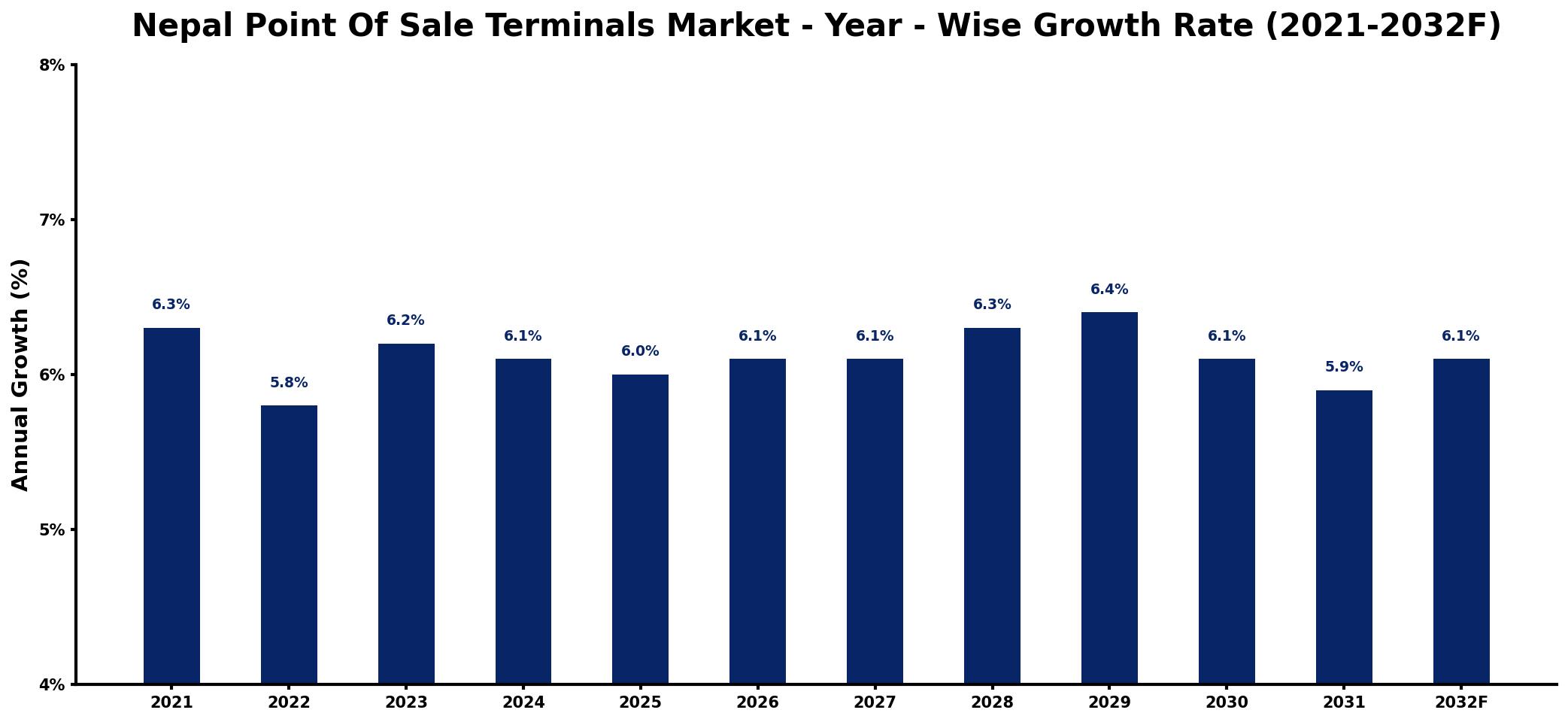
The table below presents the year‑wise growth rates along with the key drivers influencing the market
| Year | Growth Rate | Major Drivers |
| 2021 | 6.3% | Increased digital payment adoption |
| 2022 | 5.8% | Growth in retail sector investment |
| 2023 | 6.2% | Expansion of e-commerce platforms |
| 2024 | 6.1% | Rise in mobile payment solutions |
| 2025 | 6.0% | Boost in consumer spending habits |
| 2026 | 6.1% | Technological advancements in payments |
| 2027 | 6.1% | Increase in small business transactions |
| 2028 | 6.3% | growing downstream application demand |
| 2029 | 6.4% | Surge in contactless payment preferences |
| 2030 | 6.1% | strengthening underlying market demand |
| 2031 | 5.9% | Shift towards cashless economy |
| 2032 | 6.1% | Increased demand for payment security |
Note: Market size estimations and growth projections presented in this report are based on 6Wresearch's proprietary forecasting methodology, utilizing the latest available industry data, government publications, and primary research inputs.
Nepal Point Of Sale Terminals Market Synopsis
The adoption of Point Of Sale terminals in Nepal is rapidly evolving, underscored by rising digital payment acceptance. This shift is not only reshaping consumer behavior but also optimizing operational efficiencies for businesses across various sectors, including retail and hospitality.
Current market dynamics indicate a healthy appetite for innovative solutions that cater to both large enterprises and smaller establishments. As Nepali businesses increasingly recognize the value of effective inventory management and superior customer service, the demand for advanced POS systems continues to gain momentum.
Nepal Point Of Sale Terminals Market Key Takeaways
- Digital payment adoption is a key growth driver for the Nepal POS terminals market.
- The retail and hospitality sectors are witnessing enhanced demand for mobile and cloud-based POS solutions.
- Contactless payment technologies are becoming integral to POS systems in response to consumer preferences.
- Government initiatives are significantly contributing to the push for a cashless economy.
- Investments in infrastructure and cybersecurity will be critical for sustained market growth.
Evaluation of Restraints in Nepal Point Of Sale Terminals Market
Despite its growth prospects, the Nepal Point Of Sale Terminals Market faces several limitations. Limited internet access and infrastructural challenges in rural areas pose significant hurdles to the effective deployment of POS systems. Furthermore, the cost of acquiring both hardware and software solutions can deter small businesses from making the transition to digital payment methods. Concerns regarding data security and a general lack of awareness about the benefits of POS technology further complicate the market landscape, necessitating targeted efforts to mitigate these issues.
Nepal Point Of Sale Terminals Market Trends
Several notable trends are shaping the Nepal POS terminals market. The increasing reliance on mobile POS solutions is a direct response to the growing smartphone penetration among merchants. Cloud-based systems are also gaining traction due to their flexibility and cost-effectiveness, making them appealing to a diverse range of businesses. Furthermore, the integration of advanced analytics in POS technology is enabling businesses to derive valuable insights into consumer behavior, thus refining marketing strategies and enhancing customer engagement.
Nepal Point Of Sale Terminals Market Opportunities
The market presents ample opportunities for investors and businesses alike, particularly in the realm of customized POS solutions that cater to the unique needs of local enterprises. The demand for innovative payment technologies, along with collaboration opportunities with financial institutions and retailers, offers promising avenues for growth. Investing in infrastructure to improve connectivity and security will also be pivotal in capitalizing on the increasing shift towards digital transactions.
Government Initiatives in the Nepal Point Of Sale Terminals Market
The Nepalese government has implemented a range of policies aimed at promoting the use of POS terminals. These initiatives include subsidies for terminal acquisition and efforts to reduce transaction fees, enhancing the appeal of digital payment solutions. Additionally, there is a strong push for interoperability among various payment systems and regulations designed to ensure the security and privacy of financial data. Such policies are essential for fostering a more inclusive financial ecosystem and transitioning the country towards a cashless economy.
Future Insights of the Nepal Point Of Sale Terminals Market
Looking forward to the period between 2026 and 2032, the outlook for the Nepal Point Of Sale Terminals Market is optimistic. The transition to cashless transactions, facilitated by evolving consumer preferences and government support, is set to stimulate demand for sophisticated payment solutions. As e-commerce continues to grow, the necessity for efficient POS systems to handle a diverse array of transaction types will become increasingly critical. This evolution will present opportunities for both domestic and international players to penetrate and expand within the Nepalese market.
Nepal Point Of Sale Terminals Market Latest Developments (2025 - 2026)
Recent developments in the Nepal Point Of Sale Terminals Market indicate a surge in interest surrounding advanced payment technologies. Businesses are increasingly exploring integrated solutions that facilitate seamless transactions and enhance customer experiences. Additionally, there are ongoing discussions surrounding collaborations between local tech firms and international providers to enhance the capabilities of POS systems, particularly in areas like security and analytics.
Nepal Point Of Sale Terminals Market - Key Attractiveness of the Report
- 10 Years of Market Numbers
- Historical Data Starting from 2022 to 2025
- Base Year: 2025
- Forecast Data until 2032
- Key Performance Indicators Impacting the Market
- Major Upcoming Developments and Projects
Key Highlights of the Report:
- Nepal Point Of Sale Terminals Market Outlook
- Market Size of Nepal Point Of Sale Terminals Market, 2025
- Forecast of Nepal Point Of Sale Terminals Market, 2032
- Historical Data and Forecast of Nepal Point Of Sale Terminals Revenues & Volume for the Period 2022-2032F
- Nepal Point Of Sale Terminals Market Trend Evolution
- Nepal Point Of Sale Terminals Market Drivers and Challenges
- Nepal Point Of Sale Terminals Price Trends
- Nepal Point Of Sale Terminals Porter's Five Forces
- Nepal Point Of Sale Terminals Industry Life Cycle
- Historical Data and Forecast of Nepal Point Of Sale Terminals Market Revenues & Volume By Product for the Period 2022-2032F
- Historical Data and Forecast of Nepal Point Of Sale Terminals Market Revenues & Volume By Fixed for the Period 2022-2032F
- Historical Data and Forecast of Nepal Point Of Sale Terminals Market Revenues & Volume By Mobile for the Period 2022-2032F
- Historical Data and Forecast of Nepal Point Of Sale Terminals Market Revenues & Volume By Component for the Period 2022-2032F
- Historical Data and Forecast of Nepal Point Of Sale Terminals Market Revenues & Volume By Hardware for the Period 2022-2032F
- Historical Data and Forecast of Nepal Point Of Sale Terminals Market Revenues & Volume By Software for the Period 2022-2032F
- Historical Data and Forecast of Nepal Point Of Sale Terminals Market Revenues & Volume By Services for the Period 2022-2032F
- Historical Data and Forecast of Nepal Point Of Sale Terminals Market Revenues & Volume By Deployment for the Period 2022-2032F
- Historical Data and Forecast of Nepal Point Of Sale Terminals Market Revenues & Volume By Cloud for the Period 2022-2032F
- Historical Data and Forecast of Nepal Point Of Sale Terminals Market Revenues & Volume By On-premise for the Period 2022-2032F
- Historical Data and Forecast of Nepal Point Of Sale Terminals Market Revenues & Volume By End Use for the Period 2022-2032F
- Historical Data and Forecast of Nepal Point Of Sale Terminals Market Revenues & Volume By Restaurants for the Period 2022-2032F
- Historical Data and Forecast of Nepal Point Of Sale Terminals Market Revenues & Volume By Retail for the Period 2022-2032F
- Historical Data and Forecast of Nepal Point Of Sale Terminals Market Revenues & Volume By Hospitality for the Period 2022-2032F
- Historical Data and Forecast of Nepal Point Of Sale Terminals Market Revenues & Volume By Healthcare for the Period 2022-2032F
- Historical Data and Forecast of Nepal Point Of Sale Terminals Market Revenues & Volume By Warehouse for the Period 2022-2032F
- Historical Data and Forecast of Nepal Point Of Sale Terminals Market Revenues & Volume By Entertainment for the Period 2022-2032F
- Historical Data and Forecast of Nepal Point Of Sale Terminals Market Revenues & Volume By Others for the Period 2022-2032F
- Nepal Point Of Sale Terminals Import Export Trade Statistics
- Market Opportunity Assessment By Product
- Market Opportunity Assessment By Component
- Market Opportunity Assessment By Deployment
- Market Opportunity Assessment By End Use
- Nepal Point Of Sale Terminals Top Companies Market Share
- Nepal Point Of Sale Terminals Competitive Benchmarking By Technical and Operational Parameters
- Nepal Point Of Sale Terminals Company Profiles
- Nepal Point Of Sale Terminals Key Strategic Recommendations






































