Nepal Policy Management in Telecom Market Size & Growth Rate (2026-2032)
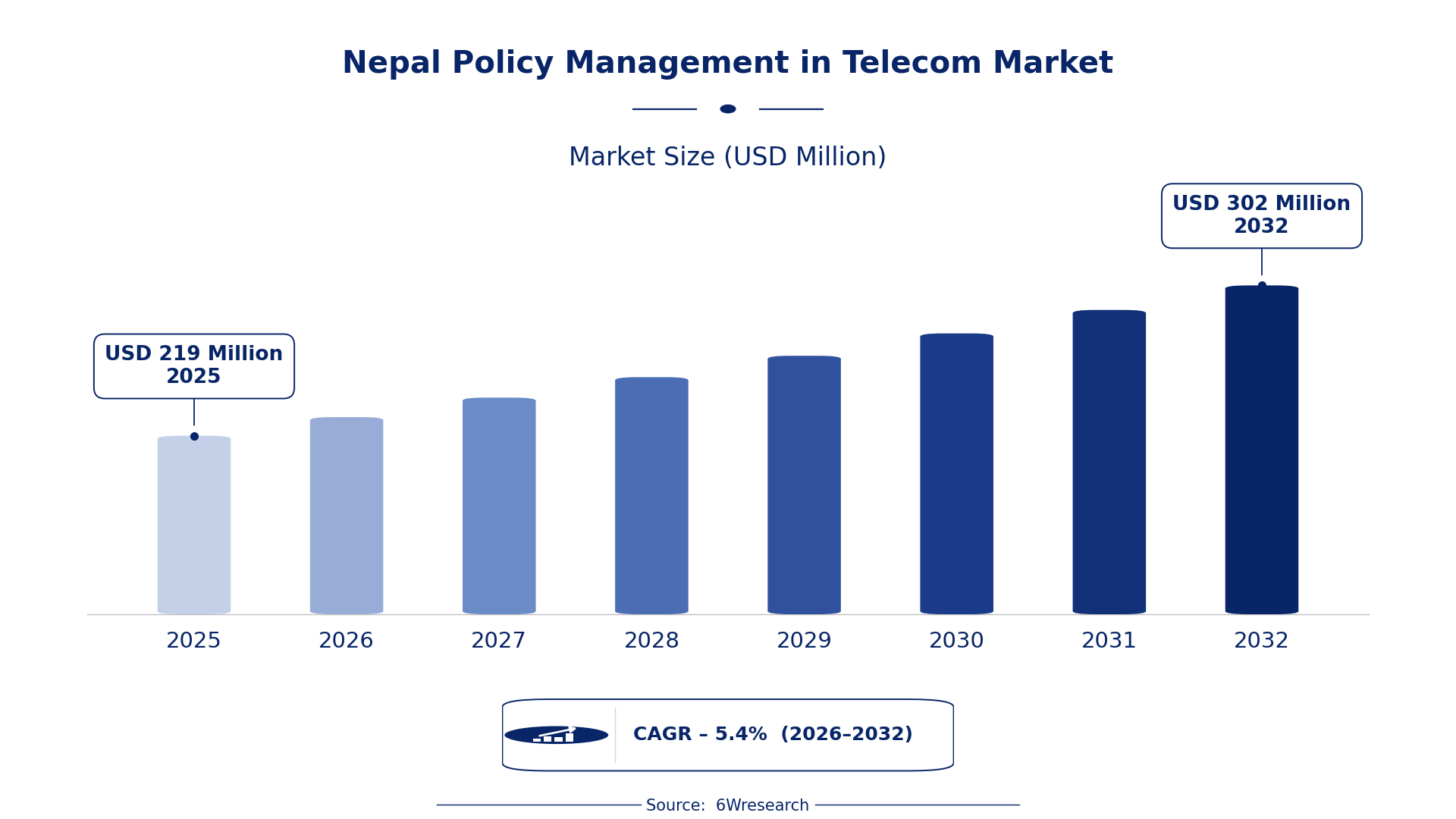
The Nepal Policy Management in Telecom Market was estimated at USD 219 Million in 2025 and is projected to reach USD 302 Million by 2032, growing at a CAGR of 5.4% from 2026 to 2032.
Nepal Policy Management in Telecom Market Synopsis
The regulatory framework governing Nepal's telecom sector is evolving, shaped significantly by the initiatives of the Nepal Telecommunications Authority (NTA). With the objective of bolstering consumer protection and encouraging competition, policies are being introduced to enhance the operational landscape for telecom operators.
Recent government efforts focus on expanding digital inclusion, particularly in rural areas, while addressing challenges related to outdated regulations and the complexities of policy implementation. The interplay between government initiatives and market demands will be critical in determining the future trajectory of telecom policy management in Nepal.
Nepal Policy Management in Telecom Market Year-wise Growth Rate and Key Drivers
This graph illustrates the annual growth rates of the Nepal Policy Management in Telecom Market from 2021 to 2032, highlighting a steady upward trajectory and projected expansion over the forecast period.
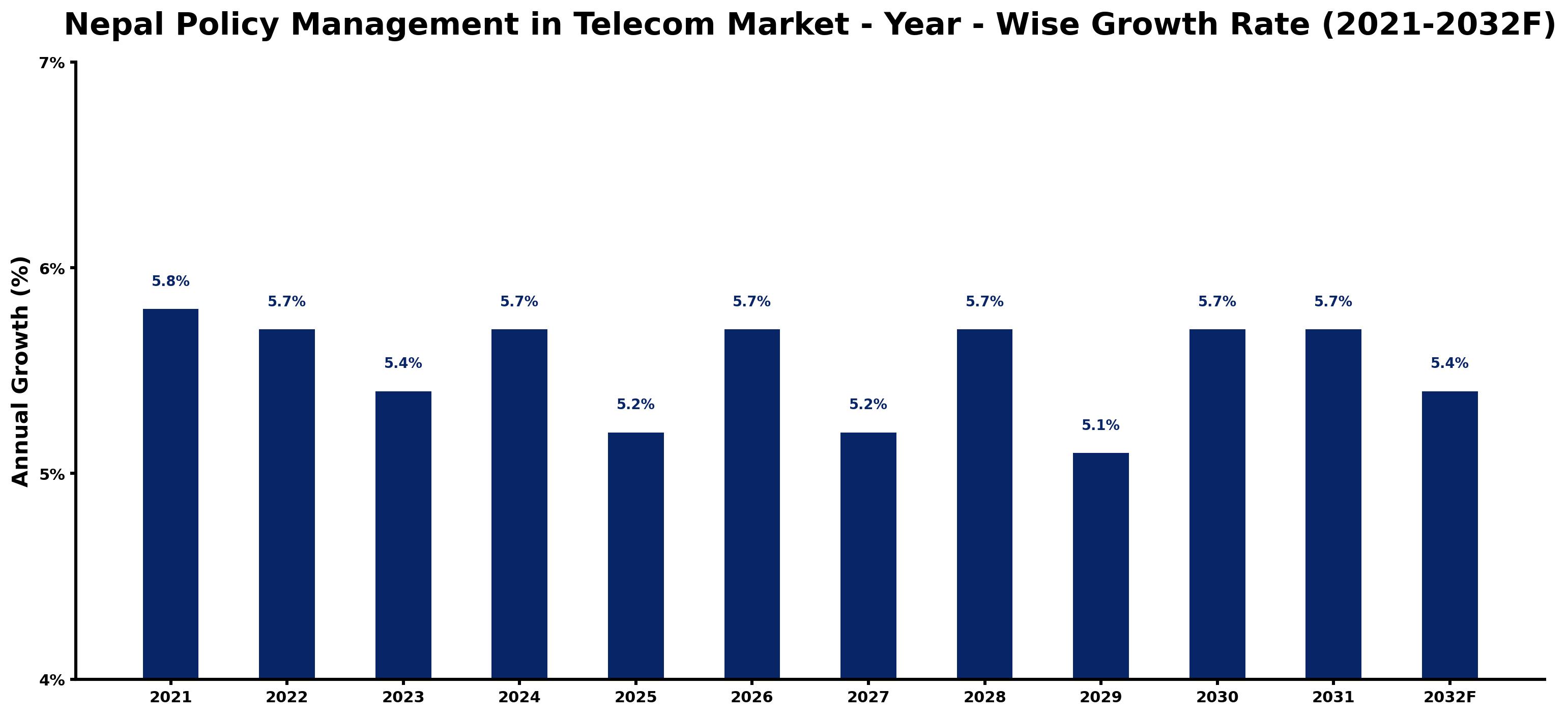
The table below presents the year‑wise growth rates along with the key drivers influencing the market
| Year | Growth Rate | Major Drivers |
| 2021 | 5.8% | Nepal Telecommunications Authority's regulatory flexibility enhancing service rollout. |
| 2022 | 5.7% | New government initiatives boosting rural telecom infrastructure investments. |
| 2023 | 5.4% | Increased mobile penetration stimulating data service subscription growth. |
| 2024 | 5.7% | Telecom Policy 2023 promoting competition among service providers. |
| 2025 | 5.2% | Rising international remittances driving demand for mobile money services. |
| 2026 | 5.7% | Post-pandemic recovery increasing reliance on digital communication. |
| 2027 | 5.2% | Improved 4G coverage enabling access to online education resources. |
| 2028 | 5.7% | Growing smartphone adoption enhancing access to telecom services. |
| 2029 | 5.1% | Incentives for green technology adoption benefitting telecom sector upgrades. |
| 2030 | 5.7% | Local start-ups innovating in telecom service delivery models. |
| 2031 | 5.7% | Government focus on digitalization enhancing telecom regulatory environment. |
| 2032 | 5.4% | Increased foreign investment stimulating telecom market development. |
Note: Market size estimations and growth projections presented in this report are based on 6Wresearch's proprietary forecasting methodology, utilizing the latest available industry data, government publications, and primary research inputs.
Nepal Policy Management in Telecom Market Key Takeaways
Below are some of the specific key takeaways from the market, including:
- The NTA plays a central role in shaping policies that foster competition and protect consumer interests.
- Current regulatory trends emphasize the need for improved internet connectivity and digital infrastructure.
- Investment opportunities are on the rise, particularly in technology and consulting services for policy compliance.
- The government's commitment to digital inclusion is evident through multiple infrastructure initiatives.
- Challenges remain, particularly in regulatory complexity and outdated laws that do not keep pace with innovation.
Evaluation of Restraints in Nepal Policy Management in Telecom Market
The Nepal Policy Management in Telecom Market is constrained by regulatory complexities that often deter investment. A fragmented policy environment creates confusion among telecom operators, making compliance a significant hurdle. Furthermore, the regulatory framework struggles to adapt to rapid technological advancements, leading to outdated laws that fail to address new challenges like data privacy and cybersecurity. For the market to thrive, these systemic issues must be confronted through cohesive policy reforms and better coordination among regulatory bodies.
Nepal Policy Management in Telecom Market Trends
A notable trend is the government's increasing focus on fostering competition and innovation through revamped regulatory frameworks. New policies are being designed to ensure a fair playing field for telecom operators while prioritizing consumer protection. Additionally, efforts to enhance broadband penetration and network quality are becoming central to policy discussions. An emerging focus on data privacy is also apparent, as authorities seek to introduce regulations that safeguard consumer information against misuse.
Nepal Policy Management in Telecom Market Opportunities
As the Nepali telecom sector continues to evolve, several lucrative investment opportunities are emerging. The ongoing liberalization of the telecom market invites domestic and foreign players to explore innovative policy management solutions, particularly in regulatory compliance technology. Consulting services aimed at helping telecom companies navigate the complex regulatory landscape are also in high demand. The anticipated growth in broadband services and digital infrastructure further underscores the potential for substantial returns on investment in this sector.
Government Initiatives in the Nepal Policy Management in Telecom Market
Government initiatives play a critical role in shaping the direction of Nepal's telecom sector. Current policies aim to expand access to affordable telecom services and improve the regulatory environment. The focus on aligning regulations with technological advancements indicates a proactive approach toward enhancing market dynamics.
- A recently completed Telecommunication Act aims to streamline licensing requirements and enhance operational transparency.
- Current initiatives include a national digital infrastructure upgrade program aimed at improving internet access in underserved areas.
- A planned public-private partnership is expected to begin in mid-2026 to expand mobile coverage in rural regions.
- The NTA is currently working on a regulatory framework to enhance data privacy standards for telecom operators.
- Ongoing reviews of tariff regulations aim to ensure competitive pricing for consumers while maintaining industry viability.
Future Insights of the Nepal Policy Management in Telecom Market
Looking ahead to 2026-2032, the Nepal Policy Management in Telecom Market is set for significant growth, driven by a governmental commitment to enhance regulatory frameworks and promote digital access. The increasing reliance on digital technologies and high-speed internet services will likely spur further policy reforms. Additionally, initiatives aimed at improving data security and spectrum management are expected to contribute to a more competitive telecom environment, benefiting consumers and operators alike.
Nepal Policy Management in Telecom Market Latest Developments
The past year has seen a flurry of activity in the Nepal Policy Management in Telecom Market as stakeholders respond to regulatory changes and market demands. The government's proactive stance on digital inclusion and infrastructure enhancement has opened avenues for various initiatives aimed at expanding telecom services across the nation.
- A major technology vendor launched a new policy management software in early 2025, designed to help telecom companies comply with regulatory standards efficiently.
- An initiative to enhance mobile network infrastructure is currently underway, expected to be completed by late 2025.
- The government is planning a comprehensive review of existing telecom tariffs, slated for the second half of 2026.
- In Q1 2025, a leading regional operator announced a partnership with a local tech firm to improve customer data protection measures.
- A pilot project focused on expanding broadband access in rural areas began in mid-2025 and is still ongoing.
Nepal Policy Management in Telecom Market - Key Attractiveness of the Report
- 10 Years of Market Numbers
- Historical Data Starting from 2022 to 2025
- Base Year: 2025
- Forecast Data until 2032
- Key Performance Indicators Impacting the Market
- Major Upcoming Developments and Projects
Key Highlights of the Report:
- Nepal Policy Management in Telecom Market Outlook
- Market Size of Nepal Policy Management in Telecom Market, 2025
- Forecast of Nepal Policy Management in Telecom Market, 2032
- Historical Data and Forecast of Nepal Policy Management in Telecom Revenues & Volume for the Period 2022-2032F
- Nepal Policy Management in Telecom Market Trend Evolution
- Nepal Policy Management in Telecom Market Drivers and Challenges
- Nepal Policy Management in Telecom Price Trends
- Nepal Policy Management in Telecom Porter's Five Forces
- Nepal Policy Management in Telecom Industry Life Cycle
- Historical Data and Forecast of Nepal Policy Management in Telecom Market Revenues & Volume By Network for the Period 2022-2032F
- Historical Data and Forecast of Nepal Policy Management in Telecom Market Revenues & Volume By Fixed for the Period 2022-2032F
- Historical Data and Forecast of Nepal Policy Management in Telecom Market Revenues & Volume By Wireless for the Period 2022-2032F
- Historical Data and Forecast of Nepal Policy Management in Telecom Market Revenues & Volume By Component for the Period 2022-2032F
- Historical Data and Forecast of Nepal Policy Management in Telecom Market Revenues & Volume By Solutions for the Period 2022-2032F
- Historical Data and Forecast of Nepal Policy Management in Telecom Market Revenues & Volume By Services for the Period 2022-2032F
- Historical Data and Forecast of Nepal Policy Management in Telecom Market Revenues & Volume By Deployment for the Period 2022-2032F
- Historical Data and Forecast of Nepal Policy Management in Telecom Market Revenues & Volume By Cloud for the Period 2022-2032F
- Historical Data and Forecast of Nepal Policy Management in Telecom Market Revenues & Volume By On-Premises for the Period 2022-2032F
- Nepal Policy Management in Telecom Import Export Trade Statistics
- Market Opportunity Assessment By Network
- Market Opportunity Assessment By Component
- Market Opportunity Assessment By Deployment
- Nepal Policy Management in Telecom Top Companies Market Share
- Nepal Policy Management in Telecom Competitive Benchmarking By Technical and Operational Parameters
- Nepal Policy Management in Telecom Company Profiles
- Nepal Policy Management in Telecom Key Strategic Recommendations






































