Nepal Processed Food Market Size Growth Rate
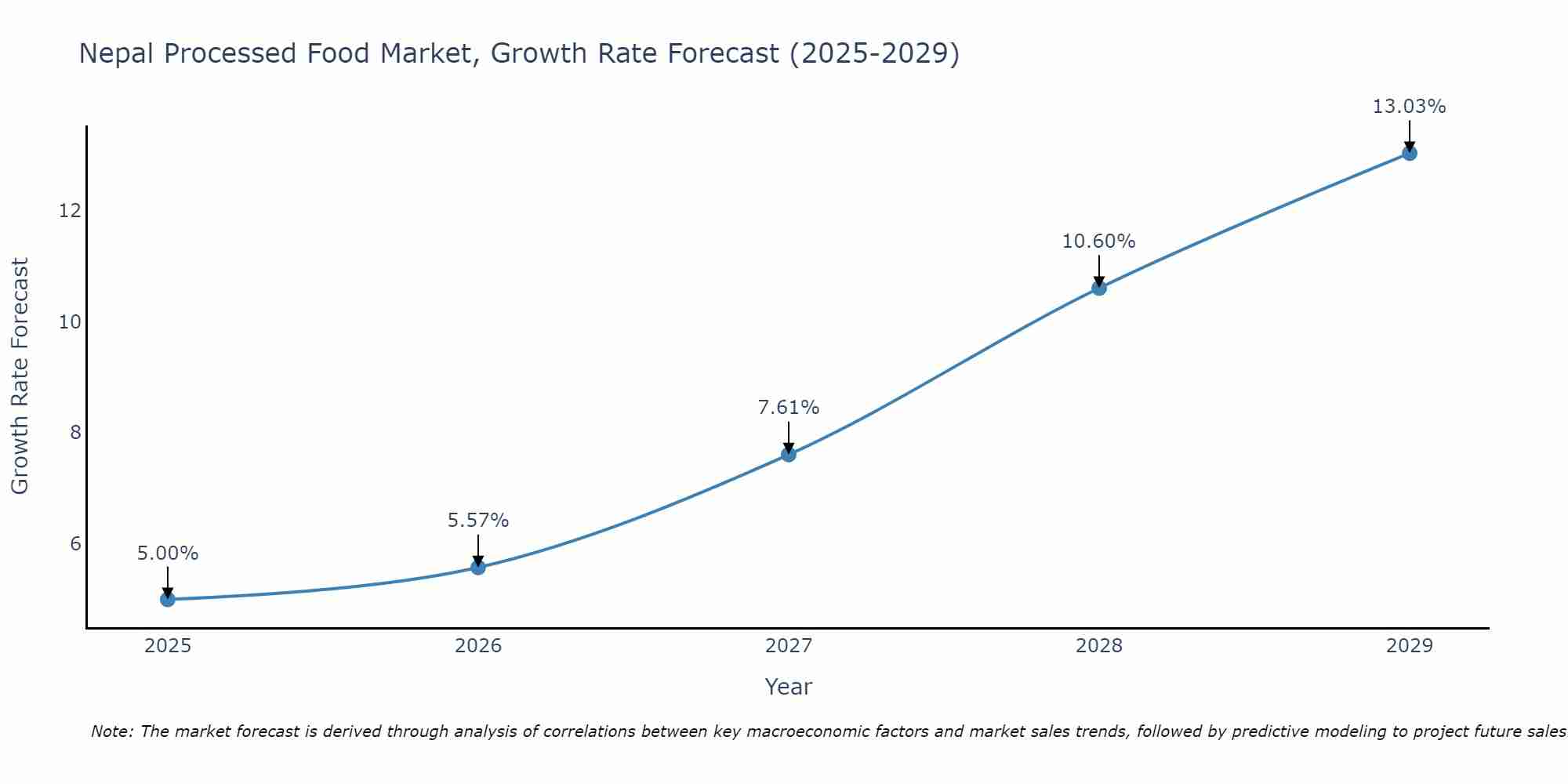
The Nepal Processed Food Market is likely to experience consistent growth rate gains over the period 2025 to 2029. From 5.00% in 2025, the growth rate steadily ascends to 13.03% in 2029.
Processed Food Market: Nepal vs Top 5 Major Economies in 2027 (Asia)
Nepal's Processed Food market is anticipated to experience a growing growth rate of 7.61% by 2027, reflecting trends observed in the largest economy China, followed by India, Japan, Australia and South Korea.

Nepal Processed Food Market Synopsis
The Nepal Processed Food Market is experiencing steady growth driven by factors such as changing consumer lifestyles, increasing disposable incomes, and a growing preference for convenience foods. The market offers a wide range of processed food products including snacks, ready-to-eat meals, bakery products, and beverages. Key players in the market are focusing on product innovation, packaging enhancements, and expanding distribution channels to cater to the evolving consumer preferences. The urban population, particularly in major cities like Kathmandu and Pokhara, is driving demand for processed foods, while increasing awareness about health and wellness is also influencing product offerings. The market is competitive, with both domestic and international brands vying for market share through aggressive marketing strategies and promotional activities. Overall, the Nepal Processed Food Market presents opportunities for further growth and expansion in the coming years.
Nepal Processed Food Market Trends
The Nepal Processed Food Market is experiencing several key trends, including a growing demand for convenient and ready-to-eat food products due to changing lifestyles and busy schedules. Consumers are increasingly looking for healthier options, leading to a rise in demand for organic and natural processed foods. There is also a shift towards more innovative and unique flavors and food products, catering to the evolving preferences of consumers. Additionally, the market is witnessing the emergence of small and medium-sized local producers offering artisanal and traditional processed foods, appealing to consumers looking for authentic and locally sourced products. Overall, the Nepal Processed Food Market is evolving to meet the demands of modern consumers while also preserving traditional culinary practices.
Nepal Processed Food Market Challenges
In the Nepal Processed Food Market, several challenges are prevalent. One major challenge is the lack of infrastructure and cold chain facilities, which hinders the distribution and storage of processed food products, leading to quality issues and wastage. Additionally, the market faces stiff competition from unbranded and informal sector products, impacting the market share of established processed food companies. Another challenge is the limited consumer awareness and purchasing power, as many consumers still prefer fresh and traditional foods over processed options. Furthermore, regulatory hurdles and inconsistent government policies create uncertainties for businesses operating in the processed food sector. Overcoming these challenges requires investments in infrastructure, increasing consumer education, developing innovative products, and navigating regulatory complexities to drive growth in the Nepal Processed Food Market.
Nepal Processed Food Market Investment Opportunities
In the Nepal processed food market, there are various investment opportunities for both domestic and international investors. With changing consumer preferences, urbanization, and increasing disposable income, there is a growing demand for convenient and ready-to-eat food products in Nepal. Investing in the production and distribution of packaged snacks, frozen foods, ready-to-cook meals, and specialty food items can be lucrative. Additionally, there is a rising trend towards healthier and organic food products, presenting opportunities for investment in this segment. Collaborating with local farmers and producers to source high-quality raw materials can also be a strategic investment approach. Overall, the Nepal processed food market offers potential for growth and diversification for investors looking to capitalize on the changing food consumption patterns in the country.
Jordan Agar Market Government Policies
In Nepal, the government has implemented several policies to regulate and promote the processed food market. The Food Act and Food Safety and Standards Regulations set standards for food safety, labeling, and packaging requirements to ensure consumer protection. Additionally, the government has introduced various incentives such as tax breaks and subsidies to encourage investment in the processed food sector. The Department of Food Technology and Quality Control (DFTQC) oversees the implementation of these policies and provides support to businesses in complying with regulations. The government`s focus on improving food safety standards and supporting industry growth indicates a commitment to developing the processed food market in Nepal.
Nepal Processed Food Market Future Outlook
The future outlook for the Nepal Processed Food Market appears promising, with anticipated growth driven by factors such as increasing disposable income, urbanization, changing lifestyles, and a growing preference for convenience foods. Consumers are increasingly seeking ready-to-eat and packaged food products due to busier schedules and a desire for convenience. Furthermore, the rising awareness of health and wellness is expected to drive demand for healthier processed food options. The market is likely to witness a shift towards organic, natural, and locally sourced ingredients, as consumers become more conscious of their food choices. With a growing young population and expanding retail infrastructure, the Nepal Processed Food Market is positioned for steady expansion in the coming years.
Key Highlights of the Report:
- Nepal Processed Food Market Outlook
- Market Size of Nepal Processed Food Market, 2024
- Forecast of Nepal Processed Food Market, 2031
- Historical Data and Forecast of Nepal Processed Food Revenues & Volume for the Period 2021 - 2031
- Nepal Processed Food Market Trend Evolution
- Nepal Processed Food Market Drivers and Challenges
- Nepal Processed Food Price Trends
- Nepal Processed Food Porter's Five Forces
- Nepal Processed Food Industry Life Cycle
- Historical Data and Forecast of Nepal Processed Food Market Revenues & Volume By Process for the Period 2021 - 2031
- Historical Data and Forecast of Nepal Processed Food Market Revenues & Volume By Minimally for the Period 2021 - 2031
- Historical Data and Forecast of Nepal Processed Food Market Revenues & Volume By Highly for the Period 2021 - 2031
- Historical Data and Forecast of Nepal Processed Food Market Revenues & Volume By Product type for the Period 2021 - 2031
- Historical Data and Forecast of Nepal Processed Food Market Revenues & Volume By Plant based for the Period 2021 - 2031
- Historical Data and Forecast of Nepal Processed Food Market Revenues & Volume By Fruits for the Period 2021 - 2031
- Historical Data and Forecast of Nepal Processed Food Market Revenues & Volume By Vegetables for the Period 2021 - 2031
- Historical Data and Forecast of Nepal Processed Food Market Revenues & Volume By Legumes for the Period 2021 - 2031
- Historical Data and Forecast of Nepal Processed Food Market Revenues & Volume By Extracted foods for the Period 2021 - 2031
- Historical Data and Forecast of Nepal Processed Food Market Revenues & Volume By Others for the Period 2021 - 2031
- Historical Data and Forecast of Nepal Processed Food Market Revenues & Volume By Animal based for the Period 2021 - 2031
- Historical Data and Forecast of Nepal Processed Food Market Revenues & Volume By Milk for the Period 2021 - 2031
- Historical Data and Forecast of Nepal Processed Food Market Revenues & Volume By Application for the Period 2021 - 2031
- Historical Data and Forecast of Nepal Processed Food Market Revenues & Volume By Baked foods for the Period 2021 - 2031
- Historical Data and Forecast of Nepal Processed Food Market Revenues & Volume By Baby food for the Period 2021 - 2031
- Historical Data and Forecast of Nepal Processed Food Market Revenues & Volume By Breakfast Cereal for the Period 2021 - 2031
- Historical Data and Forecast of Nepal Processed Food Market Revenues & Volume By Biscuits for the Period 2021 - 2031
- Historical Data and Forecast of Nepal Processed Food Market Revenues & Volume By Cheese for the Period 2021 - 2031
- Historical Data and Forecast of Nepal Processed Food Market Revenues & Volume By Chocolate confectionary for the Period 2021 - 2031
- Historical Data and Forecast of Nepal Processed Food Market Revenues & Volume By Ice creams for the Period 2021 - 2031
- Historical Data and Forecast of Nepal Processed Food Market Revenues & Volume By Instant Noodles for the Period 2021 - 2031
- Nepal Processed Food Import Export Trade Statistics
- Market Opportunity Assessment By Process
- Market Opportunity Assessment By Product type
- Market Opportunity Assessment By Application
- Nepal Processed Food Top Companies Market Share
- Nepal Processed Food Competitive Benchmarking By Technical and Operational Parameters
- Nepal Processed Food Company Profiles
- Nepal Processed Food Key Strategic Recommendations






































