Nepal Retail And Wholesale Market Size, Share & Growth Rate
The Nepal Retail And Wholesale Market was estimated at USD 1395 Million in 2025 and is projected to reach USD 2431 Million by 2032, growing at a CAGR of 8.3% from 2026 to 2032. This growth is fueled by a robust increase in consumer spending, largely driven by rising disposable incomes and a burgeoning middle class. As urbanization progresses, more consumers are gravitating towards modern retail formats and e-commerce, reshaping the market landscape.
Nepal Retail And Wholesale Market Year-wise Growth Rate and Key Drivers
This graph highlights how the Nepal Retail And Wholesale Market has steadily grown over the years, supported by major growth factors.
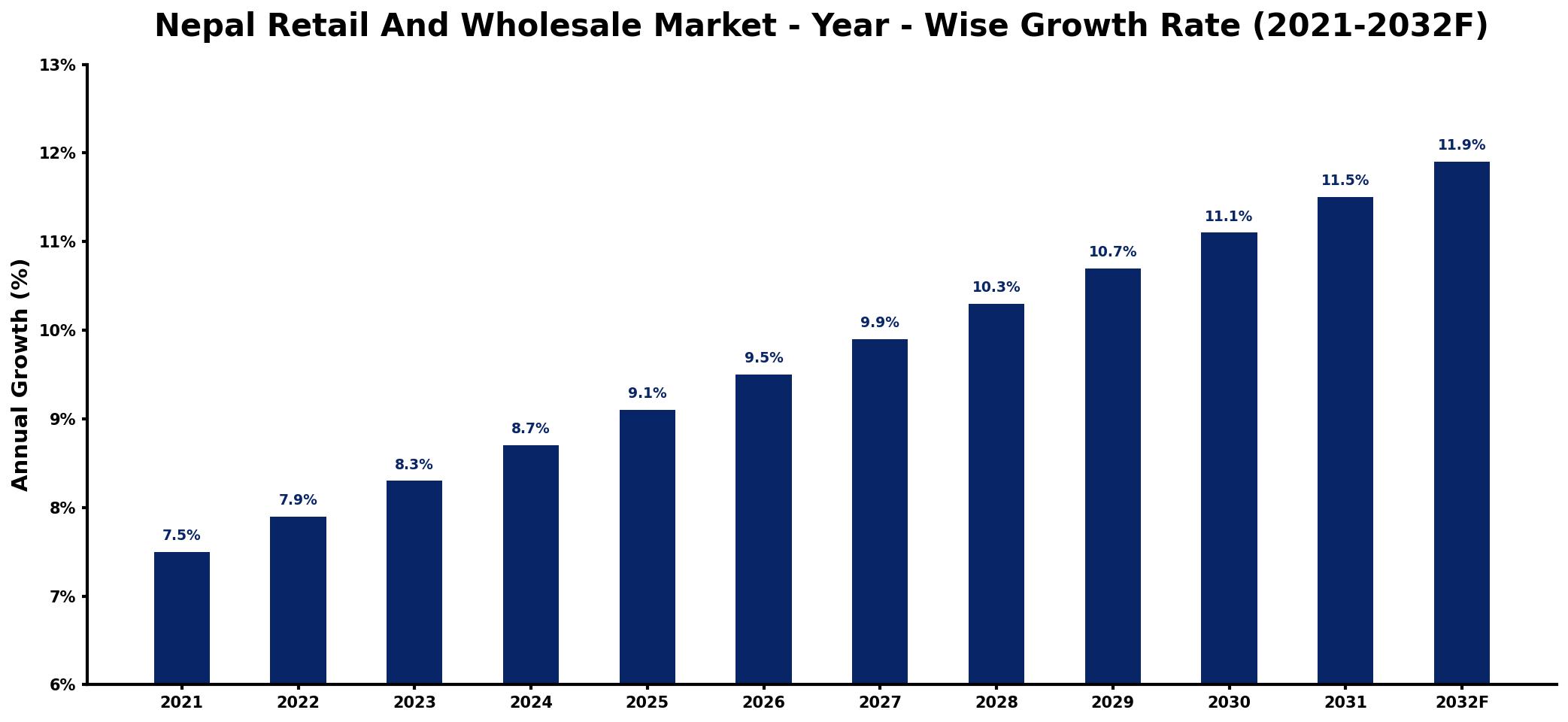
The table below presents the year‑wise growth rates along with the key drivers influencing the market
| Year | Growth Rate | Major Drivers |
| 2021 | 7.5% | Rising consumer spending patterns |
| 2022 | 7.9% | Expansion of digital payment solutions |
| 2023 | 8.3% | Increase in urban population density |
| 2024 | 8.7% | Growth in e-commerce platforms |
| 2025 | 9.1% | Investment in logistics infrastructure |
| 2026 | 9.5% | Emergence of local brands |
| 2027 | 9.9% | Surge in tourism activities |
| 2028 | 10.3% | Introduction of sustainable practices |
| 2029 | 10.7% | Enhancement of supply chain efficiency |
| 2030 | 11.1% | Diversification of product offerings |
| 2031 | 11.5% | Strengthening of market regulations |
| 2032 | 11.9% | Advancement in technology adoption |
Note: Market size estimations and growth projections presented in this report are based on 6Wresearch's proprietary forecasting methodology, utilizing the latest available industry data, government publications, and primary research inputs.
Nepal Retail And Wholesale Market Synopsis
The demand for groceries, clothing, and household goods is surging, particularly in urban hubs like Kathmandu and Pokhara. This trend is punctuated by a gradual shift from traditional shopping habits to modern retail experiences, including convenience stores and online shopping platforms.
Simultaneously, the wholesale sector remains fragmented with numerous small-scale wholesalers operating across various industries. While urban centers enjoy an advantage in retail offerings, there is a noticeable movement towards catering to smaller cities and rural areas, where consumer habits are also evolving.
Nepal Retail And Wholesale Market Key Takeaways
- Consumer demand is rapidly transitioning towards e-commerce and modern retail, driven by urbanization.
- Groceries, clothing, and electronics dominate key product categories in the retail landscape.
- Intensifying competition and pricing pressures characterize the fragmented wholesale sector.
- Innovative strategies focusing on customer experience and sustainability are gaining traction.
- Investment opportunities abound in modern retail formats and efficient supply chain solutions.
Evaluation of Restraints in Nepal Retail And Wholesale Market
Despite its growth potential, the Nepal retail and wholesale market faces notable restraints. Infrastructure limitations, particularly concerning road networks and logistics, significantly impact distribution efficiency. The highly fragmented nature of the market creates intense competition, often leading to price wars that can squeeze margins. Moreover, access to financing remains limited for many businesses seeking to expand or innovate, hampering growth prospects. Regulatory challenges also pose hurdles, as businesses navigate complex bureaucratic processes that can stifle new entrants and restrict market dynamism.
Nepal Retail And Wholesale Market Trends
Several trends are currently reshaping the Nepal retail and wholesale market. The rise of e-commerce platforms is not just a convenience but also a necessity as consumers embrace digital shopping. Additionally, the increasing demand for sustainable and eco-friendly products reflects a growing awareness among consumers regarding environmental issues. Another noteworthy trend is the shift towards cashless transactions, with digital payment methods becoming the norm for many consumers. Retailers and wholesalers are also enhancing customer engagement through personalized services and loyalty programs, adapting to the competitive landscape.
Nepal Retail And Wholesale Market Opportunities
Investment opportunities in the Nepal retail and wholesale market are vast. The expanding middle class and urbanization drive the demand for modern retail spaces, such as supermarkets and e-commerce ventures. Additionally, opportunities exist in the wholesale distribution of fresh produce from the agriculture sector, particularly as food safety and quality become paramount. The tourism industry is also a critical component, with potential growth in hospitality-related retail sectors. Innovative supply chain management, alongside technology integration, presents avenues for enhanced profitability and market reach.
Government Initiatives in the Nepal Retail And Wholesale Market
The Nepal government has introduced several policies aimed at fostering a conducive environment for the retail and wholesale market. Regulations surrounding foreign investment are in place to support local enterprises while maintaining fair competition. Measures to protect consumer rights and combat price manipulation are also emphasized. Furthermore, the government is actively promoting initiatives to improve infrastructure and streamline bureaucratic processes, facilitating smoother operations for businesses in this sector.
Future Insights of the Nepal Retail And Wholesale Market
Looking ahead to 2026-2032, the outlook for the Nepal retail and wholesale market remains optimistic. Sustained economic growth, coupled with ongoing urbanization, is likely to drive increased consumer spending. The rapid growth of e-commerce will continue to reshape consumer habits, making products more accessible. Additionally, greater foreign direct investment and government-led infrastructure projects are expected to enhance market competitiveness. However, overcoming hurdles such as regulatory inconsistencies and logistics inefficiencies will be vital for unlocking the market's full potential.
Nepal Retail And Wholesale Market Latest Developments (2025 - 2026)
Recent months have witnessed notable shifts within the Nepal retail and wholesale market. E-commerce companies have been expanding their offerings, focusing on improved customer experiences through enhanced delivery options and product ranges. The surge in digital payment adoption has also prompted many retailers to invest in new technologies that support cashless transactions. Additionally, sustainable practices are gaining traction, with more brands emphasizing eco-friendly products in response to consumer demand.
Nepal Retail And Wholesale Market - Key Attractiveness of the Report
- 10 Years of Market Numbers
- Historical Data Starting from 2022 to 2025
- Base Year: 2025
- Forecast Data until 2032
- Key Performance Indicators Impacting the Market
- Major Upcoming Developments and Projects
Key Highlights of the Report:
- Nepal Retail And Wholesale Market Outlook
- Market Size of Nepal Retail And Wholesale Market, 2025
- Forecast of Nepal Retail And Wholesale Market, 2032
- Historical Data and Forecast of Nepal Retail And Wholesale Revenues & Volume for the Period 2022-2032F
- Nepal Retail And Wholesale Market Trend Evolution
- Nepal Retail And Wholesale Market Drivers and Challenges
- Nepal Retail And Wholesale Price Trends
- Nepal Retail And Wholesale Porter's Five Forces
- Nepal Retail And Wholesale Industry Life Cycle
- Historical Data and Forecast of Nepal Retail And Wholesale Market Revenues & Volume By Type for the Period 2022-2032F
- Historical Data and Forecast of Nepal Retail And Wholesale Market Revenues & Volume By Retail for the Period 2022-2032F
- Historical Data and Forecast of Nepal Retail And Wholesale Market Revenues & Volume By Wholesale for the Period 2022-2032F
- Historical Data and Forecast of Nepal Retail And Wholesale Market Revenues & Volume By Ownership for the Period 2022-2032F
- Historical Data and Forecast of Nepal Retail And Wholesale Market Revenues & Volume By Retail Chain/Wholesale Chain for the Period 2022-2032F
- Historical Data and Forecast of Nepal Retail And Wholesale Market Revenues & Volume By Independent Retailer/Independent Wholesalers for the Period 2022-2032F
- Historical Data and Forecast of Nepal Retail And Wholesale Market Revenues & Volume By Price Range for the Period 2022-2032F
- Historical Data and Forecast of Nepal Retail And Wholesale Market Revenues & Volume By Premium for the Period 2022-2032F
- Historical Data and Forecast of Nepal Retail And Wholesale Market Revenues & Volume By Mid-Range for the Period 2022-2032F
- Historical Data and Forecast of Nepal Retail And Wholesale Market Revenues & Volume By Economy for the Period 2022-2032F
- Historical Data and Forecast of Nepal Retail And Wholesale Market Revenues & Volume By Distribution Channel for the Period 2022-2032F
- Historical Data and Forecast of Nepal Retail And Wholesale Market Revenues & Volume By Supermarkets/Hypermarkets for the Period 2022-2032F
- Historical Data and Forecast of Nepal Retail And Wholesale Market Revenues & Volume By Convenience Stores for the Period 2022-2032F
- Historical Data and Forecast of Nepal Retail And Wholesale Market Revenues & Volume By Department Stores for the Period 2022-2032F
- Historical Data and Forecast of Nepal Retail And Wholesale Market Revenues & Volume By Specialty Stores for the Period 2022-2032F
- Nepal Retail And Wholesale Import Export Trade Statistics
- Market Opportunity Assessment By Type
- Market Opportunity Assessment By Ownership
- Market Opportunity Assessment By Price Range
- Market Opportunity Assessment By Distribution Channel
- Nepal Retail And Wholesale Top Companies Market Share
- Nepal Retail And Wholesale Competitive Benchmarking By Technical and Operational Parameters
- Nepal Retail And Wholesale Company Profiles
- Nepal Retail And Wholesale Key Strategic Recommendations






































