Nepal Wine production Machinery Market Summary
The nepal wine production machinery market was estimated at USD 490 Million in 2025 and is projected to reach USD 685 Million by 2032, growing at a CAGR of 6.0% from 2026 to 2032.
Nepal Wine production Machinery Market Year-wise Growth Rate and Key Drivers
This graph highlights how the Nepal Wine production Machinery Market has steadily grown over the past five years, supported by major growth factors.
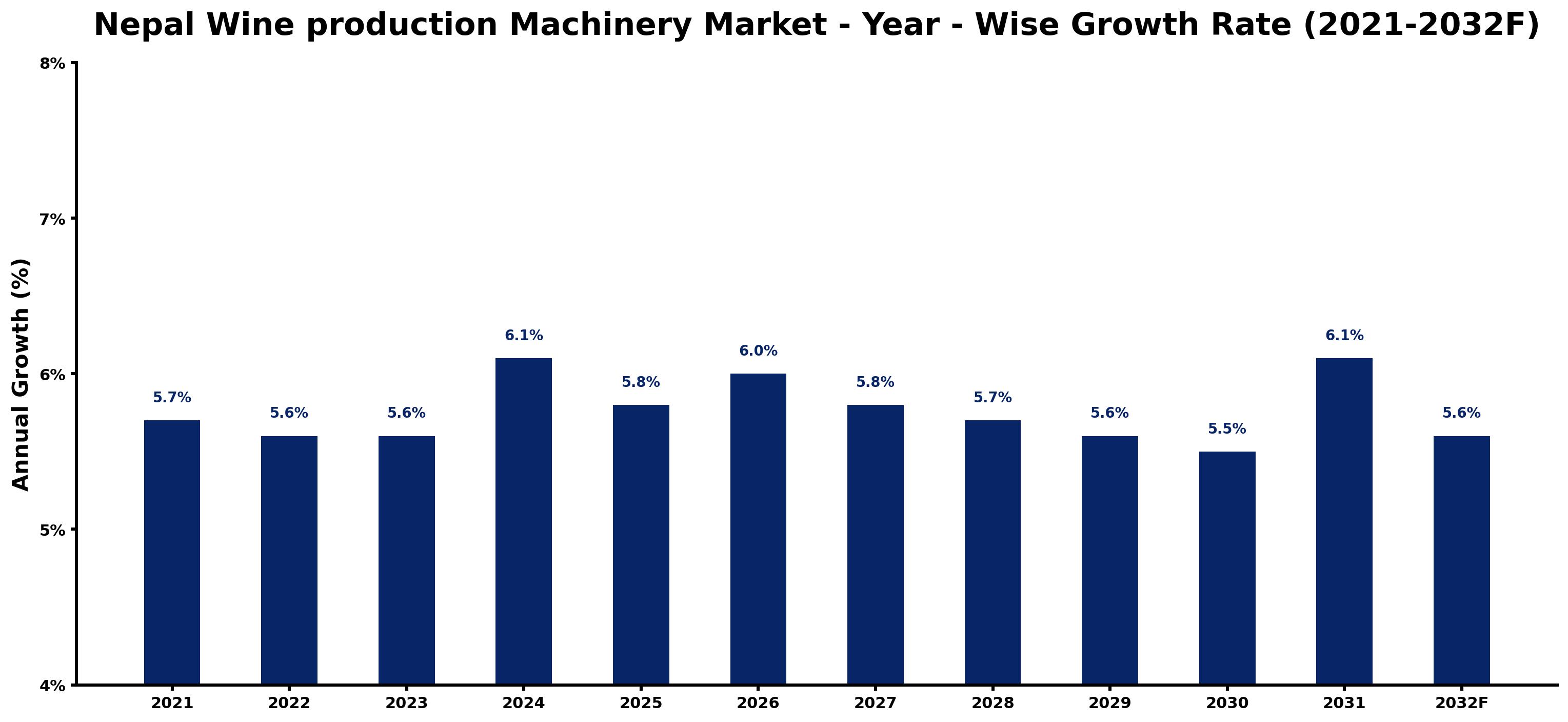
The table below presents the year wise growth rates along with the key drivers influencing the market
| Year | Growth Rate | Major Drivers |
| 2021 | 5.7% | Domestic wine consumption in Nepal began to capture significant local interest. |
| 2022 | 5.6% | Investment in modern equipment streamlined local vineyard operations across the country. |
| 2023 | 5.6% | Nepal saw a surge in wine tourism, increasing visibility for local producers. |
| 2024 | 6.1% | Emerging winemakers prioritized sustainable practices to attract environmentally conscious consumers. |
| 2025 | 5.8% | Rural cooperatives formed, sharing resources and reducing costs for wine production machinery. |
| 2026 | 6.0% | Local universities introduced viticulture programs, enhancing skillsets within the industry. |
| 2027 | 5.8% | Increased export potential encouraged investments in advanced production technologies. |
| 2028 | 5.7% | Innovations in fermentation technology improved quality, appealing to both local and international markets. |
| 2029 | 5.6% | Regional climate adaptations necessitated specialized equipment for unique Nepali conditions. |
| 2030 | 5.5% | Partnerships between local and foreign firms fostered knowledge transfer in production techniques. |
| 2031 | 6.1% | Consumer preferences shifted towards artisanal wines, boosting demand for bespoke machinery. |
| 2032 | 5.6% | National branding campaigns elevated Nepal's wine reputation, encouraging further investment in equipment. |
Note - Market size estimations and growth projections presented in this report are based on 6Wresearch's advanced forecasting approach, validated with industry datasets as of June 2026.
Nepal Wine production Machinery Market Synopsis
The Nepal Wine production Machinery Market is projected to reach 6.0% and witness significant growth during the forecast period (2026-2032). This market is fueled by an increasing demand for wine production equipment that caters to the evolving needs of local wineries. With machinery offerings including grape crushers, fermentation tanks, filters, bottling lines, and storage solutions, the market reflects a robust interest in enhancing the production capabilities of the Nepali wine industry.
Nepal Wine production Machinery Market Growth Drivers
Several key drivers are shaping the growth of the Nepal Wine production Machinery Market. Firstly, the rising popularity of wine consumption among Nepali consumers is stimulating the demand for quality production equipment. Secondly, technological advancements in winemaking machinery are providing wineries with tools to enhance efficiency and minimize production errors. Thirdly, a growing emphasis on sustainable practices is pushing wineries to seek eco-friendly machinery options that limit environmental impact. Additionally, increasing investments in the wine sector are creating opportunities for modern equipment adoption. Finally, the expansion of the hospitality industry in Nepal is contributing to a greater requirement for high-quality wines, thereby driving production needs.
Nepal Wine production Machinery Market Trends and Opportunities
The landscape of the Nepal Wine production Machinery Market is evolving, with trends that reflect modernization and sustainability. Wineries are transitioning towards automated solutions that enhance production efficiency, such as automated bottling systems and temperature-controlled fermentation tanks. The trend towards sustainable production practices, including machinery that reduces water and energy consumption, is gaining traction. Additionally, an emerging opportunity exists for the introduction of niche equipment tailored for small to medium-sized wineries, addressing their specific production challenges. The convergence of consumer preferences for premium wines and the need for quality enhancement presents a favorable environment for innovative machinery solutions.
Nepal Wine production Machinery Market Challenges and Restraints
Despite the promising outlook, the Nepal Wine production Machinery Market faces several challenges. A primary concern is the limited availability of high-quality, specialized machinery that aligns with the requirements of small to medium-sized wineries. Many local winemakers encounter difficulties sourcing affordable and efficient equipment tailored to their unique processes. Furthermore, the lack of local manufacturing capabilities often necessitates importing machinery, which results in increased costs and extended lead times. Compounding these challenges is a general lack of awareness among local winemakers regarding modern production techniques and the importance of investing in quality machinery, potentially hindering the overall competitiveness of the industry.
Nepal Wine production Machinery Market Investment Opportunities
The prospect of investment in the Nepal Wine production Machinery Market is increasingly attractive as the local wine consumption landscape shifts. Investors can capitalize on the growing need for advanced winemaking equipment, including grape crushers, fermentation systems, and bottling lines. Establishing partnerships with local wineries to supply modern machinery can yield significant returns. Additionally, providing maintenance and technical support for existing machinery represents another promising venture. By tapping into this market, stakeholders can play a key role in bolstering the development of the wine industry in Nepal.
Nepal Wine production Machinery Market Government Investment and Initiatives
The Nepalese government is actively engaged in fostering the growth of the wine production machinery market through various initiatives. Policies aimed at providing financial incentives and tax benefits serve to encourage both domestic and foreign investment in the sector. The government is also promoting research and development efforts to improve technological capabilities within the industry. Furthermore, infrastructural enhancements to support logistics and supply chains are being prioritized, establishing a more conducive environment for the operation of wineries and machinery suppliers. Through these initiatives, the government seeks to bolster the competitiveness of the Nepal wine sector both at home and abroad.
Nepal Wine production Machinery Market Latest Developments (May 2025 - June 2026)
In the period spanning May 2025 to June 2026, the Nepal Wine production Machinery Market has witnessed significant movements toward modernization and sustainability. Wineries are increasingly adopting state-of-the-art machinery to improve production efficiencies and meet rising consumer expectations for premium quality wines. Discussions on collaborative ventures with international manufacturers have gained momentum, aimed at enhancing local technological capabilities. Moreover, ecological considerations have led to heightened interest in machinery that minimizes resource consumption, aligning with global sustainability trends. The market is becoming more dynamic, driven by innovation and the ongoing expansion of the domestic wine industry.
Nepal Wine production Machinery Market - Key Attractiveness of the Report
- 10 Years of Market Numbers
- Historical Data Starting from 2022 to 2025
- Base Year: 2025
- Forecast Data until 2032
- Key Performance Indicators Impacting the Market
- Major Upcoming Developments and Projects
Key Highlights of the Report:
- Nepal Wine production Machinery Market Outlook
- Market Size of Nepal Wine production Machinery Market, 2025
- Forecast of Nepal Wine production Machinery Market, 2032F
- Historical Data and Forecast of Nepal Wine production Machinery Revenues & Volume for the Period 2022-2032F
- Nepal Wine production Machinery Market Trend Evolution
- Nepal Wine production Machinery Market Drivers and Challenges
- Nepal Wine production Machinery Price Trends
- Nepal Wine production Machinery Porter's Five Forces
- Nepal Wine production Machinery Industry Life Cycle
- Historical Data and Forecast of Nepal Wine production Machinery Market Revenues & Volume By Type for the Period 2022-2032F
- Historical Data and Forecast of Nepal Wine production Machinery Market Revenues & Volume By Tanks & fermenters for the Period 2022-2032F
- Historical Data and Forecast of Nepal Wine production Machinery Market Revenues & Volume By Crushing & Pressing Equipment for the Period 2022-2032F
- Historical Data and Forecast of Nepal Wine production Machinery Market Revenues & Volume By Temperature Control Equipment for the Period 2022-2032F
- Historical Data and Forecast of Nepal Wine production Machinery Market Revenues & Volume By Filtration Equipment for the Period 2022-2032F
- Historical Data and Forecast of Nepal Wine production Machinery Market Revenues & Volume By Others for the Period 2022-2032F
- Nepal Wine production Machinery Import Export Trade Statistics
- Market Opportunity Assessment By Type
- Nepal Wine production Machinery Top Companies Market Share
- Nepal Wine production Machinery Competitive Benchmarking By Technical and Operational Parameters
- Nepal Wine production Machinery Company Profiles
- Nepal Wine production Machinery Key Strategic Recommendations






































