Netherlands Content Delivery Market Top 5 Importing Countries and Market Competition (HHI) Analysis
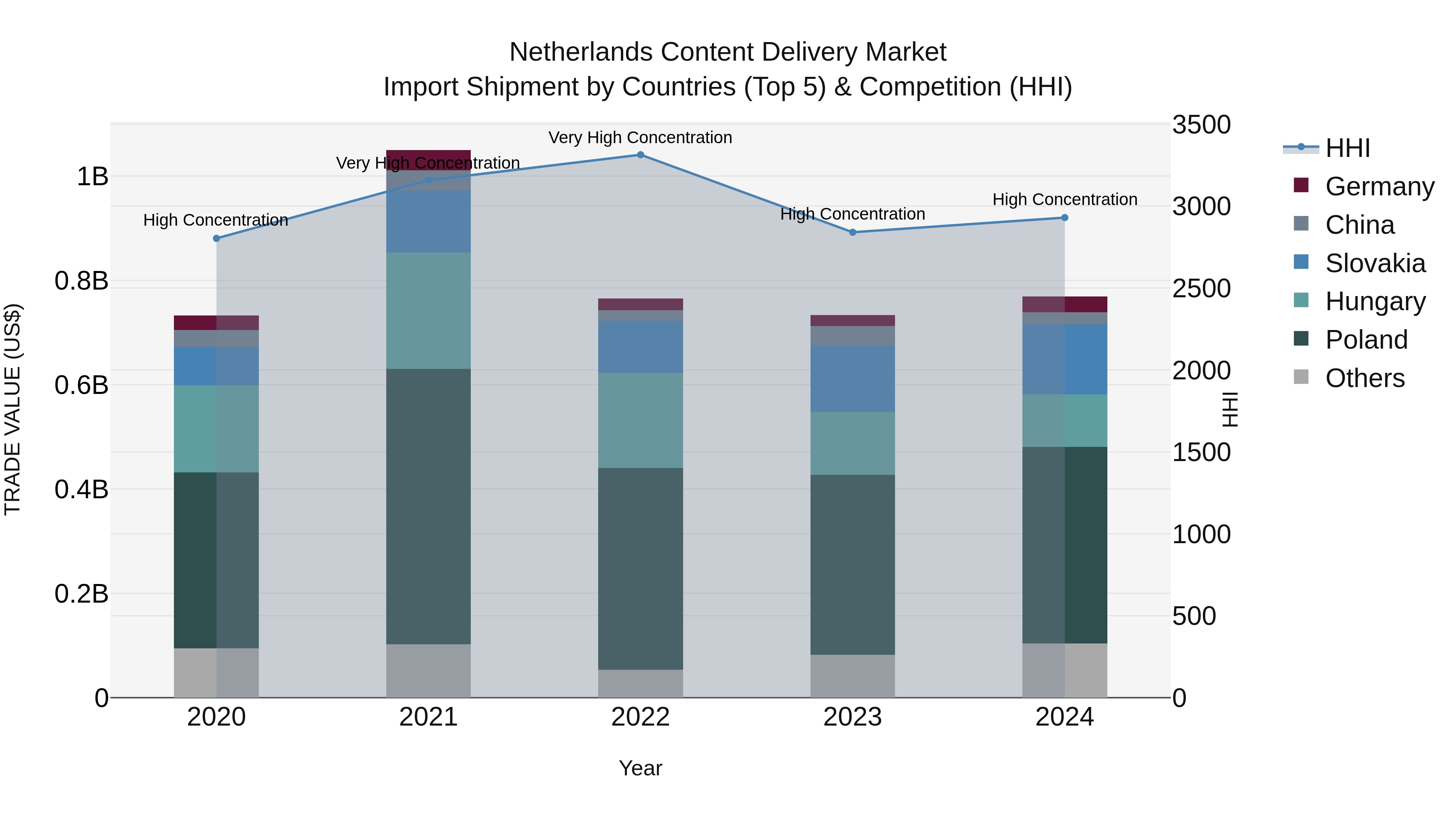
The Netherlands continues to be a key hub for content delivery import shipments, with top exporters in 2024 including Poland, Slovakia, Hungary, Slovenia, and Germany. The market shows high concentration levels, with the Herfindahl-Hirschman Index (HHI) remaining elevated in 2024. The compound annual growth rate (CAGR) for the period 2020-2024 stands at 1.23%, indicating steady expansion. Furthermore, the growth rate from 2023 to 2024 is notably strong at 4.85%, underscoring the resilience and attractiveness of the Netherlands market for content delivery imports.
Netherlands Content Delivery Market Overview
The Netherlands content delivery market is a rapidly growing sector driven by the increasing demand for streaming services, online gaming, and cloud-based solutions. Key players in the market include international CDN providers like Akamai, Cloudflare, and Limelight Networks, as well as local providers such as LeaseWeb and Alticom. These companies offer a range of services including video streaming, website acceleration, and secure content delivery. The market is characterized by a high level of competition, with providers focusing on delivering high-quality, low-latency services to meet the growing needs of businesses and consumers. The Netherlands` strategic location in Europe also makes it an attractive hub for content delivery, serving both local and international clients. Overall, the market is poised for continued growth as digital content consumption continues to rise.
Netherlands Content Delivery Market Trends
In the Netherlands, the content delivery market is experiencing several key trends. One significant trend is the increasing demand for high-quality video streaming services, driven by the growing popularity of online video content and the rise of over-the-top (OTT) platforms. Consumers are increasingly seeking on-demand access to a wide range of content, including movies, TV shows, and live sports events. Another notable trend is the emergence of local content providers and niche streaming services catering to specific interests or demographics. Additionally, there is a growing focus on enhancing the user experience through personalized recommendations, seamless streaming across devices, and improved video quality. Overall, the Dutch content delivery market is evolving to meet the changing preferences and expectations of consumers for convenient, diverse, and engaging digital content experiences.
Netherlands Content Delivery Market Challenges
In the Netherlands, the content delivery market faces challenges such as increasing competition from global streaming giants like Netflix and Amazon Prime Video, leading to a fragmented market with numerous players vying for market share. Additionally, the rise of illegal streaming services and piracy poses a threat to content providers who are trying to monetize their offerings. Furthermore, the high costs associated with acquiring rights to popular content and maintaining a robust infrastructure for streaming services can strain smaller players in the market. Lastly, changing consumer preferences and the shift towards mobile and on-the-go viewing habits require content delivery providers to constantly innovate and adapt to meet the evolving needs of their audience in order to remain competitive in the market.
Netherlands Content Delivery Market Investment Opportunities
In the Netherlands content delivery market, there are several investment opportunities worth considering. With the increasing demand for high-quality streaming services, investing in companies that offer content delivery network (CDN) solutions could be lucrative. These companies help deliver digital content efficiently and reliably to end-users, catering to the growing online video streaming, gaming, and e-commerce sectors. Additionally, investing in technology firms specializing in cloud services and infrastructure could also be promising, as businesses continue to transition towards digitalization and remote work. Furthermore, with the rise of 5G technology and Internet of Things (IoT) devices, there is potential for investments in companies developing innovative solutions to enhance content delivery speed and reliability. Overall, the Netherlands content delivery market presents opportunities for investors looking to capitalize on the digital transformation trend and the increasing demand for seamless online experiences.
Netherlands Content Delivery Market Government Policy
In the Netherlands, the content delivery market is regulated by various government policies aimed at promoting fair competition and consumer protection. The Dutch government has implemented net neutrality laws, ensuring that internet service providers treat all data on their networks equally without discrimination or preferential treatment. Additionally, there are regulations in place to promote copyright protection and combat piracy, which impact the distribution of content online. The government also works to promote access to high-speed internet infrastructure across the country to support the growth of the content delivery market. Overall, the regulatory environment in the Netherlands aims to balance the interests of content providers, consumers, and service providers while fostering innovation and competition in the digital economy.
Netherlands Content Delivery Market Future Outlook
The future outlook for the content delivery market in the Netherlands appears promising, driven by increasing demand for digital content consumption across various industries such as media, e-commerce, and gaming. The market is expected to witness steady growth as businesses continue to prioritize online presence and customer engagement. Factors such as the growing adoption of cloud-based services, advancements in technology like edge computing, and the expansion of 5G networks further contribute to the positive outlook for the content delivery market. Additionally, the rise of video streaming services and the need for fast and reliable content delivery are likely to fuel investments in infrastructure and solutions that enhance content delivery capabilities, positioning the Netherlands as a key player in the global content delivery landscape.
Key Highlights of the Report:
- Netherlands Content Delivery Market Outlook
- Market Size of Netherlands Content Delivery Market,2024
- Forecast of Netherlands Content Delivery Market, 2031
- Historical Data and Forecast of Netherlands Content Delivery Revenues & Volume for the Period 2021-2031
- Netherlands Content Delivery Market Trend Evolution
- Netherlands Content Delivery Market Drivers and Challenges
- Netherlands Content Delivery Price Trends
- Netherlands Content Delivery Porter's Five Forces
- Netherlands Content Delivery Industry Life Cycle
- Historical Data and Forecast of Netherlands Content Delivery Market Revenues & Volume By Product Type for the Period 2021-2031
- Historical Data and Forecast of Netherlands Content Delivery Market Revenues & Volume By CDN (Content Delivery Network) for the Period 2021-2031
- Historical Data and Forecast of Netherlands Content Delivery Market Revenues & Volume By Edge Delivery for the Period 2021-2031
- Historical Data and Forecast of Netherlands Content Delivery Market Revenues & Volume By Web Delivery for the Period 2021-2031
- Historical Data and Forecast of Netherlands Content Delivery Market Revenues & Volume By Others for the Period 2021-2031
- Historical Data and Forecast of Netherlands Content Delivery Market Revenues & Volume By Delivery Method for the Period 2021-2031
- Historical Data and Forecast of Netherlands Content Delivery Market Revenues & Volume By Cloud-Based for the Period 2021-2031
- Historical Data and Forecast of Netherlands Content Delivery Market Revenues & Volume By On-Premises for the Period 2021-2031
- Historical Data and Forecast of Netherlands Content Delivery Market Revenues & Volume By Hybrid for the Period 2021-2031
- Historical Data and Forecast of Netherlands Content Delivery Market Revenues & Volume By End User for the Period 2021-2031
- Historical Data and Forecast of Netherlands Content Delivery Market Revenues & Volume By Media & Entertainment for the Period 2021-2031
- Historical Data and Forecast of Netherlands Content Delivery Market Revenues & Volume By E-commerce for the Period 2021-2031
- Historical Data and Forecast of Netherlands Content Delivery Market Revenues & Volume By IT & Telecom for the Period 2021-2031
- Historical Data and Forecast of Netherlands Content Delivery Market Revenues & Volume By Retail for the Period 2021-2031
- Historical Data and Forecast of Netherlands Content Delivery Market Revenues & Volume By Technology for the Period 2021-2031
- Historical Data and Forecast of Netherlands Content Delivery Market Revenues & Volume By Cloud for the Period 2021-2031
- Historical Data and Forecast of Netherlands Content Delivery Market Revenues & Volume By Hybrid for the Period 2021-2031
- Historical Data and Forecast of Netherlands Content Delivery Market Revenues & Volume By SaaS for the Period 2021-2031
- Historical Data and Forecast of Netherlands Content Delivery Market Revenues & Volume By P2P for the Period 2021-2031
- Netherlands Content Delivery Import Export Trade Statistics
- Market Opportunity Assessment By Product Type
- Market Opportunity Assessment By Delivery Method
- Market Opportunity Assessment By End User
- Market Opportunity Assessment By Technology
- Netherlands Content Delivery Top Companies Market Share
- Netherlands Content Delivery Competitive Benchmarking By Technical and Operational Parameters
- Netherlands Content Delivery Company Profiles
- Netherlands Content Delivery Key Strategic Recommendations






































