Netherlands Fatty Acid Market Top 5 Importing Countries and Market Competition (HHI) Analysis
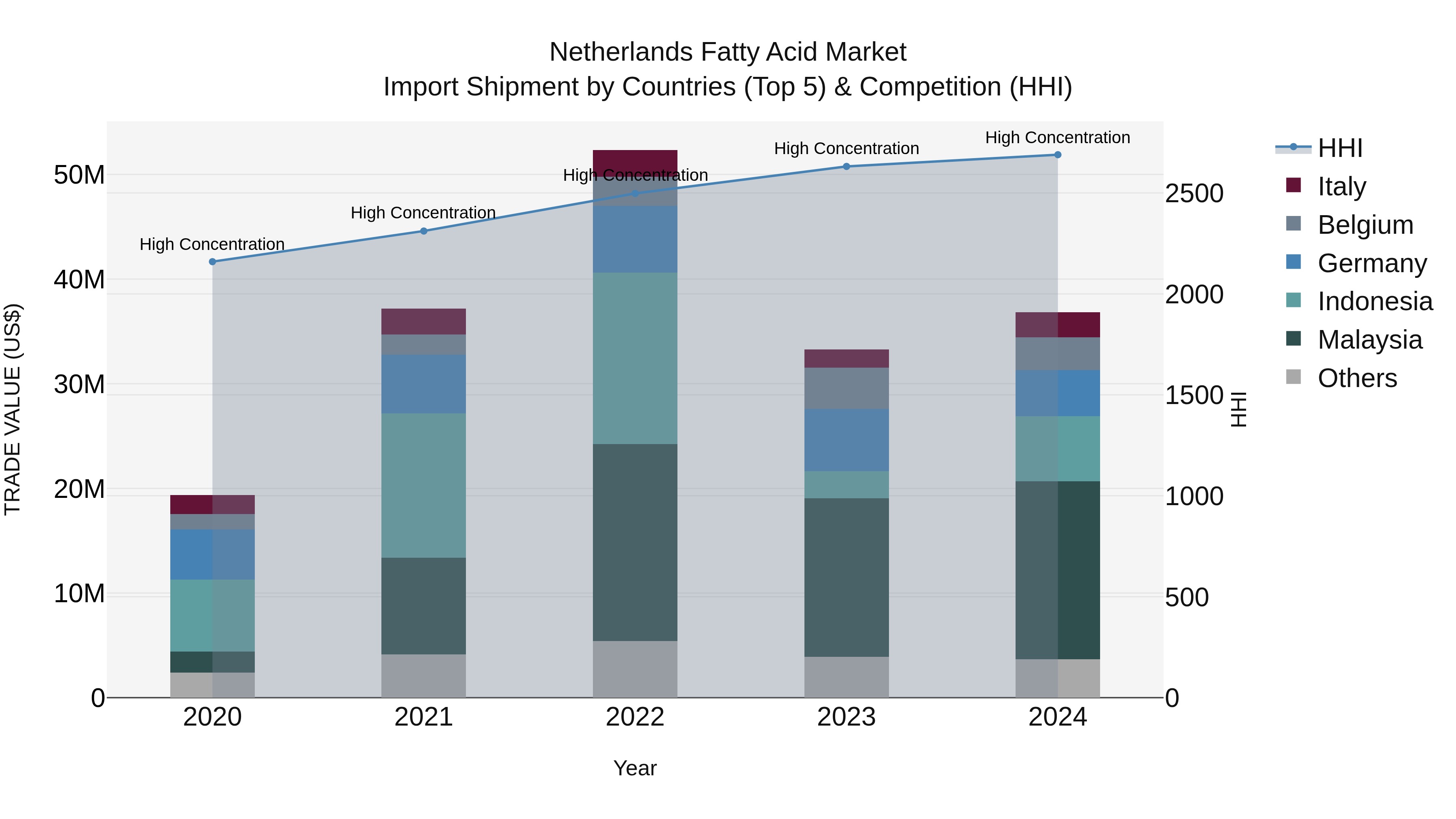
In 2024, the Netherlands continued to see significant imports of fatty acids, with Malaysia, Indonesia, Germany, Belgium, and Italy emerging as the top exporting countries. The high Herfindahl-Hirschman Index (HHI) indicates a concentrated market. The compound annual growth rate (CAGR) from 2020 to 2024 stood at an impressive 17.45%, showcasing sustained market expansion. Moreover, the growth rate from 2023 to 2024 was robust at 10.76%, underscoring the continued demand for fatty acids in the Netherlands. This data suggests a dynamic and evolving market landscape for fatty acid imports in the country.
Netherlands Fatty Acid Market Overview
The Netherlands fatty acid market is a significant segment within the country`s chemical industry, driven by the demand for various types of fatty acids such as oleic acid, stearic acid, and palmitic acid. These fatty acids find applications in a wide range of industries including food and beverages, pharmaceuticals, personal care products, and industrial chemicals. The market is characterized by a strong presence of key players like Wilmar International, IOI Oleochemicals, and KLK Oleo, who are constantly innovating to meet the evolving consumer demands for sustainable and eco-friendly fatty acid products. The market is also witnessing a growing trend towards the use of bio-based fatty acids derived from renewable sources, in alignment with the increasing focus on environmental sustainability and green chemistry practices.
Netherlands Fatty Acid Market Trends
The Netherlands fatty acid market is witnessing a growing demand for healthier alternatives, such as omega-3 fatty acids and plant-based fatty acids like coconut and avocado oils. Consumers are increasingly seeking products that offer health benefits, including improved heart health and cognitive function. This trend is driving the market towards functional food and dietary supplements that are fortified with essential fatty acids. Additionally, there is a rising interest in sustainable and eco-friendly sources of fatty acids, leading to the popularity of products derived from algae and other plant-based sources. Manufacturers are responding to these trends by incorporating these ingredients into a wide range of products, including packaged foods, beverages, and cosmetics. Overall, the Netherlands fatty acid market is evolving towards more diverse and health-conscious options to meet consumer preferences.
Netherlands Fatty Acid Market Challenges
In the Netherlands fatty acid market, challenges include increasing competition from other sources of fats and oils, fluctuating raw material prices, and changing consumer preferences towards healthier alternatives. The market is also impacted by regulatory changes aimed at reducing environmental impact and promoting sustainability in production processes. Additionally, the need for continuous innovation to meet evolving consumer demands for clean label products and transparency in sourcing poses a challenge for companies operating in the fatty acid market. Adapting to these challenges requires industry players to invest in research and development, adopt sustainable practices, and diversify their product offerings to stay competitive in the market.
Netherlands Fatty Acid Market Investment Opportunities
The Netherlands fatty acid market offers promising investment opportunities due to the increasing demand for sustainable and bio-based products in various industries such as food, cosmetics, and pharmaceuticals. With a strong focus on innovation and sustainability, Dutch companies are actively investing in research and development of new fatty acid products derived from sources like algae, plant oils, and waste materials. Additionally, the Netherlands is strategically located with access to key markets in Europe, making it an attractive hub for exporting fatty acid products. Investors can consider opportunities in renewable energy projects, biotechnology startups, and partnerships with established companies in the Dutch fatty acid market to capitalize on the growing demand for eco-friendly solutions.
Netherlands Fatty Acid Market Government Policy
The Netherlands has implemented various government policies related to the fatty acid market, with a focus on promoting sustainability and health-conscious practices. One key policy is the Sustainable Palm Oil Covenant, aiming to increase the use of sustainable palm oil in the food industry. Additionally, the government has set targets to reduce saturated fats in food products to improve public health. Regulations also require transparent labeling of fatty acids on food packaging to inform consumers and promote healthier choices. The Netherlands places an emphasis on supporting research and innovation in alternative sources of fatty acids, such as plant-based oils, to reduce dependency on unsustainable or unhealthy sources. Overall, the government policies in the Netherlands are geared towards fostering a more sustainable and health-oriented fatty acid market.
Netherlands Fatty Acid Market Future Outlook
The future outlook for the Netherlands fatty acid market appears promising, driven by factors such as the rising demand for personal care products, dietary supplements, and the growing awareness of the health benefits associated with fatty acids. The market is expected to witness steady growth due to increasing consumer preference for natural and organic products. Additionally, technological advancements in production processes are likely to enhance the quality and purity of fatty acids, further boosting market growth. With a focus on sustainability and innovation, key players in the industry are anticipated to introduce new product formulations and expand their product portfolios to cater to evolving consumer preferences. Overall, the Netherlands fatty acid market is poised for expansion and development in the coming years.
Key Highlights of the Report:
- Netherlands Fatty Acid Market Outlook
- Market Size of Netherlands Fatty Acid Market,2024
- Forecast of Netherlands Fatty Acid Market, 2031
- Historical Data and Forecast of Netherlands Fatty Acid Revenues & Volume for the Period 2021-2031
- Netherlands Fatty Acid Market Trend Evolution
- Netherlands Fatty Acid Market Drivers and Challenges
- Netherlands Fatty Acid Price Trends
- Netherlands Fatty Acid Porter's Five Forces
- Netherlands Fatty Acid Industry Life Cycle
- Historical Data and Forecast of Netherlands Fatty Acid Market Revenues & Volume By Product Type for the Period 2021-2031
- Historical Data and Forecast of Netherlands Fatty Acid Market Revenues & Volume By Saturated Fatty Acids for the Period 2021-2031
- Historical Data and Forecast of Netherlands Fatty Acid Market Revenues & Volume By Unsaturated Fatty Acids for the Period 2021-2031
- Historical Data and Forecast of Netherlands Fatty Acid Market Revenues & Volume By Omega-3 Fatty Acids for the Period 2021-2031
- Historical Data and Forecast of Netherlands Fatty Acid Market Revenues & Volume By Medium-Chain Fatty Acids for the Period 2021-2031
- Historical Data and Forecast of Netherlands Fatty Acid Market Revenues & Volume By Technology Type for the Period 2021-2031
- Historical Data and Forecast of Netherlands Fatty Acid Market Revenues & Volume By Extraction and Distillation for the Period 2021-2031
- Historical Data and Forecast of Netherlands Fatty Acid Market Revenues & Volume By Hydrogenation for the Period 2021-2031
- Historical Data and Forecast of Netherlands Fatty Acid Market Revenues & Volume By Solvent Extraction for the Period 2021-2031
- Historical Data and Forecast of Netherlands Fatty Acid Market Revenues & Volume By Chemical Synthesis for the Period 2021-2031
- Historical Data and Forecast of Netherlands Fatty Acid Market Revenues & Volume By End User for the Period 2021-2031
- Historical Data and Forecast of Netherlands Fatty Acid Market Revenues & Volume By Food and Beverage Industry for the Period 2021-2031
- Historical Data and Forecast of Netherlands Fatty Acid Market Revenues & Volume By Pharmaceuticals and Nutraceuticals for the Period 2021-2031
- Historical Data and Forecast of Netherlands Fatty Acid Market Revenues & Volume By Health-Conscious Consumers for the Period 2021-2031
- Historical Data and Forecast of Netherlands Fatty Acid Market Revenues & Volume By Animal Feed Manufacturers for the Period 2021-2031
- Historical Data and Forecast of Netherlands Fatty Acid Market Revenues & Volume By Application for the Period 2021-2031
- Historical Data and Forecast of Netherlands Fatty Acid Market Revenues & Volume By Fats and Oils in Cooking and Baking for the Period 2021-2031
- Historical Data and Forecast of Netherlands Fatty Acid Market Revenues & Volume By Dietary Supplements and Medicinal Uses for the Period 2021-2031
- Historical Data and Forecast of Netherlands Fatty Acid Market Revenues & Volume By Nutritional Supplements for the Period 2021-2031
- Historical Data and Forecast of Netherlands Fatty Acid Market Revenues & Volume By Animal Nutrition and Feed Additives for the Period 2021-2031
- Netherlands Fatty Acid Import Export Trade Statistics
- Market Opportunity Assessment By Product Type
- Market Opportunity Assessment By Technology Type
- Market Opportunity Assessment By End User
- Market Opportunity Assessment By Application
- Netherlands Fatty Acid Top Companies Market Share
- Netherlands Fatty Acid Competitive Benchmarking By Technical and Operational Parameters
- Netherlands Fatty Acid Company Profiles
- Netherlands Fatty Acid Key Strategic Recommendations






































