Netherlands Football Helmet Market Top 5 Importing Countries and Market Competition (HHI) Analysis
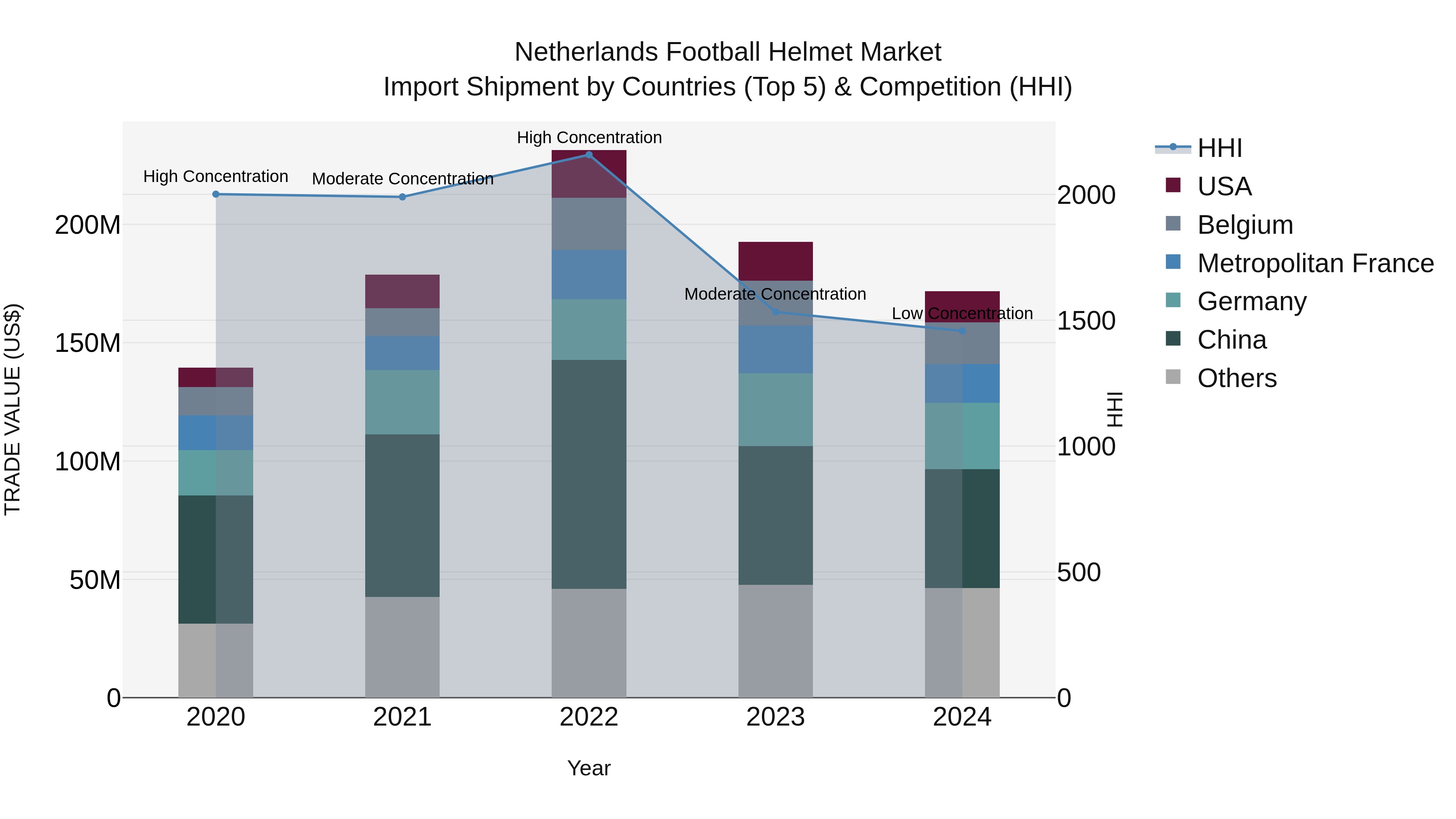
In 2024, the Netherlands saw a shift in the concentration of football helmet imports, moving from moderate to low concentration. The top exporting countries to the Netherlands were China, Germany, Belgium, Metropolitan France, and the USA. Despite a slight decline in growth rate from 2023 to 2024, the compound annual growth rate (CAGR) from 2020 to 2024 remained positive at 5.36%. This data suggests a stable market with a diverse range of suppliers, indicating a healthy competition and potential opportunities for further growth in the football helmet import industry in the Netherlands.
Netherlands Football Helmet Market Market Overview
The Netherlands football helmet market is a niche segment within the broader sports equipment industry. It is characterized by a moderate level of demand primarily driven by amateur and youth football leagues, as well as individual players looking to enhance their safety during gameplay. Key players in the market include international sports brands such as Adidas, Nike, and Puma, along with local manufacturers catering to specific needs of Dutch football players. The market is influenced by regulations and safety standards set by national sports bodies, leading to a focus on high-quality and certified helmets. Despite its relatively smaller size compared to other sports equipment categories, the Netherlands football helmet market is expected to see steady growth in the coming years as awareness of head injuries and player safety continues to rise in the sports community.
Netherlands Football Helmet Market Trends
The Netherlands football helmet market is experiencing a growing trend towards increased safety and technology integration. With a heightened awareness of head injuries in football, there is a greater demand for helmets that offer enhanced protection and concussion prevention features. This has led to a surge in the development of innovative helmet designs that prioritize player safety without compromising on comfort and performance. Additionally, customization options and personalized fits are gaining popularity among athletes, reflecting a shift towards personalized equipment in the market. As the importance of player safety continues to be emphasized, we can expect to see further advancements in helmet technology and an expansion of options available to football players in the Netherlands.
Netherlands Football Helmet Market Challenges
In the Netherlands, the football helmet market faces several challenges. One major challenge is the lack of widespread adoption of helmets in football culture, as compared to countries like the United States where their use is more common. This cultural barrier makes it difficult for manufacturers to penetrate the market and convince players, coaches, and parents of the importance of using helmets for safety. Additionally, there may be concerns about the comfort and fit of helmets, as well as the potential impact on performance and aesthetics. Furthermore, the relatively smaller size of the football market in the Netherlands compared to other countries also presents a challenge in terms of achieving economies of scale and driving down costs. Overall, increasing awareness, addressing cultural norms, and improving product design are key factors that need to be addressed to stimulate growth in the football helmet market in the Netherlands.
Netherlands Football Helmet Market Investment Opportunities
In the Netherlands, the football helmet market presents potential investment opportunities due to the growing awareness of sports-related head injuries and the increasing emphasis on player safety. Investing in innovative football helmet technologies that offer enhanced protection, comfort, and performance could be lucrative. Collaborating with local football clubs, leagues, and governing bodies to promote the usage of high-quality helmets could also be a strategic move. Additionally, targeting the youth football segment, where safety concerns are paramount, could prove to be a profitable niche market. Continuous research and development to stay ahead of safety standards and regulations will be crucial for long-term success in the Netherlands football helmet market.
Netherlands Football Helmet Market Government Policy
In the Netherlands, there are no specific government policies related to the football helmet market as of now. Unlike in some other countries like the United States where regulations require football players to wear helmets for safety reasons, the Netherlands does not have such mandates in place for football players at this time. However, the Dutch government does have broader product safety regulations in place that apply to all products sold in the country, including sports equipment like football helmets. Manufacturers and sellers of football helmets in the Netherlands are required to ensure that their products meet these general safety standards to protect consumers. Additionally, there may be guidelines or recommendations from sports associations or governing bodies regarding the use of protective gear in football, but these are typically not legally enforced by the government.
Netherlands Football Helmet Market Future Outlook
The future outlook for the Netherlands football helmet market appears positive, driven by increasing awareness of head injuries in sports and growing emphasis on player safety. With the rising popularity of American football in the country and the continued participation in other contact sports like rugby and hockey, there is a growing demand for high-quality helmets that offer superior protection. Manufacturers are likely to innovate and introduce advanced technologies such as impact-absorbing materials and customizable fit systems to cater to the evolving needs of athletes. Additionally, collaborations between sports organizations and helmet manufacturers to promote safety guidelines and regulations are expected to further fuel market growth. Overall, the Netherlands football helmet market is poised for steady expansion in the coming years as safety becomes a top priority for players and sports enthusiasts.
Key Highlights of the Report:
- Netherlands Football Helmet Market Outlook
- Market Size of Netherlands Football Helmet Market,2024
- Forecast of Netherlands Football Helmet Market, 2031
- Historical Data and Forecast of Netherlands Football Helmet Revenues & Volume for the Period 2021-2031
- Netherlands Football Helmet Market Trend Evolution
- Netherlands Football Helmet Market Drivers and Challenges
- Netherlands Football Helmet Price Trends
- Netherlands Football Helmet Porter's Five Forces
- Netherlands Football Helmet Industry Life Cycle
- Historical Data and Forecast of Netherlands Football Helmet Market Revenues & Volume By Type for the Period 2021-2031
- Historical Data and Forecast of Netherlands Football Helmet Market Revenues & Volume By Adult Helmet for the Period 2021-2031
- Historical Data and Forecast of Netherlands Football Helmet Market Revenues & Volume By Youth Helmet for the Period 2021-2031
- Historical Data and Forecast of Netherlands Football Helmet Market Revenues & Volume By Position-Specific Helmet for the Period 2021-2031
- Historical Data and Forecast of Netherlands Football Helmet Market Revenues & Volume By Custom-Fit Helmet for the Period 2021-2031
- Historical Data and Forecast of Netherlands Football Helmet Market Revenues & Volume By Material for the Period 2021-2031
- Historical Data and Forecast of Netherlands Football Helmet Market Revenues & Volume By Polycarbonate Shell for the Period 2021-2031
- Historical Data and Forecast of Netherlands Football Helmet Market Revenues & Volume By ABS Plastic for the Period 2021-2031
- Historical Data and Forecast of Netherlands Football Helmet Market Revenues & Volume By Carbon Fiber for the Period 2021-2031
- Historical Data and Forecast of Netherlands Football Helmet Market Revenues & Volume By Composite Shell for the Period 2021-2031
- Historical Data and Forecast of Netherlands Football Helmet Market Revenues & Volume By Technology Used for the Period 2021-2031
- Historical Data and Forecast of Netherlands Football Helmet Market Revenues & Volume By Impact Absorption Tech for the Period 2021-2031
- Historical Data and Forecast of Netherlands Football Helmet Market Revenues & Volume By Multi-Layered Cushioning for the Period 2021-2031
- Historical Data and Forecast of Netherlands Football Helmet Market Revenues & Volume By Smart Sensor-Integrated for the Period 2021-2031
- Historical Data and Forecast of Netherlands Football Helmet Market Revenues & Volume By Anti-Concussion Design for the Period 2021-2031
- Historical Data and Forecast of Netherlands Football Helmet Market Revenues & Volume By End User for the Period 2021-2031
- Historical Data and Forecast of Netherlands Football Helmet Market Revenues & Volume By Professional Players for the Period 2021-2031
- Historical Data and Forecast of Netherlands Football Helmet Market Revenues & Volume By Amateur Players for the Period 2021-2031
- Historical Data and Forecast of Netherlands Football Helmet Market Revenues & Volume By School Teams for the Period 2021-2031
- Historical Data and Forecast of Netherlands Football Helmet Market Revenues & Volume By Training Institutes for the Period 2021-2031
- Historical Data and Forecast of Netherlands Football Helmet Market Revenues & Volume By Safety Standard for the Period 2021-2031
- Historical Data and Forecast of Netherlands Football Helmet Market Revenues & Volume By NOCSAE Certified for the Period 2021-2031
- Historical Data and Forecast of Netherlands Football Helmet Market Revenues & Volume By ASTM Certified for the Period 2021-2031
- Historical Data and Forecast of Netherlands Football Helmet Market Revenues & Volume By ISO Certified for the Period 2021-2031
- Historical Data and Forecast of Netherlands Football Helmet Market Revenues & Volume By CE Certified for the Period 2021 - 2029
- Netherlands Football Helmet Import Export Trade Statistics
- Market Opportunity Assessment By Type
- Market Opportunity Assessment By Material
- Market Opportunity Assessment By Technology Used
- Market Opportunity Assessment By End User
- Market Opportunity Assessment By Safety Standard
- Netherlands Football Helmet Top Companies Market Share
- Netherlands Football Helmet Competitive Benchmarking By Technical and Operational Parameters
- Netherlands Football Helmet Company Profiles
- Netherlands Football Helmet Key Strategic Recommendations






































