Netherlands Hyaluronic Acid Market Top 5 Importing Countries and Market Competition (HHI) Analysis
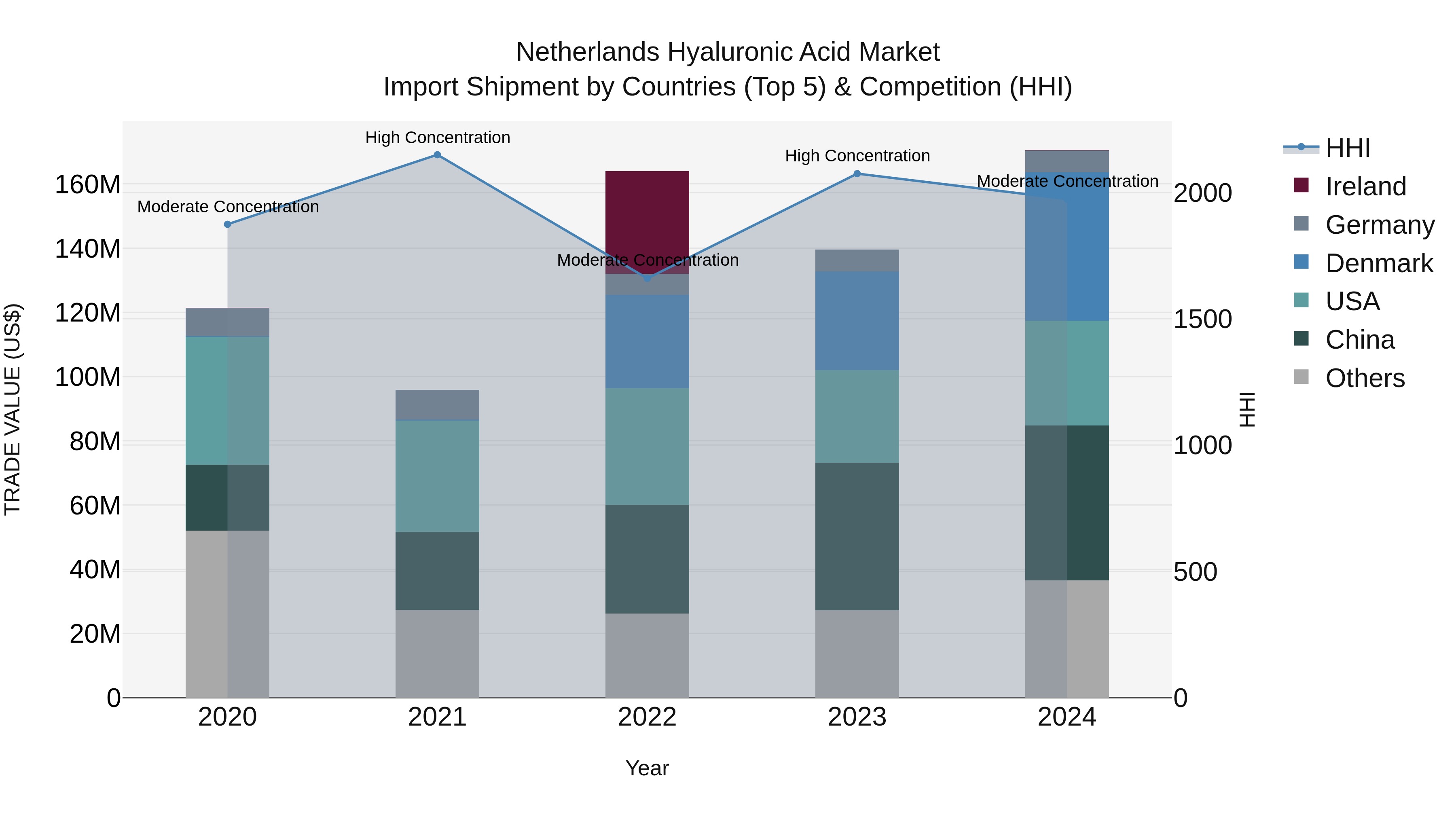
The Netherlands saw a significant increase in hyaluronic acid import shipments in 2024, with top exporting countries including China, Denmark, USA, UK, and Germany. The market concentration, as measured by the HHI, decreased from high to moderate in 2024, indicating a more diversified import market. The compound annual growth rate (CAGR) from 2020 to 2024 was a solid 8.87%, while the growth rate from 2023 to 2024 spiked at 22.19%. This data suggests a growing demand for hyaluronic acid in the Netherlands, with a more balanced distribution of imports among key exporting countries.
Netherlands Hyaluronic Acid Market Overview
The Netherlands hyaluronic acid market is experiencing steady growth driven by increasing awareness of its benefits in skincare, ophthalmology, and orthopedics. The market is primarily driven by the rising demand for anti-aging products and cosmetic procedures, as well as the growing prevalence of eye disorders and joint-related issues among the aging population. Key players in the market include multinational pharmaceutical companies, local manufacturers, and distributors catering to a diverse range of industries. Technological advancements in hyaluronic acid formulations and delivery systems are also contributing to market growth. Additionally, the Netherlands` strong healthcare infrastructure and high disposable income levels further support the market`s expansion. Overall, the Netherlands hyaluronic acid market is poised for continued growth in the coming years.
Netherlands Hyaluronic Acid Market Trends
The Netherlands hyaluronic acid market is experiencing significant growth due to the rising demand for skincare and cosmetic products containing hyaluronic acid. Consumers are increasingly seeking products that offer hydration, anti-aging, and skin-plumping benefits, driving the popularity of hyaluronic acid-based serums, creams, and masks. Additionally, the trend towards clean and natural beauty products has led to an increased focus on hyaluronic acid as a naturally-derived ingredient with proven skin benefits. The market is witnessing a proliferation of new product launches and innovations, with various brands incorporating hyaluronic acid into their formulations to cater to the growing consumer interest. Overall, the Netherlands hyaluronic acid market is poised for further expansion as consumers prioritize skincare solutions that deliver effective and visible results.
Netherlands Hyaluronic Acid Market Challenges
In the Netherlands hyaluronic acid market, some key challenges include increasing competition from both domestic and international players, pricing pressure due to the presence of numerous suppliers offering similar products, and the need for continuous innovation to differentiate products and stay ahead in the market. Additionally, regulatory requirements and compliance standards can pose obstacles for companies looking to enter or expand in the market. Moreover, consumer awareness and education about the benefits of hyaluronic acid products may also be a challenge, requiring companies to invest in marketing and promotional activities to increase product adoption. Overall, navigating these challenges while maintaining product quality and market position remains crucial for success in the hyaluronic acid market in the Netherlands.
Netherlands Hyaluronic Acid Market Investment Opportunities
In the Netherlands, the hyaluronic acid market presents several investment opportunities due to the growing demand for skincare and cosmetic products incorporating this ingredient. Investors could consider opportunities in local cosmetic brands looking to expand their product lines with hyaluronic acid-based offerings or in distribution companies that supply raw materials to the cosmetics industry. Additionally, investing in research and development firms focusing on innovative formulations of hyaluronic acid products could be profitable, as there is a trend towards natural and sustainable beauty solutions in the market. Overall, the Netherlands hyaluronic acid market offers potential for growth and diversification, making it an attractive sector for investors seeking opportunities in the beauty and skincare industry.
Netherlands Hyaluronic Acid Market Government Policy
The Netherlands has implemented regulations on the use of hyaluronic acid in cosmetic products. The European Union`s Cosmetic Regulation (EC) No 1223/2009 sets out requirements for the use of hyaluronic acid in cosmetics, including the need for safety assessments and labeling. Additionally, the Netherlands` Ministry of Health, Welfare, and Sport oversees the implementation of these regulations to ensure consumer safety. The Dutch government also monitors advertising claims related to hyaluronic acid products to prevent misleading information. Overall, the regulatory framework in the Netherlands aims to promote the safe use of hyaluronic acid in cosmetics and protect the health of consumers.
Netherlands Hyaluronic Acid Market Future Outlook
The future outlook for the Netherlands hyaluronic acid market appears promising, driven by increasing consumer awareness of the benefits of hyaluronic acid in skincare and cosmetics. The growing aging population and rising demand for anti-aging products are expected to fuel market growth. Additionally, advancements in technology and product innovation are likely to contribute to the expansion of the market. The Netherlands` strong cosmetic industry and focus on natural and sustainable products further support the positive outlook for hyaluronic acid in the country. With a shift towards clean beauty and organic skincare products, the market is forecasted to experience steady growth in the coming years, presenting opportunities for both domestic and international players in the hyaluronic acid segment.
Key Highlights of the Report:
- Netherlands Hyaluronic Acid Market Outlook
- Market Size of Netherlands Hyaluronic Acid Market,2024
- Forecast of Netherlands Hyaluronic Acid Market, 2031
- Historical Data and Forecast of Netherlands Hyaluronic Acid Revenues & Volume for the Period 2021-2031
- Netherlands Hyaluronic Acid Market Trend Evolution
- Netherlands Hyaluronic Acid Market Drivers and Challenges
- Netherlands Hyaluronic Acid Price Trends
- Netherlands Hyaluronic Acid Porter's Five Forces
- Netherlands Hyaluronic Acid Industry Life Cycle
- Historical Data and Forecast of Netherlands Hyaluronic Acid Market Revenues & Volume By Type for the Period 2021-2031
- Historical Data and Forecast of Netherlands Hyaluronic Acid Market Revenues & Volume By High Molecular Weight for the Period 2021-2031
- Historical Data and Forecast of Netherlands Hyaluronic Acid Market Revenues & Volume By Medium Molecular Weight for the Period 2021-2031
- Historical Data and Forecast of Netherlands Hyaluronic Acid Market Revenues & Volume By Low Molecular Weight for the Period 2021-2031
- Historical Data and Forecast of Netherlands Hyaluronic Acid Market Revenues & Volume By Cross-Linked for the Period 2021-2031
- Historical Data and Forecast of Netherlands Hyaluronic Acid Market Revenues & Volume By Non-Cross-Linked for the Period 2021 - 2029
- Historical Data and Forecast of Netherlands Hyaluronic Acid Market Revenues & Volume By Application for the Period 2021-2031
- Historical Data and Forecast of Netherlands Hyaluronic Acid Market Revenues & Volume By Dermatology for the Period 2021-2031
- Historical Data and Forecast of Netherlands Hyaluronic Acid Market Revenues & Volume By Ophthalmology for the Period 2021-2031
- Historical Data and Forecast of Netherlands Hyaluronic Acid Market Revenues & Volume By Orthopedics for the Period 2021-2031
- Historical Data and Forecast of Netherlands Hyaluronic Acid Market Revenues & Volume By Wound Healing for the Period 2021-2031
- Historical Data and Forecast of Netherlands Hyaluronic Acid Market Revenues & Volume By Cosmetics for the Period 2021 - 2029
- Historical Data and Forecast of Netherlands Hyaluronic Acid Market Revenues & Volume By End Use for the Period 2021-2031
- Historical Data and Forecast of Netherlands Hyaluronic Acid Market Revenues & Volume By Personal Care for the Period 2021-2031
- Historical Data and Forecast of Netherlands Hyaluronic Acid Market Revenues & Volume By Pharmaceuticals for the Period 2021-2031
- Historical Data and Forecast of Netherlands Hyaluronic Acid Market Revenues & Volume By Dietary Supplements for the Period 2021-2031
- Historical Data and Forecast of Netherlands Hyaluronic Acid Market Revenues & Volume By Food & Beverages for the Period 2021-2031
- Historical Data and Forecast of Netherlands Hyaluronic Acid Market Revenues & Volume By Biotech Research for the Period 2021 - 2029
- Historical Data and Forecast of Netherlands Hyaluronic Acid Market Revenues & Volume By Form for the Period 2021-2031
- Historical Data and Forecast of Netherlands Hyaluronic Acid Market Revenues & Volume By Powder for the Period 2021-2031
- Historical Data and Forecast of Netherlands Hyaluronic Acid Market Revenues & Volume By Liquid for the Period 2021-2031
- Historical Data and Forecast of Netherlands Hyaluronic Acid Market Revenues & Volume By Gel for the Period 2021-2031
- Historical Data and Forecast of Netherlands Hyaluronic Acid Market Revenues & Volume By Solution for the Period 2021-2031
- Historical Data and Forecast of Netherlands Hyaluronic Acid Market Revenues & Volume By Injectable for the Period 2021 - 2029
- Historical Data and Forecast of Netherlands Hyaluronic Acid Market Revenues & Volume By Source for the Period 2021-2031
- Historical Data and Forecast of Netherlands Hyaluronic Acid Market Revenues & Volume By Synthetic for the Period 2021-2031
- Historical Data and Forecast of Netherlands Hyaluronic Acid Market Revenues & Volume By Natural (Fermentation) for the Period 2021-2031
- Historical Data and Forecast of Netherlands Hyaluronic Acid Market Revenues & Volume By Animal-Based for the Period 2021-2031
- Historical Data and Forecast of Netherlands Hyaluronic Acid Market Revenues & Volume By Plant-Based for the Period 2021 - 2029
- Historical Data and Forecast of Netherlands Hyaluronic Acid Market Revenues & Volume By Microbial Fermentation for the Period 2021 - 2029
- Netherlands Hyaluronic Acid Import Export Trade Statistics
- Market Opportunity Assessment By Type
- Market Opportunity Assessment By Application
- Market Opportunity Assessment By End Use
- Market Opportunity Assessment By Form
- Market Opportunity Assessment By Source
- Netherlands Hyaluronic Acid Top Companies Market Share
- Netherlands Hyaluronic Acid Competitive Benchmarking By Technical and Operational Parameters
- Netherlands Hyaluronic Acid Company Profiles
- Netherlands Hyaluronic Acid Key Strategic Recommendations






































