Netherlands Industrial Chain Market Size (2020-2030)
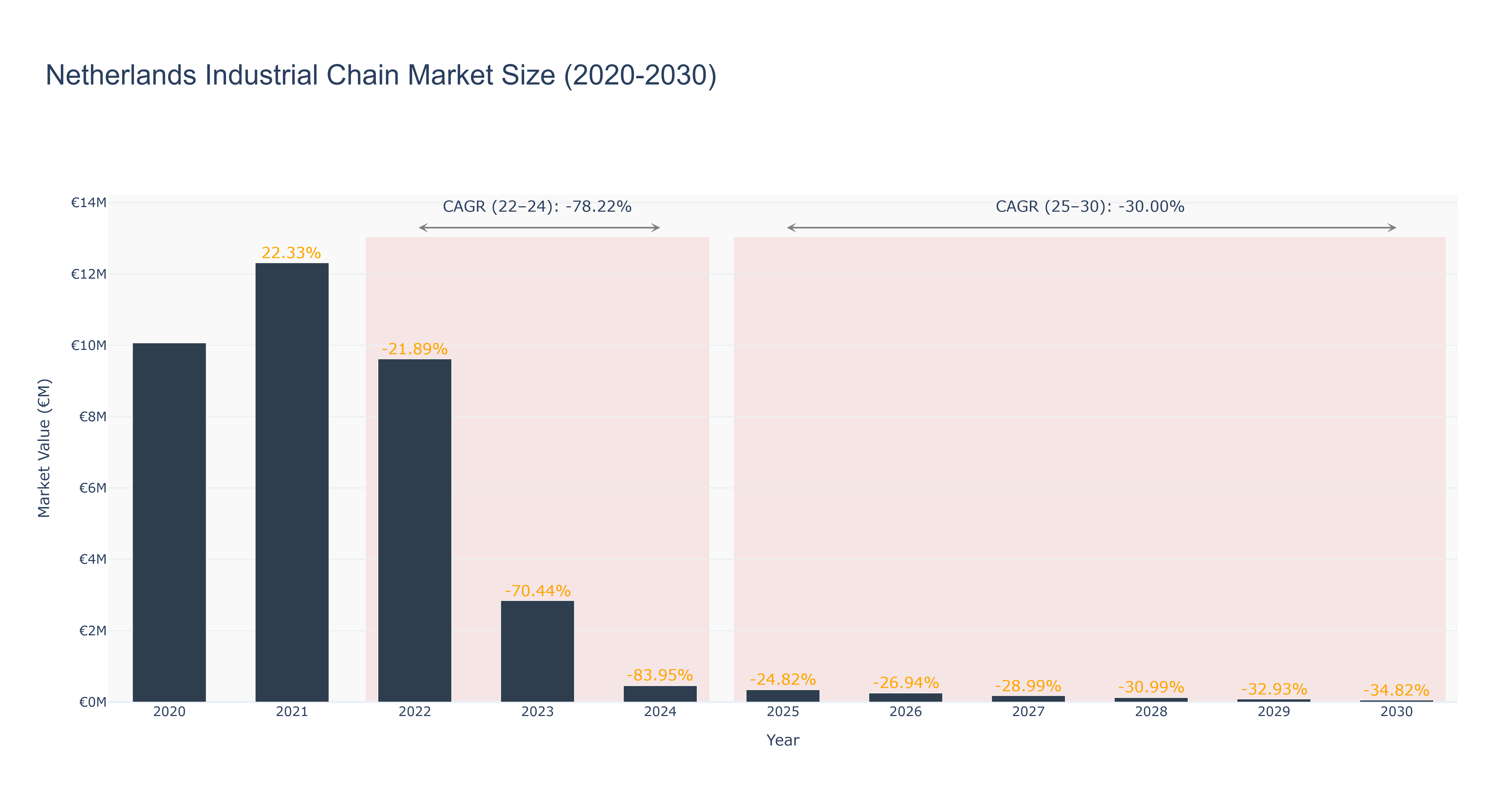
The Netherlands Industrial Chain Market experienced its peak in 2021, reaching a market size of €12.31 million, followed by a steep decline in subsequent years, with 2022 witnessing a significant drop to €9.62 million and a further plummet to €2.84 million in 2023. The actual period from 2022 to 2024 shows a stark CAGR of -78.22%, reflecting a challenging economic environment, competitive pressures, and potential disruptions in supply chains. Looking ahead, the forecasted period from 2025 to 2030 anticipates continued contraction, with a projected CAGR of -30.00%. Market sizes are expected to decrease from €342.99 thousand in 2025 to €53.68 thousand by 2030. This decline highlights ongoing structural challenges within the market, including shifts in demand and increased automation. While no major upcoming projects are currently identified, macroeconomic factors such as technological advancements and sustainability initiatives will be pivotal in shaping the future landscape of the industrial chain sector in the Netherlands.
Netherlands Industrial Chain Market: Production & Trade Performance (2019-2025)
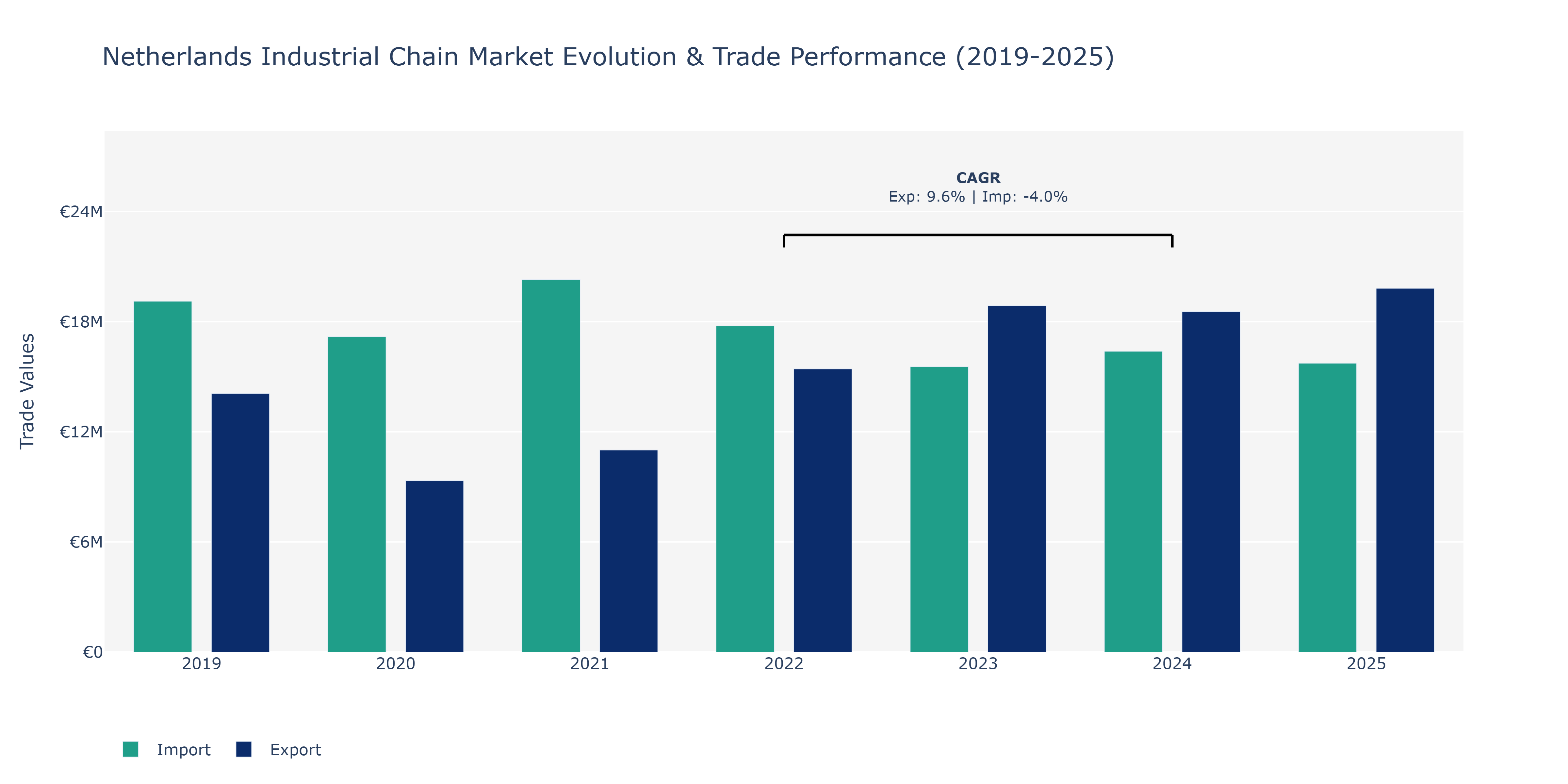
The Netherlands Industrial Chain Market witnessed fluctuations in both Exports and Imports from 2019 to 2025. Exports started at €14.1 million in 2019, decreasing to €9.34 million in 2020, before rebounding to €19.82 million in 2025. This pattern suggests initial challenges, possibly due to global economic uncertainties, followed by a steady recovery and growth, indicating resilience and adaptability within the market. In contrast, Imports began at €19.12 million in 2019, peaked at €20.29 million in 2021, and then experienced a gradual decline to €15.74 million in 2025. The peak in 2021 could be attributed to increased demand for specific industrial chain components, aligning with reports of expanding manufacturing activities and technological upgrades in the Netherlands during that period. The subsequent decrease in Imports might be linked to strategic shifts in sourcing or evolving domestic production capabilities. Such fluctuations highlight the market's sensitivity to both global trade dynamics and local industrial advancements, emphasizing the importance of agility and strategic planning for industry players operating within the Netherlands Industrial Chain Market.
Netherlands Industrial Chain Market Market Overview
The Netherlands industrial chain market is a well-developed and diverse sector that encompasses various industries such as manufacturing, logistics, and transportation. The country`s strategic location with access to major European markets, advanced infrastructure, and skilled workforce make it an attractive hub for industrial activities. Key industries within the industrial chain market include chemical production, food processing, machinery manufacturing, and electronics. The Netherlands has a strong focus on sustainability and innovation, driving the development of advanced technologies and processes within the industrial sector. Additionally, the presence of major ports and efficient transportation networks further enhances the country`s position as a key player in the global industrial chain market.
Netherlands Industrial Chain Market Trends
In the Netherlands industrial chain market, there is a growing emphasis on sustainability and circularity. Companies are increasingly focused on reducing waste, optimizing resource usage, and promoting eco-friendly practices throughout the entire supply chain. Additionally, digitalization and automation are key trends, with a push towards smart factories and integrated technologies to enhance efficiency and productivity. The rise of e-commerce and the demand for faster delivery times have also driven the adoption of advanced logistics solutions such as autonomous vehicles and robotics. Collaborations and partnerships between companies within the industrial chain are becoming more common to address complex challenges and leverage each other`s expertise. Overall, the Netherlands industrial chain market is evolving towards a more sustainable, efficient, and interconnected ecosystem.
Netherlands Industrial Chain Market Challenges
In the Netherlands industrial chain market, several challenges are commonly faced. One significant challenge is the pressure to innovate and adopt new technologies to remain competitive in a fast-paced global market. Companies need to constantly upgrade their production processes to meet changing customer demands and sustainability requirements. Another challenge is the increasing focus on sustainability and environmental regulations, which require businesses to invest in eco-friendly practices and renewable energy sources. Additionally, the Netherlands` industrial chain market must navigate supply chain disruptions, such as those caused by geopolitical tensions or natural disasters, which can impact the flow of raw materials and components. Overall, companies in the Netherlands industrial chain market need to balance innovation, sustainability, and supply chain resilience to thrive in a dynamic and competitive environment.
Netherlands Industrial Chain Market Investment Opportunities
In the Netherlands industrial chain market, there are various investment opportunities across different sectors such as logistics, manufacturing, and technology. With the country`s strong focus on sustainability and innovation, investments in renewable energy projects, smart manufacturing solutions, and advanced logistics technologies are particularly promising. The Netherlands is also a key player in the global trade and transportation sectors, making investments in ports, distribution centers, and supply chain management companies attractive options. Additionally, with the rise of e-commerce and the increasing demand for efficient delivery services, investments in last-mile delivery solutions and warehouse automation technologies present lucrative opportunities for investors looking to capitalize on the evolving industrial landscape in the Netherlands.
Netherlands Industrial Chain Market Government Policy
In the Netherlands, government policies related to the industrial chain market focus on promoting sustainability, innovation, and competitiveness. The government has implemented initiatives to support the transition towards a circular economy, encouraging industries to reduce waste and promote recycling. Additionally, there are policies in place to incentivize research and development in key sectors, such as technology and renewable energy, to drive innovation and enhance the country`s competitive edge in the global market. The government also emphasizes collaboration between industry stakeholders to foster a strong industrial chain that is resilient and adaptable to changing market conditions. Overall, the Netherlands` industrial chain market is shaped by policies that prioritize sustainability, innovation, and competitiveness to ensure long-term growth and success.
Netherlands Industrial Chain Market Future Outlook
The future outlook for the Netherlands industrial chain market appears promising, driven by factors such as technological advancements, increasing automation, and the growing emphasis on sustainability. With a strong focus on innovation and efficiency, companies in the industrial chain sector are expected to invest in digitalization and smart manufacturing solutions to enhance productivity and reduce operational costs. Additionally, the rising demand for environmentally friendly practices is likely to drive the adoption of sustainable materials and processes within the industrial chain market. Overall, the Netherlands industrial chain market is anticipated to witness steady growth and opportunities for businesses that can adapt to changing market dynamics and embrace new technologies to stay competitive in the evolving landscape.
Key Highlights of the Report:
- Netherlands Industrial Chain Market Outlook
- Market Size of Netherlands Industrial Chain Market,2024
- Forecast of Netherlands Industrial Chain Market, 2031
- Historical Data and Forecast of Netherlands Industrial Chain Revenues & Volume for the Period 2021-2031
- Netherlands Industrial Chain Market Trend Evolution
- Netherlands Industrial Chain Market Drivers and Challenges
- Netherlands Industrial Chain Price Trends
- Netherlands Industrial Chain Porter's Five Forces
- Netherlands Industrial Chain Industry Life Cycle
- Historical Data and Forecast of Netherlands Industrial Chain Market Revenues & Volume By Chain Type for the Period 2021-2031
- Historical Data and Forecast of Netherlands Industrial Chain Market Revenues & Volume By Roller Chains for the Period 2021-2031
- Historical Data and Forecast of Netherlands Industrial Chain Market Revenues & Volume By Leaf Chains for the Period 2021-2031
- Historical Data and Forecast of Netherlands Industrial Chain Market Revenues & Volume By Silent Chains for the Period 2021-2031
- Historical Data and Forecast of Netherlands Industrial Chain Market Revenues & Volume By Engineered Chains for the Period 2021-2031
- Historical Data and Forecast of Netherlands Industrial Chain Market Revenues & Volume By Material Used for the Period 2021-2031
- Historical Data and Forecast of Netherlands Industrial Chain Market Revenues & Volume By Stainless Steel for the Period 2021-2031
- Historical Data and Forecast of Netherlands Industrial Chain Market Revenues & Volume By Carbon Steel for the Period 2021-2031
- Historical Data and Forecast of Netherlands Industrial Chain Market Revenues & Volume By Alloy Steel for the Period 2021-2031
- Historical Data and Forecast of Netherlands Industrial Chain Market Revenues & Volume By Nickel-Plated Steel for the Period 2021-2031
- Historical Data and Forecast of Netherlands Industrial Chain Market Revenues & Volume By Application for the Period 2021-2031
- Historical Data and Forecast of Netherlands Industrial Chain Market Revenues & Volume By Conveyor Systems for the Period 2021-2031
- Historical Data and Forecast of Netherlands Industrial Chain Market Revenues & Volume By Power Transmission for the Period 2021-2031
- Historical Data and Forecast of Netherlands Industrial Chain Market Revenues & Volume By Lifting Applications for the Period 2021-2031
- Historical Data and Forecast of Netherlands Industrial Chain Market Revenues & Volume By Mining & Drilling for the Period 2021-2031
- Historical Data and Forecast of Netherlands Industrial Chain Market Revenues & Volume By End User for the Period 2021-2031
- Historical Data and Forecast of Netherlands Industrial Chain Market Revenues & Volume By Manufacturing for the Period 2021-2031
- Historical Data and Forecast of Netherlands Industrial Chain Market Revenues & Volume By Automotive for the Period 2021-2031
- Historical Data and Forecast of Netherlands Industrial Chain Market Revenues & Volume By Construction for the Period 2021-2031
- Historical Data and Forecast of Netherlands Industrial Chain Market Revenues & Volume By Oil & Gas for the Period 2021-2031
- Historical Data and Forecast of Netherlands Industrial Chain Market Revenues & Volume By Sales Model for the Period 2021-2031
- Historical Data and Forecast of Netherlands Industrial Chain Market Revenues & Volume By Direct Sales for the Period 2021-2031
- Historical Data and Forecast of Netherlands Industrial Chain Market Revenues & Volume By Distributors for the Period 2021-2031
- Historical Data and Forecast of Netherlands Industrial Chain Market Revenues & Volume By Online Suppliers for the Period 2021-2031
- Historical Data and Forecast of Netherlands Industrial Chain Market Revenues & Volume By Industrial Suppliers for the Period 2021 - 2029
- Netherlands Industrial Chain Import Export Trade Statistics
- Market Opportunity Assessment By Chain Type
- Market Opportunity Assessment By Material Used
- Market Opportunity Assessment By Application
- Market Opportunity Assessment By End User
- Market Opportunity Assessment By Sales Model
- Netherlands Industrial Chain Top Companies Market Share
- Netherlands Industrial Chain Competitive Benchmarking By Technical and Operational Parameters
- Netherlands Industrial Chain Company Profiles
- Netherlands Industrial Chain Key Strategic Recommendations






































