Netherlands Low Voltage Circuit Breaker Market Top 5 Importing Countries and Market Competition (HHI) Analysis
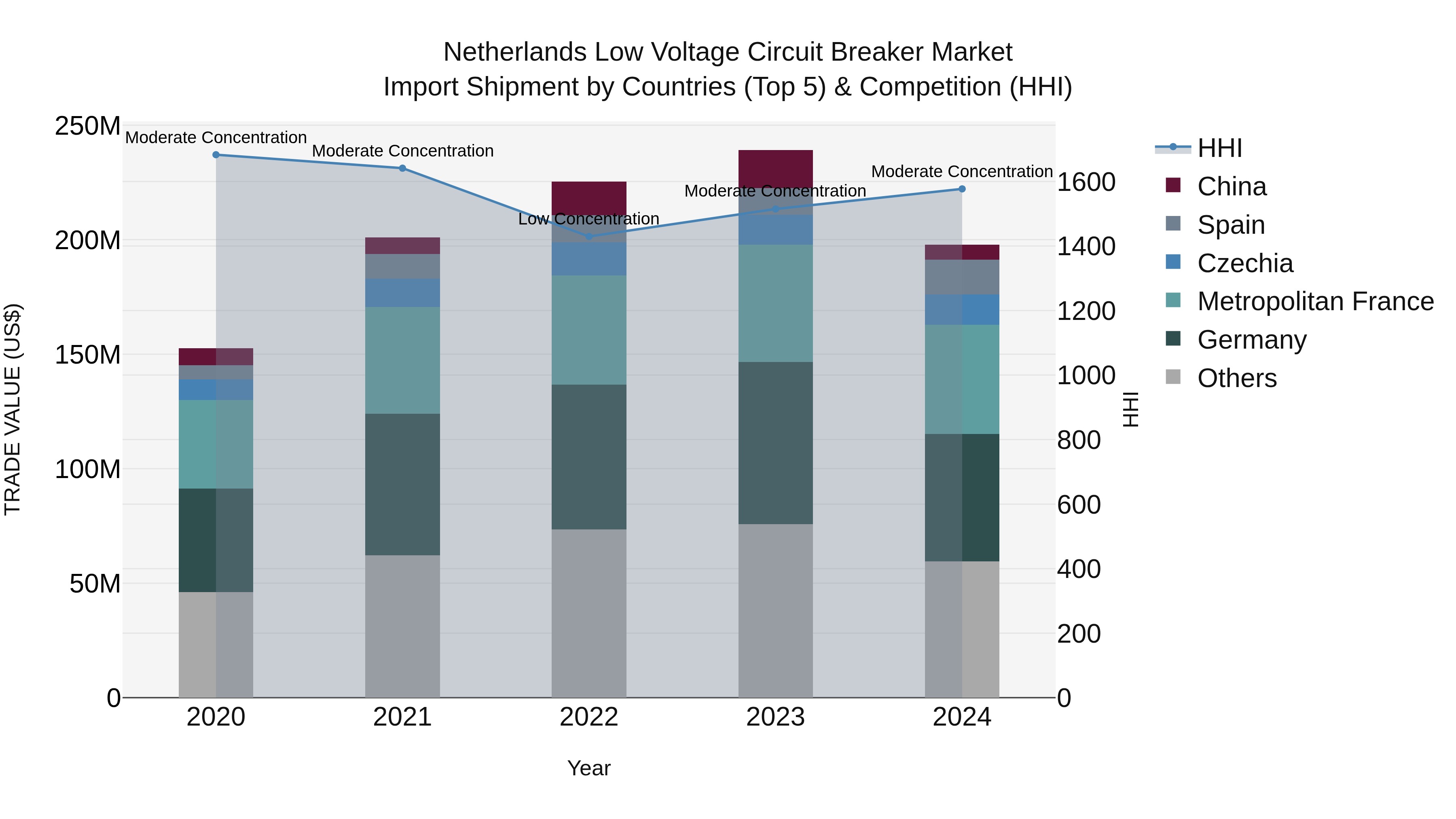
The Netherlands saw steady growth in low voltage circuit breaker imports in 2024, with top suppliers including Germany, Metropolitan France, Spain, Czechia, and Poland. Despite a slight decline in growth rate from 2023 to 2024, the compound annual growth rate (CAGR) for the period of 2020-2024 remained strong at 6.7%. The market concentration, as measured by the Herfindahl-Hirschman Index (HHI), remained at a moderate level in 2024, indicating a competitive landscape for low voltage circuit breaker imports in the Netherlands.
Netherlands Low Voltage Circuit Breaker Market Overview
The Netherlands low voltage circuit breaker market is characterized by steady growth driven by increasing investments in infrastructure development, industrial automation, and renewable energy projects. The market is highly competitive with key players such as ABB, Schneider Electric, Siemens, and Eaton dominating the landscape. Technological advancements, such as the integration of smart features for remote monitoring and control, are influencing market trends. Rising concerns regarding electrical safety and the need for efficient power distribution systems are also contributing to market expansion. The adoption of sustainable practices and regulations promoting energy efficiency are further propelling the demand for low voltage circuit breakers in the country. Overall, the Netherlands low voltage circuit breaker market is poised for continued growth, with a focus on innovation and sustainability shaping its future trajectory.
Netherlands Low Voltage Circuit Breaker Market Trends
In the Netherlands, the low voltage circuit breaker market is experiencing a growing demand for smart and energy-efficient solutions. This trend is driven by the increasing focus on sustainability and the adoption of renewable energy sources. Customers are looking for circuit breakers that can help optimize energy usage, enhance safety, and enable remote monitoring and control capabilities. Additionally, there is a rising interest in digitalization and connectivity in low voltage circuit breakers to enable predictive maintenance and real-time data analytics. Manufacturers are responding to these trends by developing innovative products with advanced features such as integrated communication interfaces, IoT compatibility, and cloud-based monitoring systems to meet the evolving needs of the market.
Netherlands Low Voltage Circuit Breaker Market Challenges
In the Netherlands low voltage circuit breaker market, some of the key challenges include increasing competition from both domestic and international manufacturers, stringent regulations and standards governing electrical equipment, and the need for continuous innovation to meet evolving customer demands for more efficient and reliable products. Additionally, the market is also impacted by fluctuations in raw material prices, which can affect manufacturing costs and pricing strategies for companies operating in this sector. As sustainability and energy efficiency become more important considerations for customers, circuit breaker manufacturers in the Netherlands face the challenge of developing products that not only meet performance requirements but also align with environmentally friendly practices. Overall, companies in the Netherlands low voltage circuit breaker market must navigate these challenges to stay competitive and maintain their market share.
Netherlands Low Voltage Circuit Breaker Market Investment Opportunities
In the Netherlands low voltage circuit breaker market, there are several promising investment opportunities for savvy investors. One key area of focus is the increasing demand for smart and digital circuit breakers, driven by the growing adoption of smart home technologies and renewable energy sources. Investing in companies that specialize in innovative circuit breaker technologies, such as IoT-enabled devices for remote monitoring and control, could yield significant returns. Additionally, with the country`s push towards sustainable energy solutions, there is a rising need for circuit breakers that can efficiently handle the fluctuating demands of renewable energy systems. Investing in companies that develop eco-friendly and energy-efficient circuit breakers could also be a lucrative opportunity in the Netherlands market. Overall, the low voltage circuit breaker market in the Netherlands presents a range of investment prospects for those looking to capitalize on technological advancements and sustainability trends.
Netherlands Low Voltage Circuit Breaker Market Government Policy
In the Netherlands, the low voltage circuit breaker market is regulated by various government policies aimed at ensuring safety and quality standards. The Dutch government enforces the European Union`s directives on low voltage electrical equipment, such as the Low Voltage Directive 2014/35/EU, which sets requirements for the safety and performance of circuit breakers. Additionally, market surveillance authorities in the Netherlands monitor compliance with these regulations to protect consumers and maintain a level playing field for businesses. The government also promotes energy efficiency and sustainability in the electrical sector, which influences the development and adoption of innovative circuit breaker technologies. Overall, the regulatory framework in the Netherlands plays a crucial role in shaping the low voltage circuit breaker market by emphasizing safety, quality, and environmental considerations.
Netherlands Low Voltage Circuit Breaker Market Future Outlook
The future outlook for the Netherlands low voltage circuit breaker market appears promising, driven by factors such as increasing industrial automation, infrastructure development, and growing focus on renewable energy sources. The market is expected to witness steady growth due to the rising demand for efficient and reliable electrical protection devices in various sectors including residential, commercial, and industrial. Technological advancements leading to the development of smart circuit breakers with enhanced features such as remote monitoring and control capabilities are also expected to propel market growth. Additionally, initiatives towards energy efficiency and sustainability are likely to create opportunities for market expansion. Overall, the Netherlands low voltage circuit breaker market is anticipated to experience positive growth in the coming years.
Key Highlights of the Report:
- Netherlands Low Voltage Circuit Breaker Market Outlook
- Market Size of Netherlands Low Voltage Circuit Breaker Market,2024
- Forecast of Netherlands Low Voltage Circuit Breaker Market, 2031
- Historical Data and Forecast of Netherlands Low Voltage Circuit Breaker Revenues & Volume for the Period 2021-2031
- Netherlands Low Voltage Circuit Breaker Market Trend Evolution
- Netherlands Low Voltage Circuit Breaker Market Drivers and Challenges
- Netherlands Low Voltage Circuit Breaker Price Trends
- Netherlands Low Voltage Circuit Breaker Porter's Five Forces
- Netherlands Low Voltage Circuit Breaker Industry Life Cycle
- Historical Data and Forecast of Netherlands Low Voltage Circuit Breaker Market Revenues & Volume By Type for the Period 2021-2031
- Historical Data and Forecast of Netherlands Low Voltage Circuit Breaker Market Revenues & Volume By Miniature Circuit Breaker (MCB) for the Period 2021-2031
- Historical Data and Forecast of Netherlands Low Voltage Circuit Breaker Market Revenues & Volume By Molded Case Circuit Breaker (MCCB) for the Period 2021-2031
- Historical Data and Forecast of Netherlands Low Voltage Circuit Breaker Market Revenues & Volume By Air Circuit Breaker (ACB) for the Period 2021-2031
- Historical Data and Forecast of Netherlands Low Voltage Circuit Breaker Market Revenues & Volume By Application for the Period 2021-2031
- Historical Data and Forecast of Netherlands Low Voltage Circuit Breaker Market Revenues & Volume By Residential for the Period 2021-2031
- Historical Data and Forecast of Netherlands Low Voltage Circuit Breaker Market Revenues & Volume By Commercial for the Period 2021-2031
- Historical Data and Forecast of Netherlands Low Voltage Circuit Breaker Market Revenues & Volume By Industrial for the Period 2021-2031
- Historical Data and Forecast of Netherlands Low Voltage Circuit Breaker Market Revenues & Volume By End User for the Period 2021-2031
- Historical Data and Forecast of Netherlands Low Voltage Circuit Breaker Market Revenues & Volume By Home for the Period 2021-2031
- Historical Data and Forecast of Netherlands Low Voltage Circuit Breaker Market Revenues & Volume By Building for the Period 2021-2031
- Historical Data and Forecast of Netherlands Low Voltage Circuit Breaker Market Revenues & Volume By Factory for the Period 2021-2031
- Historical Data and Forecast of Netherlands Low Voltage Circuit Breaker Market Revenues & Volume By Data Center for the Period 2021-2031
- Historical Data and Forecast of Netherlands Low Voltage Circuit Breaker Market Revenues & Volume By Transportation for the Period 2021 - 2029
- Netherlands Low Voltage Circuit Breaker Import Export Trade Statistics
- Market Opportunity Assessment By Type
- Market Opportunity Assessment By Application
- Market Opportunity Assessment By End User
- Netherlands Low Voltage Circuit Breaker Top Companies Market Share
- Netherlands Low Voltage Circuit Breaker Competitive Benchmarking By Technical and Operational Parameters
- Netherlands Low Voltage Circuit Breaker Company Profiles
- Netherlands Low Voltage Circuit Breaker Key Strategic Recommendations






































