Netherlands Oil Free Air Compressor Market Top 5 Importing Countries and Market Competition (HHI) Analysis
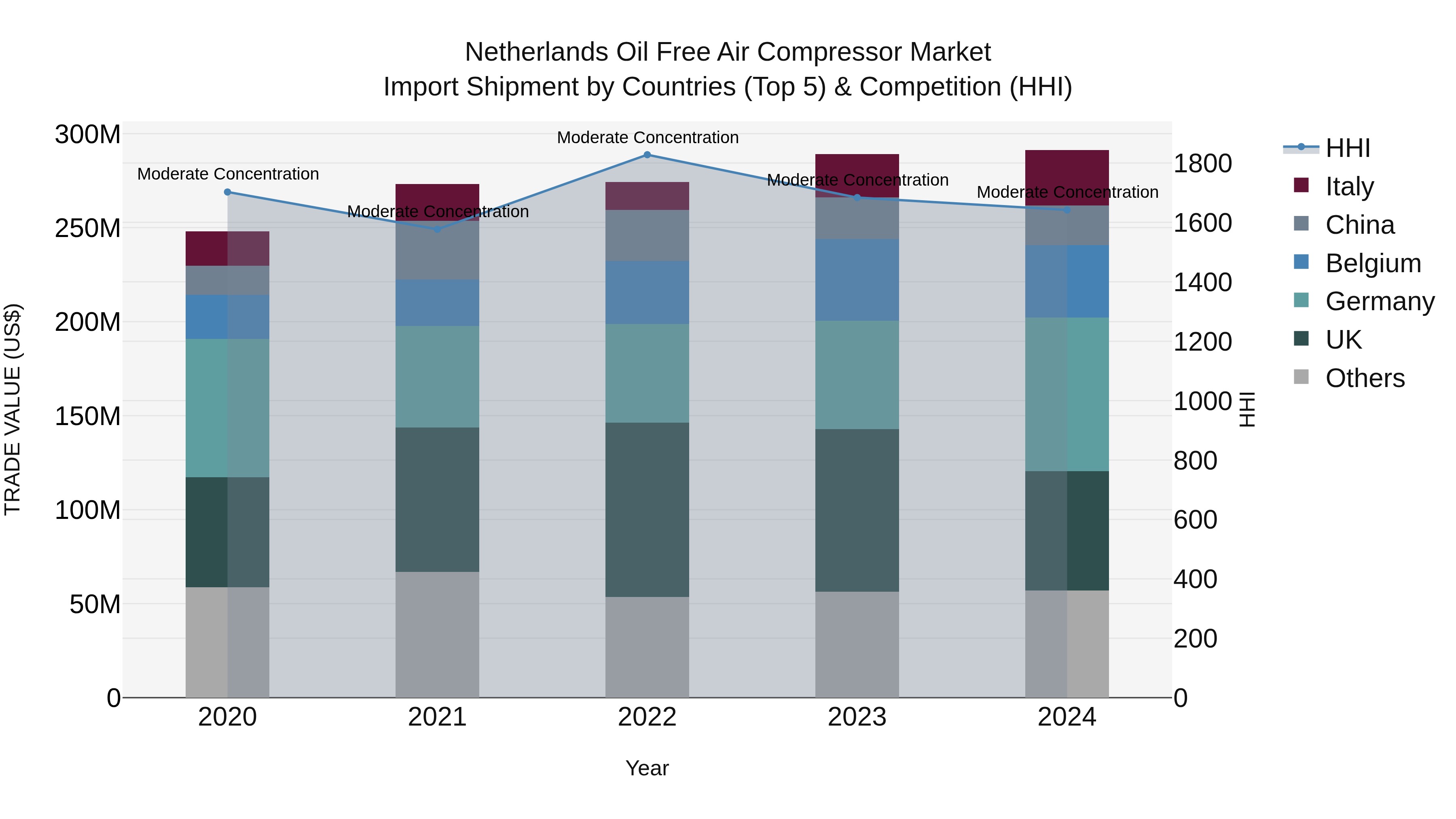
In 2024, the Netherlands continued to see significant import shipments of oil-free air compressors, with top exporting countries including Germany, UK, Belgium, Italy, and China. The market remained moderately concentrated, with a CAGR of 4.11% from 2020 to 2024. Despite a slight slowdown in growth rate from 2023 to 2024 at 0.74%, the consistent demand for oil-free air compressors indicates a stable market outlook for the foreseeable future.
Netherlands Oil Free Air Compressor Market Overview
The Netherlands oil-free air compressor market is experiencing steady growth due to increasing awareness about environmental concerns and the need for clean air solutions in various industries. The demand for oil-free compressors is being driven by strict regulations on emissions and a growing emphasis on sustainability. Key players in the market are focusing on product innovation to meet the specific requirements of different sectors such as healthcare, food & beverage, and electronics manufacturing. The market is also witnessing a trend towards energy-efficient compressors to reduce operating costs and carbon footprint. With a strong presence of industrial sectors and stringent environmental regulations in the Netherlands, the oil-free air compressor market is expected to continue its growth trajectory in the coming years.
Netherlands Oil Free Air Compressor Market Trends
In the Netherlands, the oil-free air compressor market is witnessing a growing demand due to increasing awareness about environmental sustainability and stringent regulations on emissions. Industries such as food and beverage, pharmaceuticals, and electronics are driving the adoption of oil-free air compressors to ensure high-quality air for their processes and products. Companies are focusing on developing energy-efficient and eco-friendly oil-free compressors with advanced technologies such as variable speed drives and digital controls to meet the evolving needs of customers. The market is also witnessing a trend towards rental services for oil-free air compressors, providing cost-effective solutions to businesses with temporary or fluctuating air compression needs. Overall, the Netherlands oil-free air compressor market is expected to continue growing as companies prioritize environmental responsibility and operational efficiency.
Netherlands Oil Free Air Compressor Market Challenges
In the Netherlands oil-free air compressor market, one of the main challenges faced is the increasing competition from manufacturers offering similar products. This heightened competition can lead to pricing pressures and the need for companies to differentiate their offerings through innovative technology or superior customer service. Additionally, there is a growing emphasis on sustainability and environmental concerns, driving the demand for more energy-efficient and environmentally friendly air compressors. Meeting these stringent environmental standards while maintaining high performance levels can be a challenge for companies in the market. Furthermore, the economic uncertainty and fluctuating oil prices can also impact the purchasing decisions of customers, making it essential for companies to adapt their strategies to the changing market conditions to stay competitive.
Netherlands Oil Free Air Compressor Market Investment Opportunities
The Netherlands oil-free air compressor market presents significant investment opportunities due to the country`s stringent environmental regulations and increasing focus on sustainability. With the shift towards clean energy sources, there is a rising demand for oil-free air compressors in various industries such as manufacturing, healthcare, and food & beverage. Investing in companies that specialize in oil-free air compressor technology could prove profitable as these companies are likely to experience growth in line with the increasing demand for eco-friendly solutions. Additionally, the Netherlands` position as a key player in the European market can provide a strong foundation for expansion into neighboring countries, further enhancing the investment potential in this sector.
Netherlands Oil Free Air Compressor Market Government Policy
In the Netherlands, the government has been actively promoting sustainability and environmental protection measures, including policies related to the use of oil-free air compressors. These policies aim to reduce carbon emissions and promote energy efficiency by encouraging industries to adopt cleaner technologies. The government offers incentives and subsidies for businesses that switch to oil-free air compressors, which have lower environmental impact and require less maintenance compared to traditional oil-lubricated compressors. Additionally, there are regulations in place to ensure that companies comply with environmental standards and reduce their carbon footprint. Overall, the government`s policies in the Netherlands are driving the adoption of oil-free air compressors in the market as part of a broader effort to achieve sustainability goals and combat climate change.
Netherlands Oil Free Air Compressor Market Future Outlook
The future outlook for the Netherlands oil-free air compressor market appears promising, driven by increasing environmental awareness and stringent regulations promoting sustainable practices. The demand for oil-free air compressors is expected to rise as industries prioritize reducing carbon emissions and avoiding contamination risks. Additionally, technological advancements in oil-free compressor designs are enhancing efficiency and reliability, further fueling market growth. The Netherlands` focus on transitioning towards cleaner energy sources aligns with the benefits of oil-free air compressors in reducing environmental impact. As a result, the market is likely to witness steady expansion with opportunities for innovation and adoption across various sectors such as manufacturing, healthcare, and food processing, positioning the country as a key player in the global shift towards sustainable compressor solutions.
Key Highlights of the Report:
- Netherlands Oil Free Air Compressor Market Outlook
- Market Size of Netherlands Oil Free Air Compressor Market,2024
- Forecast of Netherlands Oil Free Air Compressor Market, 2031
- Historical Data and Forecast of Netherlands Oil Free Air Compressor Revenues & Volume for the Period 2021-2031
- Netherlands Oil Free Air Compressor Market Trend Evolution
- Netherlands Oil Free Air Compressor Market Drivers and Challenges
- Netherlands Oil Free Air Compressor Price Trends
- Netherlands Oil Free Air Compressor Porter's Five Forces
- Netherlands Oil Free Air Compressor Industry Life Cycle
- Historical Data and Forecast of Netherlands Oil Free Air Compressor Market Revenues & Volume By Type for the Period 2021-2031
- Historical Data and Forecast of Netherlands Oil Free Air Compressor Market Revenues & Volume By Rotary Screw for the Period 2021-2031
- Historical Data and Forecast of Netherlands Oil Free Air Compressor Market Revenues & Volume By Piston for the Period 2021-2031
- Historical Data and Forecast of Netherlands Oil Free Air Compressor Market Revenues & Volume By Centrifugal for the Period 2021-2031
- Historical Data and Forecast of Netherlands Oil Free Air Compressor Market Revenues & Volume By Scroll for the Period 2021-2031
- Historical Data and Forecast of Netherlands Oil Free Air Compressor Market Revenues & Volume By Application Area for the Period 2021-2031
- Historical Data and Forecast of Netherlands Oil Free Air Compressor Market Revenues & Volume By Industrial Manufacturing for the Period 2021-2031
- Historical Data and Forecast of Netherlands Oil Free Air Compressor Market Revenues & Volume By Food and Beverage Processing for the Period 2021-2031
- Historical Data and Forecast of Netherlands Oil Free Air Compressor Market Revenues & Volume By Pharmaceutical Industry for the Period 2021-2031
- Historical Data and Forecast of Netherlands Oil Free Air Compressor Market Revenues & Volume By Electronics and Semiconductor for the Period 2021-2031
- Historical Data and Forecast of Netherlands Oil Free Air Compressor Market Revenues & Volume By End User for the Period 2021-2031
- Historical Data and Forecast of Netherlands Oil Free Air Compressor Market Revenues & Volume By Automotive Sector for the Period 2021-2031
- Historical Data and Forecast of Netherlands Oil Free Air Compressor Market Revenues & Volume By Chemical Industry for the Period 2021-2031
- Historical Data and Forecast of Netherlands Oil Free Air Compressor Market Revenues & Volume By Healthcare Sector for the Period 2021-2031
- Historical Data and Forecast of Netherlands Oil Free Air Compressor Market Revenues & Volume By Power Plants for the Period 2021-2031
- Historical Data and Forecast of Netherlands Oil Free Air Compressor Market Revenues & Volume By Product Type for the Period 2021-2031
- Historical Data and Forecast of Netherlands Oil Free Air Compressor Market Revenues & Volume By Energy-Efficient Compressors for the Period 2021-2031
- Historical Data and Forecast of Netherlands Oil Free Air Compressor Market Revenues & Volume By Corrosion-Resistant Compressors for the Period 2021-2031
- Historical Data and Forecast of Netherlands Oil Free Air Compressor Market Revenues & Volume By High-Pressure Systems for the Period 2021-2031
- Historical Data and Forecast of Netherlands Oil Free Air Compressor Market Revenues & Volume By Compact Low-Noise Models for the Period 2021-2031
- Netherlands Oil Free Air Compressor Import Export Trade Statistics
- Market Opportunity Assessment By Type
- Market Opportunity Assessment By Application Area
- Market Opportunity Assessment By End User
- Market Opportunity Assessment By Product Type
- Netherlands Oil Free Air Compressor Top Companies Market Share
- Netherlands Oil Free Air Compressor Competitive Benchmarking By Technical and Operational Parameters
- Netherlands Oil Free Air Compressor Company Profiles
- Netherlands Oil Free Air Compressor Key Strategic Recommendations






































