Netherlands Passenger Car Motor Oil Market Top 5 Importing Countries and Market Competition (HHI) Analysis
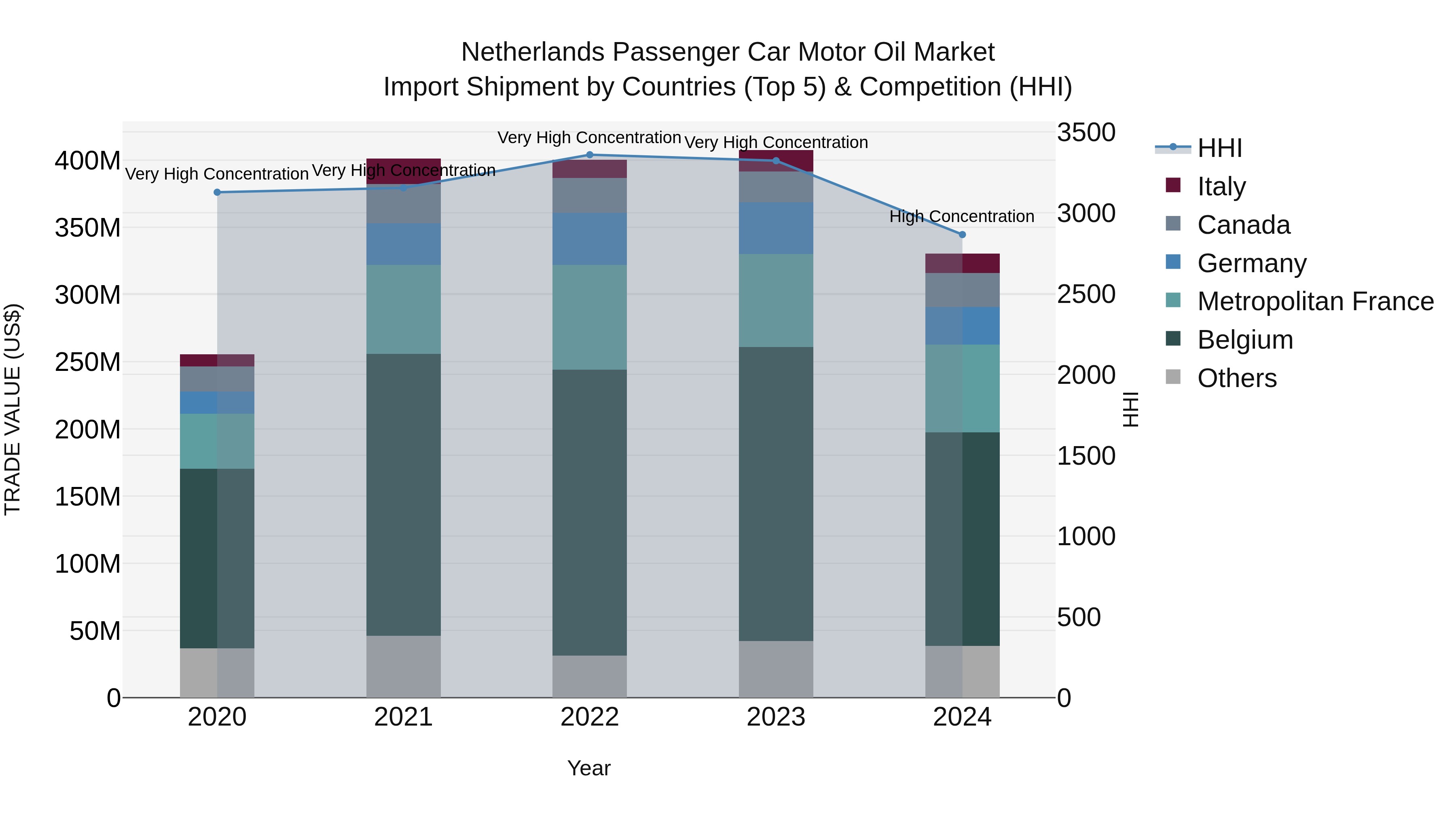
The Netherlands continues to be a significant player in the passenger car motor oil import market, with key suppliers including Belgium, Metropolitan France, Germany, Canada, and Italy. Despite a decrease in growth rate from 2023 to 2024, the market has maintained a healthy compound annual growth rate of 6.65% from 2020 to 2024. The high concentration of the Herfindahl-Hirschman Index (HHI) in 2023 persisted into 2024, indicating a competitive market landscape. As the market evolves, stakeholders should closely monitor these trends to capitalize on emerging opportunities and navigate potential challenges.
Netherlands Passenger Car Motor Oil Market Overview
The Netherlands passenger car motor oil market is characterized by a growing focus on sustainable and environmentally friendly products, with a strong emphasis on synthetic and semi-synthetic oils due to their superior performance and longer drain intervals. The market is highly competitive, with key players such as Shell, Castrol, and Total dominating the landscape. The shift towards electric vehicles is also influencing the market, with a growing demand for specialized lubricants for hybrid and electric cars. Additionally, increasing consumer awareness about the importance of regular maintenance and the use of high-quality motor oil is driving the market growth. Distribution channels include automotive retailers, online platforms, and independent workshops, with a trend towards digitalization and e-commerce gaining momentum in recent years.
Netherlands Passenger Car Motor Oil Market Trends
The Netherlands passenger car motor oil market is experiencing a shift towards environmentally friendly and sustainable products, driven by increasing awareness of climate change and environmental concerns. Consumers are showing a preference for synthetic oils that offer improved fuel efficiency, longer engine life, and reduced emissions. Manufacturers are also focusing on developing motor oils with lower viscosity grades to meet the requirements of modern engines and improve overall performance. Additionally, the market is witnessing a growing demand for electric vehicle-specific lubricants as the adoption of electric cars increases. Overall, the trend in the Netherlands passenger car motor oil market is towards eco-friendly, high-performance products that cater to the evolving needs of both consumers and the environment.
Netherlands Passenger Car Motor Oil Market Challenges
One of the main challenges faced in the Netherlands passenger car motor oil market is the increasing shift towards electric vehicles (EVs) and the rising demand for more environmentally friendly and sustainable transportation options. This shift is leading to a decrease in the overall demand for traditional internal combustion engine (ICE) vehicles, which in turn impacts the demand for passenger car motor oil. Additionally, there is a growing focus on promoting the use of synthetic and high-performance motor oils, which require higher investment costs for both manufacturers and consumers. Market players in the Netherlands are also facing competition from alternative lubricants and additives, further intensifying the competitive landscape. Adapting to these changing market dynamics and consumer preferences while also meeting stringent environmental regulations poses a significant challenge for companies operating in the passenger car motor oil market in the Netherlands.
Netherlands Passenger Car Motor Oil Market Investment Opportunities
In the Netherlands passenger car motor oil market, there are several investment opportunities worth considering. Firstly, the growing trend towards electric vehicles presents an opportunity for investing in synthetic motor oils designed specifically for electric cars, which require different formulations compared to traditional internal combustion engines. Secondly, the increasing focus on sustainability and environmental concerns creates a demand for eco-friendly motor oil products made from renewable resources or with reduced carbon footprints. Additionally, with the rise of e-commerce and online retail channels, investing in innovative distribution and marketing strategies can help reach a wider customer base. Lastly, partnerships with car manufacturers or service centers to offer exclusive motor oil products or services can also be a lucrative investment opportunity in this market.
Netherlands Passenger Car Motor Oil Market Government Policy
In the Netherlands, government policies related to the passenger car motor oil market primarily focus on environmental sustainability and consumer protection. The government has implemented regulations to promote the use of environmentally friendly motor oils that meet specific performance standards to reduce emissions and protect air quality. Additionally, there are initiatives in place to ensure that consumers are provided with accurate information about motor oil products, including labeling requirements and quality standards. The government also monitors and enforces compliance with these regulations to safeguard consumer interests and promote a competitive market environment. Overall, the Netherlands has a strong regulatory framework in place to support the sustainable development and responsible consumption of passenger car motor oils in line with environmental and consumer protection goals.
Netherlands Passenger Car Motor Oil Market Future Outlook
The future outlook for the Netherlands passenger car motor oil market appears promising, driven by factors such as the increasing demand for high-quality lubricants to enhance engine performance and efficiency, as well as the growing focus on sustainable and environmentally friendly products. With the shift towards electric vehicles and the development of advanced engine technologies, the market is expected to witness a gradual transition towards synthetic and bio-based motor oils. Additionally, the rising awareness among consumers regarding the importance of regular maintenance and the need for extended oil change intervals will further fuel market growth. Collaboration between oil manufacturers and automotive companies to develop innovative products that meet the evolving industry standards will play a crucial role in shaping the future landscape of the passenger car motor oil market in the Netherlands.
Key Highlights of the Report:
- Netherlands Passenger Car Motor Oil Market Outlook
- Market Size of Netherlands Passenger Car Motor Oil Market,2024
- Forecast of Netherlands Passenger Car Motor Oil Market, 2031
- Historical Data and Forecast of Netherlands Passenger Car Motor Oil Revenues & Volume for the Period 2021-2031
- Netherlands Passenger Car Motor Oil Market Trend Evolution
- Netherlands Passenger Car Motor Oil Market Drivers and Challenges
- Netherlands Passenger Car Motor Oil Price Trends
- Netherlands Passenger Car Motor Oil Porter's Five Forces
- Netherlands Passenger Car Motor Oil Industry Life Cycle
- Historical Data and Forecast of Netherlands Passenger Car Motor Oil Market Revenues & Volume By Type for the Period 2021-2031
- Historical Data and Forecast of Netherlands Passenger Car Motor Oil Market Revenues & Volume By Synthetic for the Period 2021-2031
- Historical Data and Forecast of Netherlands Passenger Car Motor Oil Market Revenues & Volume By Conventional for the Period 2021-2031
- Historical Data and Forecast of Netherlands Passenger Car Motor Oil Market Revenues & Volume By Semi-Synthetic for the Period 2021-2031
- Historical Data and Forecast of Netherlands Passenger Car Motor Oil Market Revenues & Volume By High-Mileage for the Period 2021-2031
- Historical Data and Forecast of Netherlands Passenger Car Motor Oil Market Revenues & Volume By Viscosity Grade for the Period 2021-2031
- Historical Data and Forecast of Netherlands Passenger Car Motor Oil Market Revenues & Volume By 5W-30 for the Period 2021-2031
- Historical Data and Forecast of Netherlands Passenger Car Motor Oil Market Revenues & Volume By 10W-40 for the Period 2021-2031
- Historical Data and Forecast of Netherlands Passenger Car Motor Oil Market Revenues & Volume By 15W-50 for the Period 2021-2031
- Historical Data and Forecast of Netherlands Passenger Car Motor Oil Market Revenues & Volume By 0W-20 for the Period 2021-2031
- Historical Data and Forecast of Netherlands Passenger Car Motor Oil Market Revenues & Volume By Application for the Period 2021-2031
- Historical Data and Forecast of Netherlands Passenger Car Motor Oil Market Revenues & Volume By High Performance for the Period 2021-2031
- Historical Data and Forecast of Netherlands Passenger Car Motor Oil Market Revenues & Volume By Standard Driving for the Period 2021-2031
- Historical Data and Forecast of Netherlands Passenger Car Motor Oil Market Revenues & Volume By Long Mileage for the Period 2021-2031
- Historical Data and Forecast of Netherlands Passenger Car Motor Oil Market Revenues & Volume By Fuel Efficiency for the Period 2021-2031
- Historical Data and Forecast of Netherlands Passenger Car Motor Oil Market Revenues & Volume By End Use for the Period 2021-2031
- Historical Data and Forecast of Netherlands Passenger Car Motor Oil Market Revenues & Volume By Car Owners for the Period 2021-2031
- Historical Data and Forecast of Netherlands Passenger Car Motor Oil Market Revenues & Volume By Dealerships for the Period 2021-2031
- Historical Data and Forecast of Netherlands Passenger Car Motor Oil Market Revenues & Volume By Service Centers for the Period 2021-2031
- Historical Data and Forecast of Netherlands Passenger Car Motor Oil Market Revenues & Volume By Automotive for the Period 2021-2031
- Netherlands Passenger Car Motor Oil Import Export Trade Statistics
- Market Opportunity Assessment By Type
- Market Opportunity Assessment By Viscosity Grade
- Market Opportunity Assessment By Application
- Market Opportunity Assessment By End Use
- Netherlands Passenger Car Motor Oil Top Companies Market Share
- Netherlands Passenger Car Motor Oil Competitive Benchmarking By Technical and Operational Parameters
- Netherlands Passenger Car Motor Oil Company Profiles
- Netherlands Passenger Car Motor Oil Key Strategic Recommendations






































