New Zealand Animal Feed Enzymes Market Top 5 Importing Countries and Market Competition (HHI) Analysis
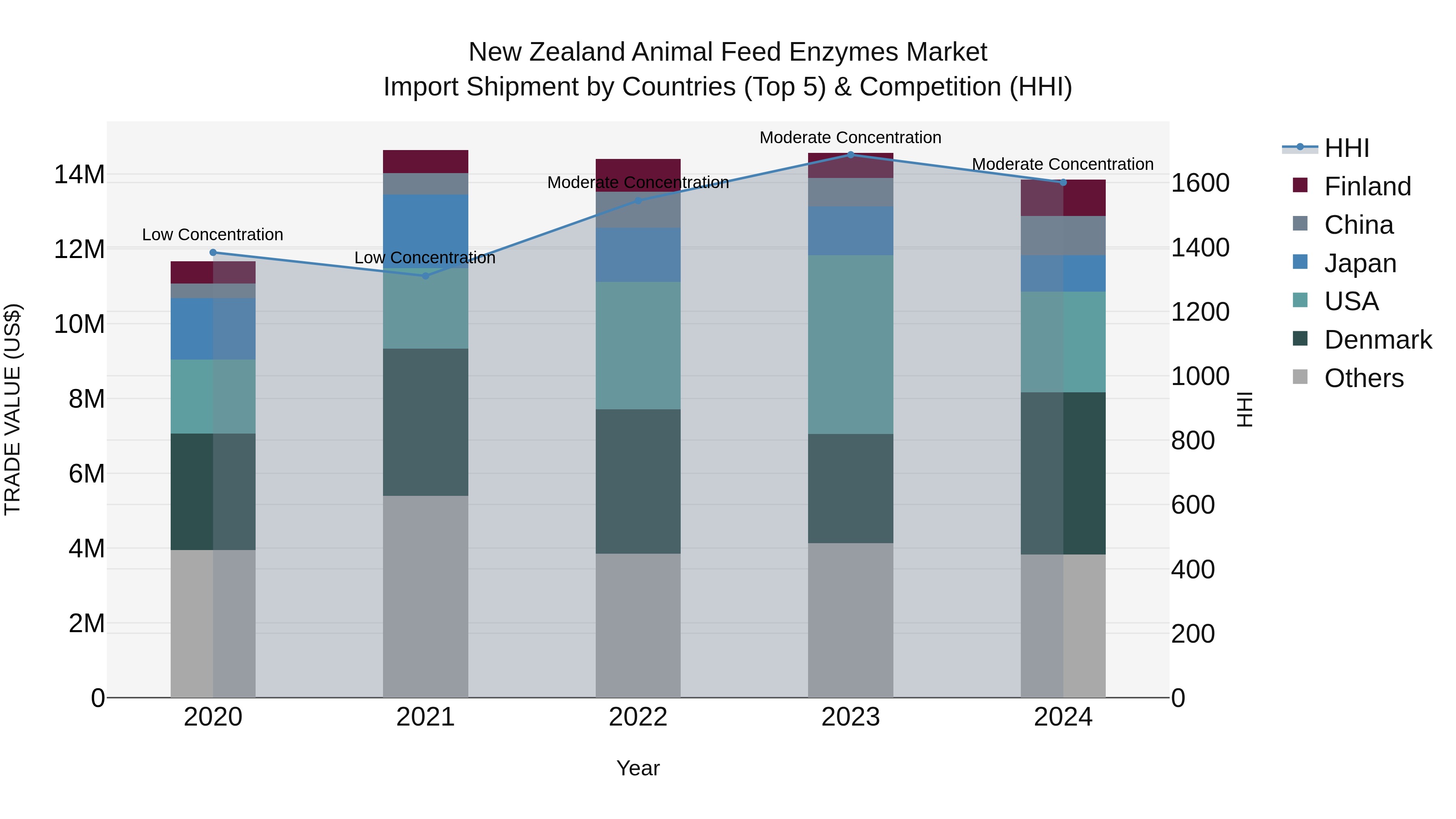
In 2024, New Zealand`s animal feed enzymes import market continued to show moderate concentration, with top exporting countries being Denmark, USA, China, Finland, and Japan. Despite a slight decline in growth rate from 2023 to 2024, the compound annual growth rate (CAGR) for the period of 2020-2024 remained positive at 4.38%. This indicates a stable demand for animal feed enzymes in the New Zealand market, with key suppliers from various countries contributing to the industry`s growth.
Key Highlights of the Report:
- New Zealand Animal Feed Enzymes Market Outlook
- Market Size of New Zealand Animal Feed Enzymes Market, 2025
- Forecast of New Zealand Animal Feed Enzymes Market, 2032
- Historical Data and Forecast of New Zealand Animal Feed Enzymes Revenues & Volume for the Period 2022 - 2032F
- New Zealand Animal Feed Enzymes Market Trend Evolution
- New Zealand Animal Feed Enzymes Market Drivers and Challenges
- New Zealand Animal Feed Enzymes Price Trends
- New Zealand Animal Feed Enzymes Porter`s Five Forces
- New Zealand Animal Feed Enzymes Industry Life Cycle
- Historical Data and Forecast of New Zealand Animal Feed Enzymes Market Revenues & Volume By Formulation for the Period 2022 - 2032F
- Historical Data and Forecast of New Zealand Animal Feed Enzymes Market Revenues & Volume By Dry for the Period 2022 - 2032F
- Historical Data and Forecast of New Zealand Animal Feed Enzymes Market Revenues & Volume By Liquid for the Period 2022 - 2032F
- Historical Data and Forecast of New Zealand Animal Feed Enzymes Market Revenues & Volume By Product for the Period 2022 - 2032F
- Historical Data and Forecast of New Zealand Animal Feed Enzymes Market Revenues & Volume By Phytase for the Period 2022 - 2032F
- Historical Data and Forecast of New Zealand Animal Feed Enzymes Market Revenues & Volume By Carbohydrase for the Period 2022 - 2032F
- Historical Data and Forecast of New Zealand Animal Feed Enzymes Market Revenues & Volume By Protease for the Period 2022 - 2032F
- Historical Data and Forecast of New Zealand Animal Feed Enzymes Market Revenues & Volume By Non starch polysaccharides for the Period 2022 - 2032F
- Historical Data and Forecast of New Zealand Animal Feed Enzymes Market Revenues & Volume By Livestock for the Period 2022 - 2032F
- Historical Data and Forecast of New Zealand Animal Feed Enzymes Market Revenues & Volume By Poultry for the Period 2022 - 2032F
- Historical Data and Forecast of New Zealand Animal Feed Enzymes Market Revenues & Volume By Swine for the Period 2022 - 2032F
- Historical Data and Forecast of New Zealand Animal Feed Enzymes Market Revenues & Volume By Ruminant for the Period 2022 - 2032F
- Historical Data and Forecast of New Zealand Animal Feed Enzymes Market Revenues & Volume By Aquaculture for the Period 2022 - 2032F
- Historical Data and Forecast of New Zealand Animal Feed Enzymes Market Revenues & Volume By Others for the Period 2022 - 2032F
- New Zealand Animal Feed Enzymes Import Export Trade Statistics
- Market Opportunity Assessment By Formulation
- Market Opportunity Assessment By Product
- Market Opportunity Assessment By Livestock
- New Zealand Animal Feed Enzymes Top Companies Market Share
- New Zealand Animal Feed Enzymes Competitive Benchmarking By Technical and Operational Parameters
- New Zealand Animal Feed Enzymes Company Profiles
- New Zealand Animal Feed Enzymes Key Strategic Recommendations






































